

Opinion
Farooq Kperogi: New insights into “Badamasi,” “Gbadamosi,” and IBB’s paternal heritage
Farooq Kperogi: New insights into “Badamasi,” “Gbadamosi,” and IBB’s paternal heritage
Former President Ibrahim Badamasi Babangida’s autobiography triggered questions about the onomastic etymology of “Badamasi,” his former last name, which appears to share historical and semantic kinship with the Yoruba “Gbadamosi.” It also activated interest in his paternal heritage about which he has been strategically coy, which I captured in my last column.
Because I know that the best system of inquiry for facts is necessarily question-oriented, self-critical, and cumulative, I shared a perspective I had heard about the provenance of Badamasi but expressed doubts about its reliability and historical accuracy and invited further reflections from others.
Saturday Tribune editor Lasisi Olagunju took up the challenge and, relying on insights from the late Sheikh Adam Abdullah El-Ilory, proposed that Badamasi originated from Ghadames (sometimes spelled Ghadamis), a historic Berber town in what is now Libya.
The town’s citizens are called Ghadamisi. It’s in line with the Middle Eastern practice of adding “i” to the end of the names of villages, towns, cities, and countries to form demonyms. Bukhari (which we domesticated as Buhari in Nigeria), for instance, means a native of the town of Bukhara, now in Uzbekistan, a West Asian nation that used to be a part of the Union of Soviet Socialist Republics (USSR).
Olagunju also referenced a fawningly Anglophilic, pro-colonial autobiography written in Arabic by a certain Abd Allah el-Ghadamisi, who arrived in Kano in 1903, titled, “Your Humble Servant: The Memoirs of Abd Allah Al-Ghadamisi.” He wondered whether this might be the book IBB mentioned as his grandfather’s favorite and that inspired him to name his son after its author.
He then suggested that the Yoruba Gbadamosi is more faithful to what he thinks is the original form of the name than the Hausa Badamasi since the voiced labial-velar plosive “gb” found in many Niger Congo languages, including Yoruba, is closer to the voiced uvular fricative “gh” in Arabic.
READ ALSO:
- EFCC grills ex-Minister Uju Ohanenye over N138m fraud
- Simon Ekpa, 16 others named as terrorism financiers, account frozen
- Militants orders non-indigenes to leave Rivers, threaten oil production
Well, Olagunju’s proposition appears to suffer a factual collapse when it is burdened with the weight of historical, chronological, and even sociolinguistic evidence.
First, anyone who reads Professor Razaq ʿDeremi Abubakre’s 2017 book chapter titled “Stefan Reichmuth’s Wanderings in Arabicized and Islamized Yorubaland” will come across an Ilorin Muslim scholar and poet by the name of Badamasi “from Ile Saura, Agbaji, Balogun Ajikobi Ward, who was one of the first people to produce Yoruba poetry in Arabic script (p.373).” He died around 1891.
This suggests that even Yoruba Muslims have borne the name Badamasi since at least the 1800s, years before Abd Allah el-Ghadamisi appeared in Kano.
Second, it is unlikely that Abd Allah el-Ghadamisi’s autobiography is the book IBB’s grandfather was fond of and that students of Arabic in Hausaland read for pedagogical and spiritual nourishment because the commentary on the book by Muhammad S. Umar and John O. Hunwick, which Olagunju references, describes the book as betraying “imperfect knowledge of written Arabic” and full of “simple errors of Arabic grammar.”
Such a book can’t be a model that Islamic scholars venerate and teach. In any case, it wasn’t a piece of Islamic scholarship. The memoirs, Umar and Hunwick point out, “construct a discourse that portrays colonialism positively through a particularly laudatory proclamation of the good deeds of colonial authorities….”
Third, Olagunju’s claim that “Because, sometimes an author gets more famous than his work, al-Ghadamisi’s name appears to have overwhelmed the book’s title” doesn’t seem to be true. Only one copy of Abd Allah el-Ghadamisi’s book has survived, according to Umar and Hunwick.
Fourth, although traders and Islamic scholars from Ghadames have lived in Hausa land since at least the 16th century, sociolinguistic evidence suggests that it is implausible for Hausa speakers to domesticate the Arabic phoneme “gh” to “b.”
When Hausa speakers borrow Arabic words with the phoneme “gh,” which doesn’t occur naturally in Hausa, they adapt it to “g” (and occasionally to “k”) but never “b.” So, it’s socio-linguistically improbable that Ghadamisi would ever become Badamasi to Hausa speakers. It would most likely be Gadamisi.
READ ALSO:
- Supreme Court orders Fubara to pay 27 pro-Wike lawmakers legal fees
- EPL: Amorim’s wife unhappy in Manchester United
- Scientists working to extend human lifespan to 250 years — Expert
Now, what might be the root of Badamasi? Someone on Facebook by the name of M.Y. Kabara (I wonder if he is a progeny of the famous Nasiru Kabara family in Kano who died in my final year at Bayero University) pointed me to Arabic sources that seem to definitively show that the name Badamasi owes its presence in (northern) Nigerian Muslim onomastic universe to an Egyptian poet by the name of Muhammad bin Ahmed bin Ismail bin Ahmed Al-Sharaf Al-Badmasi Al-Masri. (Miṣr is the Arabic name for Egypt).
He was born in 1808 AH (equivalent to around 1405) in the small village of Badamas and died in Mecca at the age of 40. He was famous for a book of Arabic poetry he wrote in praise of Prophet Muhammad (SAW) titled “al-Qasīdatul Mukhmasah,” which is very popular with Sufi Muslims and Arabic students in (northern) Nigeria.
I am certain that it’s the book IBB’s grandfather loved so much that he named his son after it—like many people in the North did and still do.
Kabara pointed out to me that because “every quintet in Arabic poetry can be called ‘mukhmasah,’” the book of poetry has come to be known by the name of its author to differentiate it from similar works.
According to Dr. Ihab El-Sherbini, author of the book “Stories of Mansoura’s Streets,” Badamas, the poet’s hometown, used to be called “Potamos,” which means “river,” but that Copts (descendants of ancient Egyptians who are now mostly Christians that are associated with the Coptic Church) called it Badamos. After the Arab conquest of Egypt in the 7th century, Badamos evolved to Badamas.
Over time, the Badamas village ceased to be territorially independent. It’s now a neighborhood of the Egyptian city of Mansoura.
Based on this new knowledge, I am prepared to suggest that Gbadamosi and Badamasi are mere onomatological false friends, that is, they are names that sound alike but that are actually different and descended from different sources.
I suspect that the Yoruba Gbadamosi traces descent from Ghadamisi, most probably from Abdallāh b. Abī Bakr al-Ghadāmisī, a 17th-century Arabic poet and Islamic scholar born in Timbuktu who wrote the famous Manāhij al-Sālikīn fī Manāfiʿ al-Qurʾān al-Karīm (“Paths of the Seekers to the Benefits of the Noble Qur’an”) that is popular with West African Sufis.
READ ALSO:
- Lawyers fault Senate’s suspension of Natasha Akpoti-Uduaghan
- Simon Ekpa accounts frozen for alleged terrorism financing
- Bandits kill 12 Zamfara community guards, vigilantes
Curiously, the resolution of the etymology of IBB’s middle name coextends with new hints I’ve encountered about the probable ethnic identity of his paternal ancestry.
The village of Kumurya in Kano where IBB told a biographer his paternal roots are located was founded by the Agalawa, a historical trading community in Hausaland, originally of Tuareg (Berber) stock who migrated into the Kano region in the 18th century.
Though now fully assimilated as a sub-group of the Hausa people, the Agalawa trace their ancestry to nomadic Tuareg origins in the southern Sahara. I owe this insight to Rabiu Isah Hassan who first pointed it out to me on Facebook and provoked me to read further.
In his 2005 book titled “Ecology and Ethnography of Muslim Trade in West Africa,” Paul E. Lovejoy points out that early Agalawa immigrants in Hausaland occupied a lowly social status because “Most had been enslaved from Sudanese populations (p. 16).” They were derisively called “Bugaje” (is the famous Dr. Usman Bugaje of Agalawa origins?) as a collective plural and “Buzu” as a singular form.
Over time, they acculturated, dominated commerce, became prominent in Islamic scholarship, and have now become indistinguishable from the native Hausa population, except that they tend to have a lighter complexion than Hausa people, which causes many people to mistake them for Fulani.
Is IBB aware of this history of his paternal ancestry but chose to conceal it for fear of exoticizing and alienating himself, especially in the eyes of southerners who tend to delegitimize people’s Nigerian origins when they find out that the ancestral origins of (mostly northerners) people can be traced to spaces outside what is now Nigeria?
No northerner would question the legitimacy of anyone’s “Nigerianness” because of the accident of the location of their distant ancestral roots. It’s a consequence of the originary syncretism of modern northern identity. We are all mixed with all sorts of stemma from a vast array of places because we were never an insular, landlocked people.
Many of Kano’s prominent merchant dynasties, for example, have Agalawa roots, a famous example being the family of Alhaji Alhassan Dantata, who was West Africa’s richest man in the early 20th century. Since Aliko Dangote’s mother is from the Dantata family, it means he is at least half Agalawa. He himself might even be ancestrally Agalawa.
What’s there to conceal about this, especially because our heritage—ethnicity, linguistic group, even religious traditions—is merely incidental to us. We didn’t choose it, so there is no basis to be proud or ashamed of it.
Farooq Kperogi is a renowned Nigerian columnist and United States-based Professor of journalism.
Farooq Kperogi: New insights into “Badamasi,” “Gbadamosi,” and IBB’s paternal heritage





Opinion
2027: Competence, Not Zoning, Should Decide Nigeria’s Next President — Imasuagbon
Nigerians should look beyond ethnicity, region and the longstanding debate over rotational presidency when choosing the country’s next leader, according to a chieftain of the African Democratic Congress (ADC), Kenneth Imasuagbon.
The former Edo State governorship aspirant said the priority ahead of the 2027 election should be finding a president with the ability to confront Nigeria’s economic, security and infrastructure challenges.
Speaking to journalists in Benin, Imasuagbon argued that presidential rotation is not a requirement of the Nigerian Constitution and should therefore not outweigh the question of competence.
He said voters should be more concerned about replacing poor schools with better ones, improving healthcare and addressing hardship than debating where the next president comes from.
Imasuagbon specifically appealed to voters in the South to support former Vice President Atiku Abubakar, who is contesting the 2027 presidency on the ADC platform.
According to him, Atiku has demonstrated the experience and determination needed to improve the country, describing the former vice president as someone capable of promoting national unity and fairness.
He also accused the Bola Tinubu administration of worsening economic pressure through policies including the removal of fuel subsidy, while expressing concern about the condition of roads, electricity and other infrastructure.
Imasuagbon argued that the next administration must focus on practical improvements in areas such as power, transportation, employment, security and public services.
The ADC chieftain also dismissed the idea that the ruling All Progressives Congress (APC) would automatically benefit from its incumbency advantage in 2027.
He maintained that the electorate ultimately determines the outcome of an election, arguing that voters could change the political direction of the country if they were determined to do so.
Imasuagbon further criticised what he described as regional and ethnic considerations in the distribution of political appointments and opportunities, insisting that the next president should give Nigerians across different parts of the country a sense of belonging.
His comments come as political parties and their candidates intensify preparations for the 2027 presidential election.
Opinion
Lesson from Dotun Oladipo’s Brave Daughters, by Bamidele Johnson
Lesson from Dotun Oladipo’s Brave Daughters, by Bamidele Johnson
I hope to grow old. I want to see my kids become real adults, find their own feet, make mistakes, recover from them, and perhaps one day complain that their own children are giving them grey hairs. I want that plainly stated before anything else, as everything that follows might read as a man agreeing to an early exit rather than a man simply being honest about the odds.
I want the decades. I want to become the grandfather who repeats the same stories until nobody bothers correcting him anymore. But wanting a thing and being granted are different things. The last year has made that difference harder to ignore than I would like. I have lost many friends recently to keep thinking that optimism is my natural resting state. Some of these men had better blood pressure than mine, better habits, better everything that is supposed to count. It did not save them.
There is no formula I know that reliably separates the men who make it to 70 from those who do not. Anyone who says he knows one is selling something. So, I do not assume that old age is an already booked destination. Even if I once did, which I doubt, the last three years have cured me of such an illusion. As such, I treat it as a hope rather than an expectation, and I have found that a more honest way to live.
It is exactly why I want something placed on record now, while I am still able to place things on record, rather than leave it for people to guess what my wishes were in the fog of a funeral week. If I do not make old bones, my children are not to be asked to read tributes at my funeral. Not one line, however short, however lovingly written.
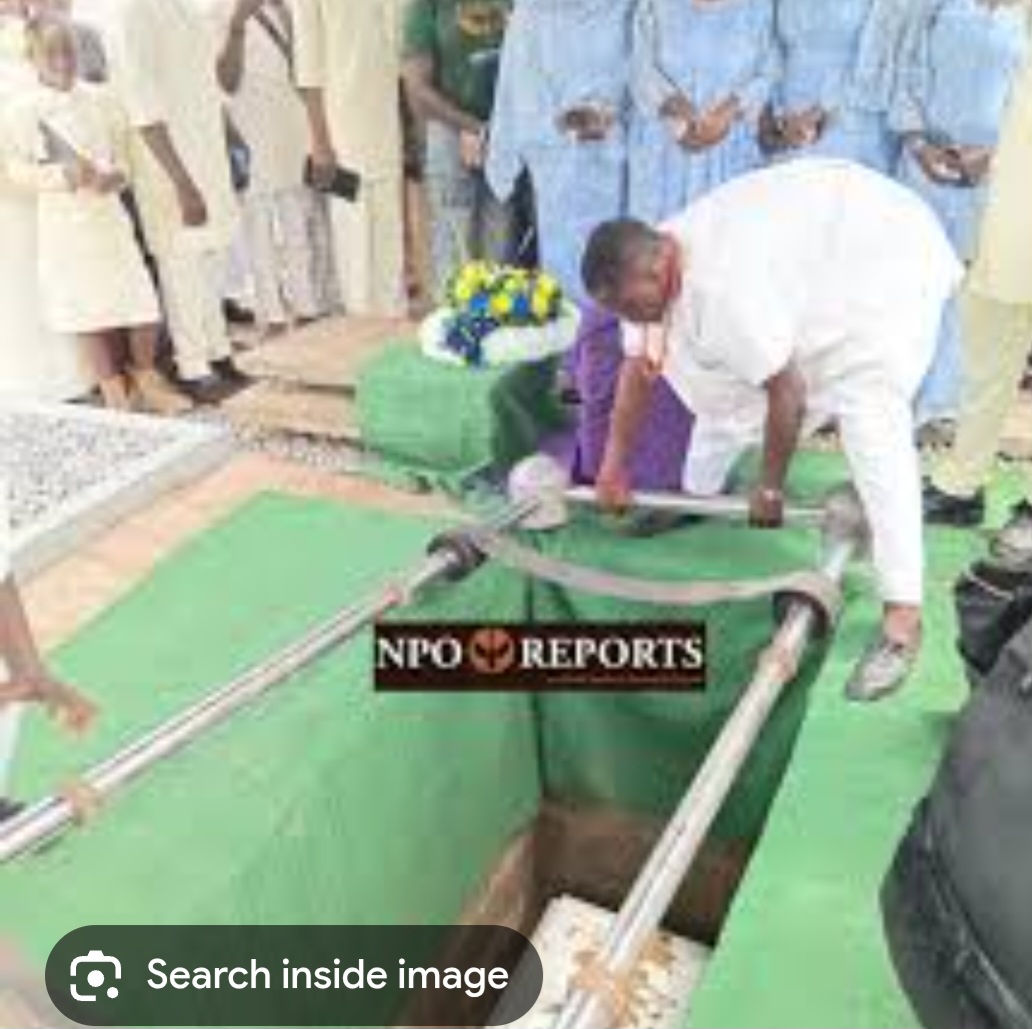
This, for me, was settled today rather than re-opened. At Dotun Oladipo’s funeral service, his three daughters took turns to read their tributes to their dad, and I found myself watching them with awe. There was a kind of strength in them that I do not possess. It is the strength needed to stand in front of a hall brimming with grieving adults and speak about a man they have just lost. Forever. Strength, however, is not the same as ease. I could see plainly what that strength was costing them as they read. Their voices caught. Their composure held and then did not hold and then held again through sheer will.
In front of them, in the pews, men and women considerably older than them came undone in ways the girls themselves were somehow managing to resist. I went mightily close. Some of the sobbing was quiet, the type people try to fold into a handkerchief. Some of it was not quiet at all, the kind that announces itself whether or not you want it.
Those young women honoured their father with a grace that is beyond me. What they did was astonishing. So, what I am attempting is an observation of a custom I have now watched wound people. This was not the first time I had watched this particular ritual extract more than it should from people already running on fumes. I saw an earlier and harder version of it at a friend’s wake back in 2015.
The first son was called forward to read his father’s tribute, and he could not do it. He tried, but the words would not come, and he stood there in front of a crowd of mourners, with his grief simply refusing to organise itself into sentences. The officiating minister, rather than releasing him from the task, urged him to continue. I sat fizzing with sorrow and ire. He could not go on and, eventually, the minister accepted, but not before insisting a while longer than it should have reasonably taken. His younger brother was called up next, presumably on the theory that if one grieving son could not manage it, maybe another one could. He flunked it in the same way. Grief does not distribute itself more conveniently among siblings just because a programme has been printed and needs to be followed.
I have turned that memory over many times since, trying to work out why this part of the rites is treated as mandatory in the first place. I have not found a satisfying answer. Maybe it comes from a belief that a child’s words carry more weight than anyone else’s, which may even be true, but weight is exactly the problem when those carrying it are struggling to hold themselves together with nothing but adrenaline and the fear of dissolving in public.
Maybe it is simply inertia, the reason we still do a hundred things at funerals that nobody can explain the original purpose of. Either way, I have stopped looking for the justification. I no longer think one exists that is good enough to weigh against what I watched happen to that boy in 2015.
So, let this stand as my instruction rather than my preference, the kind of thing I would rather state plainly now than leave for my children to infer later from how uncertain I sound when the subject comes up in passing. If I do not get the old age I am hoping for, my children will not be asked to read a single word over my body. Someone else can speak for me. A friend, a stranger with a steadier voice and a smaller stake in the loss, anyone whose grief will not be quite so total that standing upright becomes almost impossible.
My children, of course, will sit in front and fall apart if that is what the day requires of them, but without the microphone. That, at least, is one small mercy I intend to arrange for them while I am still here to arrange it.
Dotun deserved every bit of the send-off his daughters gave him today, and I suspect he would have been the first to tell them to sit down and let someone else carry the weight for a while. He did not get a say in that, as none of us ever do once we are the ones being spoken of rather than the ones speaking. Rest well, Dotun. You raised three young women whose strength I will not soon forget. That alone says everything worth saying about the man you were.
Opinion
‘Tinubu Will Win Again in 2027’ — Charismatic Bishops’ Secretary
‘Tinubu Will Win Again in 2027’ — Charismatic Bishops’ Secretary
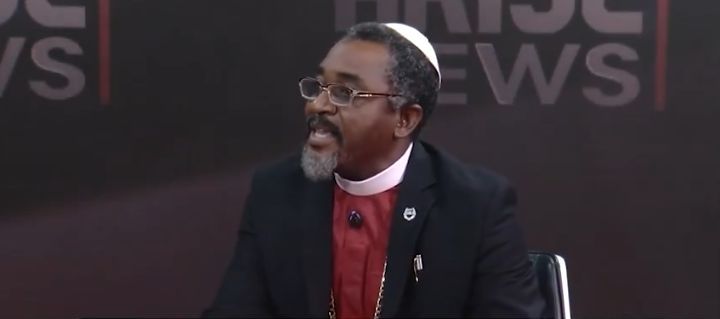
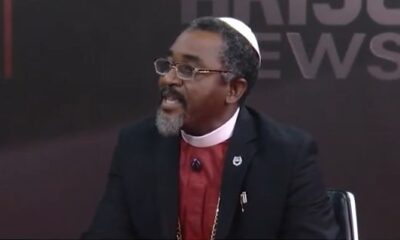
A senior Nigerian cleric, Archbishop Chivir Chianson, has declared that President Bola Tinubu will retain the presidency after the 2027 general election, attributing the prediction to a message he said came from God.
Chianson, who serves as Secretary General of the Charismatic Bishops’ Conference of Nigeria, made the statement while appearing on Arise Television on Saturday.
Rather than basing his prediction on political calculations, the archbishop said his confidence came from what he described as the prophetic role of bishops.
He maintained that the conference had previously spoken about Tinubu’s political future based on what he said was divine revelation and that the President would return for another term.
Chianson also predicted that Tinubu’s performance would improve if he wins the 2027 election.
READ ALSO:
- DSS warns Osun churches, mosques, markets over alleged terrorist attack plot ahead of 2027
- ‘Tinubu Will Win Again in 2027’ — Charismatic Bishops’ Secretary
- Fake miracles, bogus grants: How clerics allegedly fleece Nigerians of millions
Addressing the political opposition, the cleric said the bishops could not be blamed if rival parties failed to unite or organise themselves effectively ahead of the election.
He also sought to clarify the position of the bishops when dealing with government, saying their role in speaking truth to power did not mean they should approach political leaders with hostility or disrespect.
According to him, the Constitution, alongside their religious convictions, should guide how they engage the President and the country.
Chianson said he was sufficiently confident in his prediction to promise that he would return to the Arise TV studio after the 2027 election, when he expects the result to demonstrate that the bishops’ prophecy was correct.
His comments add a religious dimension to the increasingly active political conversation surrounding the 2027 presidential race.
‘Tinubu Will Win Again in 2027’ — Charismatic Bishops’ Secretary
-

 News2 days ago
SERAP Threatens Legal Action Over ₦126bn INEC Electoral Funds
-
 Politics3 days ago
Five Islamic Clerics Abducted After Tinubu Re-Election Prayer At Yari’s Zamfara Residence
-
 Opinion3 days ago
‘Tinubu Will Win Again in 2027’ — Charismatic Bishops’ Secretary
-
 Politics1 day ago
2027: Northern Lecturers Back Tinubu, ASUU Disowns Endorsement
-

 metro2 days ago
Mother ‘sold daughter’s abuse videos for $300’: Nigeria child pornography case shocks nation
-

 Sports3 days ago
‘Unacceptable’ — Arteta Furious Over Sunderland Penalty in Arsenal Win
-
 News2 days ago
Nwifuru Dismisses Cubana Chief Priest as ‘Attention-Seeker’
-

 News2 days ago
Petrol Subsidy: Presidency Rejects Atiku’s Plan, Says No Going Back