

Sports
Football legend Diego Maradona dies of heart attack

Argentinian football legend Diego Maradona, has died of a heart attack at the age 60.
He died at home on Wednesday, according to his lawyer, Matias Morlahas, barely two weeks after having surgery on a blot clot in his brain.
The Argentine news outlet Clarin broke the news on Wednesday afternoon, describing the news of Maradona’s passing as having a ‘worldwide impact’.
The sad news was later confirmed by Maradona’s lawyer. Soon, tributes were pouring in from all over the world of football.
Maradona left hospital on November 11 just eight days after he was admitted for emergency brain surgery.
The iconic former Argentinian footballer was driven away from the private Olivos Clinic just before 6pm on November 11 as hundreds of fans of photographers tried to get a glimpse of him.
Maradona was hospitalised the previous week and had to have an emergency operation to remove a blood clot from his brain.
Argentinian TV reporters travelling on motorbikes filmed the ambulance carrying him leaving before following the vehicle to transmit every inch of his journey.
His lawyer had said that the 60-year-old would continue to receive treatment for alcohol dependency.
Widely regarded as one of the greatest players of all time on the pitch, Maradona’s life off the pitch was equally notorious – amid battles with drug and alcohol addiction, dailymail.co.uk reports.
He won the World Cup with Argentina in 1986, having knocked England out of the tournament in a match which saw him score the famous ‘Hand of God’ goal.
Maradona, who was the coach of Gimnasia Esgrima in his home country, had been admitted to hospital on several occasions since his retirement.
He almost died of cocaine-induced heart failure in 2000 and underwent years of rehabilitation.
Maradona, who was well known for having a wild lifestyle during and after his playing days, had a gastric bypass operation to lose weight in 2005.
He also fell ill at the last World Cup in Russia, where he was filmed passing out in an executive box when Argentina beat Nigeria in Group D.
Maradona began taking cocaine in the mid-1980s – during the height of his playing days, going on to develop an addiction to drugs and alcohol over the next two decades.
His drug use began in 1982 and reportedly grew worse in 1984 when he moved to Napoli and had connections with the Comorra.
In 2014, Maradona said of his drug use: ‘I gave my opponents a big advantage. Do you know the player I could have been if I hadn’t taken drugs?’
His first real punishment came in 1991 when he was banned for 15 months by Napoli after testing positive for cocaine.
Later in the same year, he was arrested in Buenos Aires for possessing half a kilo of cocaine, and was given a 14-month suspended sentence.
In 1994, Maradona was back in the fold with the Argentina national team, making headlines around the world for a now-famous screaming celebration into the camera lens after a goal against Greece.
His tournament was to come to an early end, though, after he was expelled days later for testing positive for five variants of ephedrine, a banned substance. He was banned for 15 months, ending his international career.
In 1995, he moved to Boca Juniors but two years later, he failed a drugs test for the third time in six years, putting an end to his playing career.
Officially, a ‘prohibited substance’ is all that has been revealed about that test, but Boca President Mauricio Macri has said in interviews that cocaine was found in a urine sample.
In 1996, Maradona said publicly: ‘I was, am and always will be a drug addict.’
In 2000, the football legend suffered an overdose, and in 2004 he had a heart attack.
A year later, he was forced to have gastric bypass surgery, and in 2007 he was back in hospital again, this time suffering hepatitis.
It is then understood he stopped taking drugs, telling a journalist in 2017 that he hadn’t taken drugs for 13 years and was feeling ‘great’.
He has been drinking alcohol since 2004, though, hitting the headlines at the 2018 World Cup for his bizarre antics at a number of Argentina games.
A video emerged of him drinking tequila on a plane, and he claimed he ‘drank all the wine’ ahead of their win over Nigeria.









Sports
U-17 WWC: Umejiaku Wins Golden Ball As FIFA Announces Full List Of Award Winners
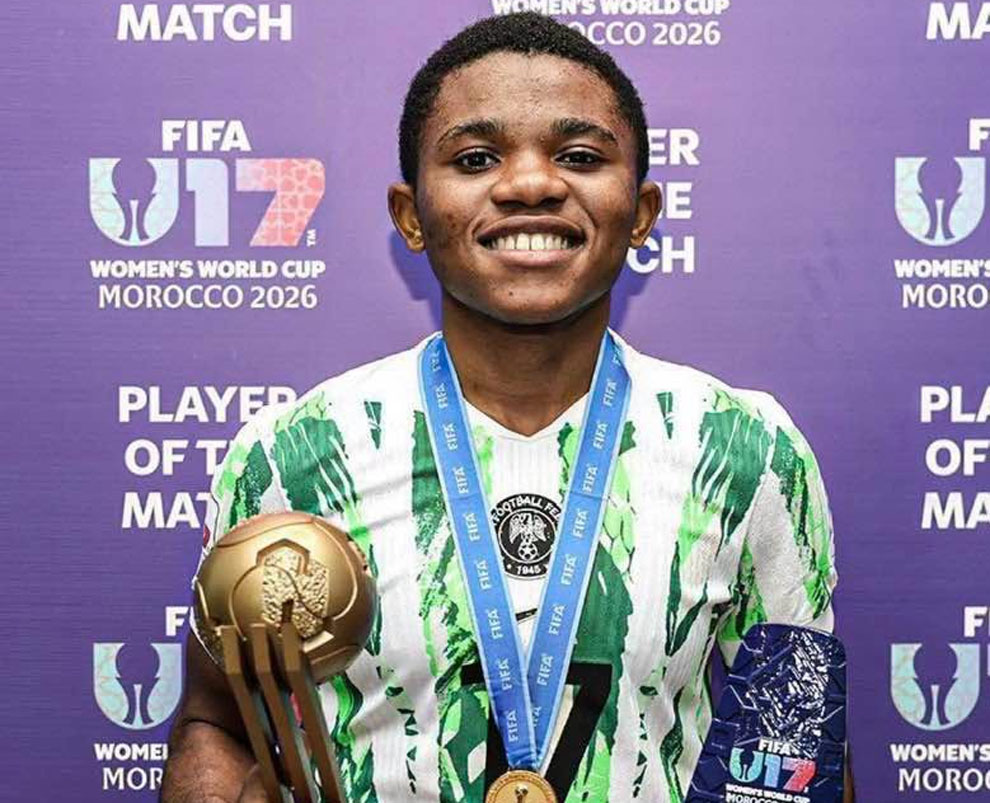
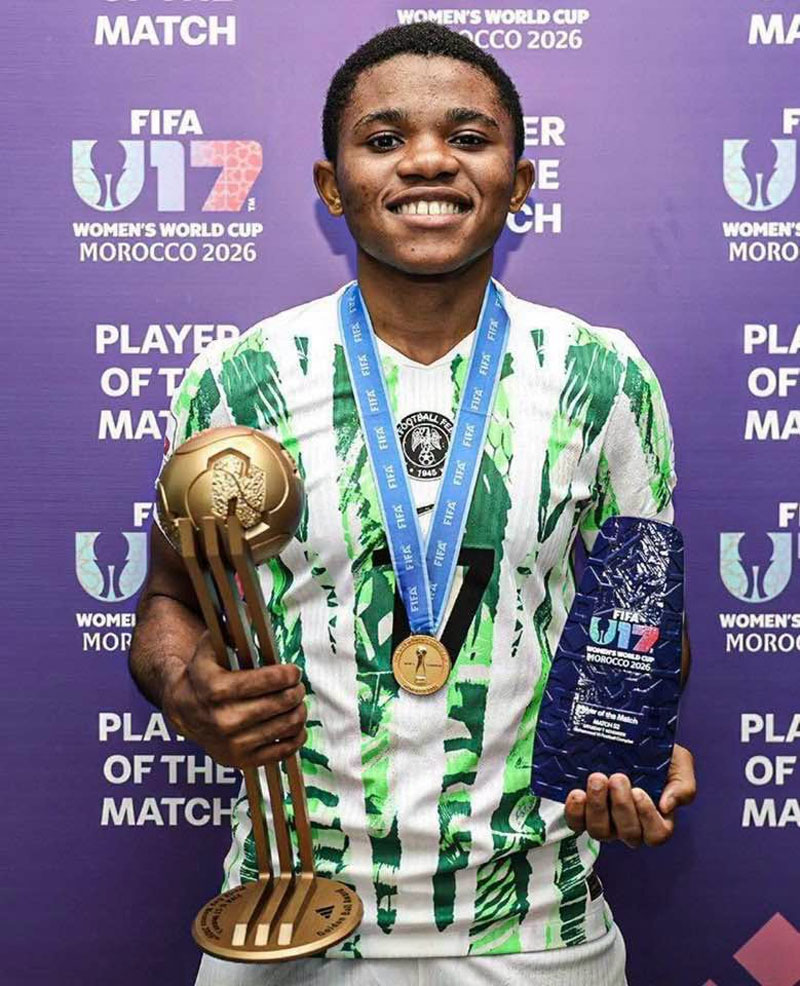
Nigeria’s Oluebube Umejiaku has been named the best player of the 2026 FIFA U-17 Women’s World Cup after helping the Flamingos win their maiden title in Morocco.
Umejiaku received the prestigious adidas Golden Ball award following her outstanding performances throughout the competition, which ended on Saturday, November 7, with Nigeria defeating Japan 2-1 in the final in Rabat.
The Nigerian forward scored the decisive second goal in the final, taking her tournament tally to four goals and capping an impressive campaign with the individual honour.
She also played a crucial role in Nigeria’s historic run, contributing to goals in all seven of the team’s matches.
U-17 WWC: Umejiaku Wins Golden Ball As FIFA Announces Full List Of Award Winners
DPR Korea’s Yu Jong-hyang won the Silver Ball, while Japan’s Fuki Ito received the Bronze Ball.
Despite the United States’ quarter-final elimination, forward Maddie DiMaria emerged as the tournament’s highest goalscorer, claiming the adidas Golden Boot with an impressive 12 goals.
READ ALSO:
- How Buhari’s Promise Cost Me 2022 APC Presidential Ticket – Amaechi
- Messi Breaks MLS Record, Becomes First Player To Win Back-to-Back Golden Boots
- Power Outage: Tegbe Gives Nigerians 72-Hour Timeline as FG Moves to Restore Electricity
DiMaria scored six goals against Samoa, four against Kenya and one each against China PR and Spain.
Yu Jong-hyang received the Silver Boot, while her DPR Korea teammate Ri Ui-gyong claimed the Bronze Boot.
DPR Korea goalkeeper Kim Son-gyong was named winner of the adidas Golden Glove after helping her country secure third place in the tournament.
Japan, despite losing the final to Nigeria, received the FIFA Fair Play Trophy.
The full list of award winners is as follows:
- Golden Ball: Oluebube Umejiaku (Nigeria)
- Silver Ball: Yu Jong-hyang (DPR Korea)
- Bronze Ball: Fuki Ito (Japan)
- Golden Boot: Maddie DiMaria (United States) – 12 goals
- Silver Boot: Yu Jong-hyang (DPR Korea)
- Bronze Boot: Ri Ui-gyong (DPR Korea)
- Golden Glove: Kim Son-gyong (DPR Korea)
- FIFA Fair Play Trophy: Japan
Nigeria’s triumph marked a historic milestone as the Flamingos became the first African nation to win the FIFA U-17 Women’s World Cup.
The team also became the first African women’s side to win a FIFA World Cup title at any level, following their remarkable 2-1 victory over Japan.
Awawu Bashiru opened the scoring for Nigeria in the 39th minute before Umejiaku doubled the advantage two minutes into the second half. Fuki Ito pulled one back for Japan in the 80th minute, but Nigeria held on to secure the historic victory.
U-17 WWC: Umejiaku Wins Golden Ball As FIFA Announces Full List Of Award Winners
Sports
Messi Breaks MLS Record, Becomes First Player To Win Back-to-Back Golden Boots

Argentine football superstar Lionel Messi has made history in Major League Soccer (MLS), becoming the first player to win the league’s Golden Boot award in consecutive seasons.
The Inter Miami captain secured the 2026 Golden Boot after finishing the regular season with 26 goals, retaining the individual honour he won in 2025 when he scored 29 times.
The MLS announced the achievement on Saturday, November 7, following the conclusion of the regular season.
Messi finished ahead of FC Dallas striker Petar Musa, who scored 22 goals, while Nashville SC forward Sam Surridge came third with 21 goals.
The 39-year-old’s latest achievement further strengthens his remarkable influence on American football since joining Inter Miami in July 2023.
Despite scoring fewer goals than he did in the previous campaign, Messi remained the league’s most productive attacking player, recording 17 assists to finish with 43 goal contributions in 2026.
According to MLS statistics, he also led the competition in goals per game, averaging 0.84, and was among the leaders in multi-goal performances, recording six such matches.
His 26 goals came in 31 regular-season appearances, with only one scored from the penalty spot.
Messi’s latest Golden Boot triumph also makes him the sixth player in MLS history to win the award more than once, joining Bradley Wright-Phillips, Chris Wondolowski, Jeff Cunningham, Taylor Twellman and Preki.
READ ALSO:
- One Killed, Five Injured as Violence Disrupts Obi-Kwankwaso Rally in Delta
- BREAKING: Flamingos Make History, Defeat Japan 2–1 to Win First FIFA U-17 Women’s World Cup
- White House Reaffirms US Policy Recognising Only Two Genders
However, none of the previous winners achieved the feat in consecutive seasons, making the Argentine the first to accomplish the milestone.
The eight-time Ballon d’Or winner had previously claimed the 2025 Golden Boot with 29 goals and 19 assists, helping Inter Miami establish themselves among the leading teams in the competition.
His influence has extended beyond goalscoring. Messi became the first player in MLS history to record at least 40 goal contributions in consecutive regular seasons, registering 43 in 2026 after an equally impressive campaign in 2025.
The Argentine also holds the record for the most non-penalty goals in a single MLS season, having scored 28 in 2025.
Messi’s latest individual success came on the final day of the regular season when Inter Miami played out a 3-3 draw against Charlotte FC.
Although he did not score, the former Barcelona and Paris Saint-Germain forward provided assists from two corner kicks as Miami surrendered a three-goal advantage.
The result ensured Inter Miami finished second in the Eastern Conference, securing home-field advantage for the opening stages of the MLS Cup playoffs.
Miami will face Columbus Crew in the opening round of the postseason as they seek to defend their MLS Cup title.
Messi joined Inter Miami in 2023 after leaving Paris Saint-Germain and quickly transformed the club’s fortunes, leading them to the Leagues Cup title in his debut season.
He subsequently helped the club win the Supporters’ Shield in 2024 and its first MLS Cup championship in 2025.
The latest Golden Boot award adds another milestone to an extraordinary career that has already produced eight Ballon d’Or titles, multiple domestic league championships and the 2022 FIFA World Cup with Argentina.
Messi Breaks MLS Record, Becomes First Player To Win Back-to-Back Golden Boots
Sports
BREAKING: Flamingos Make History, Defeat Japan 2–1 to Win First FIFA U-17 Women’s World Cup

BREAKING: Flamingos Make History, Defeat Japan 2–1 to Win First FIFA U-17 Women’s World Cup
Nigeria’s Flamingos have made history after defeating Japan 2–1 to lift the 2026 FIFA U-17 Women’s World Cup trophy in Morocco on Saturday, November 7.
The Nigerian girls produced an impressive performance in the final to secure the country’s first-ever championship title in the competition.
Awawu Bashiru opened the scoring for Nigeria in the 38th minute of the first half with a long-range effort that slipped through the hands of Japanese goalkeeper Kou Kadowaki.
The Flamingos doubled their advantage early in the second half through Oluebube Umejiaku, who calmly lifted the ball over the advancing goalkeeper to give Nigeria a commanding 2–0 lead.
Japan fought back and reduced the deficit through Ito in the 80th minute, but the Nigerian side held on to secure a historic 2–1 victory.
READ ALSO:
- ‘Stop Blaming Us’, APC Tells Atiku, ADC Over Court Judgment
- Atiku to Tinubu: You Cannot Use Courts to Escape Nigerians’ Verdict
- University Funding Crisis: States Beg FG to Take Over Cash-Strapped Institutions
The triumph marks a major milestone for Nigerian and African football, as the Flamingos become the first African team to win the FIFA U-17 Women’s World Cup.
Nigeria booked their place in the final after defeating Brazil 3–1 in the semi-finals, while Japan secured their ticket following a dramatic penalty shootout victory over defending champions North Korea.
The victory represents a remarkable achievement for coach Akeem Busari and his players, who have brought global recognition to Nigeria with their outstanding campaign.
The historic triumph is also Nigeria’s first title at the FIFA U-17 Women’s World Cup, having previously finished third in the 2022 edition.
Nigeria’s victory over Japan has further established the Flamingos as one of the emerging forces in women’s youth football.
BREAKING: Flamingos Make History, Defeat Japan 2–1 to Win First FIFA U-17 Women’s World Cup
-

 Sports2 days ago
BREAKING: Flamingos Make History, Defeat Japan 2–1 to Win First FIFA U-17 Women’s World Cup
-

 Entertainment2 days ago
Mohbad: Court-Supervised DNA Samples Collected From Singer’s Remains, Son Liam
-
 News2 days ago
Power Outage: Tegbe Gives Nigerians 72-Hour Timeline as FG Moves to Restore Electricity
-

 International2 days ago
US Offers $20m Reward, Relocation for Information on Iran’s Nuclear Programme
-

 Africa2 days ago
Shakahola Massacre: Kenyan Court Jails Doomsday Pastor 200 Years Over 191 Deaths
-

 Politics2 days ago
‘Stop Blaming Us’, APC Tells Atiku, ADC Over Court Judgment
-

 metro3 days ago
Church Growth Is Not About Numbers’: Bishop Smith Champions Training for Small Churches
-

 News2 days ago
NDLEA Arraigns Two Mexicans, Four Nigerians Over Secret Meth Lab in Oyo Forest
You must be logged in to post a comment Login