

International
‘My wife died giving birth after Trump cut funding to our clinic’

‘My wife died giving birth after Trump cut funding to our clinic’
When Shahnaz went into labour, her husband Abdul called a taxi to take them to the only medical facility accessible to them.
“She was in a lot pain,” he says.
A 20-minute drive away, the clinic was in Shesh Pol village in Afghanistan’s north-eastern Badakhshan province. It was where their two older children were born.
Abdul sat next to Shahnaz comforting her as they drove over gravel tracks to reach help.
“But when we reached the clinic, we saw that it was closed. I didn’t know it had shut down,” he said, his face crumpling with agony.
Warning: Readers may find some details in this article distressing.
The clinic in Shesh Pol is one of more than 400 medical facilities that closed down in Afghanistan, one of the world’s poorest countries, after the Trump administration cut nearly all US aid to the country earlier this year, in a drastic and abrupt move following the dismantling of the US Agency for International Development (USAID).
A single-storey structure with four small rooms, white paint peeling off its walls, the Shesh Pol clinic has USAID posters tacked up everywhere with information and guidance for pregnant women and new mothers.
It doesn’t look like much but in Badakhshan’s mountainous, unforgiving terrain, where a lack of access has been a major reason for historically high maternal mortality rates, the clinic was a critical lifeline, part of a wider programme implemented during the tenure of the US-backed government in the country, to reduce maternal and newborn deaths.
It had a trained midwife who assisted around 25-30 deliveries every month. It had a stock of medicines and injections, and it also provided basic healthcare services.
READ ALSO:
- Leaked WhatsApp message revealed Gbenga Daniel working against APC – Report
- Salah’s late penalty gives Liverpool 1-0 win against Burnley
- Tobi Amusan advances to world 100m hurdles semi-finals
Other medical facilities are simply too far from Abdul’s village, and it was not without risk for Shahnaz to travel on bumpy roads. Abdul also didn’t have money to pay for a longer journey – renting the taxi cost 1,000 Afghani ($14.65; £12.70), roughly a quarter of his monthly income as a labourer. So they decided to return home.
“But the baby was coming and we had to stop by the side of the road,” Abdul said.
Shahnaz delivered their baby girl in the car. Shortly after, she died, bleeding profusely. A few hours later, before she could be named, their baby also died.
“I wept and screamed. My wife and child could’ve been saved if the clinic was open,” said Abdul. “We had a hard life, but we were living it together. I was always happy when I was with her.”
He doesn’t even have a photo of Shahnaz to hold on to.
There’s no certainty the mother and baby would’ve survived if they’d been treated at the clinic, but without it, they didn’t stand a chance, underlining the undeniable impact of US aid cuts in Afghanistan.
For decades, America has been the largest donor to Afghanistan, and in 2024, US funds made up a staggering 43% of all aid coming into the country.
The Trump administration has justified withdrawing it, saying there were “credible and longstanding concerns that funding was benefiting terrorist groups, including… the Taliban”, who govern the country. The US government further added that they had reports stating that at least $11m were “being siphoned or enriching the Taliban”.
The report that the US State Department referenced was made by the Special Inspector General for Afghanistan Reconstruction (SIGAR). It said that $10.9m of US taxpayer money had been paid to the Taliban-controlled government by partners of USAID in “taxes, fees, duties, or utilities”.
READ ALSO:
- Submit yourself to probe, northern youths tell El-Rufai
- TAX ID: No need for separate TIN to operate bank accounts – FIRS
- JUST IN: ADC denies INEC confirmation of state chairmen list
The Taliban government denies that aid money was going into their hands.
“This allegation is not true. The aid is given to the UN, and through them to NGOs in provinces. They identify who needs the aid, and they distribute it themselves. The government is not involved,” said Suhail Shaheen, the head of the Taliban’s political office in Doha.
The Taliban government’s policies, especially its restrictions on women, the harshest in the world, have meant that after four years in power, it is still not recognised by most of the world. It’s also a key reason donors have been increasingly walking away from the country.
The US insists no one has died because of aid cuts. Shahnaz and her baby’s deaths are not recorded anywhere. Neither are countless others.
The BBC has documented at least half a dozen first-hand, devastating accounts in areas where USAID-supported clinics have shut down.
Right next to Shahnaz’s grave, villagers who had gathered around us pointed to two other graves. They told us both were of women who died in childbirth in the past four months – Daulat Begi and Javhar. Their babies survived.
Not far from the graveyard, we met Khan Mohammad whose wife, 36-year-old Gul Jan, died in childbirth five months ago. Their baby boy Safiullah died three days later.
“When she became pregnant, she would go to the clinic for check-ups. But midway through her pregnancy it shut down. During the delivery she had a lot of pain and blood loss,” Khan Mohammad said. “My children are sad all the time. No one can give them the love of a mother. I miss her every day. We had a sweet and loving life together.”
A roughly five-hour drive from Shesh Pol, in Cawgani, another village where a USAID-backed clinic closed down, Ahmad Khan, the grief-stricken father of Maidamo showed us the room in their mud and clay home where she died giving birth to baby Karima.
“If the clinic had been open, she might have survived. And even if she had died, we would not have had regrets knowing the medics tried their best. Now we’re left with regret and pain. America did this to us,” he said, tears rolling down his face.
In another home a few lanes away, Bahisa tells us how terrifying it was to give birth at home. Her three other children were born in the Cawgani clinic.
“I was so scared. In the clinic, we had a midwife, medicines and injections. At home I had nothing, no painkillers. It was unbearable pain. I felt like life was leaving my body. I became numb,” she said.
READ ALSO:
- I married Soludo as a virgin, Anambra governor’s wife replies Ekwunife
- Ex-lawmakers endorse Tinubu for 2027, say South must finish term
- Yahaya Bello promised to make me Kogi governor – Ex-deputy gov
Her baby girl, named Fakiha, died three days after she was born.
The closure of clinics in villages has resulted in a surge of patients at the maternity ward of the main regional hospital in the provincial capital Faizabad.
Getting to it, through Badakhshan’s treacherous landscape is risky. We were shown a horrifying photo of a newborn baby, who was delivered on the way to Faizabad, and whose neck snapped before he got to the hospital.
We had visited the hospital back in 2022, and while it was stretched then, the scenes we saw this time were unprecedented.
In each bed, there were three women. Imagine having gone into labour, or just having gone through a miscarriage, and not even having a bed to yourself to lie in.
It’s what Zuhra Shewan, who suffered a miscarriage, had to endure.
“I was bleeding severely and didn’t even have a place to sit. It was really hard. By the time a bed is free, a woman could die bleeding,” she said.
Dr Shafiq Hamdard, the director of the hospital, said: “We have 120 beds in the hospital. Now we’ve admitted 300 to 305.”
While the patient load is swelling, the hospital, too, has faced sharp cuts in its funding.
“Three years ago our annual budget was $80,000. Now we have $25,000,” Dr Hamdard said.
By August this year, there had been as many maternal deaths recorded as there were for the whole of last year. Which means that at this rate, maternal mortality could increase by as much as 50% over last year.
Newborn deaths have already increased by roughly a third in the past four months, compared with the start of the year.
Razia Hanifi, the hospital’s head midwife, says she’s exhausted. “I have been working for the past 20 years. This year is the toughest, because of the overcrowding, the shortage of resources and the shortage of trained staff,” she said.
But no reinforcements are coming because of the Taliban government’s restrictions on women. Three years ago, all higher education, including medical education was banned for women. Less than a year ago, in December 2024, training for midwives and female nurses was also banned.
At a discreet location, we met two female students who were midway through the training when it was closed. They didn’t want to be identified for fear of reprisal.
Anya (name changed) said they both were in graduate courses at university when the Taliban took over. When those were closed in December 2022, they began midwife and nursing training, as it was the only path left to getting an education and a job.
“When that was also banned, I became depressed. I was crying day and night, and I wasn’t able to eat. It’s a painful situation,” she said.
Karishma (named changed) said: “There is already a shortage of midwives and nurses in Afghanistan. Without more being trained, women will be forced to give birth at home which will put them at risk.”
We asked the Taliban government’s Suhail Shaheen how they can justify bans which effectively curb access to health for half the population.
“It is our internal issue. These are our issues, how to handle them, how to consider them, how to take decisions, this is something internal. That is up to the leadership. Based on the needs of the society, they will take a decision,” he said.
With their access to medical services severely restricted, by wave after wave of crushing blows, for Afghanistan’s women, their right to health, and life itself, is at grave risk.
Additional reporting, photography and video: Aakriti Thapar, Mahfouz Zubaide, Sanjay Ganguly
Top image shows Abdul with his daughter and son in Shesh Pol.
‘My wife died giving birth after Trump cut funding to our clinic’










Health
Fiji Declares National HIV Emergency as Diagnoses Surge Sixteenfold
Fiji Declares National HIV Emergency as Diagnoses Surge Sixteenfold
Authorities launch a multi-agency public health campaign to expand free testing, treatment, and harm-reduction services
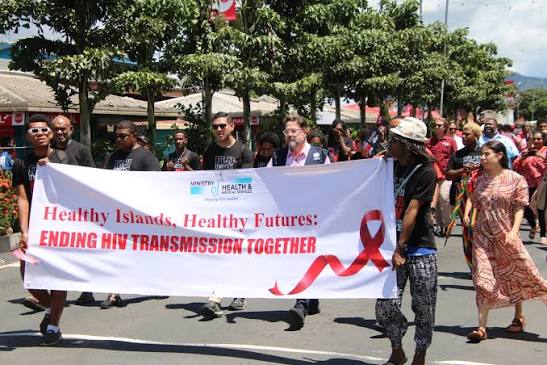
Fiji has announced a nationwide health response to address a significant rise in HIV cases and ensure that all residents can access essential medical care.
On Wednesday, Health Minister Dr. Atonio Lalabalavu shared the emergency declaration, explaining that national agencies are joining forces to provide rapid medical support, expand testing, and protect community well-being across the islands.
Official reports indicate that about one in every 60 adults in Fiji currently lives with HIV, following an increase in new infections over recent years. Health specialists explain that the virus spreads primarily through intimate sexual contact and shared needles among individuals using illicit substances.
Additionally, routine screenings revealed that two out of every 100 expecting mothers carry the virus, highlighting an urgent need for early maternal healthcare to protect newborns from infection.
To safeguard public health, authorities are delivering free daily treatments, distributing protective preventive medications, and setting up clean needle programs to stop infections before they start.
Furthermore, global partners, including Australia, New Zealand, India, and United Nations health bodies are providing financial resources and medical supplies to back the local effort.
By encouraging open community conversations and delivering accessible healthcare without judgment, health workers aim to ensure that everyone receives the care and dignity they deserve.
Fiji Declares National HIV Emergency as Diagnoses Surge Sixteenfold
International
Kim Yo-jong: Only ‘Idiots’ Think North Korea Will Give Up Nuclear Weapons

International
Gaza Building Collapse Kills 21, Including Eight Children
Gaza Building Collapse Kills 21, Including Eight Children
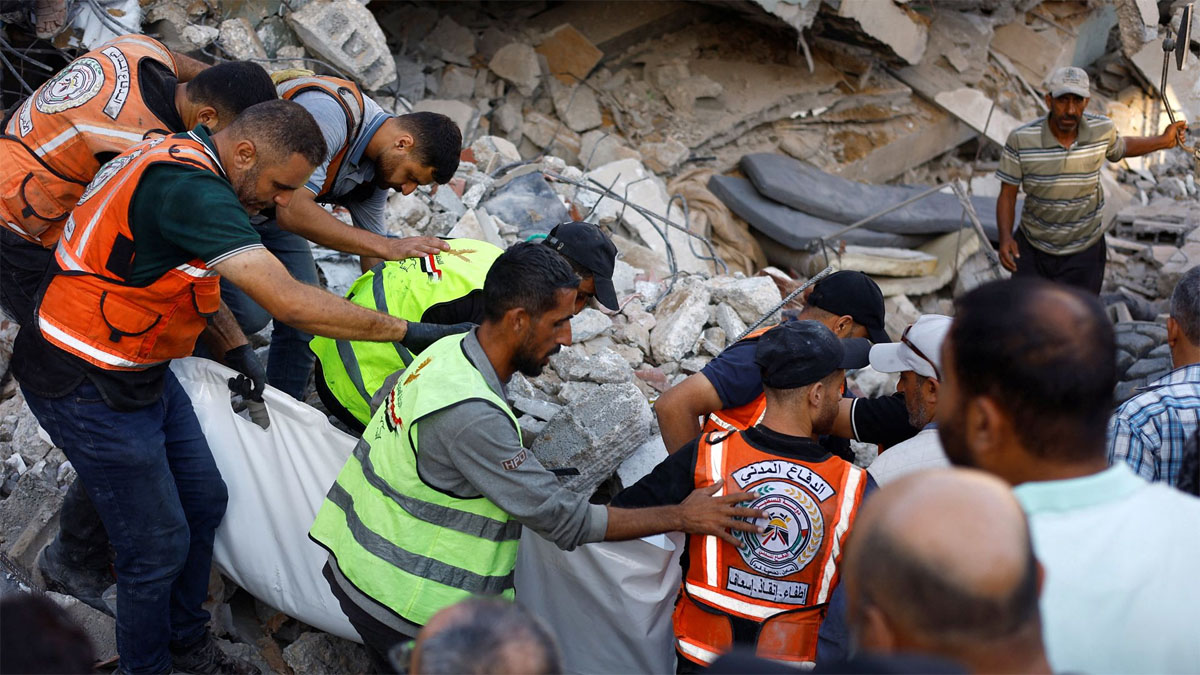
At least 21 people have been killed, including eight children, after a war-damaged building collapsed in Gaza City overnight, rescuers and medics say. The tragedy has renewed concerns about the collapse risk facing hundreds of bomb-damaged structures across the Gaza Strip as winter approaches.
The six-storey residential building in Gaza City’s Tal al-Hawa area collapsed in the early hours of Wednesday. According to the United Nations humanitarian coordinator for the occupied Palestinian territories, Ramiz Alakbarov, an estimated 100 people, including 50 children, were living in the building when it came down. The Gaza Civil Defence agency confirmed that rescuers extracted 21 bodies and rescued 20 unharmed individuals from the rubble on al-Sinaa Street in Tal al-Hawa. Dozens remain missing or injured underneath the debris.
Witnesses told the BBC that the building had been left tilting dangerously to one side after an Israeli strike more than a year ago. Displaced families had moved inside because they were desperate, with nowhere else to go. The building had been hit multiple times in 2024 and March 2025, leading to warnings for Gazans not to return, according to Civil Defence spokesman Mahmoud Basal. More than 10 families, totalling around 80 people, lived in the building, according to residents, with dozens of them being children. Sherif, whose sister was killed, said: “They couldn’t find a tent or somewhere to live. This was the last place they could turn to, despite the danger. They were aware that it would likely end in tragedy. A lack of resources drove them towards certain death.“
A woman living in a tent nearby, Umm Mohammed Bakrun, said she had been talking to her son when the building collapsed suddenly. “It felt like an earthquake. There was a loud sound and I couldn’t stand up. Stones rained down on us and when I looked outside I saw a lot of dust,” she told the BBC. “Within minutes, there were screams everywhere.” Another witness, Mansour Abu Mohammed, said the building collapsed “in a few seconds”. “Every day, a stone or a few stones would fall from it, but the people inside couldn’t find anywhere else to live. I used to live next door to it and you could see that it was tilting to one side.”
READ ALSO:
- Niger Mosque Abductions: Terrorists Execute 30 of 500 Captive Muslim Worshippers
- OAU Investigates Death of Final-Year Student as Police Begin Probe
- 57-Year-Old Man Arrested Over Sexual Abuse of Stepdaughter in Edo
UN and Egyptian teams joined the search for survivors, which was slow due to a lack of heavy machinery. Initially, rescuers from the Hamas-run Civil Defence agency had to use their bare hands. Egypt provided heavy machinery for the rescue operation, while the United Arab Emirates and Qatar were set to deliver relief items. The Palestinian Civil Defence said rescue teams had been working continuously since the collapse, but lacked even the most basic tools. “In the first moments after the collapse, we had to ask neighbours and displaced people nearby to bring hammers, shovels and other tools because of the severe shortage of equipment,” said Abdullah al-Majdalawi, director of public relations at Gaza’s Civil Defence. The head of the United Nations Development Programme (UNDP) Gaza office, Alessandro Mrakic, told reporters at the scene that “the situation… is tragic because we don’t have the equipment and machinery that is needed”.
Mrakic warned that approximately 400 other war-damaged buildings across Gaza were at imminent risk of collapse, particularly as winter approaches. The Civil Defence agency has identified around 2,000 buildings across the territory at risk of collapse. “We need support, most importantly with machinery, equipment, among others. Our colleagues here don’t have [engine] oil and spare parts to continue to work with all the equipment that is still in Gaza.” The UN’s humanitarian relief coordinator, Ramiz Alakbarov, said he was “devastated” by the reports. “No-one should have to risk their life simply to find a safe place to shelter,” he said. He also urged Israeli authorities to approve deliveries to Gaza of heavy machinery for rescue operations, as well as tents, tarpaulins and other non-food items for displaced people ahead of the winter rains. Israel says its restrictions are meant to keep equipment out of the hands of Palestinian armed groups that could also have military uses.
An estimated 80% of all structures in Gaza have been destroyed or damaged during the war between Israel and Hamas, according to the UN. More than 1.9 million people — about 90% of the territory’s population — have been displaced, many of them multiple times, and 1.2 million of them are currently living in tents or makeshift shelters. The UN has warned that the humanitarian situation in Gaza remains dire despite the ceasefire agreed last October, as Israeli air strikes and other attacks continue to hit populated areas, causing casualties and property damage and driving further displacement. According to Gaza’s health ministry, 1,369 Palestinians have been killed and 4,627 wounded since the fragile ceasefire took effect on 11 October 2025. The total death toll since the war began has reached 73,783, with 174,738 injured.
On Tuesday, Israeli air strikes killed at least five Palestinians, including two children and a Hamas commander, according to health officials and Hamas sources. The Israeli military said it killed a Hamas commander in southern Gaza and another fighter in the north. In both cases, a child was also reportedly killed. Separately, the British charity Medical Aid for Palestinians said that a patient was killed by an Israeli drone at a health centre it supports in Jabalia in northern Gaza. A spokesperson for the Israeli military told the BBC it was not aware of such an incident.
The Gaza war was triggered by the Hamas-led attack on southern Israel on 7 October 2023, when about 1,200 people were killed and 251 others were taken hostage. Since then, more than 73,790 people have been killed in Gaza, according to the territory’s Hamas-run health ministry, whose figures are considered reliable by the UN. In a statement, the Gaza government media office under Hamas said it held “the Israeli occupation and the international community fully and directly responsible for this catastrophe befalling our Palestinian people“.
Gaza Building Collapse Kills 21, Including Eight Children
-

 Politics3 days ago
2027: Northern Lecturers Back Tinubu, ASUU Disowns Endorsement
-
 metro3 days ago
Police Arrest Mother Over Alleged Brutal Abuse of 7-Year-Old Girl in Anambra
-

 Sports2 days ago
‘I Was Never the Chosen One’ — Dembele Responds to Mbappe
-

 International1 day ago
Islamic Council Condemns Attempted Attack on Holy City of Mecca
-

 Education2 days ago
JAMB Moves 2027 UTME Time — Here’s What Candidates Need To Know
-

 metro2 days ago
Lagos Power Outage: Ikeja Electric Blames TCN as Businesses, Homes Groan
-

 News1 day ago
Keep Politics Out of My Office — Ogbomoso Grand Chief Imam Warns Politicians, Bloggers
-

 Politics2 days ago
2027: APC Governors Reject Wike’s Rainbow Coalition, Insist on Party Loyalty