
News
Osun govt, MTN in dispute over N1bn Right of Way fee
Osun govt, MTN in dispute over N1bn Right of Way fee
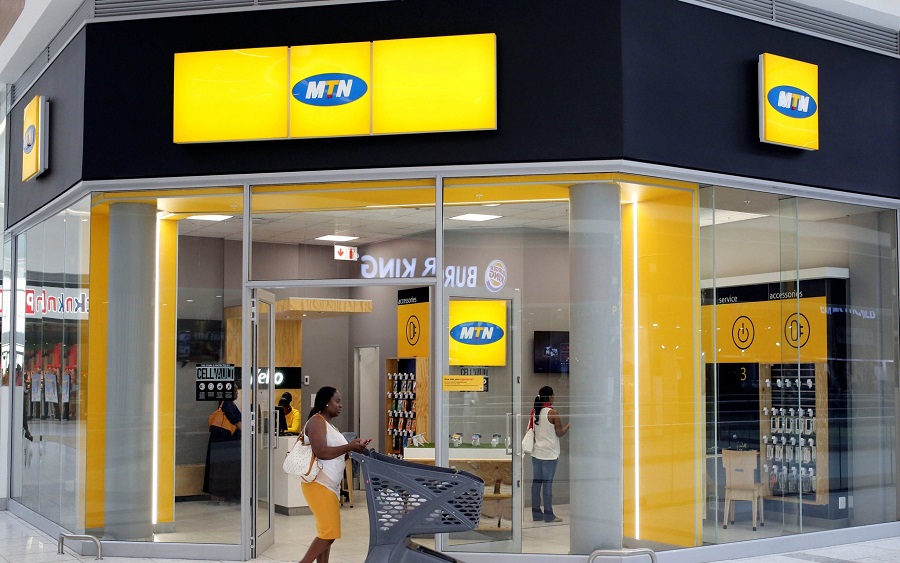
Tech giant, MTN Nigeria, is currently locked in a dispute with the Osun State government over an alleged outstanding Right of Way (RoW) fee and penalty worth over N1 billion.
According to documents sighted by Nairametrics, the Osun State Government is demanding the tech company pay a sum of N945 million as RoW fees for 270 kilometres of fibre optic and a penalty fee of N100 million for an alleged non-payment of the fee.
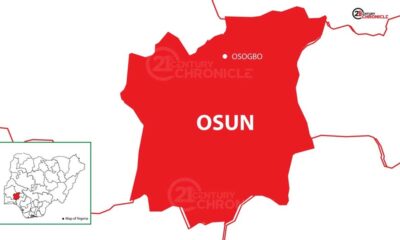
However, MTN said it owed no fee as it had signed a legal contractual agreement with Odua Infraco, which is partly owned by the Osun government and licensed by the Nigerian Communications Commission (NCC), and made all necessary payments to the company before laying its cables in the State.
The documents also revealed that Odua Infraco has the right of way for 1031.44 kilometres across four states (Osun, Oyo, Ondo and Ekiti States) for the construction and operation of fibre infrastructure, for which MTN signed a contract with the InfraCo.
Origin of the dispute
Nairametrics learnt that the disagreement between the State and the tech company started with the former’s appointment of a consultant, Global Transaction Nigeria Limited (GTNL) to handle the collection of RoW charges even with the existence of Odua Infraco doing the same.
According to the documents, MTN’s business relationship with Osun State, through O’odua Infraco, was seamless until the company received a letter dated 14th September 2023 from GTNL introducing itself and informing the company of its appointment as Technical Consultant to the Osun State Ministry of Environment on telecommunications infrastructure within the state.
- GTNL also informed MTN that it had been tasked by the Osun State Government to coordinate telecommunications infrastructure pursuant to the Osun State Environmental Protection Law 2022, including the inspection, audit, and monitoring of installations within the state to ensure compliance with the environmental laws and safety standards to protect the people of Osun State.
READ ALSO:
- Police identify Lagos BRT bus attackers
- EFCC says its ‘X’ account undergoing upgrade
- Mother who had 3some with two 13-year-old schoolboys in her son’s bedroom jailed four years
- Subsequently, by a letter dated 15th December 2023, GTNL notified MTN of an ongoing investigation of Odua Infraco’s activities in Osun State, alleging that Odua Infraco did not have any legal right to lay fibre optic cables within Osun State and requested for a meeting with MTN.
- At the meeting, GTNL informed MTN that there was a plan to terminate Odua Infraco’s Right of Way and Easement Agreement with Osun State owing to O’odua Infraco’s alleged breach of its terms of appointment, non-remittance of fees to Osun State’s account, contravention of the Osun State Environmental Law, and illegal award of right-of-way to telecommunications operators including MTN.
However, Odua Infraco in a letter dated January 20th, 2024 sent to MTN countered GNTL’s allegations and insisted that its Right of Way and Easement Agreement with Osun State Government was still subsisting.
Amid efforts to resolve the matter, MTN received two letters from GTNL with Demand Notices both dated 25th March 2024, requiring the company to pay N945 million for its fibre cable plus N100 million as a penalty.
Regulatory intervention
While the consultant to the Osun State Government, GTNL, is insisting on the payment of over N1 billion by MTN, Newstrends learnt that the matter is now before the Compliance Monitoring and Enforcement Department of the NCC.
The telecom regulator is currently seeking a way of resolving the issue which is about to cast a dent on its infrastructure project.
- Recall that NCC in 2018 under its InfraCo project aimed at fast-tracking the deployment of fibre optic cables across the country, licensed Odua Infraco Resources Limited for South West alongside 4 other companies including Brinks Integrated Solutions Limited for North East Zone; Fleek Network Limited for North West; Raenna Nigeria Limited for South-South; and Zinox Technology Limited for Southeast.
- Before that, MainOne’s subsidiary, Infraco Nigeria Limited and IHS were the first two companies to be licensed in 2016 to cover Lagos and the North Central zone including the Federal Capital Territory (FCT).
- However, IHS later returned its licence, which was re-issued to Broadbased Communications Ltd. in 2021.
Osun govt, MTN in dispute over N1bn Right of Way fee





News
Ramadan Begins in Nigeria as Sultan Confirms Crescent Sighting
Ramadan Begins in Nigeria as Sultan Confirms Crescent Sighting
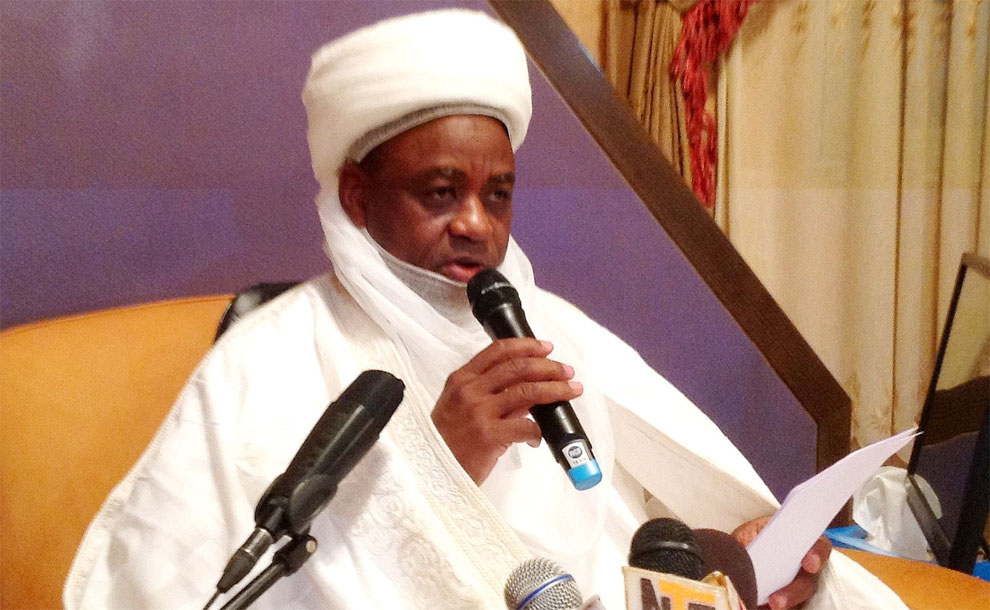
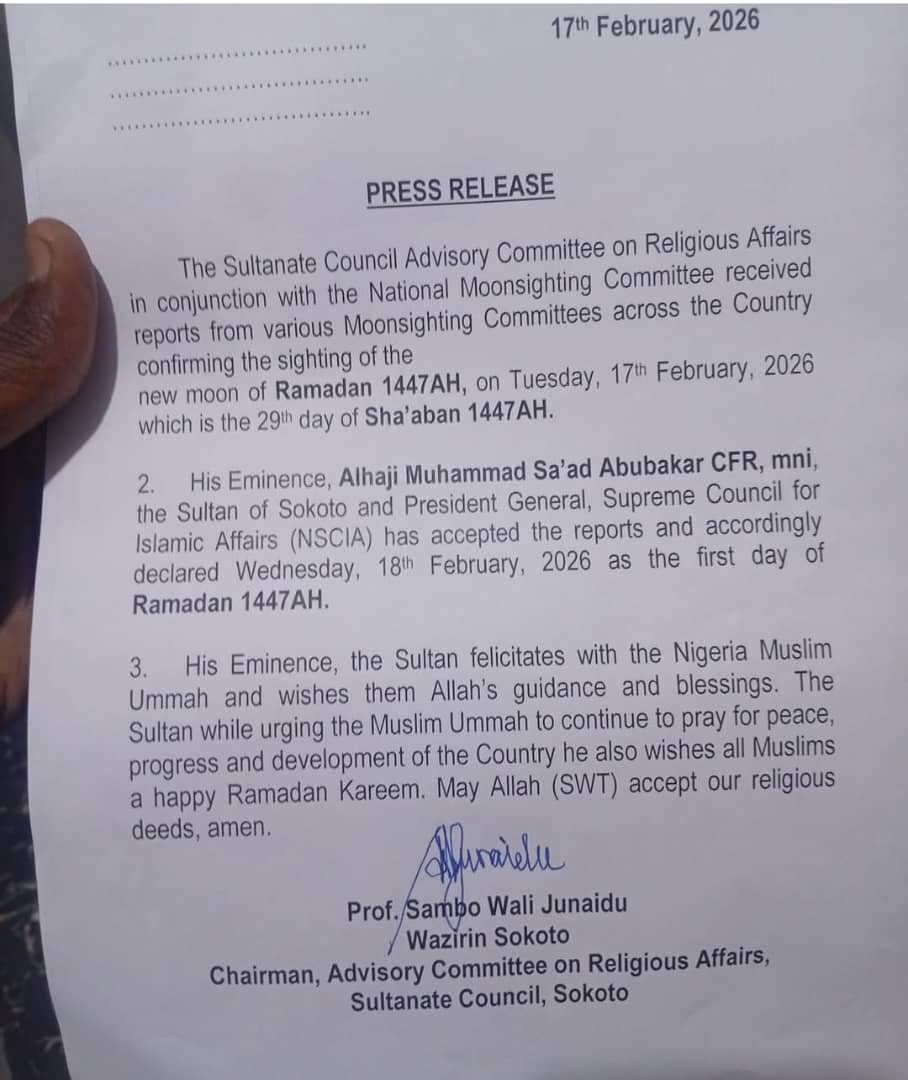
Abuja — The Sultanate Council on Tuesday night confirmed the sighting of the crescent moon, officially signaling the commencement of Ramadan 1447AH in Nigeria.
The President-General of the Nigerian Supreme Council for Islamic Affairs (NSCIA) and Sultan of Sokoto, Muhammad Sa’ad Abubakar III, announced that the new moon was sighted in parts of the country, thereby declaring Wednesday, February 18, 2026, as the first day of fasting for Muslims nationwide.
The announcement followed verified reports from moon-sighting committees across several states, in line with Islamic tradition which requires physical sighting of the crescent to mark the beginning of the ninth month of the Islamic lunar calendar.
In his message to the Muslim faithful, the Sultan urged Nigerians to use the holy month to pray for peace, unity, and national development. He also called on Muslims to embody the virtues of patience, compassion, charity, and self-discipline which Ramadan represents.
READ ALSO:
- Deadlock at National Assembly as House Snubs Electoral Act Bill Meeting on E-Transmission Clause
- Maikori Accuses Ex‑Governor El‑Rufai of Persecution Over 2017 Tweet
- Shari’ah Council Defends Kwankwaso, Rejects US “Christian Genocide” Claims
 Ramadan, one of the five pillars of Islam, requires adult Muslims to abstain from food, drink, and other physical needs from dawn until sunset throughout the month. The period is also marked by increased devotion, nightly congregational prayers in mosques, recitation of the Qur’an, and acts of charity to the less privileged.
Across major cities including Abuja, Lagos, Kano, and Port Harcourt, mosques recorded increased attendance for special night prayers following the announcement. Markets also witnessed heightened activity as families made last-minute purchases in preparation for the fasting period.
Ramadan will last 29 or 30 days, depending on the sighting of the next crescent, and will culminate in the celebration of Eid al-Fitr, marking the end of the fasting month.
Muslim leaders have encouraged faithful to observe the fast in accordance with Islamic teachings while maintaining harmony and mutual respect within Nigeria’s diverse society.
Ramadan Begins in Nigeria as Sultan Confirms Crescent Sighting
News
Saudi Arabia Confirms Sighting of Ramadan Crescent, Fasting Begins Wednesday
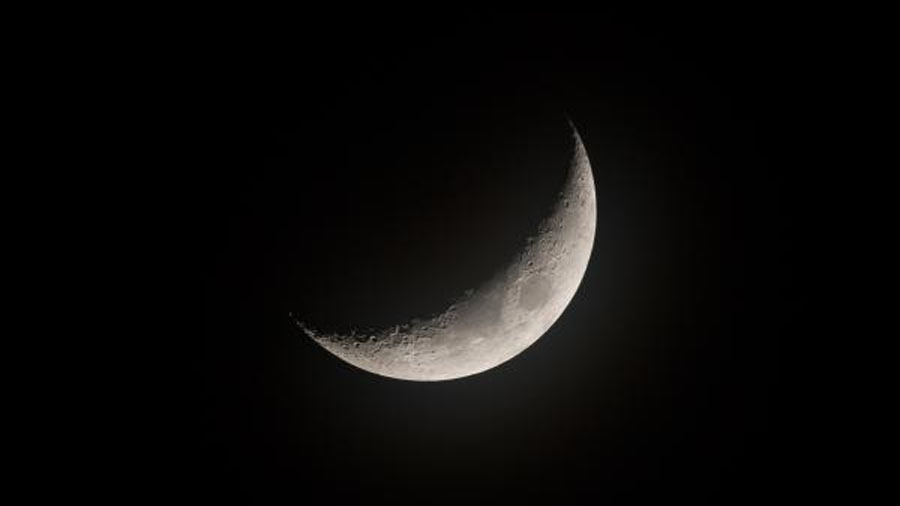
Saudi Arabia Confirms Sighting of Ramadan Crescent, Fasting Begins Wednesday
Riyadh, February 17, 2026 — Authorities in Saudi Arabia have officially confirmed the sighting of the crescent moon marking the beginning of the holy month of Ramadan, signaling that fasting will commence on Wednesday, February 18, 2026.
The announcement was made Tuesday evening following reports from moon-sighting committees across the Kingdom. In a statement carried by state media, the Supreme Court confirmed that verified testimonies of the crescent’s sighting had been received after sunset on the 29th day of Sha’ban.
With the confirmation, Muslims throughout the Kingdom will begin the first fast of Ramadan at dawn on Wednesday.
READ ALSO:
- Deadlock at National Assembly as House Snubs Electoral Act Bill Meeting on E-Transmission Clause
- Maikori Accuses Ex‑Governor El‑Rufai of Persecution Over 2017 Tweet
- Shari’ah Council Defends Kwankwaso, Rejects US “Christian Genocide” Claims
Religious authorities had earlier called on citizens and residents to look for the crescent on Tuesday evening and report any confirmed sightings to the nearest court. Observations were conducted in various regions, including areas around Riyadh and Mecca, as part of the Kingdom’s longstanding tradition of physical moon sighting.
Ramadan, the ninth month of the Islamic lunar calendar, is observed by Muslims worldwide as a period of fasting, prayer, charity, and spiritual reflection. The start of the month is determined by the sighting of the new crescent moon, in accordance with Islamic tradition.
Several other countries in the Gulf region are also expected to begin fasting on Wednesday following similar confirmations, while some nations may rely on local moon sightings to determine their own start date.
Further announcements regarding the duration of nightly Taraweeh prayers and official Ramadan working hours are expected from relevant authorities in the coming days.
Saudi Arabia Confirms Sighting of Ramadan Crescent, Fasting Begins Wednesday
News
Former INEC REC Warns of “Chaos” in 2027 Over E-Transmission of Election Results
Former INEC REC Warns of “Chaos” in 2027 Over E-Transmission of Election Results
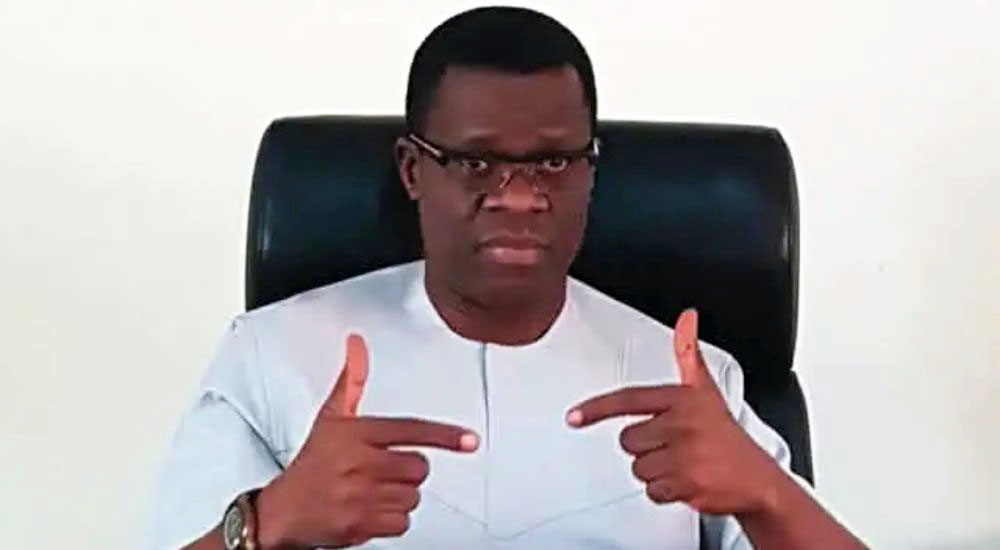
A former Resident Electoral Commissioner (REC) of the Independent National Electoral Commission (INEC), Mike Igini, has raised concerns that Nigeria’s ongoing debate over electronic transmission of election results exposes unresolved legal, institutional, and technological challenges, despite years of electoral reforms. Speaking on Channels Television’s Politics Today on Monday, Igini warned that recent Senate amendments to the Electoral Act could create confusion and vulnerabilities in future elections, particularly the 2027 general polls. He stressed that failing to clarify rules on electronic results transmission risks undermining democracy, transparency, and public confidence.
The controversy stems from the Senate’s recent amendment to the Electoral Act, which now allows electronic transmission of results but removed the “real-time” requirement that had previously been proposed to enable direct uploading from polling units to the INEC Result Viewing Portal (IREV). Under the amendment, Form EC8A, the physical result sheet, remains the primary document in cases of internet outages or connectivity failure. Igini cautioned that this creates a grey area that could trigger disputes in 2027 if presiding officers are allowed discretion over network availability, highlighting that legal and technological clarity is essential to avoid chaos.
READ ALSO:
- DHQ Confirms 100 US Military Personnel Arrive in Bauchi for Counter-Terrorism Training
- Dokpesi Jr, Ex-GMD Akiotu Clash Over DAAR Communications Mgt Restructuring
- EFCC Holds El-Rufai Overnight Over ₦423bn Kaduna Corruption Allegations
Referencing a 2021 technical report by INEC and the Nigerian Communications Commission (NCC), Igini said Nigeria possesses adequate telecommunications coverage, with 2G and 3G networks covering about 93% of the country, making electronic transmission feasible nationwide. INEC had also mapped polling units to mobile network operators and prepared SIM cards and data arrangements to ensure smooth uploads to IREV. He explained that Nigeria had previously relied on interim innovations, including biometric voter registers, card readers, and digital result-viewing platforms, to enhance transparency where legal provisions prohibited full electronic transmission.
Igini further warned that introducing discretionary fallbacks for “network issues” could reintroduce vulnerabilities, as presiding officers might abuse their authority to manipulate results. He emphasised that modern election devices, such as BIVAS machines, can operate both online and offline, uploading results at the nearest connectivity point to ensure integrity in IREV. “The whole purpose of IREV is to make results verifiable and immutable once entered. Allowing manual override defeats the reforms we have painstakingly implemented over the years,” he said.
He also noted that judicial interpretations and evolving legislative amendments have contributed to uncertainty over the legality of technological innovations in elections. Igini urged lawmakers to consider the long-term implications of changes to the Electoral Act, stressing that Nigeria’s democratic stability relies on cooperation between INEC, the judiciary, and key stakeholders. “Our democracy’s future depends on the rule of law. Without it, society risks being dominated by those who act for personal interest rather than public good,” he added.
With the 2027 elections approaching, Igini’s warnings underscore the need for clear legal frameworks, technological preparedness, and robust institutional coordination. He urged all stakeholders to work collaboratively to ensure that electronic transmission of results enhances transparency, accountability, and credibility in Nigeria’s electoral process.
Former INEC REC Warns of “Chaos” in 2027 Over E-Transmission of Election Results

-

 Education3 days ago
Check Your Name: UNILORIN Releases Updated NELFUND Refund List for 2024/2025 Students
-

 News2 days ago
Osogbo Sons and Daughters Mark 5th Anniversary with Awards, Political Undertones
-

 News14 hours ago
Saudi Arabia Confirms Sighting of Ramadan Crescent, Fasting Begins Wednesday
-

 metro2 days ago
US Freezes Assets of Eight Nigerians Over Boko Haram, ISIL, Cybercrime Links
-

 News3 days ago
Afenifere Calls for Immediate Take-Off of State Police as Terror Threats Rise in Yorubaland
-

 metro3 days ago
Argungu Festival 2026 Highlights Peace, Stability, Economic Growth — Tinubu
-
 metro2 days ago
Terror in Lagos Traffic: Cutlass Gang Unleashes Mayhem on Mile 12–Ketu Road
-
 Entertainment2 days ago
Mystery in Lekki: Police Probe Death of Two Nollywood Crew Found Lifeless in Parked Car