

Education
Reps halt WAEC 2026 CBT plan, say schools not ready till 2030

Reps halt WAEC 2026 CBT plan, say schools not ready till 2030
The House of Representatives has asked the Federal Ministry of Education and the West African Examinations Council (WAEC) to suspend plans to introduce Computer-Based Testing (CBT) for school candidates until 2030.
Lawmakers said the 2026 target announced by WAEC was unrealistic, given the acute shortage of infrastructure and trained personnel in most public schools, especially in rural communities.
The resolution followed a motion of urgent public importance by Rep. Kelechi Wogu (PDP, Rivers), adopted at Thursday’s plenary.
Wogu, in his motion titled “Need for Intervention to Avert the Pending Massive Failure of Candidates Intending to Write the 2026 WAEC Examination Using CBT, Capable of Causing Depression and Deaths of Students,” warned that a premature rollout could lead to mass failure, frustration, and even psychological distress among students.
He recalled that WAEC’s 2025 online result-checking portal crashed temporarily due to “technical glitches,” leaving thousands of candidates stranded — a development he said exposed the system’s fragility.
“The House is aware that most schools lack functional computers, reliable internet connectivity, and constant power supply needed for CBT,” Wogu said, noting that over 70 per cent of WAEC candidates are from rural areas.
He added that about 25,500 schools nationwide are expected to present candidates for the 2026 examination, which typically spans four months and covers at least nine subjects — including theory, objectives, and practicals.
“Unlike JAMB, WAEC exams are more extensive and would require massive digital infrastructure and teacher retraining,” he said.
The House urged the Ministry of Education and state governments to make budgetary provisions between 2026 and 2029 for the recruitment of computer teachers, construction of ICT halls, internet connectivity, and standby power supply ahead of a phased rollout in 2030.
It also mandated its Committees on Basic Examination Bodies, Digital and Information Technology, Basic Education and Services, and Labour, Employment and Productivity to liaise with relevant stakeholders and report back within four weeks.
WAEC had earlier announced plans to conduct the 2026 May/June school examination using computers after what it described as a “successful” pilot run with private candidates in 2024.
The council has been carrying out sensitisation campaigns tagged “CB-WASSCE: New Way, Same Destination,” insisting the shift would modernise the examination process.
But with Thursday’s resolution, WAEC may now have to shelve the plan — at least until Nigerian schools are ready.




Education
Nigerian Young Academy, LASU to Host 16th International Conference on Convergent Research
Nigerian Young Academy, LASU to Host 16th International Conference on Convergent Research
Five-day event to bring together academics, policymakers, industry leaders to explore interdisciplinary solutions to global challenges
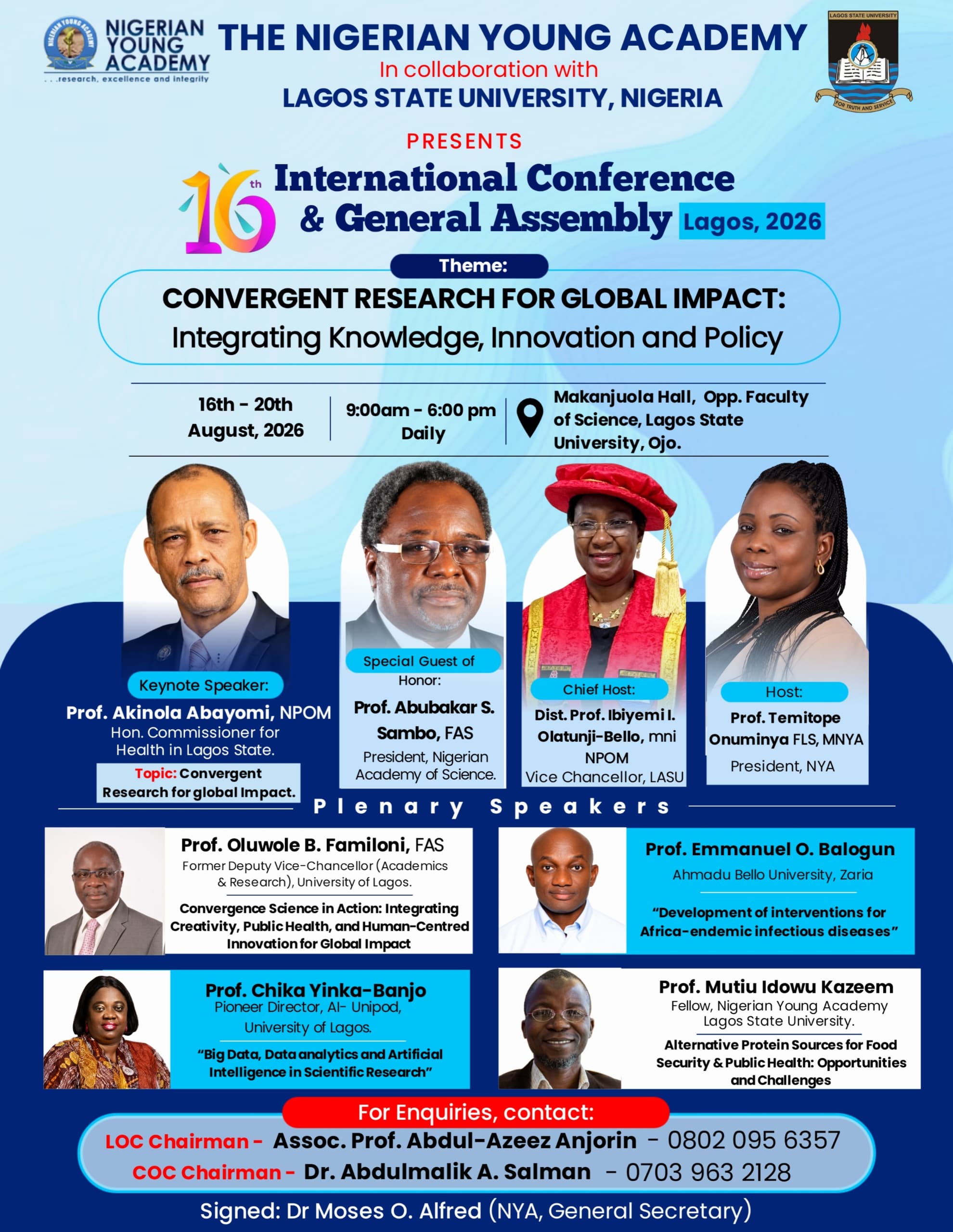
LAGOS — The Nigerian Young Academy (NYA), in collaboration with Lagos State University (LASU), will host its 16th International Conference and General Assembly from 16 to 20 August 2026 at the LASU Ojo Campus, Lagos, the organisers have announced.
The conference, themed “Convergent Research for Global Impact: Integrating Knowledge, Innovation and Policy,” will convene academics, researchers, policymakers, industry leaders, development partners, and civil society organisations from Nigeria and around the world to examine how interdisciplinary research can address complex societal and global challenges.
According to a press release issued by the Academy, the conference aims to showcase cutting-edge research, strengthen collaboration among emerging and established scholars, and promote evidence-based policies that support sustainable development. It underscores the Nigerian Young Academy’s commitment to advancing research excellence, innovation, and leadership.
The five-day programme will feature keynote and plenary sessions, lead paper presentations, oral and poster presentations, scientific awards, networking opportunities, and a pre-conference workshop on “Building Research Capacity in the AI Era: Grant Writing and Practical Data Analysis Using R.”
READ ALSO:
- 2027 Elections: Atiku Raises Alarm Over Outdated BVAS Software, Warns of Manipulation Risks
- Nigerian Army Opens 2026/2027 Short Service Combatant Commission Recruitment – Apply Now
- US, Iran Nearing Peace Agreement, Pakistan Defence Minister
Discussions will span a broad range of themes, including sustainable development, public health systems, disease prevention, urban resilience, smart cities, energy systems, environmental policy, human-centred technology, rural development, food security, agribusiness, ethics in convergence science, and the application of artificial intelligence and machine learning in governance, planning, and risk assessment.
Keynote and Hosts
The conference keynote address will be delivered by Professor Akin Abayomi, Lagos State Commissioner for Health. Professor Temitope Onuminya, President of the Nigerian Young Academy, will host the event, while Professor Ibiyemi I. Olatunji-Bello, Vice-Chancellor of Lagos State University, will serve as Chief Host.
Call for Abstracts and Registration
Researchers are invited to submit abstracts of no more than 250 words between 1 March and 14 June 2026, while submissions for poster presentations will remain open until 24 July 2026. The conference is open to participants from Nigeria and abroad.
According to the Chairman of the Local Organising Committee, Associate Professor Abdul-Azeez Adeyemi Anjorin of Lagos State University, the conference provides an important platform for researchers, professionals, and policymakers to exchange ideas, foster partnerships, and develop innovative solutions that can shape the future of research, innovation, and public policy.
Scholars, students, professionals, and stakeholders across academia, government, industry, and civil society are encouraged to participate. Registration details and additional information are available through the Nigerian Young Academy website.
About the Nigerian Young Academy
The Nigerian Young Academy (NYA) is Nigeria’s foremost interdisciplinary academy for outstanding early-career researchers and professionals. Established in 2010 by the Nigeria Academy of Science, with the support of the Nigeria Academy of Education and the Nigeria Academy of Engineering, the Academy promotes research excellence, leadership, interdisciplinary collaboration, and public engagement.
The NYA is affiliated with the International Science Council, the Global Young Academy, and the Network of African Science Academies (NASAC). Through its conferences, awards, publications, and capacity-building initiatives, the Academy supports the development of young researchers and contributes to national and global development through science, scholarship, and innovation.
For further information, contact:
Dr. Abdulmalik Salman
Conference Organising Committee, Nigerian Young Academy (NYA)
Email: amas2k7@gmail.com
Telephone: +2347039632128
Website: https://nigerianyoungacademy.org
Nigerian Young Academy, LASU to Host 16th International Conference on Convergent Research
Education
Nigerian Mother Gifts Son a Live Goat After Polytechnic Graduation

Nigerian Mother Gifts Son a Live Goat After Polytechnic Graduation
A Nigerian mother has captured the hearts of millions online after she presented her son with a live goat during his sign-out ceremony at the Federal Polytechnic, Nekede, in Imo State. The unexpected gift, captured on video and shared widely across social media platforms, shows Chinyere walking toward her son, Promise Okoro, with the goat in tow as fellow students cheer and celebrate. But behind the unconventional gesture lies a deeply personal story of love, discipline, and a promise kept. This is the full story behind the viral moment, what it meant to the family, and why the mother chose a goat over an expensive car.
Chinyere explained that before her son, Promise, left for the Federal Polytechnic, Nekede, she gave him clear instructions. She warned him against joining cult groups, urged him to remain focused on his studies, and reminded him to always respect his family and others. She made him a promise: if he successfully completed his education and made her proud, she would give him a special surprise. Speaking to BBC News Pidgin on Monday, Chinyere said her son
honoured every instruction. “He has been respectful to the family and everyone. He’s a footballer, and I want to prove my love for him. That is why I bought the goat for him,” she said.
For many, the choice of a live goat as a graduation gift might seem unusual. But for Chinyere, it was a meaningful and practical way to demonstrate her love while fulfilling the promise she had made to her son. “I don’t have money for a 4matic jeep, and I love that guy, my son. I said, let me buy this goat as a gift,” she explained. She noted that although she could not afford an expensive car, she was determined to give Promise something special that would show how proud she was of his achievement. The goat, she said, was a symbol of that pride and a reward for his discipline throughout his academic journey.
READ ALSO:
- Radio Caroline Fined Over False King Charles III Death Announcement
- Osun poll: Adeleke’s wife leads women’s protest over alleged arrests, violence
- FRSC Confirms 15 Dead, 25 Injured in Enagi-Mokwa Road Accident
Chinyere revealed that the goat cost her ₦120,000 – a significant sum that she was willing to pay to keep her word. She told BBC News Pidgin that she was prepared to spend even more if necessary, saying, “I said even if it is ₦200,000, I will try my best to see that I come with that goat.” For a mother who described herself as not wealthy enough to buy a luxury car, the expense was a testament to her commitment to celebrating her son’s success in a way that felt authentic and heartfelt.
The video capturing the moment has since gone viral across platforms like Instagram, Twitter (X), and TikTok. In the footage, Chinyere is seen walking confidently toward her son, leading the goat on a rope, as students erupt in cheers and laughter. She then embraces Promise in a warm hug while fellow students shout in excitement. Chinyere described the students’ reaction as one of the highlights of the surprise. “As I was walking, they were screaming. I was happy, and I knew my son too was,” she recalled.
For Promise, the moment started with complete confusion. He told BBC News Pidgin that he heard students shouting “say yes” and initially assumed they were calling him to witness an engagement ceremony. It was only when a coursemate asked him to come and see his mother that he discovered the reason for the excitement. “I was surprised for her to even call me to come and see my mum because she brought a goat. I was asking if she knew my mum because I wasn’t convinced,” Promise said. Once he realized what had happened, Promise said he felt overwhelmed with happiness and deep emotion. He expressed no embarrassment about his mother’s unconventional gift. “I came, happy and deeply emotional. I wasn’t ashamed. I was extremely happy. I am not even ashamed in school; why then would I be ashamed of my mum or her action?” he said.
The video has sparked widespread reactions online, with many Nigerians praising Chinyere for her creativity and the depth of her love. Commenters described the gesture as a “beautiful display of maternal love” and a “unique graduation memory” that Promise will cherish forever. Some social media users noted that the goat was not just a gift but a valuable asset that could be used for breeding or even sold to support the graduate’s next steps. Others simply celebrated the mother’s determination to keep her promise despite financial constraints.
Promise Okoro has now completed his studies at the Federal Polytechnic, Nekede, and his mother’s gift has turned his sign-out ceremony into a moment that will be remembered not just by his family, but by thousands of people across Nigeria and beyond. While many graduates receive watches, phones, or even cars, Promise received something far more meaningful – a symbol of his mother’s love, sacrifice, and pride in the man he has become.
Nigerian Mother Gifts Son a Live Goat After Polytechnic Graduation
Education
FG to supply six-seater electric tricycles, charging station to Offa Polytechnic
FG to supply six-seater electric tricycles, charging station to Offa Polytechnic
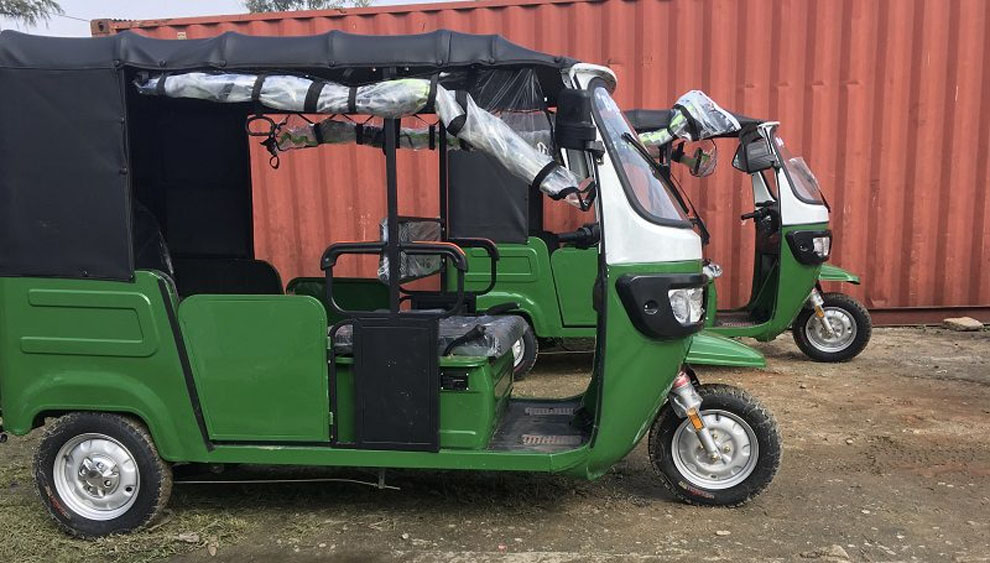
The Federal Government has approved the supply of six-seater electric tricycles and the construction of a modern electric vehicle charging station at the Federal Polytechnic, Offa, Kwara State, as part of efforts to promote clean transportation, innovation and technical skills development.
The institution is among the selected beneficiaries of the One Product, One Polytechnic (OPOP) initiative, a Federal Government intervention designed to promote innovation, technology transfer, entrepreneurship and institutional self-reliance across Nigeria’s polytechnics.
The approval was conveyed to the institution by the Tertiary Education Trust Fund (TETFund), according to the polytechnic’s spokesperson, Olayinka Iroye.
Iroye said the intervention would provide the institution with six-seater electric tricycles for campus transportation and a modern charging station to support their operation.
He said the project would go beyond improving intra-campus mobility, as it would also expose students to practical applications of electric mobility, renewable energy systems and sustainable engineering.
The development comes as Federal Polytechnic Offa expands its focus on emerging green technologies and electric vehicle development.
READ ALSO:
- Jorge Messi, Father and Agent of Lionel Messi, Dies at 68 After Long Illness
- Edo Spiritualist Arrested for $1,100 Sextortion of Indian Woman – EFCC
- Wike mocks Bode George, calls him ‘failed politician’ who can’t win his polling unit
The institution recently attracted attention with the successful design, development and unveiling of its indigenous electric vehicle, OKIN EV1, which was developed as part of its efforts to strengthen local capacity in electric vehicle technology.
The new government-backed intervention is expected to complement that achievement by providing students and researchers with greater access to electric mobility infrastructure and practical applications of the technology.
The polytechnic has also entered into a strategic partnership with Electric Motor Vehicle Company (EMVC), a Nigerian indigenous electric vehicle manufacturer, to accelerate the development and commercialisation of locally produced electric vehicles.
The partnership is expected to support joint research and innovation in electric vehicle engineering, battery technology, renewable energy systems and component fabrication.
It will also provide students and researchers with opportunities for industry exposure, practical training and skills development in areas linked to the emerging electric vehicle industry in Nigeria.
According to the institution, the collaboration will facilitate technology transfer, innovation and commercialisation, while helping to develop specialised manpower required for Nigeria’s growing electric mobility ecosystem.
The partnership also provides for the deployment of modern electric vehicle charging infrastructure at the polytechnic, with the institution seeking to establish itself as a major electric vehicle charging hub in Kwara State.
The combination of the OPOP intervention, the electric vehicle charging project, the OKIN EV1 development and the EMVC partnership is expected to strengthen the institution’s position as a centre for electric mobility, sustainable transportation and green technology.
The electric tricycle project could also provide a practical platform for students to gain experience in the operation, maintenance and development of electric mobility systems, while researchers can use the infrastructure to advance work in areas such as batteries, charging systems, renewable energy and electric vehicle engineering.
The initiative is part of a broader shift towards cleaner transportation in Nigeria, as government institutions, educational establishments and private-sector operators increasingly explore electric vehicles as an alternative to petrol- and diesel-powered transport.
For Federal Polytechnic Offa, the intervention is expected to combine improved campus transportation with technical education, research, innovation and entrepreneurship, potentially creating a stronger link between classroom learning and the country’s emerging electric mobility sector.
FG to supply six-seater electric tricycles, charging station to Offa Polytechnic
-

 Sports2 days ago
After Cameroon Heartbreak, Falcons Battle Banyana Thursday for World Cup Lifeline
-

 Business2 days ago
Xenophobia: MTN, Stanbic IBTC, other South African firms face pressure in Nigeria
-

 Politics2 days ago
Aregbesola: I’ve never slept with another woman since marriage
-

 metro2 days ago
“I Begged for Years” – Nigerian Man Says Wife Never Forgave Him Over Social Media Incident
-

 metro2 days ago
ISWAP Executes Four Shura Council Members Amid Deepening Leadership Crisis
-

 News3 days ago
Italy-Based Businessman Excretes 98 Wraps of Cocaine at Enugu Airport
-

 News2 days ago
Nigeria Immigration Deploys Passport Intervention Team to UK to Clear Application Backlog
-

 Education2 days ago
Nigerian Mother Gifts Son a Live Goat After Polytechnic Graduation