International
Stage collapse in Mexico political campaign rally kills nine
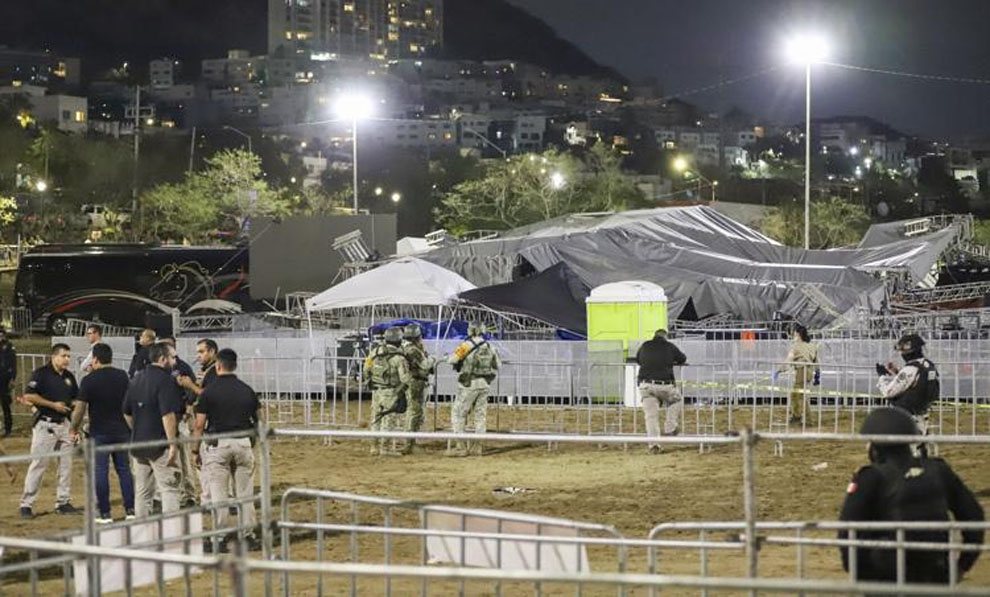
A stage has collapsed in heavy winds at a political campaign rally in northern Mexico.
The unforseen incident killed at least nine people, including a child, and injured 121, the governor of Nuevo Leon State said on Thursday.
The collapse occurred during an event Wednesday evening attended by presidential long-shot candidate Jorge Álvarez Máynez, who ran to escape. Videos of the collapse on social media showed people screaming, running away, and climbing out from under metal polls.
The victims “will not be alone in this tragedy,” Máynez told reporters Wednesday night, adding that he had suspended upcoming campaign events.
Afterward, soldiers, police, and other officials roamed the grounds of the park where the event took place, while many nearby sat stunned and haunted by the tragedy.
In a video message, Nuevo Leon Gov. Samuel Garcia, a leading member of Máynez’s Citizens Movement party, said 94 of the injured were treated and released, but 27 remained hospitalized. State health authorities said a lot of the injuries involved skull fractures. Garcia said three victims were undergoing surgery and appeared to be in critical condition.
Garcia said the accident occurred “in a matter of seconds.”
READ ALSO:
- Atiku: I’ll keep contesting for presidency, drawing inspiration from Abraham Lincoln seven attempts
- Female soldier dismissed for stealing N35m gold jewellery
- NCAA threatens to sanction Turkish Airline for maltreating Nigerians
Mexican President Andrés Manuel López Obrador said most of the injured were women. He absolved Máynez’s Citizens Movement party — widely viewed as an implicit ally of López Obrador’s Morena party — of blame even before investigations were carried out.
“We know that they are not to blame,” the president said Thursday.
Condolences poured in from across Mexico, including from the other two presidential candidates.
Máynez wrote in his social media accounts that he went to a hospital after the accident in the wealthy suburb of San Pedro Garza Garcia, near the city of Monterrey. He said he was in good condition.
“The only important thing at this point is to care for the victims of the accident,” he wrote.
Videos of the accident showed Máynez waving his arm as the crowd chanted his name. But then he looked up to see a giant screen and metal structure toppling towards him. He ran rapidly towards the back of the stage to avoid the falling structure, which appeared to consist of relatively light framework pieces as well as what appeared to be a screen with the party’s logo and theatre-style lights.
Máynez has been running third in the polls in the presidential race, trailing both front-runner Claudia Sheinbaum of the ruling Morena Party and opposition coalition candidate Xóchitl Gálvez. Both sent their condolences, and Sheinbaum cancelled a campaign event in nearby Monterrey the next day “in solidarity” with the victims and their loved ones.
“My condolences and prayers are with the families of the dead, and my wishes for a speedy recovery to all those injured,” wrote Gálvez in a social media post.
The accident happened at the height of campaign season, with many events held this week and next in anticipation of the June 2 presidential, state, and municipal elections.
The campaign had so far been plagued by the killings of about two dozen candidates for local offices.
Stage collapse in Mexico political campaign rally kills nine
![]()
International
Trump Defends Rising Inflation, Says Prices Will Fall After Iran Conflict
United States President Donald Trump has sparked fresh debate over the state of the American economy after declaring that he “loves” the latest inflation figures, even as US inflation climbed to its highest level in three years.
New data released by the US Bureau of Labor Statistics (BLS) showed that annual inflation rose to 4.2 per cent in May 2026, up from 3.8 per cent in April, marking the third straight monthly increase and the highest rate recorded since 2023.
The increase was driven largely by rising energy prices, with gasoline, electricity and other fuel-related costs surging amid ongoing geopolitical tensions involving the United States, Israel and Iran.
Reacting to the figures at the White House, Trump appeared unconcerned about the inflation spike.
“I love it. The numbers were great. You know what I really love? I love the inflation,” the president told reporters.
The remark quickly drew attention across political and economic circles, with critics arguing that millions of Americans continue to struggle with higher living costs. However, Trump later clarified that he was not celebrating rising prices but rather expressing confidence that inflation remained lower than many analysts had predicted despite global instability.
Speaking to the New York Post, Trump said the latest figures demonstrated the resilience of the US economy during a period of international conflict.
READ ALSO:
- TikTok Cracks Down on Harmful Content in Nigeria, Removes Over 4 Million Videos
- Senate Orders Police, DSS to Track Bandits Flaunting Cash on TikTok
- BREAKING: Trump Cancels US Strikes on Iran at Last Minute
“I love the inflation numbers because of what I’m talking about. The numbers are going to be phenomenal because what’s showing is that despite the fact that we’re in a war, the numbers are much lower than anticipated, and when we’re out of that war, the numbers will be at lower numbers than they were even before it started,” he said.
Trump maintained that inflationary pressures would ease significantly once tensions in the Middle East subside. According to him, oil prices are expected to decline sharply after the conflict ends, helping to reduce transportation, manufacturing and household energy costs.
“When this conflict is over, you will see oil drop to where it was before,” he told reporters.
The latest inflation report showed that energy costs accounted for a significant share of the increase in consumer prices. Government data indicated that fuel-related expenses contributed heavily to the overall rise, with gasoline prices recording one of the sharpest increases.
Data from the American Automobile Association (AAA) showed that the national average price of regular gasoline rose to approximately $4.15 per gallon, compared with about $2.98 per gallon in late February.
Analysts have linked the increase in fuel prices to disruptions in global oil markets and concerns surrounding the Strait of Hormuz, one of the world’s most important oil shipping routes. Any threat to oil exports through the waterway typically drives up crude oil prices and increases inflationary pressures across major economies.
Beyond energy, the Bureau of Labor Statistics reported higher costs for airline tickets, healthcare services, communication services, recreation and other consumer goods and services.
The inflation increase presents a fresh challenge for the US Federal Reserve, which has a long-term inflation target of 2 per cent. Rising inflation often raises expectations that the central bank could maintain higher interest rates or introduce additional measures aimed at slowing price growth.
Financial markets are now closely watching upcoming policy decisions from the Federal Reserve as officials assess whether current inflation pressures are temporary or likely to persist.
The issue is also expected to become a major political talking point ahead of the upcoming US midterm elections, with inflation, fuel costs and affordability remaining among the top concerns for American voters.
Although current inflation remains well below the 9.1 per cent peak recorded in 2022, economists remain divided over the outlook for the coming months. While some believe easing geopolitical tensions could bring prices down, others warn that continued disruptions in global energy markets may keep inflation elevated for longer than expected.
For now, the latest data underscores the continued influence of energy prices on the US economy and sets the stage for a renewed debate over inflation, interest rates and economic policy in the months ahead.
Trump Defends Rising Inflation, Says Prices Will Fall After Iran Conflict
![]()
International
BREAKING: Trump Cancels US Strikes on Iran at Last Minute
DUBAI/WASHINGTON – President Donald Trump called off plans for renewed US military strikes on Iran at the last minute on Thursday, saying negotiations with Tehran had advanced to the highest levels of Iran’s leadership and had been approved by a broad coalition of regional powers. The dramatic reversal came hours before the strikes were expected to be carried out. But details of the diplomatic breakthrough after more than three months of war — including how Iran’s leadership had signaled its approval — were not immediately clear in Trump’s post on Truth Social. In his announcement, Trump stated: “Based on the fact that discussions with the Islamic Republic of Iran have been brought to the highest level of Iranian leadership and approved, I have, as President of the United States of America, cancelled the scheduled strikes and bombings against Iran this evening.” Trump added that “discussions and final points have been, in both concept and great detail, approved by all parties involved, including the United States, Israel, Saudi Arabia, UAE, Qatar, Turkey, Pakistan, Bahrain, Kuwait, Jordan, Egypt, and others.” He also stated: “The Naval Blockade will remain in full force and effect until this Transaction is finalized — Time and place of the signing to be announced shortly.” There was no immediate official comment from Iran. Trump has repeatedly claimed that a deal with Tehran was imminent in recent weeks, only to have Iranian officials deny such suggestions.
Earlier in the day, Trump had said the United States would hit Iran “VERY HARD TONIGHT” and even added that he wanted at some point to take Iran’s oil infrastructure hub Kharg Island, after a second day of strikes by both sides in the Gulf appeared to threaten a return to all-out war. Trump claimed on Truth Social that “Iran’s Navy, Air Force, Radar, Anti Aircraft, and all other forms of Defense, together with most of its offensive capability, are GONE!” Kharg Island processes approximately 90 percent of Iran’s crude exports and serves as a major revenue source for the Iranian economy. However, it remains heavily fortified by missile batteries, naval mines, and Revolutionary Guard units — meaning any ground invasion would require thousands of American troops.
A fragile ceasefire has been in place since early April 2026, brokered by Pakistan, following the outbreak of hostilities on February 28, 2026, when the US and Israel launched airstrikes on Iran. The war has since killed thousands of people. According to Al Jazeera statistics, at least 7,129 people have died, including 3,593 in Lebanon, 3,468 in Iran, 29 in Gulf states, 26 Israelis, and 13 American soldiers killed in Iranian retaliatory attacks. The war has also pushed up global oil prices and disrupted the Strait of Hormuz, through which approximately 20 percent of the world’s oil passed before the conflict. Oil prices fell sharply after Trump announced the cancellation of US plans to strike Iran, while stocks extended their gains as fears of immediate supply disruptions in the Gulf receded.
READ ALSO:
- June 12: Falana, Falz, CSOs Declare Nationwide Protest Over Insecurity, Hardship
- Shocking Revelation: Ex-DSS Director Recounts How Sani Abacha Died
- Aisha Yesufu Slams Dickson Over Comments on Peter Obi, NDC Leadership
Iranian sources and Western officials earlier said indirect US-Iranian talks on a preliminary peace deal had intensified in recent days, while the renewed hostilities this week undermined prospects for a swift end to the conflict. One Iranian source told Reuters: “This war, from a military standpoint, is a dead end. The Americans could not achieve their goals by attacking Iran. There has been progress in negotiations.” However, despite the latest hostilities, three Iranian sources and Western officials said the talks had not yet discussed in detail issues including a mechanism for the release of billions of dollars in frozen Iranian funds. Iran demands the release of $6-24 billion in frozen funds, while the US prefers staged humanitarian releases. Unresolved questions also remain over Iran’s nuclear enrichment capacity and uranium stockpile, as well as the temporary easing of Iran’s grip on the Strait of Hormuz. The US naval blockade remains in force until final signing.
Iran’s top negotiator, Mohammad Baqer Qalibaf, had warned against any rash moves following Trump’s initial threats. He wrote on X: “Wrong strategies and impulsive decisions will reset the entire board for the worse, explode energy infrastructure and markets and create an endless quagmire that you will be stuck in for years. You will see a different Iran.” United Nations Secretary-General Antonio Guterres called on both sides to redouble their efforts “toward a peaceful, comprehensive, and durable agreement that advances regional and international peace and security,” UN spokesperson Stephane Dujarric said. The framework of an interim deal would centre on a temporary easing of Iran’s grip on the Strait of Hormuz and phased access through the waterway, while ending the US naval blockade on Iranian ports. Unresolved questions over Tehran’s nuclear enrichment capacity and its stockpile of highly enriched uranium would be left for future talks. However, a top Iranian official, Mohsen Rezaei, military adviser to Supreme Leader Ayatollah Mojtaba Khamenei, told CNN that the talks were “at a deadlock” over the release of $24 billion in frozen assets, warning that the US would “enter into a dark corridor” should it resume fighting.
US Secretary of State Marco Rubio had previously declared victory in the conflict, stating that Washington had achieved its objectives of destroying Iran’s defense industrial base and significantly reducing its missile and UAV capabilities. Meanwhile, Trump raised the possibility earlier this month of a direct meeting with Iran’s Supreme Leader Ayatollah Mojtaba Khamenei, telling the New York Post that the Iranian leader had “certainly participated” in negotiations and that “I want to meet him.” The US and Iran traded air attacks on Thursday for a second straight day. The US launched fresh bombing raids overnight, the second round after Trump ordered retaliatory strikes on Tuesday following the shoot-down of a US Apache helicopter. Two US airmen were rescued from the Strait of Hormuz by an AI-powered drone vessel. Trump is seeking to push Iran into making a deal after months of stalemate since the ceasefire was declared at the start of April. The President has lost patience with Iran, telling reporters that “they keep playing us for suckers” and accusing Tehran’s negotiators of “stringing us along.”
READ ALSO:
- Davido Turns World Cup Stage Into Protest – Wears Jacket Bearing Names of Kidnapped Oyo Schoolchildren at FIFA Concert
- Sirika Trial: Nigeria Air Aircraft Chartered From Ethiopian Airlines for 3-Day Display – EFCC Witness
- Democracy Day: FG Declares June 12 Public Holiday
As the world awaits further details, Trump’s announcement suggests that a formal agreement could be imminent, though questions remain about specific provisions regarding Iran’s nuclear program, the reopening of the Strait of Hormuz, the release of frozen Iranian assets, and whether Iran’s Supreme Leader has indeed approved any deal. The war, now in its 100th day as of June 7, has not yielded a decisive military or diplomatic breakthrough. The casualty figures, energy prices, and economic impact continue to show the growing cost of the conflict for the Middle East and the global economy. Key events in this developing story include: on February 28, 2026, the US and Israel launched airstrikes on Iran, beginning the war; in early April 2026, a Pakistan-brokered ceasefire took effect; on April 8, 2026, a two-week ceasefire was announced, but Israel launched strikes on Lebanon hours later; on April 11-12, 2026, talks in Pakistan failed over the nuclear issue; on June 7, 2026, the war reached 100 days with casualties exceeding 7,000; on June 9, 2026, a US Apache helicopter was shot down, and retaliatory strikes were launched; in the early hours of June 10, 2026, Trump threatened to hit Iran “VERY HARD TONIGHT” and seize Kharg Island; later on June 10, 2026, Trump announced the cancellation of strikes, citing progress in talks; and a potential signing ceremony for an interim deal is to be announced. Key details to remember: Trump cancelled planned US military strikes against Iran hours before execution on June 10-11, 2026; the reason cited was progress in talks approved by Iran’s highest leadership and a regional coalition including the US, Israel, Saudi Arabia, UAE, Qatar, Turkey, Pakistan, Bahrain, Kuwait, Jordan, Egypt, and others; the naval blockade remains in full force until final deal signing; earlier, Trump had threatened to hit Iran “VERY HARD TONIGHT” and seize Kharg Island, which processes 90% of Iran’s oil exports; a fragile ceasefire has been in place since early April 2026 following the outbreak of hostilities on February 28, 2026; casualties after 100 days of war stand at least 7,129 killed; the Strait of Hormuz has seen traffic drop from 100 ships per day to about 7 ships per day; oil prices have risen from $70 to approximately $100 per barrel, affecting 146 countries; Iran demands the release of $6-24 billion in frozen funds; and the UN Secretary-General has called for a durable peace agreement. This is a developing story. More details will be provided as information becomes available from the White House, Iranian officials, and international mediators.
BREAKING: Trump Cancels US Strikes on Iran at Last Minute
![]()
International
Cambridge English Fined £875,000 Over IELTS Computer Marking Error
The United Kingdom’s exams regulator has issued a landmark fine of £875,000 to Cambridge English following a major failure in its automated IELTS marking system that caused tens of thousands of candidates worldwide to receive incorrect test results over a two-year period. The penalty, handed down by the Office of Qualifications and Examinations Regulation (Ofqual) , represents one of the most significant regulatory actions against a major English language testing provider in recent years.
Between August 2023 and September 2025, Cambridge English used a computer-based marking system to score the Listening and Reading components of the International English Language Testing System (IELTS) . The system was designed to automatically compare candidate answers against pre-programmed answer keys provided by human subject experts. However, Ofqual’s investigation uncovered two critical technical failures that went undetected for more than two years. The first involved corrupted answer keys: as data moved between different systems, answer keys became incorrectly ordered, meaning that some correct answers were marked as wrong, while some incorrect answers were accidentally marked as correct. The second failure related to accent and umlaut errors: the system failed to properly ignore diacritical marks (such as accents or umlauts), which is a direct violation of official IELTS marking policy. As a result, valid responses were often given zero marks. Ofqual concluded that these failures pointed to “systemic weaknesses” in Cambridge English’s approach to quality control, particularly the lack of adequate monitoring and error-detection mechanisms. In a public statement, Amanda Swann, Ofqual’s Executive Director for Delivery, said: “Tens of thousands of people took these tests with the expectation of accurate results which influence important decisions.”
The scale of the error is substantial. During the 26-month period in question, Cambridge English processed approximately 7.7 million IELTS tests. Out of these, a total of 93,865 responses were marked incorrectly. This led to 62,794 candidates receiving incorrect results for their listening and reading components. Of that number, 21,717 candidates had their overall IELTS scores revised after the errors were identified. Among those, 20,602 candidates saw their scores increase (most by 0.5 band), while 1,115 candidates received downward revisions of 0.5 band. Additionally, 2,740 candidates experienced a change in their Common European Framework of Reference for Languages (CEFR) level as a result of the corrected scores. Ofqual also confirmed that in about one-third of the incorrectly marked responses, the error did not ultimately change the candidate’s final component score or overall band. Where overall scores did change, nearly all adjustments were by 0.5 points on the IELTS 0–9 scale, with only two candidates seeing a full one-point increase after correction.
READ ALSO:
- Senate Vacates Mele Kyari Arrest Warrant, Disowns Oshiomhole’s Remarks on NNPCL
- BREAKING: House of Reps Passes State Police Bill
- VIDEO: Nigerian Doctors in Canada Have Become ‘Medical Agberos’ — Doctor Alleges
- Dickson Fires Back at Obi, Kwankwaso Supporters: ‘Stop Running Down NDC
Among those affected, 1,108 candidates had taken the Secure English Language Test (SELT) version of IELTS – the specific exam required by UK Visas and Immigration (UKVI) for visa, settlement, and citizenship applications. Ofqual confirmed that in four cases, the marking error directly impacted a candidate’s visa eligibility. In each instance, the affected test-taker was offered a free resit and subsequently passed, meeting the required language standard. Beyond the visa-related impacts, Cambridge English also received 26,246 refund requests from affected candidates, all of which were processed.
Ofqual imposed the £875,000 fine after concluding that Cambridge English had breached regulatory requirements for accuracy and public confidence. However, the regulator’s enforcement panel also considered several mitigating factors before setting the final penalty. These included the fact that Cambridge English accepted full responsibility for the breaches, entered a voluntary settlement agreement on June 1, 2026, and spent over £6 million on corrective measures, compensation, and support systems. Once the issue was discovered in September 2025, Cambridge English took a series of corrective actions. The company corrected all affected results and notified each candidate directly. It offered free resits or full refunds to all 62,794 affected candidates. It also established a 24/7 dedicated customer support hub for queries, worked with universities and immigration authorities to minimize harm to applicants, and strengthened internal safeguards and monitoring systems to prevent recurrence. In a public statement, an IELTS spokesperson said: “We apologise to those affected, and we take responsibility for the error… We worked directly with recognising organisations and relevant authorities to help mitigate any harm.”
IELTS is accepted by more than 11,000 organisations worldwide, including universities, employers, and immigration authorities. The test is jointly owned by the British Council, IDP IELTS, and Cambridge University Press & Assessment. Despite this incident, Ofqual has confirmed that Cambridge English has now implemented additional operational controls and safeguards. The regulator continues to monitor the testing system closely. For current and future test-takers, the key takeaways are that automated marking systems are not infallible – but regulators are increasingly holding providers accountable; that affected candidates received full compensation, including free resits or refunds; and that systemic improvements have been made to prevent similar errors going forward.
Ofqual’s decision to fine Cambridge English £875,000 – and to publicly detail the “systemic failures” behind the error – sends a clear message to all regulated exam providers: accuracy, monitoring, and accountability are not optional. As Amanda Swann of Ofqual stated: “We will always step in to protect the integrity of tests and maintain public confidence in regulated qualifications.” For the 62,794 candidates who received incorrect results, the correction came too late to undo stress, missed deadlines, or delayed plans. But the regulatory response and compensation package may help restore confidence in one of the world’s most widely trusted English language tests.
Cambridge English Fined £875,000 Over IELTS Computer Marking Error
![]()
-
metro1 day agoEmir of Ilorin Appoints Sheikh Muhammad Bashir Dasuki as New Chief Imam of Ilorin
-
Entertainment15 hours agoDavido Turns World Cup Stage Into Protest – Wears Jacket Bearing Names of Kidnapped Oyo Schoolchildren at FIFA Concert
-
Politics2 days agoOkonkwo Releases Evidence Against Peter Obi as ₦5bn Defamation Battle Looms
-
metro2 days agoBandits Attack Kogi School, Vice Principal, Two Others Killed
-
Sports16 hours agoChaos at World Cup 2026 Opener as Protesters Block Access to Estadio Azteca
-
Health18 hours agoVIDEO: Nigerian Doctors in Canada Have Become ‘Medical Agberos’ — Doctor Alleges
-
Politics3 days ago2027: Babachir Lawal Reveals Why He Prefers Tinubu’s ‘Devil’ to Atiku’s Presidency
-
Politics2 days agoOkonkwo Reacts to Peter Obi’s ₦5bn Lawsuit Threat, Says ‘He’s Looking for Campaign Funds’