
News
Stolen $2bn: Report exposes Abacha looting machinery, strategies

- FG drags UK to court over £150m loot
Fresh facts have emerged on the modus operandi used by a former Head of State, late Gen. Sani Abacha, to steal humongous amount from Nigeria’s treasury and stashed the funds running into two billions of dollars away in secret foreign accounts.
This is coming as the Nigerian government has sued Britain’s National Crime Agency (NCA) over €180 million (£150 million) reportedly stashed abroad by the late dictator, asking that the funds be returned to the country (Nigeria).
In a new report by the Telegraph of the UK, Abachi was said to have executed the looting after seizing power in a 1993 coup, using his position as Nigeria’s head of state to place himself above the law and skim vast sums of money from the oil-rich nation.
For instance, the report stated that he would tell advisers to make spurious requests to him for money to deal with national “emergencies”, according to the US court documents.
Signed letters would then be sent to the CBN, which would provide cash, travellers’ cheques or arrange a wire transfer.
The report added, “Money was stuffed into boxes or bags and transported to Abacha’s house, before associates arranged for it to be sent abroad.
“At least $2 billion is thought to have been stolen this way, using more than 60 letters to the central bank.
“Abacha also arranged for the government to sell bonds to a company controlled by his allies before buying them back at vastly inflated prices, generating an illicit windfall of $282 million.”
Separately, the report stated that Abacha and his associates extorted French engineering firm, Dumez Group, of $97 million and used his spoils to live a luxurious lifestyle.
“Inside his many sprawling homes, he kept piles of glittering jewellery, including gold necklaces and rings, and at one stage as much as $100 million in cash,” the report noted.
However, the money Abacha and his associates plundered became the subject of an international search after the dictator’s sudden death in 1998 at the age of 54.
The report stated that weeks after his death, Abacha’s widow was caught trying to flee the country with 38 suitcases packed with money and his family later forfeited nearly $1 billion.
“Yet the only clues hinting at where other stashes of money could be found were a few details of secret offshore bank accounts discovered by authorities,” it said.
“Since then, the Nigerians have sought foreign help to recover as much as possible, with more than $1 billion eventually returned from Switzerland alone,” it added.
Efforts to recover the stolen funds have reportedly been hampered by the sheer complexity of Abacha’s dealings as well as marathon legal battles that have dragged on for years, some involving former associates.
The latest is that the Nigerian government has sued Britain’s National Crime Agency (NCA) over control of €180 million (£150 million) stashed abroad by former Head of State, late Gen. Sani Abacha.
According to the UK Telegraph, the case is expected to spark fresh questions about dirty money flowing through the City of London.
Nigeria is asking the NCA to release funds (about N84.5 billion) that it froze at the request of the US authorities.
In just one example of the web of transactions crisscrossing the globe, some US prosecutors outlined in court filings how money was laundered by Abacha and his associates through bank accounts in Lagos, London, New York, Paris, Zurich, and Geneva.
The assets were stashed in banks, including Deutsche Bank, HSBC, and Banque SBA, according to the lawsuit, although there was no suggestion that the banks were involved in any wrongdoing.
The Telegraph stated, “This legal action eventually resulted in a 2020 deal to repatriate about $321 million, which had been laundered through the US banking system and then held in accounts in Jersey under the name of Doraville Properties Corporation, a British Virgin Islands company, and Abacha’s son, Mohammed.”
The new development comes as Britain fights claims that it has been very tolerant of dirty money flowing through the City of London.
US officials said last month that they were concerned that deep links between the UK and several Russian oligarchs meant that sanctions issued against Moscow if it invades Ukraine could be rendered ineffective.
Last Sunday, Briish Labour MP David Lammy accused ministers of doing too little to deal with corruption in Britain.
Lammy said, “We have to fix the dirty money problem we have, this huge problem of money laundering in London, of corruption and fraud.
“There’s so much that (ministers) are not doing. Joe Biden knows it and he’s concerned.”
But simultaneously, another court tussle in the UK is happening in parallel. At stake is more than €90 million, some of which came from Abacha’s security votes fraud, according to a High Court judgement issued in 2014.
The money is said to be controlled by a Singapore-based trust set up for the benefit of the family of Abubakar Bagudu, the serving governor of Kebbi State, who is accused of playing an “instrumental role” in many of Abacha’s corrupt schemes by the US prosecutors.
Bagudu has always denied any wrongdoing. His office did not respond to a request for comment, the report said.
His brother, Ibrahim, is a director of two companies known as Blue Holdings owned by the Singapore trust.
According to the Pandora Papers, a leaked cache of documents obtained by the International Consortium of Investigative Journalists last year, the Bagudu brothers enlisted Farrer & Co, an elite London law firm that has advised the Queen, to help them set up these businesses.
They moved €98 million from a British Virgin Islands trust to a new structure spanning Singapore and the Cook Islands.
Farrer & Co said it carried out “extensive due diligence” on Bagudu and that it obtained approval from the Serious Organised Crime Agency (SOCA), the precursor to the NCA, to move the funds.
The amount reportedly controlled by the Singapore trust may now have grown to as much as €180 million and kept in accounts at Waverton Investment Management and James Hambro & Partners, both in London.
The NCA has been working with American authorities in a bid to confiscate the funds and return them to “the people of Nigeria,” the report stated.
However, the Nigerian government wants them to be returned directly to the country and the parties, including lawyers for Bagudu, have been holding negotiations about a possible settlement, court filings in the US show.
Bagudu struck a deal with the Nigerian government in 2003, in which he agreed to return a sum of money but made no admission of wrongdoing, and the agreement was reaffirmed by President Muhammadu Buhari in 2018.
This is interpreted to mean almost 70 per cent of the UK money could be handed to Bagudu if returned.
Court filings showed the Nigerian government subsequently sought to unlock the funds and repatriate them in legal action against the NCA – a move that was opposed by the UK and the US.
The country hired Kingsley Napley, the London law firm famed for representing a host of celebrities, including Rebekah Vardy, to represent it.
The report quoted Spotlight on Corruption, a non-profit campaign group, as saying that the case raises questions about whether, “law enforcement is being paid and resourced enough to get its act together”.






News
Police to Arrest TikToker Mirabel After She Recants False Rape Claim
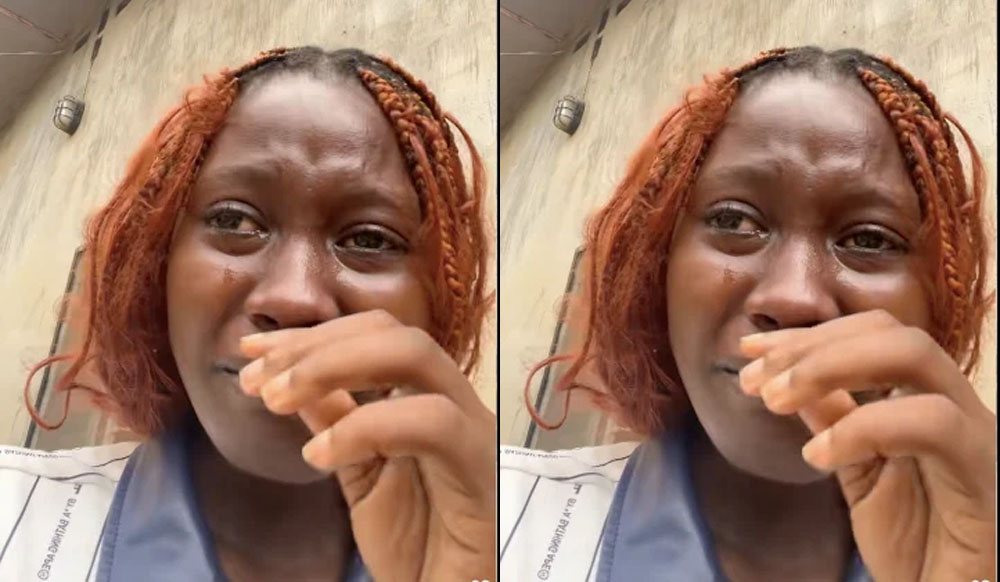
Police to Arrest TikToker Mirabel After She Recants False Rape Claim
The Ogun State Police Command has confirmed plans to arrest and prosecute TikTok user Mirabel after she admitted that her viral rape allegation was false, authorities and investigative reports indicate.
Mirabel, a social media influencer, first sparked national attention after posting videos alleging she had been sexually assaulted in her home in Ogijo, Ogun State. The posts quickly went viral, drawing widespread outrage, calls for justice, and prompting the police to launch an immediate investigation.
An audio recording of a phone conversation, shared online by social media personality VeryDarkMan (VDM), reportedly captures Mirabel acknowledging that parts of her story were fabricated. In the recording, she apologises and admits creating a threatening TikTok account to support her narrative, claiming she had been taking drugs at the time and “was not thinking clearly” when posting the videos.
READ ALSO:
- Again, Early Morning Blaze Destroys Dozens of Shops in Kano Market
- Suspected Terrorists Warn Kebbi Residents: Pay ₦100 Million or Face Attack
- ICPC Searches El-Rufai’s Abuja Home Amid Multi-Agency Corruption Investigation
A police source said senior officers, including the Divisional Police Officer, were at the hospital where Mirabel was receiving medical care. Once she is discharged, she will be taken into custody and formally charged under provisions of Nigeria’s Criminal Code relating to false reporting of sexual offenses. “The essence is to serve as a deterrent to others,” the source added.
The Ogun State Police had earlier ensured that Mirabel received medical treatment and support, following procedures to protect her health while the investigation continued. The Lagos State Domestic and Sexual Violence Agency (DSVA) confirmed that the incident fell outside its jurisdiction and forwarded all relevant information to the Ogun authorities.
This development has sparked public debate about the responsible use of social media, the impact of false allegations, and the importance of evidence-based reporting. Legal experts warn that fabricating sexual assault claims can carry serious criminal penalties and may undermine the credibility of genuine victims.
Authorities continue to urge the public to avoid spreading unverified claims and to cooperate with law enforcement in ongoing investigations. Updates on the case will be issued by the Ogun State Police Command as formal legal proceedings begin.
News
Tinubu Reduces Reliance on U.S, Strengthens Defence Partnerships With Turkey, EU
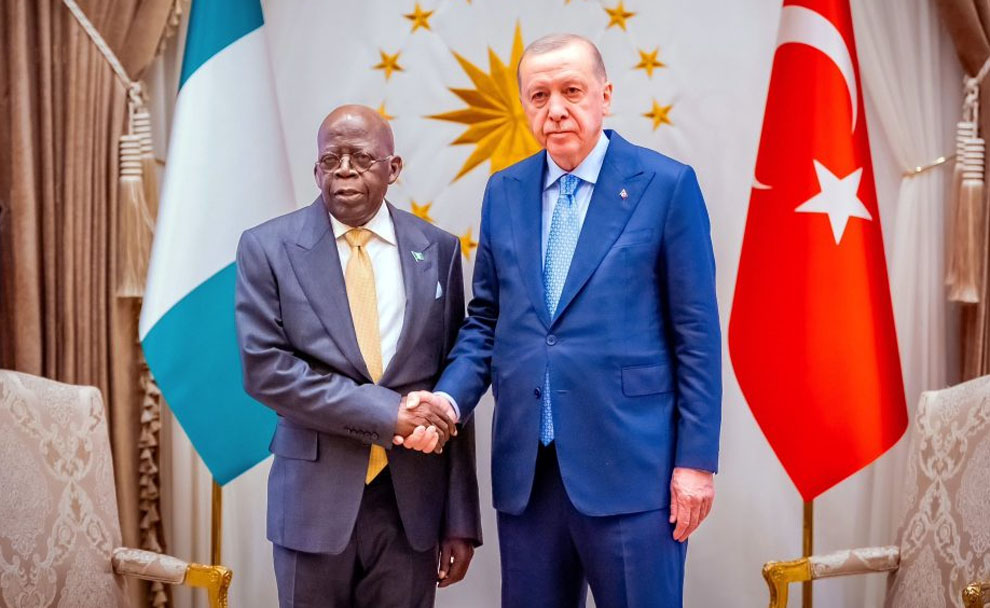
Tinubu Reduces Reliance on U.S, Strengthens Defence Partnerships With Turkey, EU
President Bola Tinubu has commenced a strategic expansion of Nigeria’s defence diplomacy, engaging the European Union (EU) and Turkey to strengthen the nation’s security architecture while reducing overreliance on the United States. The initiative comes as Nigeria faces multiple security threats, including Boko Haram insurgency in the north-east, farmer-herder clashes in the north-central region, separatist violence in the south-east, and escalating banditry in the north-west.
The move coincided with a visit to Brussels by National Security Adviser Mallam Nuhu Ribadu, who led discussions at the first EU-Nigeria Peace, Security, and Defence Dialogue. Both sides agreed to deepen collaboration on regional stability, counter-terrorism, and violent extremism, while enhancing intelligence sharing, maritime security, and cybersecurity cooperation. An EU diplomat in Abuja emphasized that the bloc would provide non-lethal military support, while respecting Nigeria’s sovereignty, describing the EU as “more consistent, more reliable, and more coherent than the United States” in delivering security assistance.
READ ALSO:
- Again, Early Morning Blaze Destroys Dozens of Shops in Kano Market
- Suspected Terrorists Warn Kebbi Residents: Pay ₦100 Million or Face Attack
- ICPC Searches El-Rufai’s Abuja Home Amid Multi-Agency Corruption Investigation
During his state visit to Turkey in January 2026, President Tinubu also held defence discussions with Turkish officials. Turkish companies pledged to supply military equipment, advanced systems, and tactical hardware, while exploring joint local production arrangements with Nigeria. Türkiye is currently regarded as a global leader in armed drones, which could bolster Nigeria’s counter-terrorism operations and reconnaissance capabilities.
Despite these new partnerships, Nigeria continues security cooperation with the United States, including deployments by United States Africa Command (AFRICOM) to support training, intelligence sharing, and operational planning. Recent U.S. personnel arrivals in Bauchi State aim to enhance counter-terrorism capacity without taking direct combat roles, operating under Nigerian command structures.
Analysts say Nigeria’s diversified defence diplomacy seeks to reduce dependency on a single partner, while providing access to a wider range of technology transfer, training opportunities, procurement options, and operational expertise. The strategy also reflects a broader trend of African nations balancing traditional defence alliances with emerging strategic partners to better address evolving security threats.
With regional instability and domestic insurgency on the rise, Nigeria’s engagement with Turkey, the EU, and other partners is expected to strengthen the Nigerian Armed Forces, enhance counter-terrorism operations, and secure national and regional stability.
Tinubu Reduces Reliance on U.S, Strengthens Defence Partnerships With Turkey, EU
News
Tinubu, German Chancellor Merz Pledge Stronger Nigeria-Germany Ties
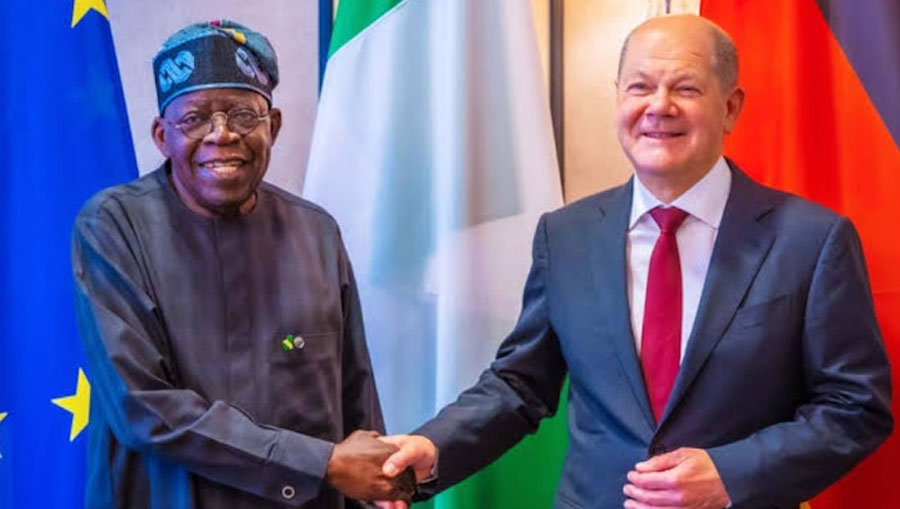
Tinubu, German Chancellor Merz Pledge Stronger Nigeria-Germany Ties
President Bola Tinubu and German Chancellor Friedrich Merz have agreed to deepen bilateral relations between Nigeria and Germany, with a focus on security cooperation, power infrastructure, and railway development.
The commitment emerged during a telephone discussion on Wednesday, in which both leaders reaffirmed their dedication to expanding collaboration across critical sectors.
A major topic was Nigeria’s Presidential Power Initiative. President Tinubu highlighted the need for further support, particularly in power transmission infrastructure, to ensure reliable electricity supply nationwide. Chancellor Merz expressed Germany’s readiness to assist, noting that Siemens could provide technical support and Deutsche Bank could finance components of the initiative.
READ ALSO:
- Tinubu, el-Rufai and the cobra
- American Woman, 64, Alleges Embassy Mocked 27-Year-Old Fiancé Before Visa Denial
- Epstein, Ex-Israeli PM Named in Alleged Profiteering From Boko Haram Crisis
Security concerns in the Sahel region also featured prominently in the call. President Tinubu stressed the urgent need for enhanced intelligence and reconnaissance capabilities, including the provision of used helicopters to strengthen regional security. “The Sahel corridor is bad and needs our support. Intelligence support and reconnaissance are needed,” he said.
Beyond security and infrastructure, both leaders emphasized the potential for collaboration in creative arts and skills development. Chancellor Merz highlighted the value of cultural exchange and proposed establishing a Great Museum of African Arts to promote African heritage internationally.
Nigeria-Germany diplomatic relations have spanned more than 65 years, with longstanding economic and political ties. Chancellor Merz also welcomed Nigeria’s incoming ambassador to Berlin, signaling intentions to further consolidate bilateral engagements.
The 10-minute telephone call, which began at 2:01 p.m. and ended at 2:10 p.m., was confirmed in a statement by President Tinubu’s Special Adviser on Information and Strategy, Bayo Onanuga, on February 18, 2026.
Tinubu, German Chancellor Merz Pledge Stronger Nigeria-Germany Ties

-
 News3 days ago
Saudi Arabia Confirms Sighting of Ramadan Crescent, Fasting Begins Wednesday
-
 metro3 days ago
Lagos Woman Shares Ordeal After Alleged Rape, Sparks Nationwide Outcry
-

 News3 days ago
Ramadan Begins in Nigeria as Sultan Confirms Crescent Sighting
-
 International23 hours ago
Canada Opens New Express Entry Draw for Nigerian Workers, Others
-
 metro3 days ago
Seven Killed in Horrific Crash at Ota Toll Gate
-
 News2 days ago
Korope Drivers Shut Down Lekki–Epe Expressway Over Lagos Ban (Video)
-

 Health2 days ago
Ramadan Health Tips: Six Ways to Stay Hydrated While Fasting
-
 metro22 hours ago
Osun Awards 55.6km Iwo–Osogbo–Ibadan Road Project to Three Contractors