

International
White House hits back at reports Trump named in Epstein files

White House hits back at reports Trump named in Epstein files
The White House has pushed back against reports that President Donald Trump is among hundreds of names that appear in justice department documents relating to the late convicted paedophile financier Jeffrey Epstein.
The claims were “nothing more than a continuation of the fake news stories concocted by the Democrats and the liberal media”, a White House spokesman said.
It comes as a US judge denied the justice department’s bid to unseal Florida court files on Epstein.
The Trump administration has been under mounting pressure to disclose more information about the well-connected sex offender. While campaigning last year, Trump had promised to release such files.
The Wall Street Journal reported that Trump’s name appeared multiple times with many others, including other high-profile figures, in records held by the justice department.
Being named in these documents is not evidence of any criminal activity, nor has Trump ever been accused of wrongdoing in connection with the Epstein case.
Attorney General Pam Bondi told Trump in a routine briefing at the White House in February that the files contained hearsay about many people, including Trump, who had socialised with Epstein in the past.
Bondi also told the president that the Epstein records included child pornography and victim information that should not be disclosed, reported the Wall Street Journal.
The story was later matched by other US media outlets, but has not been independently verified by the BBC.
Trump was once friendly with Epstein before they fell out in 2004 – two years before Epstein was first arrested.
Last week, the president was asked by a reporter whether the attorney general had told him his name was in the files.
“No, no,” Trump said.
READ ALSO:
- Horror in Enugu as mother murders two children
- Obama fires back after Trump threatens to jail him over ‘treason’
- BREAKING: Tinubu appoints Humanitarian Affairs Minister Yilwatda APC National Chairman
Steven Cheung, a spokesman for Trump, called the report “nothing more than a continuation of the fake news stories concocted by the Democrats and the liberal media, just like the Obama Russia-gate scandal, which President Trump was right about.”
The attorney general said: “Nothing in the files warranted further investigation or prosecution.”
FBI Director Kash Patel said: “The criminal leakers and Fake News media tries tirelessly to undermine President Trump with smears and lies, and this story is no different.”
But an unnamed White House official told Reuters news agency they were not denying that Trump’s name appears in the documents.
The official pointed to Epstein files disclosed months earlier by the justice department that had included Trump.
Those files, distributed to conservative influencers in February, included the phone numbers of some of Trump’s family members, including his daughter.
Trump had directed Bondi to seek the release of all grand jury materials, prompting the justice department to ask courts in Florida and New York to unseal files related to cases in both those jurisdictions.
But Judge Robin Rosenberg ruled on Wednesday that releasing papers from Epstein’s Florida case would violate state guidelines governing grand jury secrecy.
“The court’s hands are tied,” the Obama appointee ruled in her 12-page order.
The transcripts in question stem from Florida’s investigation into Epstein in 2006 that led to him being charged with soliciting a minor for prostitution.
Judge Rosenberg also declined to transfer the issue to New York, where two judges are separately deciding whether to unseal transcripts related to Epstein’s 2019 sex-trafficking probe. That request is still pending.
The ruling comes as interest has switched back to Ghislaine Maxwell, a convicted sex-trafficker who is serving 20 years in prison for helping Epstein abuse young girls.
A senior justice department official is planning to meet the former British socialite to discuss her knowledge of the case, her attorney confirmed to the BBC.
READ ALSO:
- Israeli strikes in Gaza kill at least 21 people
- NAF airstrike eliminates 95 terrorists in Niger
- Chelsea defender, Tosin Adarabioyo, visits Sanwo-Olu
Republicans on the House of Representatives Oversight Committee have sent a legal summons for Maxwell to appear before the body remotely from prison on 11 August.
Her attorney, David Oscar Markus, told the BBC that if she chooses to testify, rather than invoke her constitutional right to remain silent, “she would testify truthfully, as she always has said she would”.
“As for the congressional subpoena, Ms Maxwell is taking this one step at a time,” he added.
“She looks forward to her meeting with the Department of Justice, and that discussion will help inform how she proceeds.”
House Speaker Mike Johnson has warned that Maxwell cannot be trusted to provide accurate testimony.
The Louisiana Republican said: “I mean, this is a person who’s been sentenced to many, many years in prison for terrible, unspeakable, conspiratorial acts and acts against innocent young people.”
Bondi said earlier this month the US justice department had uncovered no “incriminating client list” on Epstein.
She also said he did take his own life in a New York jail in 2019 – despite conspiracies over his death.
Bondi had previously suggested she would make major disclosures in the case, saying she had “a lot of names” and “a lot of flight logs”.
The attorney general’s reversal prompted fury from some of Trump’s most ardent supporters, who called for her to resign.
Democrats have seized on the Republican infighting to accuse the Trump administration of a cover-up.
On Tuesday, Speaker Johnson closed down congressional voting for summer break one day early, in an attempt to stall legislative efforts to force the release of documents related to Epstein.
But Republican rebels in a House Oversight Subcommittee voted on Wednesday afternoon to force the justice department to release the files.
Three Republicans – Nancy Mace, Scott Perry and Brian Jack – joined five Democrats in voting for the subpoena. Two Republicans voted against.
But James Comer, the Republican chairman of the House Oversight Committee, must sign it off in order for the legal summons to proceed.
White House hits back at reports Trump named in Epstein files






International
Russian Bomb Kills 33 in Ukraine, Hits Two Passenger Buses
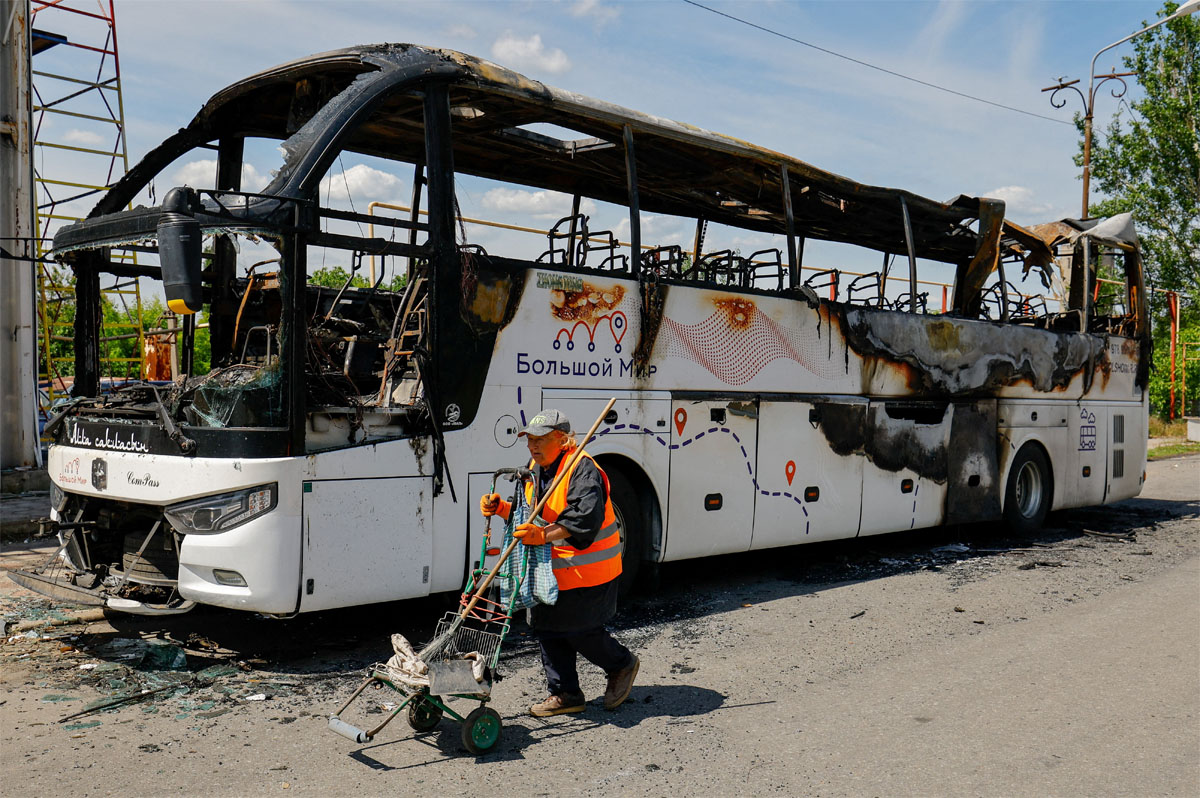
Russian Bomb Kills 33 in Ukraine, Hits Two Passenger Buses
At least 33 people have been killed and 18 others injured after a Russian guided bomb struck a road in Kramatorsk, eastern Ukraine, hitting two passenger buses in one of the deadliest attacks on civilians reported in the country this year.
The attack occurred at about 10am in the Donetsk region, where two scheduled buses were operating when the Russian munition struck the road.
The blast triggered fires in the buses and surrounding area, leaving passengers and other civilians dead or injured. Emergency workers were deployed to the scene to extinguish the fires, recover victims and evacuate the wounded.
The death toll rose from an initial figure of 12 as rescuers continued their search of the area.
Preliminary investigations indicated that the weapon may have been a UMPB D-30SN guided aerial bomb, although authorities said investigations were continuing to establish the exact type of munition used.
Images from the scene showed a badly burned bus, debris scattered across the road and bodies lying near the site of the explosion.
Donetsk Governor Vadym Filashkin accused Russian forces of deliberately targeting civilians, while Ukrainian President Volodymyr Zelenskyy condemned the attack and described the location as a bus stop.
READ ALSO:
- How Six Members of a Family Were Murdered in Oyo
- World Bank Raises Nigeria Growth Forecast, Demands More Jobs, Poverty Reduction
- Flood Submerges Enugu Road, Strands School Children, Passengers
Russia has not immediately commented on the attack or the reported casualty figures. Moscow has consistently denied deliberately targeting civilians during its war against Ukraine.
Authorities suspended public transportation in Kramatorsk and neighbouring Sloviansk following the attack as a precaution against further strikes.
Kramatorsk, an important Ukrainian-controlled city in the Donetsk region, has faced repeated Russian drone and guided-bomb attacks as fighting intensifies along the eastern front.
The latest attack came a day after another deadly Russian strike on Pryluky, in Ukraine’s Chernihiv region, where a missile hit a five-storey residential building.
The death toll in Pryluky rose to 22 people, including five children, while 54 others were injured. Several people were rescued from the damaged building as emergency crews continued search-and-rescue operations.
The attacks came amid an intensified Russian aerial campaign involving missiles, drones and guided bombs against Ukrainian cities and infrastructure.
Ukrainian authorities have appealed for stronger air-defence support from international partners as the country faces renewed attacks ahead of winter.
The latest strikes have also renewed concerns over the safety of civilians and critical infrastructure nearly five years after Russia launched its full-scale invasion of Ukraine.
Russian Bomb Kills 33 in Ukraine, Hits Two Passenger Buses
International
US Proposes $70,000 OPT Fee for Nigerians, Other Foreign Students

US Proposes $70,000 OPT Fee for Nigerians, Other Foreign Students
The administration of US President Donald Trump has proposed a $70,000 fee for international students seeking to participate in a programme that allows them to work in the United States after completing their studies.
The proposed rule by the US Department of Homeland Security (DHS) targets the Optional Practical Training (OPT) programme available to eligible foreign students on F-1 visas, including Nigerians studying in the US.
Under the proposal, US educational institutions would be required to pay $70,000 for each student’s initial OPT participation, while an additional $30,000 fee would apply for each renewal or further training.
The proposal does not initially require students themselves to pay the $70,000 directly. Instead, the financial obligation would fall on the schools recommending students for OPT, although education groups warn that the cost could ultimately affect students and universities.
The OPT programme allows eligible international students to obtain temporary work experience in jobs related to their fields of study. Most students can participate for up to one year after graduation, while graduates in qualifying science, technology, engineering and mathematics (STEM) fields can receive an additional two years.
READ ALSO:
- EFCC Re-Arraigns Two Over Alleged £110,000 Money Laundering, ₦500m Fraud
- Three Killed, 36 Injured as Houthi Attacks Hit Saudi Airports
- Bandits Kill Three in Fresh Attack on Kebbi Community
DHS said the proposed fees are intended to combat fraud, strengthen the integrity of the immigration system and protect US workers.
The department has also argued that OPT has been misused as a source of cheap foreign labour and that the proposed fees would encourage universities to exercise greater scrutiny when recommending students for the programme.
The proposed charge represents a sharp increase from the current cost associated with OPT applications, which is around $500.
The plan could have significant implications for international students from countries such as Nigeria, India and China, whose graduates make substantial use of OPT, particularly in technology and other specialised fields.
American universities and business groups have raised concerns that the proposed fee could discourage international students from studying in the US and make it harder for companies to recruit skilled graduates.
Education groups have also warned that the measure could affect American universities that rely on international enrolment for tuition revenue and employers that depend on foreign graduates to fill specialised positions.
The proposal is part of the Trump administration’s broader effort to tighten US immigration policies and impose greater restrictions on foreign students and workers.
The DHS proposal is subject to a public comment period before it can be finalised. If approved, the rule would take effect after an additional implementation period, while legal challenges are also expected.
The proposed OPT fee is separate from other changes to the H-1B visa programme, which has also faced increased costs and restrictions under the Trump administration.
US Proposes $70,000 OPT Fee for Nigerians, Other Foreign Students
International
Three Killed, 36 Injured as Houthi Attacks Hit Saudi Airports
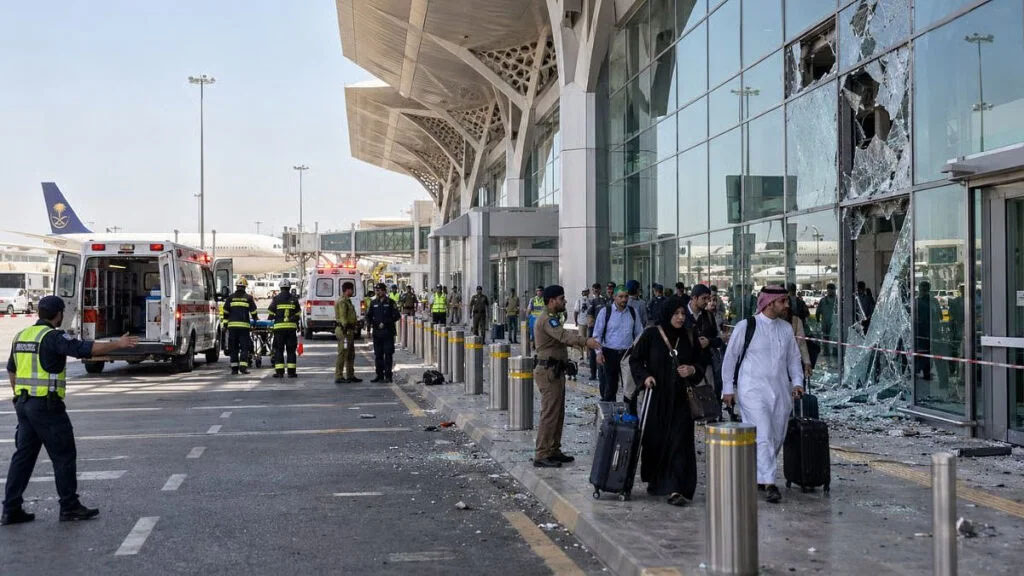
Three Killed, 36 Injured as Houthi Attacks Hit Saudi Airports
Three people have been killed and 36 others injured after attacks struck two major airports in Saudi Arabia, with Yemen’s Houthi rebels claiming responsibility for the strikes.
The attacks targeted Abha International Airport in the southern Asir province and King Khalid International Airport in the capital, Riyadh, according to Saudi Arabia’s General Authority of Civil Aviation.
Two women, identified as Moroccan and Algerian residents, were killed in the attack on Abha Airport, where 28 people were also injured.
A separate attack on King Khalid International Airport killed a Sudanese national and injured eight others, including five Saudi citizens, two Egyptian residents and a Pakistani resident.
The Saudi aviation authority said the attacks caused material damage and that emergency and security agencies were assessing the impact while taking measures to protect passengers and airport workers.
READ ALSO:
- Bandits Kill Three in Fresh Attack on Kebbi Community
- Ronaldo Pays Emotional Tribute to Messi After Argentina Farewell
- US Set to Charge Maduro, Wife Over Alleged Torture of Americans
The Houthis, who control large parts of Yemen, claimed responsibility for the attacks. Houthi military spokesman Yahya Saree said the group had targeted King Khalid Airport with drones and attacked Abha Airport with ballistic missiles and drones.
Saudi authorities did not directly attribute the attacks to the Houthis in their initial statement, although the claims by the group came shortly before the Saudi casualty figures were announced.
The attacks came amid a sharp escalation in the Yemen conflict, after Saudi-backed Yemeni government forces launched an offensive against Houthi fighters holding territory along the strategically important Red Sea coast and near the Bab el-Mandeb Strait.
The Houthis have also claimed attacks on other Saudi targets, while Saudi-led forces have intensified air operations against Houthi positions in Yemen.
The renewed fighting has raised fresh concerns about the security of Saudi airports and regional air travel, with airlines and aviation authorities monitoring developments closely.
The latest violence marks another escalation in a conflict that has repeatedly threatened civilian infrastructure and vital shipping routes in and around the Red Sea.
Three Killed, 36 Injured as Houthi Attacks Hit Saudi Airports
-

 metro3 days ago
Ondo Air Tragedy: Soldiers, Families Among 32 Killed In NAF Crash
-

 metro3 days ago
Gunmen Open Fire At Lagos Bus Stop, Kill NURTW Member, Injure Three
-

 metro3 days ago
Ogun Crash: Nine Die As Bus Collides With Truck On Ijebu-Ode-Ore Road
-
 metro3 days ago
Supreme Council For Sharia Secretary-General Nafiu Baba-Ahmed Dies
-

 metro2 days ago
UCH CMD: After Decades Without Muslim, Agunbiade Demands Fair Chance
-
![[UPDATED] 20 NYSC Prospective Corps Members Freed After Seven Days in Captivity](https://newstrends.ng/wp-content/uploads/2026/10/20-NYSC-Prospective-Corps-Members-Freed-After-Seven-Days-in-Captivity-400x240.jpg)
![[UPDATED] 20 NYSC Prospective Corps Members Freed After Seven Days in Captivity](https://newstrends.ng/wp-content/uploads/2026/10/20-NYSC-Prospective-Corps-Members-Freed-After-Seven-Days-in-Captivity-80x80.jpg) metro19 hours ago
metro19 hours ago[UPDATED] 20 NYSC Prospective Corps Members Freed After Seven Days in Captivity
-

 International3 days ago
Kemi Badenoch: I Don’t Want Migrants Turning UK Into Nation Of ‘Little Ghettos’
-
 metro2 days ago
Seven Years With Parkinson’s: Man Seeks N65m for Brain Surgery in Türkiye