

International
Zelenskyy: Russians create ‘complete disaster’ with mines

Ukrainian President Volodymyr Zelenskyy warned his people early Saturday that retreating Russian forces were creating “a complete disaster” outside the capital as they leave mines across “the whole territory,” including around homes and corpses.
He issued the warning as the humanitarian crisis in the encircled city of Mariupol deepened, with Russian forces blocking evacuation operations for the second day in a row. Meanwhile, the Kremlin accused the Ukrainians of launching a helicopter attack on a fuel depot on Russian soil.
Ukraine denied responsibility for the fiery blast, but if Moscow’s claim is confirmed, it would be the war’s first known attack in which Ukrainian aircraft penetrated Russian airspace.
“Certainly, this is not something that can be perceived as creating comfortable conditions for the continuation of the talks,” Kremlin spokesman Dmitry Peskov said, five weeks after Moscow began sending upwards of 150,000 of its own troops across Ukraine’s border.
Russia continued withdrawing some of its ground forces from areas around Kyiv after saying earlier this week it would reduce military activity near the Ukrainian capital and the northern city of Chernihiv.
“They are mining the whole territory. They are mining homes, mining equipment, even the bodies of people who were killed,” Zelenskyy said in his nightly video address to the nation. “There are a lot of trip wires, a lot of other dangers.”
Ukraine’s military said it had retaken 29 settlements in the Kyiv and Chernihiv regions.
Still, Ukraine and its allies warned that the Kremlin is not de-escalating to promote trust at the bargaining table, as it claimed, but instead resupplying and shifting its troops to the country’s east. Those movements appear to be preparation for an intensified assault on the mostly Russian-speaking Donbas region in the country’s east, which includes Mariupol.
Zelenskyy warned of difficult battles ahead as Russia redeploys troops. “We are preparing for an even more active defense,” he said.
He did not say anything about the latest round of talks, which took place Friday by video. At a round of talks earlier in the week, Ukraine said it would be willing to abandon a bid to join NATO and declare itself neutral — Moscow’s chief demand — in return for security guarantees from several other countries.
READ ALSO:
- APC transition committee probes party’s finances after Buni’s exit
- Arrest anyone enforcing sit-at-home in Anambra, IPOB tells Soludo
- Train Attack: Kaduna Receives Luggage Of 100 Affected Passengers
The invasion has left thousands dead and driven more than 4 million refugees from Ukraine.
Mariupol, the shattered and besieged southern port city, has seen some of the worst suffering of the war. Its capture would be a major prize for Russian President Vladimir Putin, giving his country an unbroken land bridge to Crimea, seized from Ukraine in 2014.
On Friday, the International Committee for the Red Cross said it was unable to carry out an operation to bring civilians out of Mariupol by bus. City authorities said the Russians were blocking access to the city.
“We do not see a real desire on the part of the Russians and their satellites to provide an opportunity for Mariupol residents to evacuate to territory controlled by Ukraine,” Petro Andryushchenko, an adviser to Mariupol’s mayor, wrote on the Telegram messaging app.
He said Russian forces “are categorically not allowing any humanitarian cargo, even in small amounts, into the city.”
Around 100,000 people are believed to remain in the city, down from a prewar 430,000. Weeks of Russian bombardment and street fighting have caused severe shortages of water, food, fuel and medicine.
“We are running out of adjectives to describe the horrors that residents in Mariupol have suffered,” Red Cross spokesperson Ewan Watson said.
On Thursday, Russian forces blocked a 45-bus convoy attempting to evacuate people from Mariupol and seized 14 tons of food and medical supplies bound for the city, Ukrainian authorities said.
Zelenskyy said more than 3,000 people were able to leave Mariupol on Friday.
He said he discussed the humanitarian disaster with French President Emmanuel Macron by telephone and with the president of the European Parliament, Roberta Metsola, during her visit to Kyiv.
“Europe doesn’t have the right to be silent about what is happening in our Mariupol,” Zelenskyy said. “The whole world should respond to this humanitarian catastrophe.”
Elsewhere, at least three Russian ballistic missiles were fired late Friday at the Odesa region on the Black Sea, regional leader Maksim Marchenko said. The Ukrainian military said the Iskander missiles did not hit the critical infrastructure they targeted.
Odesa is Ukraine’s largest port and the headquarters of its navy.
As for the fuel depot explosion, Russian Defense Ministry spokesman Igor Konashenkov said two Ukrainian helicopter gunships flew in extremely low and attacked the civilian oil storage facility on the outskirts of the city of Belgorod, about 25 kilometers (16 miles) from the Ukraine border.
The regional governor said two workers at the depot were wounded, but the Rosneft state oil company denied anyone was hurt.
Oleksiy Danilov, secretary of Ukraine’s national security council, said on Ukrainian television: “For some reason they say that we did it, but in fact this does not correspond with reality.”
Later, in an interview with Fox, Zelenskyy refused to say whether Ukraine was behind the attack.
On the outskirts of Kyiv, where Russian troops have withdrawn, damaged cars lined the streets of Irpin, a suburban area popular with young families, now in ruins. Emergency workers carried elderly people on stretchers over a wrecked bridge to safety.
Three wooden crosses next to a residential building that was damaged in a shelling marked the graves of a mother and son and an unknown man. A resident who gave her name only as Lila said she helped hurriedly bury them on March 5, just before Russian troops moved in.
“They were hit with artillery and they were burned alive,” she said.
n Irpin resident who gave his name only as Andriy said the Russians packed up their equipment and left on Tuesday. The next day, they shelled the town for close to an hour before Ukrainian soldiers retook it.
“I don’t think this is over,” Andriy said. “They will be back.”
Associated Press






Health
Fiji Declares National HIV Emergency as Diagnoses Surge Sixteenfold

Fiji Declares National HIV Emergency as Diagnoses Surge Sixteenfold
Authorities launch a multi-agency public health campaign to expand free testing, treatment, and harm-reduction services
Fiji has announced a nationwide health response to address a significant rise in HIV cases and ensure that all residents can access essential medical care.
On Wednesday, Health Minister Dr. Atonio Lalabalavu shared the emergency declaration, explaining that national agencies are joining forces to provide rapid medical support, expand testing, and protect community well-being across the islands.
Official reports indicate that about one in every 60 adults in Fiji currently lives with HIV, following an increase in new infections over recent years. Health specialists explain that the virus spreads primarily through intimate sexual contact and shared needles among individuals using illicit substances.
Additionally, routine screenings revealed that two out of every 100 expecting mothers carry the virus, highlighting an urgent need for early maternal healthcare to protect newborns from infection.
To safeguard public health, authorities are delivering free daily treatments, distributing protective preventive medications, and setting up clean needle programs to stop infections before they start.
Furthermore, global partners, including Australia, New Zealand, India, and United Nations health bodies are providing financial resources and medical supplies to back the local effort.
By encouraging open community conversations and delivering accessible healthcare without judgment, health workers aim to ensure that everyone receives the care and dignity they deserve.
Fiji Declares National HIV Emergency as Diagnoses Surge Sixteenfold
International
Kim Yo-jong: Only ‘Idiots’ Think North Korea Will Give Up Nuclear Weapons

International
Gaza Building Collapse Kills 21, Including Eight Children
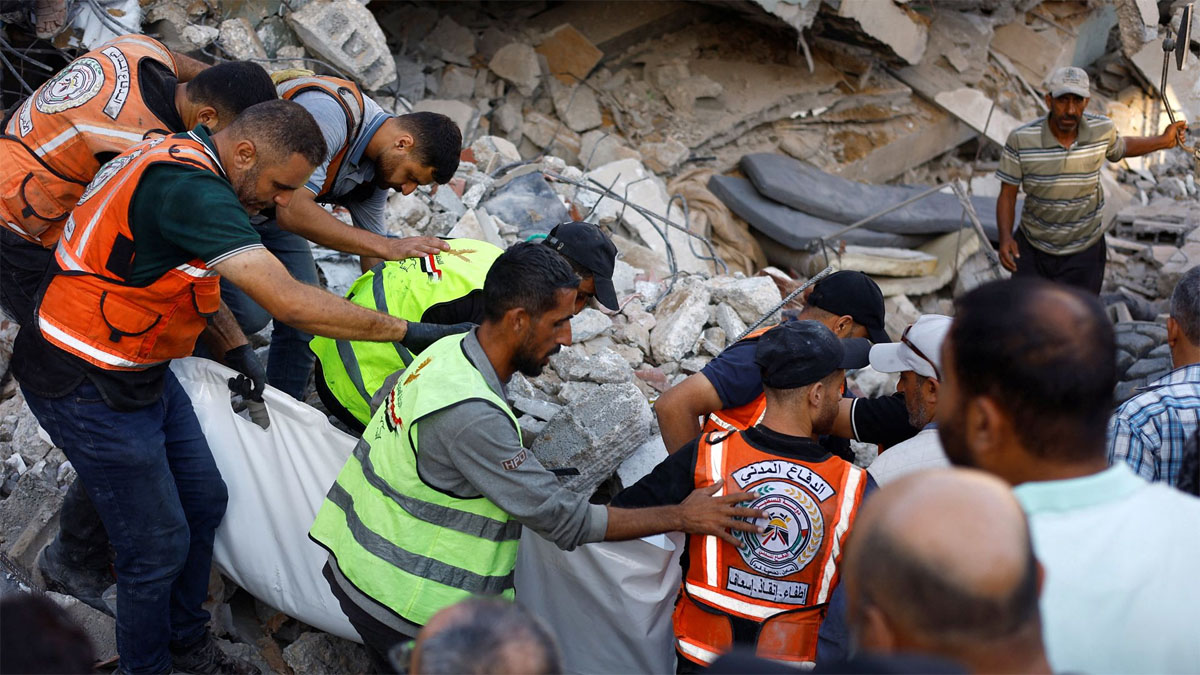
Gaza Building Collapse Kills 21, Including Eight Children
At least 21 people have been killed, including eight children, after a war-damaged building collapsed in Gaza City overnight, rescuers and medics say. The tragedy has renewed concerns about the collapse risk facing hundreds of bomb-damaged structures across the Gaza Strip as winter approaches.
The six-storey residential building in Gaza City’s Tal al-Hawa area collapsed in the early hours of Wednesday. According to the United Nations humanitarian coordinator for the occupied Palestinian territories, Ramiz Alakbarov, an estimated 100 people, including 50 children, were living in the building when it came down. The Gaza Civil Defence agency confirmed that rescuers extracted 21 bodies and rescued 20 unharmed individuals from the rubble on al-Sinaa Street in Tal al-Hawa. Dozens remain missing or injured underneath the debris.
Witnesses told the BBC that the building had been left tilting dangerously to one side after an Israeli strike more than a year ago. Displaced families had moved inside because they were desperate, with nowhere else to go. The building had been hit multiple times in 2024 and March 2025, leading to warnings for Gazans not to return, according to Civil Defence spokesman Mahmoud Basal. More than 10 families, totalling around 80 people, lived in the building, according to residents, with dozens of them being children. Sherif, whose sister was killed, said: “They couldn’t find a tent or somewhere to live. This was the last place they could turn to, despite the danger. They were aware that it would likely end in tragedy. A lack of resources drove them towards certain death.“
A woman living in a tent nearby, Umm Mohammed Bakrun, said she had been talking to her son when the building collapsed suddenly. “It felt like an earthquake. There was a loud sound and I couldn’t stand up. Stones rained down on us and when I looked outside I saw a lot of dust,” she told the BBC. “Within minutes, there were screams everywhere.” Another witness, Mansour Abu Mohammed, said the building collapsed “in a few seconds”. “Every day, a stone or a few stones would fall from it, but the people inside couldn’t find anywhere else to live. I used to live next door to it and you could see that it was tilting to one side.”
READ ALSO:
- Niger Mosque Abductions: Terrorists Execute 30 of 500 Captive Muslim Worshippers
- OAU Investigates Death of Final-Year Student as Police Begin Probe
- 57-Year-Old Man Arrested Over Sexual Abuse of Stepdaughter in Edo
UN and Egyptian teams joined the search for survivors, which was slow due to a lack of heavy machinery. Initially, rescuers from the Hamas-run Civil Defence agency had to use their bare hands. Egypt provided heavy machinery for the rescue operation, while the United Arab Emirates and Qatar were set to deliver relief items. The Palestinian Civil Defence said rescue teams had been working continuously since the collapse, but lacked even the most basic tools. “In the first moments after the collapse, we had to ask neighbours and displaced people nearby to bring hammers, shovels and other tools because of the severe shortage of equipment,” said Abdullah al-Majdalawi, director of public relations at Gaza’s Civil Defence. The head of the United Nations Development Programme (UNDP) Gaza office, Alessandro Mrakic, told reporters at the scene that “the situation… is tragic because we don’t have the equipment and machinery that is needed”.
Mrakic warned that approximately 400 other war-damaged buildings across Gaza were at imminent risk of collapse, particularly as winter approaches. The Civil Defence agency has identified around 2,000 buildings across the territory at risk of collapse. “We need support, most importantly with machinery, equipment, among others. Our colleagues here don’t have [engine] oil and spare parts to continue to work with all the equipment that is still in Gaza.” The UN’s humanitarian relief coordinator, Ramiz Alakbarov, said he was “devastated” by the reports. “No-one should have to risk their life simply to find a safe place to shelter,” he said. He also urged Israeli authorities to approve deliveries to Gaza of heavy machinery for rescue operations, as well as tents, tarpaulins and other non-food items for displaced people ahead of the winter rains. Israel says its restrictions are meant to keep equipment out of the hands of Palestinian armed groups that could also have military uses.
An estimated 80% of all structures in Gaza have been destroyed or damaged during the war between Israel and Hamas, according to the UN. More than 1.9 million people — about 90% of the territory’s population — have been displaced, many of them multiple times, and 1.2 million of them are currently living in tents or makeshift shelters. The UN has warned that the humanitarian situation in Gaza remains dire despite the ceasefire agreed last October, as Israeli air strikes and other attacks continue to hit populated areas, causing casualties and property damage and driving further displacement. According to Gaza’s health ministry, 1,369 Palestinians have been killed and 4,627 wounded since the fragile ceasefire took effect on 11 October 2025. The total death toll since the war began has reached 73,783, with 174,738 injured.
On Tuesday, Israeli air strikes killed at least five Palestinians, including two children and a Hamas commander, according to health officials and Hamas sources. The Israeli military said it killed a Hamas commander in southern Gaza and another fighter in the north. In both cases, a child was also reportedly killed. Separately, the British charity Medical Aid for Palestinians said that a patient was killed by an Israeli drone at a health centre it supports in Jabalia in northern Gaza. A spokesperson for the Israeli military told the BBC it was not aware of such an incident.
The Gaza war was triggered by the Hamas-led attack on southern Israel on 7 October 2023, when about 1,200 people were killed and 251 others were taken hostage. Since then, more than 73,790 people have been killed in Gaza, according to the territory’s Hamas-run health ministry, whose figures are considered reliable by the UN. In a statement, the Gaza government media office under Hamas said it held “the Israeli occupation and the international community fully and directly responsible for this catastrophe befalling our Palestinian people“.
Gaza Building Collapse Kills 21, Including Eight Children
-

 Politics3 days ago
2027: Northern Lecturers Back Tinubu, ASUU Disowns Endorsement
-

 metro3 days ago
Police Arrest Mother Over Alleged Brutal Abuse of 7-Year-Old Girl in Anambra
-

 Sports2 days ago
‘I Was Never the Chosen One’ — Dembele Responds to Mbappe
-

 International1 day ago
Islamic Council Condemns Attempted Attack on Holy City of Mecca
-

 metro2 days ago
Lagos Power Outage: Ikeja Electric Blames TCN as Businesses, Homes Groan
-

 News1 day ago
Keep Politics Out of My Office — Ogbomoso Grand Chief Imam Warns Politicians, Bloggers
-

 Education2 days ago
JAMB Moves 2027 UTME Time — Here’s What Candidates Need To Know
-

 Politics2 days ago
2027: APC Governors Reject Wike’s Rainbow Coalition, Insist on Party Loyalty