

International
UN aid chief says Israel’s blocking of food to Gaza is a ‘war crime’

UN aid chief says Israel’s blocking of food to Gaza is a ‘war crime’
LONDON: Israel’s blocking of food aid to starving Palestinians in Gaza in an attempt to forcibly remove the population amounts to a war crime, the UN’s humanitarian chief said in an interview broadcast on Friday.
Israel allowed a trickle of supplies into Gaza last week after a complete blockade for nearly three months. But there have been chaotic and deadly scenes amid a new distribution system that sidelined the UN.
“We’re seeing food sat on the borders and not being allowed in when there is a population on the other side of the border that is starving, and we’re hearing Israeli ministers say that is to put pressure on the population of Gaza,” Tom Fletcher told the BBC.
Using food as a weapon “is classified as a war crime,” he said, adding that would be for the courts and history to judge.
He also warned Israel against the forced displacement of Palestinians from Gaza to another country, a policy that Israeli Prime Minister Benjamin Netanyahu and members of his hard-line cabinet have advocated.
READ ALSO:
- Nigerian stock market bleeds, loses N48bn in dramatic Friday sell-off
- How deadly flood killed 111 at Mokwa, Niger community
- Jetour Nigeria flaunts new X70, affordable luxury family SUV with smart security features
Earlier this month, Israel’s extremist Finance Minister Bezalel Smotrich said Gaza would be “totally destroyed” within six months and Palestinians there would be so despairing that they would be “looking for relocation to begin a new life in other places.”
Fletcher called on Netanyahu to ensure that “this language, and ultimately, this policy … of forced displacement, isn’t enacted.”
Since Israel broke a two-month ceasefire in March it has ramped up its operations in Gaza, killing thousands more Palestinian civilians in an attempt to take full military control of the territory.
The increased violence has led European countries to shift their stance and threaten sanctions against Israel if it does not stop the slaughter and allow the full flow of aid.
On May 14, Fletcher told the UN Security Council that it must act to prevent genocide in Gaza. He said the comments were in response to what his colleagues on the ground were telling him.
“What they’re reporting is forced displacement. They’re reporting starvation, they’re reporting torture, and they’re reporting deaths on a massive scale,” he said.
“In previous cases, Rwanda, Srebrenica and Sri Lanka, the world had told us afterwards that we didn’t act in time, that we didn’t sound the warning and ask that the world respond to prevent genocide.
“And that’s my call to the Security Council and the world right now, ‘will you act to prevent genocide?’”
He added: “History will be tough in the way it judges us. And it must be.”
The conflict has killed almost 54,000 Palestinians since it started in October 2023 when a Hamas-led assault killed 1,200 Israelis and seized dozens of hostages.
UN aid chief says Israel’s blocking of food to Gaza is a ‘war crime’
ARAB NEWS








International
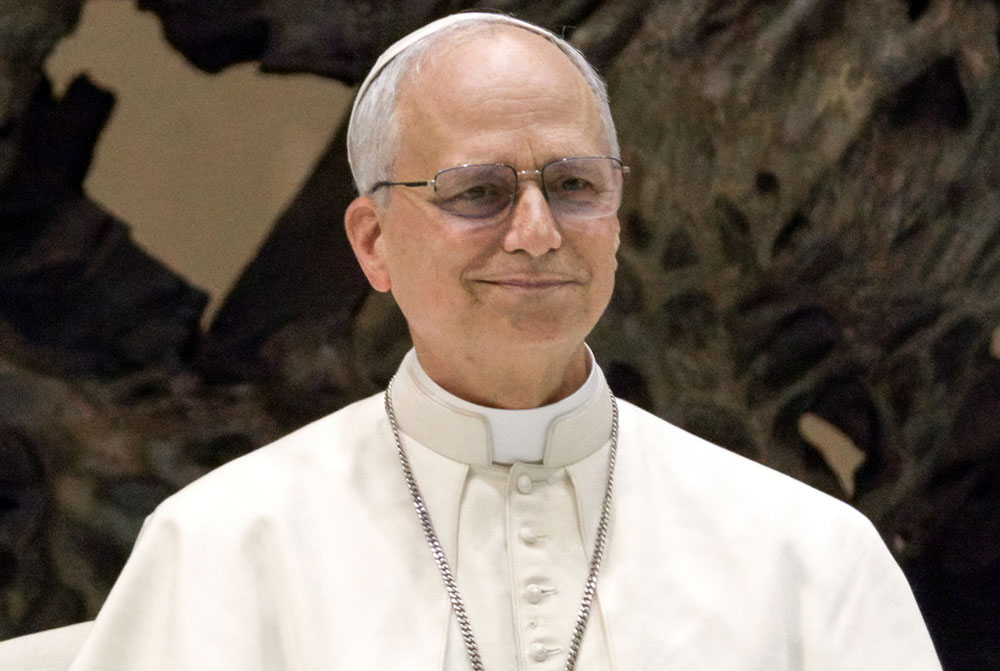
Pope Leo XIV Warns Against Letting AI Make Human Decisions
Pope Leo XIV Warns Against Letting AI Make Human Decisions
The rapid advancement of artificial intelligence has prompted a fresh warning from Pope Leo XIV, who says some decisions should never be handed over to algorithms.
The Pope made the remarks at his weekly audience in St Peter’s Square, where he addressed thousands of faithful and reflected on the impact of technology on modern human interaction.
While acknowledging that AI, social media and other forms of technological development can reduce barriers and connect people across great distances, he said they also carry a risk of making human relationships increasingly virtual.
His particular concern was the possibility that society could become accustomed to allowing algorithms to determine matters that should instead be guided by human conscience.
“Ensuring that social relationships have real substance and personal depth” is one way the Christian community seeks to respond to this challenge, he said.
The comments come amid broader concerns about the direction of AI development. Recent security incidents, along with the growing ability of some AI systems to improve their own performance without human intervention, have intensified debate about the technology.
Another major question is whether companies and organisations within the AI sector are capable of regulating themselves effectively as the technology becomes more powerful.
The Pope has previously made AI a major focus of his public interventions. His first major document, the May encyclical “Magnifica Humanitas”, urged efforts to prevent AI from becoming a force that dominates humanity.
The Holy See has also become more active in calls for international rules governing AI, grounding its position in the protection of human dignity. Its initiatives have extended to discussions involving nuclear technology, culture and artistic creation.
The latest warning places the Vatican’s concerns within a wider debate over how humanity should balance the benefits of increasingly powerful AI with the need to keep important decisions under human control.
Pope Leo XIV Warns Against Letting AI Make Human Decisions
International
Islamic Council Condemns Attempted Attack on Holy City of Mecca

Islamic Council Condemns Attempted Attack on Holy City of Mecca
International leaders call for accountability after Saudi defense systems neutralize an incoming drone before it entered protected airspace.
The Organisation of Islamic Cooperation has strongly criticized a failed drone attack directed toward the holy city of Mecca and the surrounding Medina region.
The international group, which represents 57 member nations, stated that any attempt to strike sacred places of worship or harm everyday people goes against basic human decency and international law.
The statement came after Saudi defense forces reported stopping an unmanned aircraft on Tuesday evening. Coalition officials confirmed that defense teams tracked the incoming drone and destroyed it south of Mecca before it could enter protected airspace.
Military representatives explained that keeping visiting worshippers and local communities safe remains an absolute priority, warning that threats against sacred sites will not be tolerated.
The OIC expressed full support for the safety steps Saudi Arabia uses to protect its borders, communities, and historical religious centers.

Although Houthi representatives in Yemen have previously stated that they do not intend to strike holy landmarks, global leaders emphasized that all groups must respect civilian safety and ensure that sacred religious spaces remain free from military conflict.
Islamic Council Condemns Attempted Attack on Holy City of Mecca
International
US Court Blocks Trump Visa Rule Limiting Stay of Foreign Students, Journalists

US Court Blocks Trump Visa Rule Limiting Stay of Foreign Students, Journalists
A federal court in the United States has temporarily blocked the Donald Trump administration from implementing a new immigration rule that would have imposed fixed time limits on how long foreign students, exchange visitors and journalists could remain in the country without applying for extensions.
The ruling, delivered by U.S. District Judge F. Dennis Saylor IV in Boston on Monday, September 14, came just one day before the controversial rule was scheduled to take effect.
The decision provides immediate relief for thousands of Nigerians in the United States, particularly international students, researchers, exchange visitors and journalists whose immigration status could have been affected by the new restrictions.
However, the ruling does not specifically exempt Nigerians. The rule applies broadly to foreign nationals covered by the affected visa categories, meaning Nigerians are among the people who would have been subject to the proposed restrictions.
The Trump administration’s rule, published by the U.S. Department of Homeland Security (DHS) in July, sought to replace the long-standing “duration of status” (D/S) system with fixed admission periods for holders of F, J and I visas.
Under the proposed system, F-1 international students would generally have been admitted for a maximum of four years, while J-1 exchange visitors would also have faced a four-year limit.
Foreign journalists holding I visas would have been permitted to remain for up to 240 days before being required to seek an extension. The Federal Register rule also contained a separate 90-day limit for certain Chinese journalists.
The changes would have represented a major departure from the system that has governed foreign students and researchers in the U.S. for decades.
Under the existing duration-of-status arrangement, eligible students can generally remain in the country for the period necessary to complete their approved programme, provided they maintain their immigration status and comply with the relevant requirements.
The proposed fixed-term system would instead have required many students whose programmes extend beyond four years to seek an extension from U.S. immigration authorities.
Judge Saylor ruled that the Department of Homeland Security had failed to provide an adequate justification for such a significant change.
The judge described the agency’s reasoning as “exceptionally weak”, finding that DHS had not sufficiently addressed the consequences of abandoning the existing system or considered less restrictive alternatives.
READ ALSO:
- Sokoto Shuts Mosque After Cleric Stabbing, Names Ulamas Probe Panel
- Iran Rejects US Talks as Trump’s Mixed Signals Deepen Hormuz Standoff
- Saudi Arabia Vows ‘Firm’ Response as Houthi Attacks Wound 13
The court’s decision also highlighted the potential impact on American universities, research institutions and the wider U.S. economy.
According to the ruling, approximately 1.6 million people hold F visas, while another 500,000 hold J visas. Major American research universities have significant numbers of international students, particularly at postgraduate level.
Saylor warned that implementing the rule could result in substantial financial and educational disruption, including declining international enrolment and increased administrative costs for universities.
He noted that the existing system had facilitated the arrival of millions of foreign students and researchers whose contributions had supported advances in science, medicine and technology as well as economic growth in the United States.
The legal challenge was brought by a coalition representing higher education, immigration and journalistic interests, which argued that the new restrictions would create uncertainty for international students, universities, researchers and journalists.
The groups maintained that forcing students and exchange visitors to repeatedly apply for extensions could disrupt academic programmes, research projects and professional activities.
They also argued that the rule could make American universities less attractive to international students at a time when institutions depend heavily on global talent.
The Trump administration, however, defended the policy as necessary to strengthen immigration enforcement and prevent abuse of the student and exchange-visitor visa system.
DHS General Counsel James Percival criticised the court’s decision, arguing that the existing system could allow people to remain in the United States for excessively long periods while technically maintaining student status.
The administration has particularly raised concerns about individuals who enrol in minimal academic programmes and remain in the country for years.
The court’s decision therefore represents a temporary legal setback for the administration’s effort to impose tighter controls on foreign student visas and other temporary immigration categories.
For Nigerian students in the U.S., the immediate consequence is that the proposed four-year F-1 limit does not take effect while the preliminary injunction remains in force.
Students who need more than four years to complete their programmes are therefore not currently required to leave the United States or obtain an extension solely because of the blocked rule.
READ ALSO:
- Peter Obi Rejects Anambra Debt Claims, Challenges Soludo Govt to Produce Evidence
- Peter Obi: Release My UNN Academic Records, I Have Nothing to Hide
- A Son Wouldn’t Have Done Better — Dangote Speaks on Daughters, Succession
The same applies to eligible exchange visitors and foreign journalists who would have been affected by the proposed fixed admission periods.
The ruling also means that the existing immigration framework remains in place while the legal battle continues.
However, Judge Saylor’s decision is a preliminary injunction, not a final judgment on whether the Trump administration has the legal authority to change the visa system.
The administration can continue defending the rule in court, and the final outcome could still change depending on subsequent proceedings or appeals.
A further hearing in the case is expected on October 2, 2026, as the parties continue their legal arguments over the new immigration policy.
The dispute comes amid a broader tightening of U.S. immigration policies under Trump, with the administration seeking greater scrutiny of foreign nationals entering or remaining in the country.
The blocked rule was formally published in the Federal Register on July 17 and was scheduled to become effective on September 15, 2026.
For now, however, foreign students, exchange visitors and journalists covered by the affected visa categories can continue operating under the existing rules while the court proceedings continue.
The ruling could therefore provide temporary certainty for Nigerian students in America, Nigerian researchers, exchange visitors and journalists who had faced the prospect of additional immigration applications and tighter deadlines under the now-blocked policy.
It also leaves open a wider debate over how the United States should balance immigration enforcement and national security with the interests of universities, international education, scientific research, cultural exchange and journalism.
The Federal Register had said the new system was intended to establish fixed periods of admission and clearer procedures for extensions. The court’s intervention means those provisions cannot currently be implemented as scheduled.
The case is consequently being closely watched by American universities and international students, including Nigerians, because any eventual decision could determine whether the U.S. returns permanently to fixed periods of admission or retains the long-standing duration-of-status framework.
For the moment, the key development is that Trump’s proposed visa time limits have been blocked, and the existing rules remain in effect pending further litigation.
US Court Blocks Trump Visa Rule Limiting Stay of Foreign Students, Journalists
-

 Politics2 days ago
2027: Northern Lecturers Back Tinubu, ASUU Disowns Endorsement
-

 metro2 days ago
Police Arrest Mother Over Alleged Brutal Abuse of 7-Year-Old Girl in Anambra
-

 Sports2 days ago
‘I Was Never the Chosen One’ — Dembele Responds to Mbappe
-

 News3 days ago
Nwifuru Dismisses Cubana Chief Priest as ‘Attention-Seeker’
-

 Politics3 days ago
2027: Sowore Promises ₦500,000 Minimum Wage, Free Education, 24-Hour Electricity
-

 Education2 days ago
JAMB Moves 2027 UTME Time — Here’s What Candidates Need To Know
-
 metro3 days ago
Grand Chief Imam calls for professional communication structure for Rabitoh 1964
-
 Politics1 day ago
2027: APC Governors Reject Wike’s Rainbow Coalition, Insist on Party Loyalty