

Business
FG grants Dangote exemption from land border closure
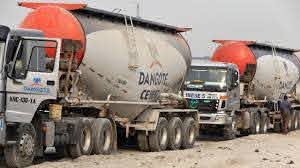
The Nigerian government has allowed Dangote Cement to resume exports across its land borders, raising hope that Nigeria may be opening up trade with neighbours after a year-long blockade.
President Muhammadu Buhari‘s administration gave its authorisation for Africa’s biggest producer to export cement to Niger and Togo in the third quarter for the first time in ten months, Michel Puchercos, chief executive officer, said on an investor call in Lagos. The export was made possible “through authorization given by this administration,” he said.
The exemption to Dangote Cement is seen as a softening of the government’s position on a border closure that started in August last year, and could open the way for other businesses to fully resume exports across the country’s land barriers.
Nigerian authorities closed borders with neighbouring countries including Benin and Niger to curb smuggling and boost local production. Although the blockade encouraged the consumption of locally grown produce such as rice, it hurt factories across West Africa, which rely on Nigeria’s market of 200 million people.
Dangote resumed land export with “restricted volumes,” and plans to grow the trade using the sea channels, according to Puchercos.






Business
Dangote Refinery drives sevenfold surge in Nigeria’s petroleum product exports
Dangote Refinery drives sevenfold surge in Nigeria’s petroleum product exports
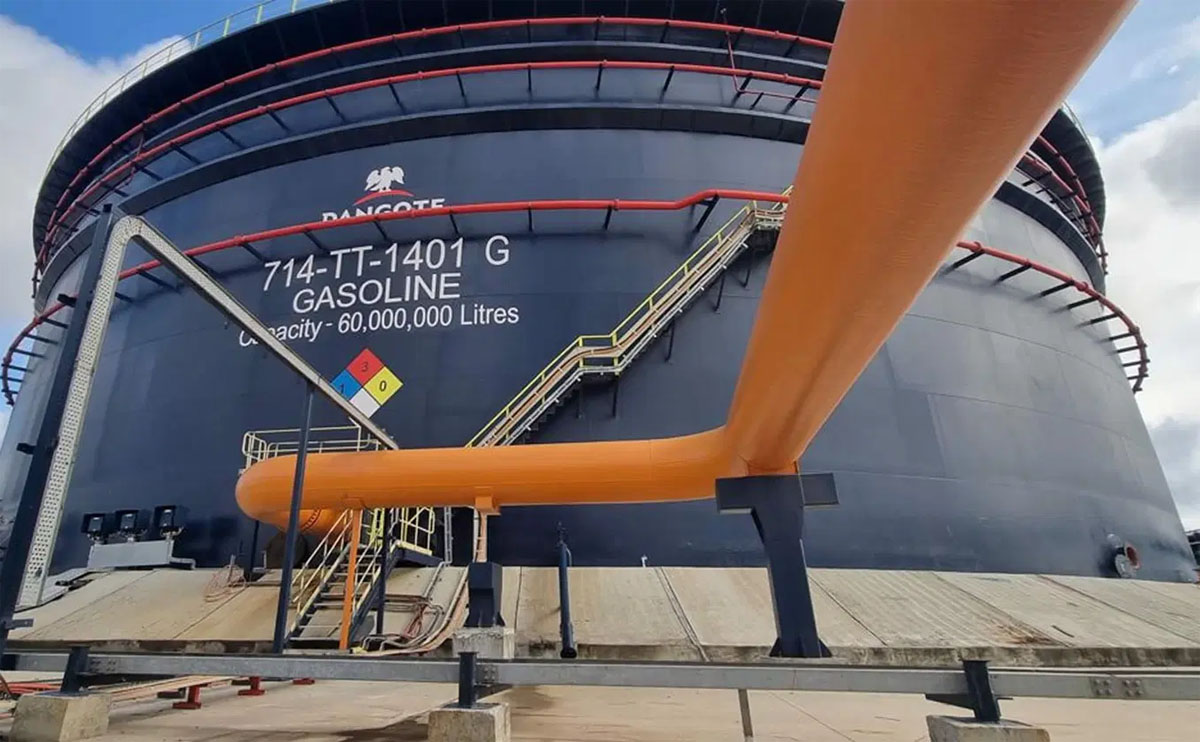
Nigeria’s petroleum product exports have surged nearly sevenfold since 2023, with the Dangote Petroleum Refinery playing a major role in the country’s rapid shift from dependence on imported refined products to increased domestic supply and exports.
The latest figures from the United States Energy Information Administration (EIA) show that Nigeria’s seaborne petroleum product shipments averaged 561,000 barrels per day (bpd) in the second quarter of 2026, compared with an annual average of 79,000 bpd in 2023.
The EIA based its assessment on shipping data from energy intelligence firm Vortexa Analytics, which showed that about 350,000 bpd of the products shipped during the second quarter were exported. That compares with an annual average of just 46,000 bpd in 2023.
The dramatic increase has strengthened Nigeria’s position in the international refined petroleum market, with the EIA attributing much of the growth to the commencement of operations at the Dangote refinery in January 2024.
The 650,000-barrels-per-day refinery, located in the Lekki Free Zone in Lagos, has significantly increased Nigeria’s domestic refining capacity and enabled the country to produce larger volumes of petrol, diesel, aviation fuel and other refined products.
“With increased supply of petroleum products in Nigeria from the country’s largest refinery, imports fell, exports increased, and Nigeria became more self-sufficient in refined petroleum products,” the EIA said.
Before the Dangote refinery began operations, Nigeria’s state-owned refineries collectively shipped less than 100,000 bpd of petroleum products to domestic and international destinations, according to the EIA.
The increase in shipments accelerated after the Dangote facility commenced operations and received another boost following the completion of maintenance and expansion work in February 2026.
The work increased the refinery’s crude distillation capacity from 650,000 bpd to 700,000 bpd, allowing the facility to process more crude and increase the volume of refined products available for domestic consumption and export.
READ ALSO:
- Dangote Raises Petrol to N1,200/Litre Despite Crude Price Decline – Second Hike in Five Days
- Atiku Disowns Aide, Vows to Restore Subsidy — But With a Crucial Difference
- Poco Lee to face UK court September 15 over alleged rape and assault charges
- Nigerian Journalism Mourns: Eagle Online Publisher Dotun Oladipo Dies Suddenly at 56
The rise in production has coincided with a sharp decline in Nigeria’s dependence on imported petroleum products. Seaborne imports, which were close to 400,000 bpd in 2023, fell to less than 130,000 bpd in the second quarter of 2026, according to the EIA.
At the same time, the volume of petroleum products transported between Nigerian ports has increased substantially.
Intra-Nigerian petroleum shipments reached 211,000 bpd in the second quarter of 2026, compared with 81,000 bpd in 2025 and only 33,000 bpd in 2023.
The increase indicates that more refined products are being distributed by sea within Nigeria, particularly from coastal refining and storage facilities to other parts of the country.
Nigeria’s growing refining capacity has also opened up greater opportunities in overseas markets, particularly Europe.
EIA data showed that Nigerian seaborne petroleum product exports to Europe averaged 130,000 bpd in the second quarter of 2026. This was up from 40,000 bpd in 2025 and 15,000 bpd in 2023, representing an increase of roughly 767 per cent over the 2023 level.
Nigeria also increased shipments to other African markets. Exports to African destinations outside Nigeria reached nearly 120,000 bpd in the second quarter, compared with 89,000 bpd in 2025.
The country also shipped significant volumes of petroleum products to Asia and Oceania, further demonstrating the expanding reach of Nigeria’s refined fuel exports.
The EIA said the growth occurred partly amid disruptions to petroleum product flows through the Strait of Hormuz, which created opportunities for alternative suppliers as some international markets faced tighter supplies.
The development marks a significant change in Nigeria’s petroleum trade. For decades, the country exported crude oil while importing substantial quantities of refined products because its domestic refineries operated below capacity or remained shut for extended periods.
The Dangote refinery has altered that pattern by increasing the volume of refined products available within Nigeria while creating surplus volumes for export.
The EIA had previously reported that Nigeria’s petroleum product exports almost quadrupled in 2024 following the Dangote refinery’s commencement of operations, rising to an average of 146,000 bpd from 46,000 bpd in 2023.
The refinery’s growing contribution is also coming as its owners prepare for another major expansion. Dangote Group plans to add a second 750,000-bpd crude distillation unit by 2028, which would further increase the complex’s potential refining capacity.
The company is also preparing for a potential initial public offering (IPO). Recent reports indicate that Dangote Refinery is targeting an October 2026 IPO as investors continue to assess the refinery’s crude supply arrangements, production costs and long-term growth prospects.
Despite the significant rise in domestic refining, the refinery still relies partly on imported crude oil to maintain operations. Recent reports indicate that between 30 and 40 per cent of the refinery’s crude supply currently comes from imports.
Nevertheless, the latest EIA data show that the refinery has become an increasingly important component of Nigeria’s downstream oil sector, contributing to higher domestic product availability and a substantial increase in exports.
The development could strengthen Nigeria’s role as a major supplier of refined petroleum products in Africa, particularly as demand for fuels continues to grow across the continent.
For Nigeria, the combination of rising exports, falling imports and increasing domestic shipments represents a major transformation in the country’s petroleum products market.
The latest figures therefore underline the growing economic significance of the Dangote Refinery and its potential to reshape Nigeria’s position in both the domestic and international petroleum market.
Dangote Refinery drives sevenfold surge in Nigeria’s petroleum product exports
Business
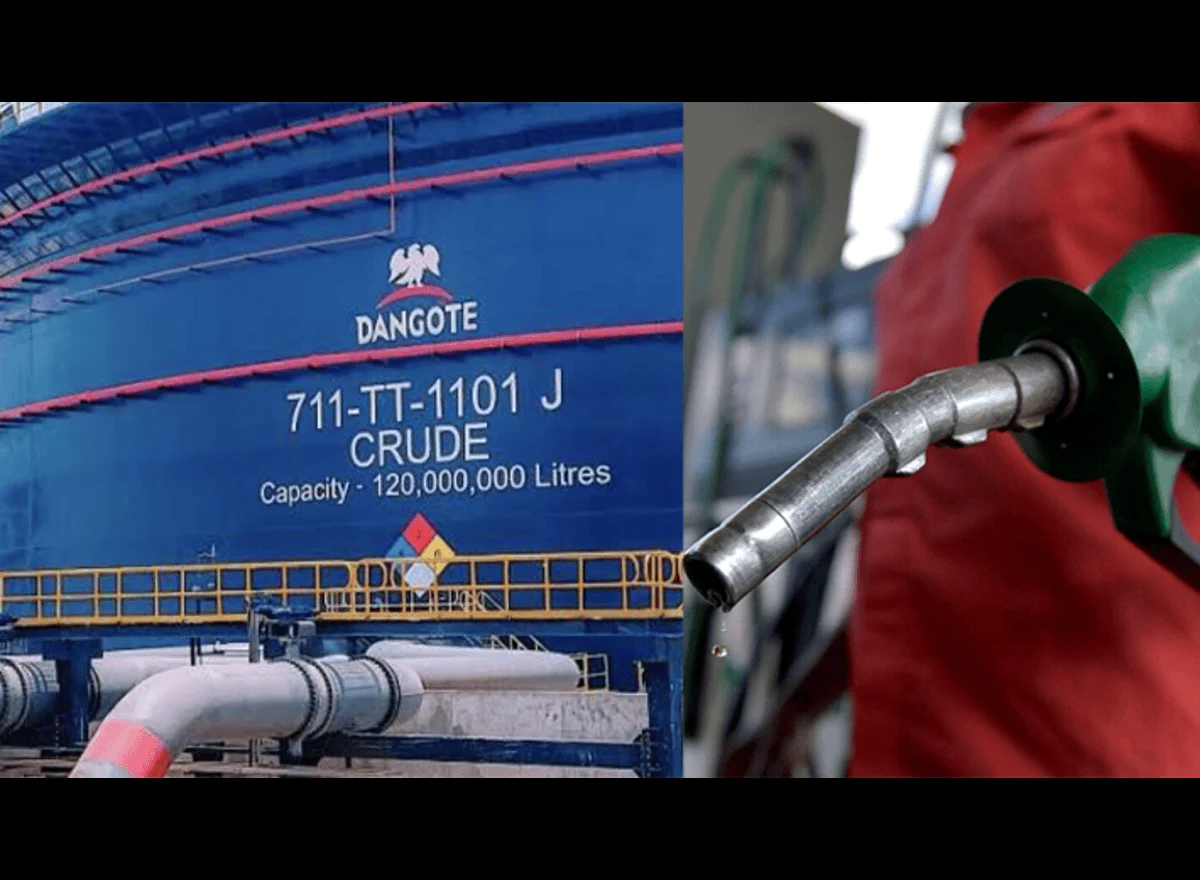
Dangote Raises Petrol to N1,200/Litre Despite Crude Price Decline – Second Hike in Five Days
Dangote Raises Petrol to N1,200/Litre Despite Crude Price Decline – Second Hike in Five Days
Auto
NIWA, LASWA, SIFAX, Dangote Transport Lead Stakeholders for 2026 TCAN Summit
NIWA, LASWA, SIFAX, Dangote Transport Lead Stakeholders for 2026 TCAN Summit
The National Inland Waterways Authority (NIWA), Lagos State Waterways Authority (LASWA), SIFAX Logistics and Dangote Transport are among leading government agencies and private-sector operators that have confirmed participation in the 2026 Transportation Summit of the Transportation Correspondents Association of Nigeria (TCAN).
The summit, scheduled for September 24, 2026, at the Radisson Hotel, Ikeja, Lagos, will bring together policymakers, regulators, industry leaders, transport operators, development partners, academics and other stakeholders to examine how transportation and logistics can be leveraged to accelerate Nigeria’s economic growth.
Themed “Unlocking Nigeria’s Economic Growth Through Transportation Logistics,” the summit is expected to focus on critical issues affecting the efficiency, competitiveness and sustainability of Nigeria’s transportation and logistics ecosystem.
According to the TCAN Chairman, Tola Adenubi, discussions will centre on strategies for improving logistics infrastructure, strengthening policy implementation, enhancing safety and innovation, and promoting sustainable development across the sector.
He said the summit would examine the current state of Nigeria’s transportation logistics architecture, with particular attention to roads, waterways, rail and aviation.
“Participants are expected to identify bottlenecks affecting the seamless movement of cargo and passengers and examine how multimodal transportation integration can contribute to economic expansion,” Adenubi said.
He added that other key areas would include investment opportunities across the logistics and supply-chain ecosystem, digital transformation of the logistics value chain, infrastructure financing and public-private partnership opportunities.
Adenubi said stakeholders would also examine regulatory frameworks needed to optimise the transportation sector and develop policy recommendations capable of improving efficiency and strengthening Nigeria’s global competitiveness.
According to him, the participation of NIWA, LASWA, SIFAX Logistics and Dangote Transport underscores the growing commitment of both government agencies and private-sector operators to finding practical solutions to the challenges confronting Nigeria’s transportation industry.
The summit is also expected to provide a platform for government representatives to present ongoing reforms, infrastructure investments and policy initiatives aimed at improving intermodal connectivity, particularly the integration of waterways with road and rail transportation.
Adenubi said the participation of key government agencies and industry players would provide stakeholders with first-hand insights into the government’s transportation agenda while creating an avenue for meaningful dialogue among policymakers, operators and the media.
The 2026 TCAN Summit will feature keynote presentations from government officials and industry stakeholders, alongside networking sessions designed to strengthen collaboration and partnerships across the transportation and logistics value chain.
Discussions will cover critical challenges and opportunities in road, rail, maritime, aviation and multimodal transportation, with emphasis on how an integrated transport system can improve cargo movement, passenger mobility and economic productivity.
TCAN will also recognise individuals and organisations that have made significant contributions to the development of Nigeria’s transportation industry through its “Champion of Transport Industry Development” compendium.
The association said the summit is expected to generate practical recommendations for strengthening Nigeria’s logistics architecture and positioning transportation as a more powerful engine of economic growth.
-

 Entertainment3 days ago
Veteran Nollywood Actor Taiwo Hassan ‘Ogogo’ Dies at 66 After Cancer Battle
-

 metro2 days ago
MUSCOYS Honours Pioneering Educationist with Commendation Award
-

 metro1 day ago
LASG Moves to Fix Ikotun Junction, Seeks Community Support
-

 metro1 day ago
Traffic Alert: Lagos Announces Diversion as Oke-Afa Bridge Undergoes Rehabilitation
-

 metro1 day ago
Lagos-Ibadan Expressway crash: Seven killed, two injured in three-vehicle collision
-

 News2 days ago
Lagos Pensioners Draw Battle Line with Government Over Pension Enhancement
-

 Entertainment2 days ago
Tears Flow in Ilaro as Nollywood Veteran Ogogo Is Laid to Rest
-

 International1 day ago
US plans largest mass visa revocation in history, up to 200,000 foreigners targeted
You must be logged in to post a comment Login