

Opinion
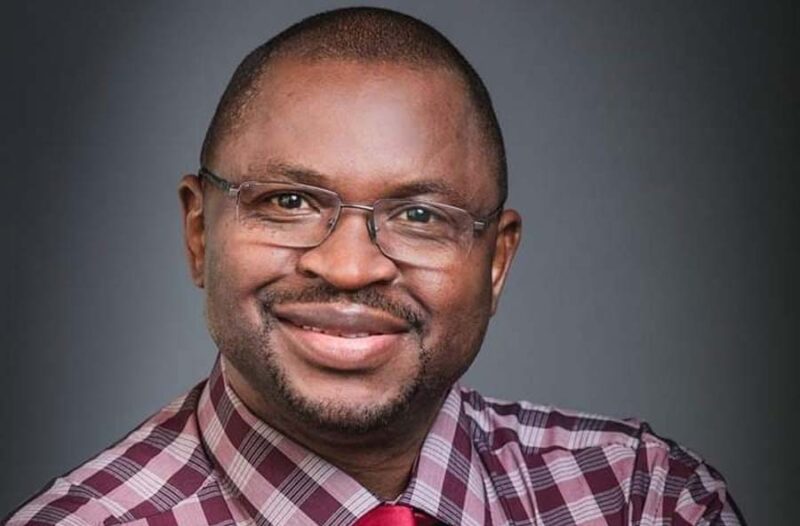
Ignorance of America that Atiku’s lawyers and supporters betray – Farooq Kperogi
Ignorance of America that Atiku’s lawyers and supporters betray – Farooq Kperogi
As I have stressed repeatedly, I have no partisan emotional investment in the political brawl between President Bola Ahmed Tinubu and former Vice President Atiku Abubakar, or in who is and is not president of Nigeria. My only partisan affinity is with the truth or, to reecho iconic Washington Post reporter Carl Bernstein, the best obtainable version of the truth.
This intervention is for people who genuinely want clarity from the blinding maze of propaganda and intentional falsehoods flying around. It’s not for sentimental partisan hacks and political devotees who just want an affirmation of and a comfort to their prejudices and preconceptions.
As an American citizen, a graduate of two American universities, and a professor in one, I can tell the reader three major things Atiku’s Nigerian lawyers and his supporters on social media— and in some openly partisan news sites— are getting wrong.
The major one is the idea that because Tinubu presented a certificate (called a “diploma” in America) to INEC that didn’t emanate from Chicago State University, whose registrar affirmed under oath that Tinubu graduated from there, he has committed forgery in the legal sense of the term. That thinking betrays ignorance of the American university system—and results from people using their limited Nigerian lenses to refract an American phenomenon that’s beyond their experiential reality.
Certificates are not used as legal proof of graduation from any school in America and therefore can’t be forged in the legal sense of the term. Only transcripts can be used as legal documents to validate the genuineness of claims to have attended institutions, including secondary schools.
Had Tinubu presented a counterfeit transcript to support his claim of graduating from CSU when he didn’t, or merely to claim a higher GPA than he actually earned even when he graduated from there, that would have been forgery in the legal sense of the term, which is understood to mean “Criminal falsification by making or altering an instrument with intent to defraud.”
READ ALSO:
-
Ondo pastor in court for threatening to kill magistrate
-
Sagamu: Police inspector, guards shot during shoot-out with rampaging armed robbers
-
Alleged N130m fraud: Court orders arraignment of property developer for alleged harassment, threat to life
In this context, “intent to defraud” would mean Tinubu wanted to pass himself off as a university graduate when he wasn’t. But he is. His transcript says he is. The registrar of the university said under oath that he is. A classmate of his said under oath that they graduated from the school the same year. That’s all that matters.
One indication of the legal worthlessness of certificates in America came from the CSU registrar’s admission in court that the school had many uncollected diplomas going as far back as the 1930s. Certificates are not required to prove graduation here. That’s why people can afford to ignore them.
Intriguingly, the registrar said Tinubu also didn’t collect his original certificate from the school and that it is still lying there. Why did he say he lost it?
In the United States, a certificate is in many ways similar to a graduation ceremony. Most people attend it and listen to the president of the university formally confer diplomas on them with “all the rights and privileges pertaining thereto.” But it has no force of law. Not attending a graduation ceremony doesn’t deprive you of “all the rights and privileges pertaining thereto.”
If you organize your own graduation ceremony, invite friends and family, and ask your father to confer your degree on you, it’s fine so long as you validly earned the degree. Incidentally, an American family friend of mine did exactly that last May. His autistic son can’t tolerate the sensory overload of large crowds. So, he organized his son’s graduation and invited friends and family. He dressed as the president, and his wife was the provost. His eldest daughter was the graduation speaker.
In America, the diploma is the printed version—or fixed extension—of a graduation ceremony. It’s merely ceremonial and can be tweaked or individualized by anyone without legal consequences.
It betrays a stupendous poverty of legal and logical imagination to say that the “forgery” (unauthorized redesign is a better expression) of a non-legally-binding ceremonial document of a validly earned degree invalidates the degree. It’s never mentioned in CSU’s diplomas that alteration of the documents renders them invalid because they have no validity beyond being decorative documents.
You find that kind of language here only on transcripts. On Tinubu’s CSU transcript, for instance, we find such legal language twice. The left-hand side of the transcript says, “Explanatory legend and authenticity confirmation information on back.” On the right-hand side, it says, “THIS RECORD IS NOT OFFICIAL UNLESS IT BEARS A SIGNATURE AND SEAL OF THE UNIVERSITY.”
The diploma does not have such language because in America the diploma is no more important than a school’s academic gown. For example, I use a cheaper, “forged” version of the academic gown of the university that awarded me a doctoral degree (that I ordered from a third-party vendor online) to attend graduation ceremonies at the school where I teach now. At the time I graduated with my doctoral degree, I could only afford to rent the gown. Most people here do the same. It doesn’t invalidate our degrees because we’re using the unofficial academic gown of our universities.
I admit, though, that Tinubu was careless. He is in Nigeria where certificates have a different meaning and valence from the United States. He should have submitted CSU’s official diploma to INEC. But what he did does not, by even the most feverish stretch of conspiratorial fantasy, rise to the level of a Salisu-Buhari-type criminal forgery.
READ ALSO:
- Customs intercepts 8 truck-loads of foreign rice, other items worth N1.76bn
-
BREAKING: More troubles for Naira Marley as court asks EFCC to produce him for Internet fraud trial
-
(BREAKING) Abia : Labour Party jubilates as tribunal upholds Gov Alex Otti’s election
Unlike Salisu Buhari who forged a University of Toronto degree that he didn’t earn, Tinubu attended and earned a degree from Chicago State University. What Tinubu did with his certificate is pointlessly self-harming in reputational terms in Nigeria, but it’s not illegal.
The second major misconception of America came from Atiku’s lawyer by the name of Kalu Kalu. He said at a news conference on October 5 that “the Chicago State University admission application form has a claim that… the owner of that document is a Black American, and the document Bola Ahmed Tinubu submitted to INEC, he denied having dual citizenship which means it doesn’t belong to him.”
I’m sorry, but I couldn’t help myself from letting out a burst of deep, loud, hearty laughter when I read that. It’s pure hilarious ignorance! You see, America has an enduringly irresistible impulse to taxonomize humanity into discrete racial categories. Every official form here requests you to identify your race. The modern options are “White, Black or African American, American Indian or Alaska Native, Asian, and Native Hawaiian or Other Pacific Islander.”
In the mid-1970s when Tinubu applied to study at CSU, what is now “Black or African American” on official forms in America was simply “Black American,” particularly in historically Black Universities like CSU.
The US Census Bureau has historically defined “Black or African American” as “A person having origins in any of the Black racial groups of Africa.”
“Black American” was the only category that closely applied to Tinubu, so he chose it because the form instructed him to “CHECK ONE BOX.” Checking the “Black American” box didn’t mean he called himself a Black American or that he impersonated a Black American. It only meant he identified HIS RACE as “Black American.” No more, no less.
The other options in the form were barely decipherable, but I could pick out “American Indian or Alaska Native,” something that looks like “Spanish Surname American,” another that looks like “Eurasian American,” etc. Although the form gave the option for “Other (explain),” most Africans here typically choose Black American as the closest description of their race.
Finally, a Dr. Abimbola Adenike Tinubu, who lives in a small town called Opelousas in the state of Louisiana, is being touted by social media trolls as the woman whose identity Bola Tinubu allegedly stole. The problem is that the lady was born in 1971, just 4 years before Tinubu enrolled at Southwest College. She graduated from the University of Ilorin in 1998 and came to the US later.
It’s chronologically and rationally impossible for Tinubu to steal the identity of a 4-year-old Nigerian preschooler (who came to America decades after Tinubu left it) and then present himself as an adult male to enroll at a community college!
Plus, Dr. Abimbola’s Whitepages information shows that she has never lived in Virginia where the social security number associated with President Tinubu was issued or Chicago where he went to school. She has only lived in Tennessee, Texas, and Louisiana.
Look, Tinubu’s life is wrapped in multiple layers of mind-bogglingly intricate fraud, but you can’t peel off these layers of fraud with fraud. You do it with the truth.
And Atiku can actually inflict fatal moral wounds on Tinubu and potentially immobilize him in 2027 if he pursues the leads that came out from his “fishing expedition” in Chicago. A low-hanging fruit is Tinubu’s obviously fraudulent secondary school attendance claim.
He can write to Cambridge University to verify the GCE A-level result that Tinubu presented to Southwest College. If it turns out that it’s fake or belongs to someone else, he can cause Daley College to rescind his associate degree.
If his associate degree is rescinded, his bachelor’s degree from Chicago State University will automatically follow. With no qualifications to present to INEC to prove that he has at least the equivalent of a secondary school certificate, he’d be legally ineligible to run again.
Ignorance of America that Atiku’s lawyers and supporters betray – Farooq Kperogi







Opinion
2027: Competence, Not Zoning, Should Decide Nigeria’s Next President — Imasuagbon
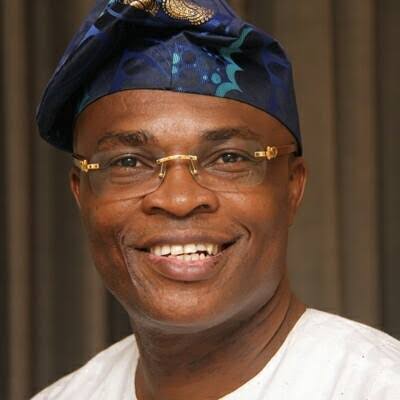
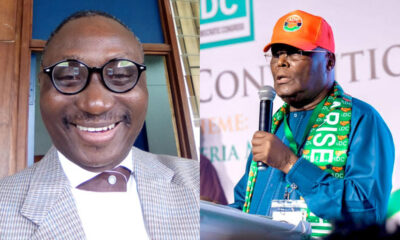
Nigerians should look beyond ethnicity, region and the longstanding debate over rotational presidency when choosing the country’s next leader, according to a chieftain of the African Democratic Congress (ADC), Kenneth Imasuagbon.
The former Edo State governorship aspirant said the priority ahead of the 2027 election should be finding a president with the ability to confront Nigeria’s economic, security and infrastructure challenges.
Speaking to journalists in Benin, Imasuagbon argued that presidential rotation is not a requirement of the Nigerian Constitution and should therefore not outweigh the question of competence.
He said voters should be more concerned about replacing poor schools with better ones, improving healthcare and addressing hardship than debating where the next president comes from.
Imasuagbon specifically appealed to voters in the South to support former Vice President Atiku Abubakar, who is contesting the 2027 presidency on the ADC platform.
According to him, Atiku has demonstrated the experience and determination needed to improve the country, describing the former vice president as someone capable of promoting national unity and fairness.
He also accused the Bola Tinubu administration of worsening economic pressure through policies including the removal of fuel subsidy, while expressing concern about the condition of roads, electricity and other infrastructure.
Imasuagbon argued that the next administration must focus on practical improvements in areas such as power, transportation, employment, security and public services.
The ADC chieftain also dismissed the idea that the ruling All Progressives Congress (APC) would automatically benefit from its incumbency advantage in 2027.
He maintained that the electorate ultimately determines the outcome of an election, arguing that voters could change the political direction of the country if they were determined to do so.
Imasuagbon further criticised what he described as regional and ethnic considerations in the distribution of political appointments and opportunities, insisting that the next president should give Nigerians across different parts of the country a sense of belonging.
His comments come as political parties and their candidates intensify preparations for the 2027 presidential election.
Opinion
Lesson from Dotun Oladipo’s Brave Daughters, by Bamidele Johnson
Lesson from Dotun Oladipo’s Brave Daughters, by Bamidele Johnson
I hope to grow old. I want to see my kids become real adults, find their own feet, make mistakes, recover from them, and perhaps one day complain that their own children are giving them grey hairs. I want that plainly stated before anything else, as everything that follows might read as a man agreeing to an early exit rather than a man simply being honest about the odds.
I want the decades. I want to become the grandfather who repeats the same stories until nobody bothers correcting him anymore. But wanting a thing and being granted are different things. The last year has made that difference harder to ignore than I would like. I have lost many friends recently to keep thinking that optimism is my natural resting state. Some of these men had better blood pressure than mine, better habits, better everything that is supposed to count. It did not save them.
There is no formula I know that reliably separates the men who make it to 70 from those who do not. Anyone who says he knows one is selling something. So, I do not assume that old age is an already booked destination. Even if I once did, which I doubt, the last three years have cured me of such an illusion. As such, I treat it as a hope rather than an expectation, and I have found that a more honest way to live.
It is exactly why I want something placed on record now, while I am still able to place things on record, rather than leave it for people to guess what my wishes were in the fog of a funeral week. If I do not make old bones, my children are not to be asked to read tributes at my funeral. Not one line, however short, however lovingly written.
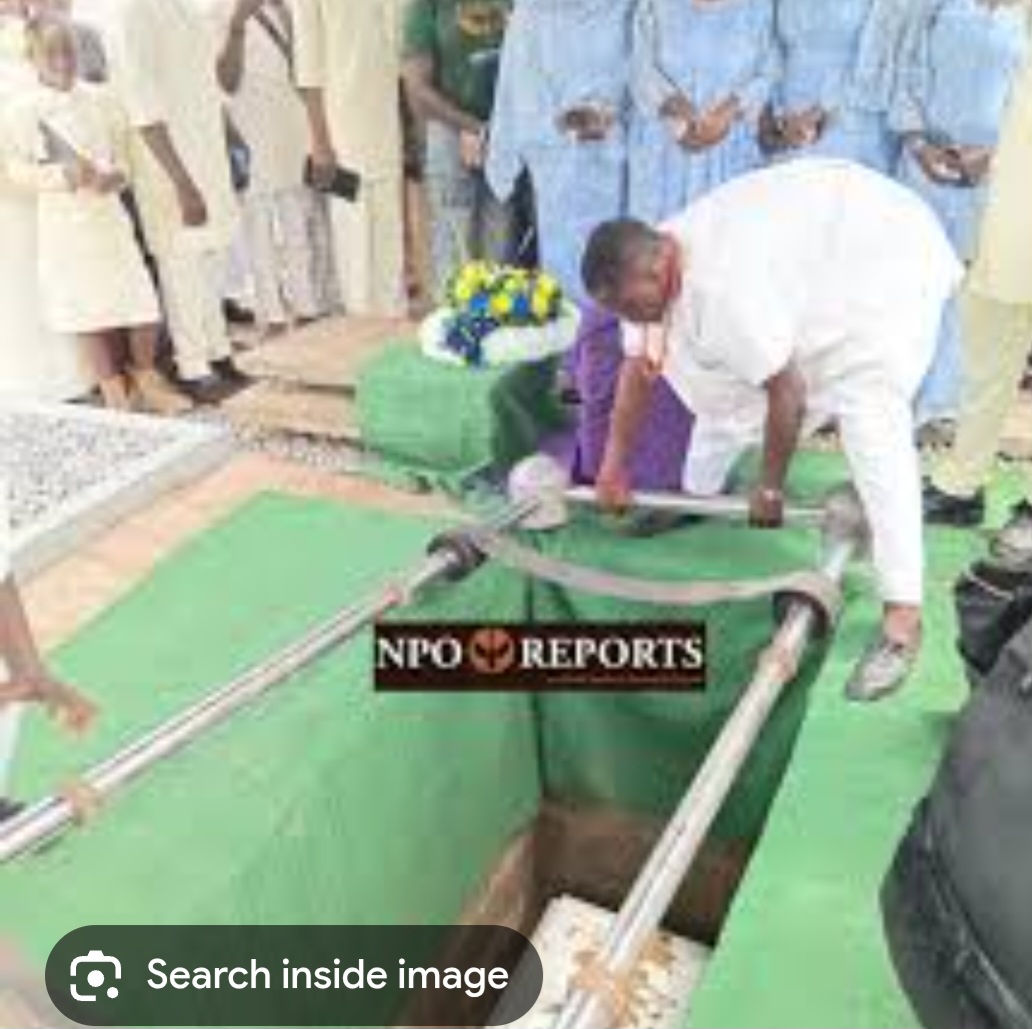
This, for me, was settled today rather than re-opened. At Dotun Oladipo’s funeral service, his three daughters took turns to read their tributes to their dad, and I found myself watching them with awe. There was a kind of strength in them that I do not possess. It is the strength needed to stand in front of a hall brimming with grieving adults and speak about a man they have just lost. Forever. Strength, however, is not the same as ease. I could see plainly what that strength was costing them as they read. Their voices caught. Their composure held and then did not hold and then held again through sheer will.
In front of them, in the pews, men and women considerably older than them came undone in ways the girls themselves were somehow managing to resist. I went mightily close. Some of the sobbing was quiet, the type people try to fold into a handkerchief. Some of it was not quiet at all, the kind that announces itself whether or not you want it.
Those young women honoured their father with a grace that is beyond me. What they did was astonishing. So, what I am attempting is an observation of a custom I have now watched wound people. This was not the first time I had watched this particular ritual extract more than it should from people already running on fumes. I saw an earlier and harder version of it at a friend’s wake back in 2015.
The first son was called forward to read his father’s tribute, and he could not do it. He tried, but the words would not come, and he stood there in front of a crowd of mourners, with his grief simply refusing to organise itself into sentences. The officiating minister, rather than releasing him from the task, urged him to continue. I sat fizzing with sorrow and ire. He could not go on and, eventually, the minister accepted, but not before insisting a while longer than it should have reasonably taken. His younger brother was called up next, presumably on the theory that if one grieving son could not manage it, maybe another one could. He flunked it in the same way. Grief does not distribute itself more conveniently among siblings just because a programme has been printed and needs to be followed.
I have turned that memory over many times since, trying to work out why this part of the rites is treated as mandatory in the first place. I have not found a satisfying answer. Maybe it comes from a belief that a child’s words carry more weight than anyone else’s, which may even be true, but weight is exactly the problem when those carrying it are struggling to hold themselves together with nothing but adrenaline and the fear of dissolving in public.
Maybe it is simply inertia, the reason we still do a hundred things at funerals that nobody can explain the original purpose of. Either way, I have stopped looking for the justification. I no longer think one exists that is good enough to weigh against what I watched happen to that boy in 2015.
So, let this stand as my instruction rather than my preference, the kind of thing I would rather state plainly now than leave for my children to infer later from how uncertain I sound when the subject comes up in passing. If I do not get the old age I am hoping for, my children will not be asked to read a single word over my body. Someone else can speak for me. A friend, a stranger with a steadier voice and a smaller stake in the loss, anyone whose grief will not be quite so total that standing upright becomes almost impossible.
My children, of course, will sit in front and fall apart if that is what the day requires of them, but without the microphone. That, at least, is one small mercy I intend to arrange for them while I am still here to arrange it.
Dotun deserved every bit of the send-off his daughters gave him today, and I suspect he would have been the first to tell them to sit down and let someone else carry the weight for a while. He did not get a say in that, as none of us ever do once we are the ones being spoken of rather than the ones speaking. Rest well, Dotun. You raised three young women whose strength I will not soon forget. That alone says everything worth saying about the man you were.
Opinion
‘Tinubu Will Win Again in 2027’ — Charismatic Bishops’ Secretary
‘Tinubu Will Win Again in 2027’ — Charismatic Bishops’ Secretary
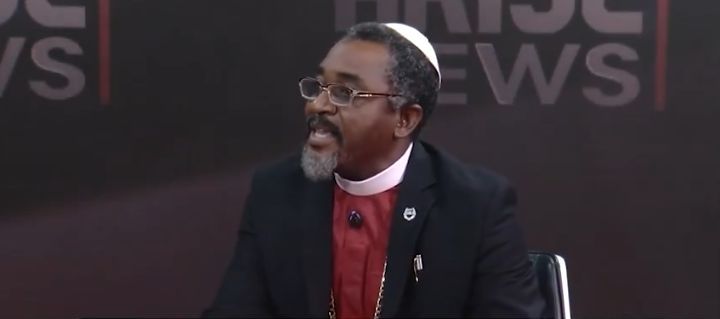
A senior Nigerian cleric, Archbishop Chivir Chianson, has declared that President Bola Tinubu will retain the presidency after the 2027 general election, attributing the prediction to a message he said came from God.
Chianson, who serves as Secretary General of the Charismatic Bishops’ Conference of Nigeria, made the statement while appearing on Arise Television on Saturday.
Rather than basing his prediction on political calculations, the archbishop said his confidence came from what he described as the prophetic role of bishops.
He maintained that the conference had previously spoken about Tinubu’s political future based on what he said was divine revelation and that the President would return for another term.
Chianson also predicted that Tinubu’s performance would improve if he wins the 2027 election.
READ ALSO:
- DSS warns Osun churches, mosques, markets over alleged terrorist attack plot ahead of 2027
- ‘Tinubu Will Win Again in 2027’ — Charismatic Bishops’ Secretary
- Fake miracles, bogus grants: How clerics allegedly fleece Nigerians of millions
Addressing the political opposition, the cleric said the bishops could not be blamed if rival parties failed to unite or organise themselves effectively ahead of the election.
He also sought to clarify the position of the bishops when dealing with government, saying their role in speaking truth to power did not mean they should approach political leaders with hostility or disrespect.
According to him, the Constitution, alongside their religious convictions, should guide how they engage the President and the country.
Chianson said he was sufficiently confident in his prediction to promise that he would return to the Arise TV studio after the 2027 election, when he expects the result to demonstrate that the bishops’ prophecy was correct.
His comments add a religious dimension to the increasingly active political conversation surrounding the 2027 presidential race.
‘Tinubu Will Win Again in 2027’ — Charismatic Bishops’ Secretary
-
 Sports3 days ago
‘I Was Never the Chosen One’ — Dembele Responds to Mbappe
-

 International2 days ago
Islamic Council Condemns Attempted Attack on Holy City of Mecca
-

 metro2 days ago
Lagos Power Outage: Ikeja Electric Blames TCN as Businesses, Homes Groan
-

 Education3 days ago
JAMB Moves 2027 UTME Time — Here’s What Candidates Need To Know
-
 News2 days ago
Keep Politics Out of My Office — Ogbomoso Grand Chief Imam Warns Politicians, Bloggers
-
 Politics3 days ago
2027: APC Governors Reject Wike’s Rainbow Coalition, Insist on Party Loyalty
-

 News3 days ago
I Wanted to Disgrace Tinubu — Omokri Reveals What He Discovered at Chicago Varsity
-

 metro3 days ago
A Son Wouldn’t Have Done Better — Dangote Speaks on Daughters, Succession