

News
N3bn fraud: Minister summons NASS staff union leadership

N3bn fraud: Minister summons NASS staff union leadership
ABUJA- FOLLOWING allegation of N3 billion fraud levelled against executive members of the National Assembly chapter of the Parliamentary Staff Association of Nigeria, PASAN, the Federal Ministry of Labour and Employment has summoned the leadership and some aggrieved members.
The ministry in a letter signed by the Director/Registrar, Department of Trade Union Services and Industrial Relations for the minister, invited the PASAN leaders and the aggrieved members to a meeting tomorrow.
The invitation letter, titled “Re: Petition Against the Misappropriation of Parliamentary Staff Association of Nigeria, PASAN, National Assembly chapter and Threats of Suspension of Members (sic)”, was signed by the Director/Registrar, Trade Unions, Amos Falonipe Amos on behalf of the minister.
Recall that a member of PASAN, Yusuf Abiola, had at a briefing in Abuja early this month, accused the union executive of funds’ misappropriation.
READ ALSO:
- Women strip, flog side chick for dating their friend’s husband
- Gaza war: Egypt proposes initial two-day truce with hostage-prisoner exchange
- Varsity workers declare indefinite nationwide strike
Abiola , who spoke on behalf of the concerned members of PASAN, had noted that the leadership of PASAN, National Assembly chapter, allegedly misappropriated N3 billion union funds.
He also demanded the audited financial statements and operational reports from 2019 till date from the executive and vowed to petition relevant authorities to seek redress.
In a swift reaction to the allegation, the chairman of PASAN in the National Assembly, Sunday Sabiyyi, in a statement jointly signed with the Secretary, David Ann Ebizimoh, described the allegation as baseless, frivolous and defamatory.
Sabiyyi called on members of the union and the general public to disregard what he described as “unfounded blackmail intended to distract the union from pursuing its mandate coherently to the letter.”
But the labour ministry in its letter of invitation, dated October 25, 2024, with reference number FMLE/TU/136/111/82 has, however, summoned the parties involved through a letter addressed to the General Secretary, National Assembly chapter of PASAN.
N3bn fraud: Minister summons NASS staff union leadership












Business
Dangote Refinery Sets ₦525 Per Share for Landmark IPO

For ₦5,250, Nigerians could soon own a piece of the refinery that has reshaped the country’s fuel market.
News
Hate Speech, Threats During Campaigns Attract ₦10m Fine, 12 Months Jail – INEC

Hate Speech, Threats During Campaigns Attract ₦10m Fine, 12 Months Jail – INEC
The electoral commission says inflammatory rhetoric crosses into intimidation when it incites ethnic or religious hostility, as political actors ramp up campaign activities ahead of the 2027 general elections.
ABUJA, Nigeria – The Independent National Electoral Commission (INEC) has warned politicians and political parties against using abusive, inflammatory, or threatening language during campaigns for the 2027 general elections, cautioning that offenders risk heavy financial penalties and possible imprisonment under the Electoral Act 2026. INEC’s Chief Press Secretary and Media Adviser to its Chairman, Adedayo Oketola, in a telephone interview on Sunday, said campaign rhetoric crosses the legal threshold into electoral intimidation the moment it moves beyond robust partisan debate or policy critique and enters the realm of coercion, hate speech, or the threat of harm. He cited Section 96 of the Electoral Act 2026, which states: “A political campaign or slogan shall not be tainted with abusive language directly or indirectly likely to injure religious, ethnic, tribal or sectional feelings.” The law further prohibits “abusive, intemperate, slanderous or base language, insinuations, innuendoes designed or likely to provoke violent reaction or emotions” in political campaigns. According to Oketola, rhetoric becomes punishable intimidation when it incites ethnic, religious, or regional hostility through language explicitly designed to provoke violent emotions or target specific groups. He explained that campaigns transition into outright intimidation when they threaten force or violence—whether by directly or indirectly warning voters, candidates, or electoral officials of physical harm, economic reprisal, or social ostracisation to compel or suppress support for a candidate. He stressed that political campaigns must not create an atmosphere of fear calculated to deter voter turnout or disenfranchise specific demographics.
Oketola disclosed that Section 96(7) of the Electoral Act 2026 prescribes severe statutory penalties for offenders. Candidates convicted of abusive campaign offences face a maximum fine of ₦5 million or imprisonment for 12 months, while political parties found liable risk a fine of ₦10 million for the first offence, and ₦2 million for each subsequent violation. While clarifying that INEC is not a security agency, Oketola explained that Section 95 of the Electoral Act 2026 explicitly prescribes the security architecture for political rallies in relation to the operational roles of the Nigeria Police Force, the Nigeria Security and Civil Defence Corps (NSCDC), and other security institutions. He noted that beyond inter-agency security coordination, INEC is statutorily empowered to monitor political campaigns and enforce compliance with the Code of Conduct for Political Parties.
READ ALSO:
- Market Fire in Indonesia Kills 11, Including Six Children
- Three Women Killed, 10 Injured in Multiple Crash on Lagos-Ibadan Expressway Bridge
- Socialite Igho ‘Tiny’ Ubiribo Dies After Penis Enlargement Surgery
The warning comes amid a fresh wave of threats by political office holders against dissenting voters, as parties intensify preparations for the 2027 elections. Among the most prominent cases is that of Osun East Senator, Francis Adenigba Fadahunsi, who was invited and questioned by the Nigeria Police Force over a viral video in which he was heard telling All Progressives Congress (APC) supporters in Ilesa, “Until the day of election, when you see any Accord party member here in Ilesa, kill them.” Governor Ademola Adeleke rejected his media office’s subsequent clarification, describing the remarks as a national security threat and demanding his arrest. Fadahunsi later claimed the video was AI-generated and that his statement was metaphorical—a “call to kill by votes.” In the Federal Capital Territory, the Chairman of Kuje Area Council, Samuel Danjuma Shekwolo, stirred controversy after warning residents who do not support the APC to relocate ahead of 2027. Amnesty International Nigeria condemned the remarks as a “call to violence” and an attack on freedom of association. In Borno State, the Commissioner for Youth and Sports Development, Sainna Buba, threatened that those who refuse to support the APC in 2027 “will be flogged,” while separately warning that anyone who crossed the ruling party would have a finger broken. In Yobe State, the state chairman of the APC, Alhaji Mohammed Gadaka, triggered widespread condemnation after urging married women to leave their husbands if the men stood in the way of their voting for the party—promising to personally settle the “new bride price” for any woman who ended her marriage on account of her loyalty to the party. He later withdrew the remark following public outcry. Other flashpoints include Kebbi State, where the Chairman of Gwandu Local Government Area, Alhaji Atiku Ahmad Mandiya, told supporters that anyone who spoke against Governor Nasir Idris “should be dealt with,” and Ebonyi State, where Governor Francis Nwifuru warned newly inaugurated local government chairmen that they would be removed from office if they failed to deliver their councils to the APC in 2027.
The International Republican Institute (IRI), in a pre-election assessment of Nigeria’s democratic environment, warned that persistent insecurity and election-related political violence are the biggest threats to Nigeria’s 2027 general elections. IRI President Daniel Twining stressed that where voters, candidates, and observers cannot participate without fear of violence or intimidation, technical improvements and legal safeguards have only limited effect. The IRI mission further warned that economic hardship, insecurity, and declining public trust in INEC pose significant threats to the credibility of the 2027 elections. It said grievances over the management of the 2023 presidential election continue to shape perceptions of INEC, while uncertainty over the implementation of new electoral provisions could deepen distrust. The mission recommended that INEC conduct more robust stress tests of its systems and mock elections to identify potential challenges with the Bimodal Voter Accreditation System (BVAS) and the INEC Result Viewing (IReV) portal. The National Peace Committee, through its Election Security Information Hub, recorded 2,510 election-related security incidents across the country in just 14 months, affecting at least 70 off-cycle elections, bye-elections and reruns since 2023. Zamfara, Borno, Kaduna, Niger, Benue and Plateau were identified as the states worst affected, with banditry, kidnapping and terrorism posing continuing threats to electoral activities.
Oketola insisted that electoral integrity cannot be preserved by INEC alone, describing it as a collective stakeholder duty. “The Nigeria Police Force and other security agencies have a clear duty to prevent the breakdown of law and order during political campaigns,” he said. He added that the media must actively play its watchdog role by calling out purveyors of incendiary statements, while traditional and religious leaders must also wade in, using their moral authority to encourage politicians to eschew inflammatory rhetoric and avoid provoking violence in the country. “Political campaigns should be platforms of competing ideas, not theatres of war,” Oketola said.
Hate Speech, Threats During Campaigns Attract ₦10m Fine, 12 Months Jail – INEC
News
Market Fire in Indonesia Kills 11, Including Six Children
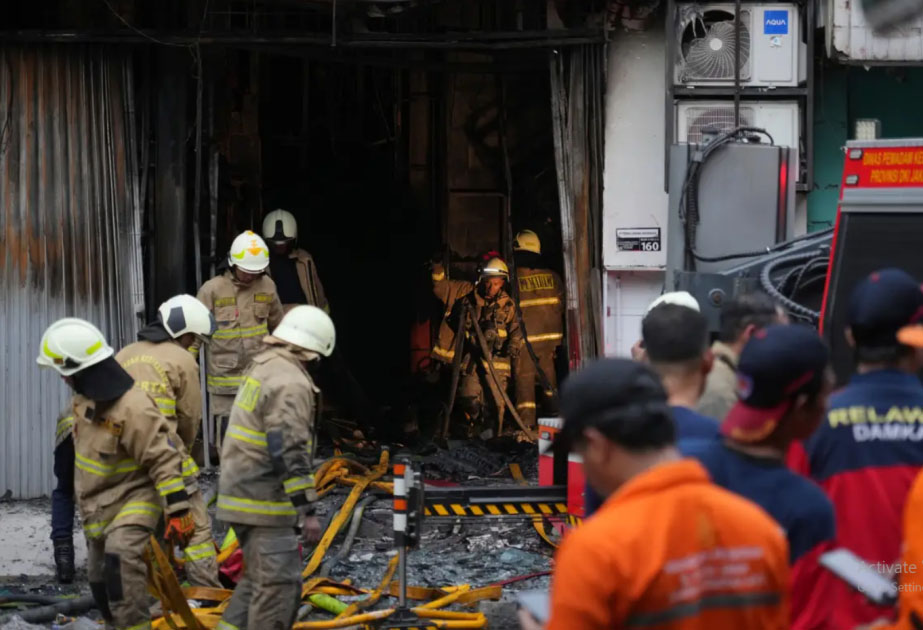
Market Fire in Indonesia Kills 11, Including Six Children
A blaze in Central Papua province destroyed about 40 buildings and left a community in mourning, with authorities investigating the cause.
JAKARTA, Indonesia – At least 11 people, including six children, have died after a fire tore through a market and nearby buildings in Indonesia’s eastern Papua region, police said on Monday. The fire broke out shortly after midnight local time in Paniai, Central Papua province, and quickly spread to several shophouses, according to local police spokesman Henry Manurung. “During the inspection, officers found 11 victims who had died with burn injuries. Of the 11 victims, five of them were adults, while the other six were children,” Henry said in a statement. He said the children were aged between two and nine years old. The blaze raged for more than three hours, destroying at least 40 kiosks and houses despite the deployment of fire trucks and water cannons. Authorities were still investigating the cause of the fire.
READ ALSO:
- Three Women Killed, 10 Injured in Multiple Crash on Lagos-Ibadan Expressway Bridge
- Socialite Igho ‘Tiny’ Ubiribo Dies After Penis Enlargement Surgery
- +Senator Shehu Buba Denies Bandit Links, Says Viral Videos Manipulated
Henry attributed the difficulty in extinguishing the blaze to the arrangement of the buildings in the area. “The intensity of the blaze and the fact that the houses and stalls were all packed tightly together made the firefighting process take quite a long time,” he said. Deadly fires are relatively common in Indonesia, where densely packed buildings and inadequate fire-safety measures can make blazes difficult to contain.
This tragedy follows a series of deadly fires in Indonesia in recent years, highlighting ongoing safety concerns. In December 2025, 22 people were killed when fire swept through a seven-storey office building in Central Jakarta. Police said an exploding drone battery on the ground floor was the likely cause. Also in December 2025, a fire at a shop in Central Jakarta killed 7 people. In 2023, an explosion at a nickel-processing plant in eastern Indonesia killed at least 12 people.
Market Fire in Indonesia Kills 11, Including Six Children
-

 Business3 days ago
BREAKING: OPay Warns Customers Against Viral Shutdown Message, Threatens Legal Action
-

 metro3 days ago
Osinbajo raises alarm over chemicals in fruits, recalls wife’s orange juice experience
-

 metro3 days ago
NSCDC Rescues 15 Trafficked Minors Sold for ₦2m Each by Fake NGO Official
-

 Auto2 days ago
NAJA 19th Auto Awards: Industry’s best to battle for honours December 3
-

 metro2 days ago
APC rally: Suspected thugs attack journalists, smash Radio Nigeria vehicle in Kano
-

 Politics2 days ago
15 northern states may collapse if fuel subsidy returns, OAU professor warns Atiku
-

 Education3 days ago
JAMB Releases Underage UTME Results, Sets Strict Conditions for Admission
-

 metro2 days ago
Lagos-Ibadan Expressway: FG begins Kara Bridge repairs Tuesday, deploys traffic agencies