

News
Buhari to world leaders: Reject coups in West Africa

President Muhammadu Buhari yesterday tasked the international community to stand up against the recent trend of power hijack by the military in some African countries.
President Buhari, who spoke at the 76th Session of the United Nations’ General Assembly in New York, the United States of America (USA), warned that rising cases of coup in West Africa were eroding the democratic gains of the past decades.
According to the President, the unconstitutional takeover of power had sometimes been in reaction to unilateral change of constitution by some leaders, admonishing those elected to lead countries to reject the temptation of staying beyond their constitutional term of office.
He affirmed Nigeria’s support of efforts by ECOWAS, AU and the UN to address this growing challenge, saying “as leaders of our individual member states, we need to adhere to the constitutional provisions of our countries, particularly on term limits. This is one area that generates crisis and political tension in our sub-region.”
The President urged the international community not only to deal with the symptoms of conflict but also the immediate causes that fuel conflicts in the first place.
“These include poor and undemocratic governance, human rights abuses, poverty, ignorance, injustice and inequalities.
“There are no easy solutions to these conditions. They require long term investments and more effective international cooperation.
“In this connection, my delegation underscores the importance of promoting peaceful, unfettered, and inclusive participation of states in global actions towards conflict prevention.
“This will facilitate the achievement of the 2030 Agenda for Sustainable Development and the African Union Agenda 2063,” he said.
The President’s speech, delivered from the podium of the General Assembly hall, addressed other matters on the international agenda of interest to Nigeria, including the COVID-19 pandemic, Arms Trade Treaty, climate change, terrorism, anti-corruption, debt suspension, international trade, UN Security Council Reform, Palestinian Question and racial discrimination, among others.
On international trade, President Buhari called for reforms that will engender recovery from the COVID-19 crisis, build resilience to future shocks and pursue transformative development strategies that can deliver the 2030 Sustainable Development Goals.
He said: “Nigeria reaffirms that international trade is an engine for development and sustained economic growth, as well as the global eradication of poverty.
‘‘My delegation would like to reaffirm the critical role that a universal, rules-based, open, non-discriminatory and equitable multilateral trading system can play in stimulating economic growth and development.
‘‘Fair and equitable trade would eventually eliminate the need for aid.
‘‘My country and indeed all African countries do not intend to stay indefinitely looking for aid. All we need is a fair and equitable system of international trade.”
On the issue of debt in the wake of the COVID-19 pandemic, the Nigerian leader urged G20 countries to extend its debt suspension initiatives to all developing countries, least developed countries, small island developing states facing fiscal and liquidity challenges.
The President also called for outright debt cancellation for countries facing the most severe challenges.
“Developing countries have been faced with unsustainable debt burdens even before the pandemic.
“The COVID-19 pandemic has increased the risk of new wave of deepening debt, where vital public financial resources are allocated to external debt servicing and repayments at the expense of domestic health and financing for critical developmental needs.
“I must commend the current initiatives by the international financial institutions and the G20 aimed at significantly mitigating the economic situation of the indebted countries and urge for more efforts in this regard.
“Therefore, there is an urgent need to consider expansion and extension of the Debt Service Suspension Initiative to include all Developing, Least Developed Countries and Small Island Developing States facing fiscal and liquidity challenges.
“In addition, a review of the eligibility criteria for debt suspension, including outright cancellation, is needed for countries facing the most severe challenges.’’
The President also used the occasion of the speech to renew his advocacy for equitable distribution of COVID-19 vaccines, outlining steps Nigeria has taken to achieve “moderate success” in containing the virus and halt its deadly onslaught in the country.
“Nigeria remains grateful for the assistance received from our partners and friends all over the world.
‘‘Vaccination is the key to our safe emergence from the pandemic.
“We fully support the COVAX initiative from which we have benefitted. We also thank the United States of America, Turkey, India, China, European Union and others for the vaccines provided.
‘‘Despite the acknowledgement, however, I would like to reiterate my call for a fairer and more equitable distribution of vaccines to all countries so that, together, we can fight and contain the pandemic.
“The rising wave of newer and more contagious strains makes this even more urgent. No country can afford the socio-economic implications of prolonged shutdown. It is imperative to underscore that no one is safe until everyone is safe.’’
On Nigeria’s intervention to halt the pandemic, the President said: ‘‘At the outset, we recognised detection and contact tracing to be important tools in combating the virus.
‘‘In this connection, from a mere four laboratories with testing and detection capacities, we ramped up the facilities to over 140 centres today.
‘‘Similarly, we built isolation centres and emergency hospital wards in record time all over the country. We carry out genomic sequencing in designated laboratories across the country with a view to detecting variants in circulation.
‘‘In addition, over 40,000 health care workers have recently been trained on Infection, Prevention and Control measures with the support of various partners.
‘‘Through the Nigerian Centre for Disease Control, we have established 16 infectious disease treatment centres located within our Teaching Hospitals and Federal Medical Centres.’’
On the fight against terrorism, the President told the UN General Assembly that the Nigerian security forces have recorded considerable success.
‘‘As a result of the renewed vigour of Nigeria’s military, many terrorist fighters are voluntarily surrendering to our security forces,’’ he said.
The President noted that while terrorism continues to dominate security discourse worldwide, in Nigeria, the Boko Haram terrorists group, though fragmented by internal strife and weakened by our defence forces, is still active and preying on soft targets.
‘‘Nigeria will continue to work closely with UN Counter-Terrorism bodies and entities with a view to bringing this scourge to an end, ’’ he said, adding that the country would spare no effort in addressing the challenges of terrorism posed by the activities of Boko Haram in North-East Nigeria and the Lake Chad region, as well as banditry in the North-West and North-Central Nigeria.
‘‘I and three other Nigerian Heads of State served actively as peace keepers and Nigeria continues to support peacekeeping efforts. We know the sacrifice involved; we also know how important peacekeeping is for those in vulnerable situations.
‘‘Nigeria will continue to play its part fully in supporting United Nations peacekeeping operations within Africa and beyond,’’ he said.
The Nigerian leader also renewed the call for the reforms of the UN Security Council, stressing that intergovernmental negotiations on the issue was taking too long.
‘‘No reform of the United Nations system is more urgent than that of the Security Council. Stakeholders around the world are asking how such power could be concentrated, with scant representation.
‘‘The intergovernmental negotiations have taken too long, some 15 years.
‘‘We must avoid going in circles. Consensus has been achieved in some of the elements of this reform, especially that of the representation of Africa on the basis of the Elzuwini consensus and the Sirte Declaration.
‘‘It is unreasonable to expect unanimity in this matter. The issue, indeed, is about justice, not unanimity. Without justice, the legitimacy (even efficacy) of our Organisation is called to question.
‘‘We can and must make substantial, irreversible progress on Security Council reform in the current session,’’ he said.
On the Palestinian question, the President encouraged Israel and Palestine to re-engage in dialogue based on relevant UN resolutions and Initiatives.
‘‘The two-state solution has the support of the international community and is widely acknowledged as the path to lasting peace,’’ he said.
President Buhari expressed deep concern at the devastating effects of small arms and weapons, calling for accountability in conventional arms trade.
“Nigeria remains deeply concerned over the illicit trade, transfer, and circulation of small arms and light weapons. Their excessive accumulation and uncontrolled spread in many regions of the world are having devastating humanitarian and socio-economic consequences, especially on the continent of Africa.
“It is on this note that my delegation calls for the worldwide application of the Arms Trade Treaty to codify accountability in conventional arms trade, which is critical to the security of nations. This is in recognition of the need for a broad-based global partnership in the ongoing battle against trans-border crimes, including terrorism and piracy.”
President Buhari concluded his UN speech at the 76th annual general debate with praise for the outgoing German Chancellor Angela Merkel.
He also pledged Nigeria’s unalloyed support for multilateralism and faith in the UN as the pre-eminent body for solving current and emerging global challenges.
‘‘Our organisation is at the peak of the multilateral system.
‘‘It is also the pre-eminent body for solving our current and emerging challenges, and for developing norms that are protective of us all. We need to re-commit to it, rejuvenate it to better serve us.
‘‘Nigeria re-affirms its faith in the United Nations and is further resolved to continue to work with all Member-States for peace and security, development and the protection of human rights.
‘‘In the current moment, hope for these, is dependent on how we assist each other to get Covid-19 out of all countries, regardless of their classification. We can and must do so.
‘‘In this regard, let me close my statement by paying special tribute to a great and humane internationalist, and an exemplary practitioner of multilateral cooperation. I am speaking of Chancellor Angela Merkel of the Federal Republic of Germany. As she exits the stage, we wish her well,’’ he said.

News
Four-Storey Building Collapses in Enugu, Workers Trapped Inside
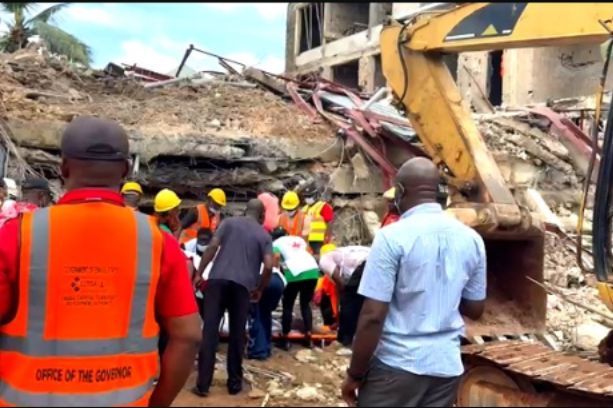
An early-morning building collapse in Enugu has left one person dead and four others injured after a four-storey structure under construction suddenly gave way in the Independence Layout area of the state.
The incident occurred around 6 a.m. on Sunday on Ogbalu Street, where workers were reportedly sleeping inside the construction site when the building collapsed.
Four workers were pulled from the debris alive and taken to the Enugu State Teaching Hospital for medical treatment.
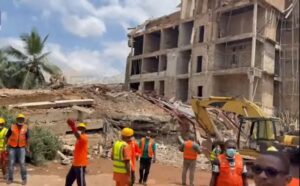
Authorities said six people had been sleeping at the site before the incident, but one of them had reportedly stepped out shortly before the structure came down. The body of another victim was recovered from the rubble.
The rescue operation has drawn the involvement of several emergency and security agencies, including the National Emergency Management Agency, Nigerian Red Cross Society, State Emergency Management Agency, Enugu State Capital Territory Development Authority and the Police.
Officials are still working at the scene to determine whether anyone else may be trapped beneath the debris.
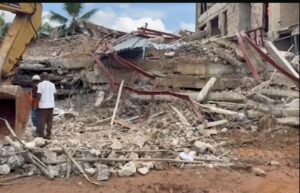
The cause of the collapse remains unknown as of the time of reporting.
The incident has also renewed questions about compliance with construction standards, site safety and the effectiveness of regulatory monitoring in Enugu.
News
Adeleke Orders Arrests After Associate Ajagungbade Is Reportedly Killed in Ife
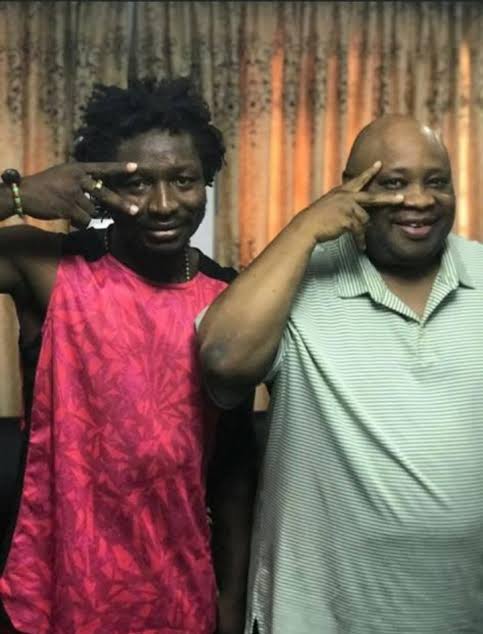
Osun State Governor Ademola Adeleke has directed security agencies to arrest anyone found to have been involved in the reported killing of his associate, Olamilekan Ajagungbade, popularly known as Emir Ajagungbade.
Ajagungbade was reportedly shot dead in Ile-Ife on Sunday amid a dispute connected to the leadership of a motor park.
Reacting to the incident, Adeleke ordered Commissioner of Police Ibrahim Zungura to take immediate action against those responsible. The directive was disclosed by the governor’s spokesperson, Olawale Rasheed.
The governor also ordered rival groups involved in the park dispute to leave the motor parks while security agencies work to restore calm.
“There will be no sacred cows as all culprits will be brought to book” Adeleke said, while urging residents to remain calm.
As part of his response, the governor announced plans to bring back the Park Management System across the state, saying an Executive Order would soon be issued to provide the legal backing for the arrangement.
The renewed system is expected to regulate the operation of motor parks and garages and address disputes over their management.
Ajagungbade was described in the report as a close associate of the governor and a member of the Accord Party.
The circumstances surrounding the shooting and the identities of those responsible had not been fully disclosed at the time of reporting.
News
Police Arrest Two in Delta, Recover Guns, Daggers and Battle Axe
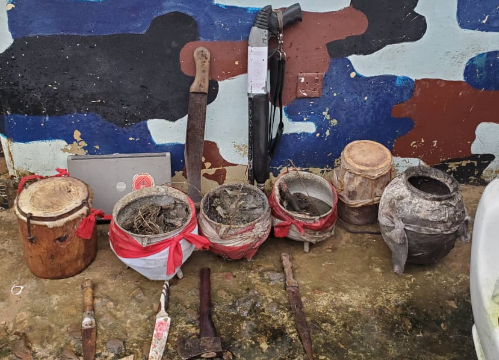
Two suspects are in police custody in Delta State following separate raids that resulted in the recovery of firearms, ammunition and other items, the state police command has said.
The latest operation involved the arrest of Chukwuka Nzete, also known as “Ododo”, in Isupe Community, Ndokwa West Local Government Area.
Police said Nzete was suspected of dealing in illegal firearms and alleged that he ran a shrine used to fortify suspected criminal elements.
Items recovered during a search of his residence included a pump-action gun, four dagger knives, a battle axe and pots containing substances suspected to be charms.
The command said detectives were investigating to establish the extent of Nzete’s activities and whether he had links with other criminal groups.
A separate operation also led to the arrest of Joel Iwomi, 36, in Umuebu, Obiaruku.
According to the police, Iwomi resisted attempts by operatives of the Command Anti-Cult Unit to enter his residence before officers eventually gained access and conducted a search.
The search allegedly produced a pump-action gun and 18 live cartridges.
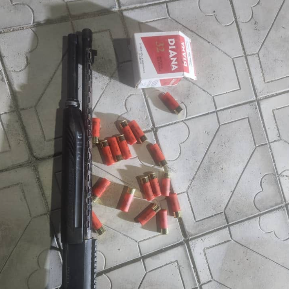
Both suspects have been taken into custody while investigations continue.
The Delta State Commissioner of Police, Samuel E. Erale, said the command would continue efforts to keep illicit firearms away from criminal elements and prevent weapons capable of threatening public safety from circulating in the state.
He urged residents to cooperate with security agencies by reporting suspicious movements, illegal firearms and other criminal activities.
The police said information supplied by members of the public would be handled confidentially.
-

 metro2 days ago
Woman disguises as Muslim woman in Niqab to steal in Ado-Ekiti market, video sparks outrage
-

 metro2 days ago
Ondo Herbal Drink Tragedy: Survivor Vows Never to Drink Again as Death Toll Tops 30
-

 metro2 days ago
Sokoto Cleric Stabbed Twice in Neck After Juma’at Prayer, Attacker Killed
-

 Business2 days ago
Dangote: ₦525 Refinery Shares Could Rise to ₦10,000
-

 Africa2 days ago
Murder of Nigerian Bishop in South Africa Sparks Outcry Over Unsolved Killings
-

 News2 days ago
AI on the Roads: LASTMA Turns to China to Fix Lagos Traffic
-

 Community2 days ago
Kaduna Traditional Rulers Set for 100% Pay Rise as Zazzau Emir Backs Proposal
-
 metro2 days ago
Abia Police Arrest Father, Three Others Over Alleged Attempt to Sell 16-Month-Old Daughter