

metro
FG Denies Payment of Half Salary to ASUU in Oct
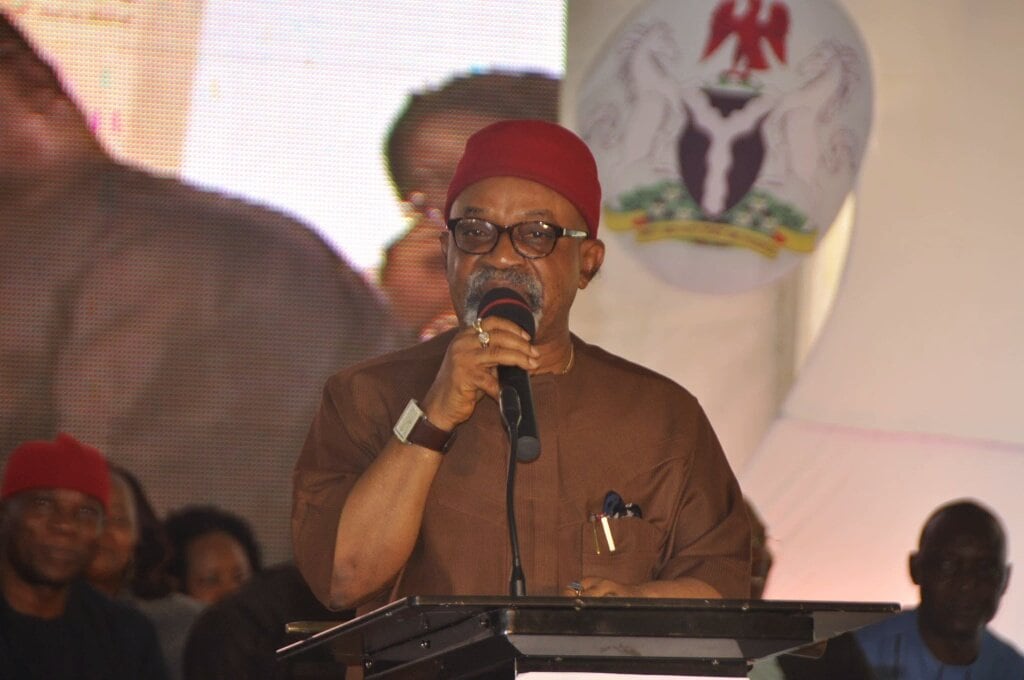
The Federal Government has denied the accusation that it paid members of the Academic Staff Union of Nigeria (ASUU) half salaries in October.
The Head of Press and Public Relations, Federal Ministry of Labour and Environment, Mr Olajide Oshundun, said this in a statement he signed on Saturday in Abuja.
Oshundun said the ministry was reacting to reports on alleged selective treatment and half salary payment to ASUU members.
He described both reports as grossly inaccurate, misleading and barefaced distortion of facts.
He confirmed that members of ASUU were paid their October salary pro-rata, and not half salary as the media widely reported.
According to him, pro-rata was done because they cannot be paid for work not done.
He also said that the Minister of Labour and Employment, Sen. Chris Ngige, never directed the Accountant General of the Federation to pay the university lecturers half salary.
“Following the ruling of the Court of Appeal, which upheld the order of the National Industrial Court of Nigeria (NICN), asking ASUU to go back to work, the leadership of the union wrote to the Minister, informing him that they have suspended the strike.
READ ALSO:
- Elon Musk’s Twitter Begins Collection Of $8 Monthly Subscription Fee
- Half Salary: Fresh Strike Looms As ASUU NEC Meets Monday
- Hackers steal $11m from Nigeria, others
- Troops Kill 3 B/Haram Fighters, Recover Weapons In Borno
“The Federal Ministry of Education wrote to Ngige in a similar vein and our labour inspectors in various states also confirmed that they have resumed work.
“So, the minister wrote to the Federal Ministry of Finance, Budget and Planning, directing that their salaries should be restored.
“They were paid pro-rata according to the number of days they worked in October,’’ he said.
He added counting from the day they suspended their industrial action, pro-rata was done because “you cannot pay them for work not done. Everybody’s hands are tied.”
Oshundun also dismissed a statement by the Chairperson of ASUU, Usman Danfodiyo University Sokoto (UDUS) branch, Muhammad Al-Mustapha, that the Minister of Labour and Employment was bias in the payment of salaries to selected professional members of the union.
“Those obviously being referred to by the UDUS ASUU chairperson are members of the Medical and Dental Consultants Association (MDCAN) who abstained from the eight-month strike of ASUU.
“This is because they abhorred the incessant strikes by the union and its grave effects on medical education in Nigeria and production of more medical doctors.
“Accusing the Minister of Labour and Employment of biased payment of salaries to selected professional members of ASUU is a barefaced distortion of facts.
“Mustapha said he received information that a segment of the staff in the College of Health Sciences (CHS) has been paid seven months of their withheld salaries from March to September.
“He added that this was due to a letter written to the Minister of Finance, instructing the exemption of the listed staff on the application of ‘No Work, No Pay’ rule,“ Oshundun said.
According to him, to set the records straight, the medical lecturers who are being referred to by the Chairperson of ASUU UDUS branch, abstained from the eight-month strike of ASUU.
READ ALSO:
- Post-UTME: Unilorin announces date for commencement of registration
- NDLEA Made No Request To Buy Sniffer Dogs In 2023 Budget
- IPOB members protest, vow to disrupt 2023 election in S/East over non-release of Nnamdi Kanu
He added that the the Medical and Dental Consultants Association (MDCAN) had in a statement corroborated this on Nov. 4.
The association said in the statement, “Realising the emergency situation in the sub-region, worsened by emerging public health threats, we abstained from the strike.
“The medical and dental lecturers in UDUS decided to continue the academic activities during the ASUU strike to save our healthcare from total collapse.”
Consequently, the ministry dismissed the accusation of selective treatment in payment of salaries to ASUU members, urging the media to crosscheck their facts to avoid feeding the public with the wrong information.
However, Prof. Emmanuel Osodeke, the ASUU President, said that members of the union were shocked when they received the half salary payment.
According to Osodeke, we cannot understand what is going on. How do you pay people who are just resuming from a prolonged strike half salary.
“Well, what we need to do, is to sort it out with the Minister of Labour and Employment,” Osodeke said.
NPO









metro
Lagos Club Robbery: Police Arrest Suspect After N5m Bounty
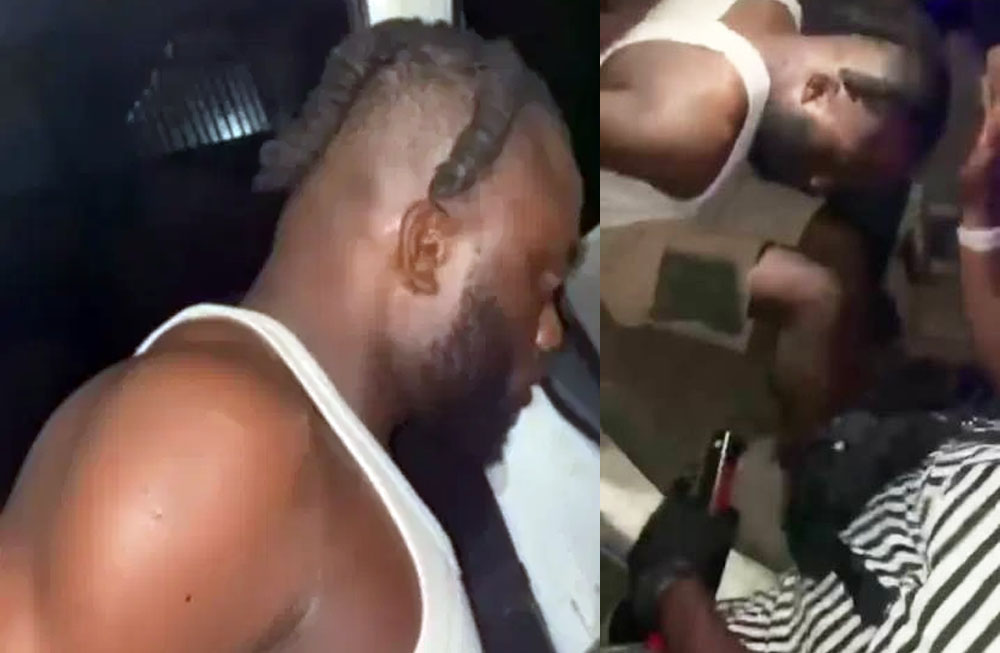
Lagos Club Robbery: Police Arrest Suspect After N5m Bounty
The Lagos State Police Command has arrested a suspected member of the gang that allegedly robbed clubgoers outside Ghost and Spirits Lounge on Ekoro Road, Abule Egba, Lagos.
The suspect was reportedly identified from video footage of the incident, which showed several people being attacked outside the entertainment venue in the early hours of the morning.
The Lagos club robbery reportedly occurred at about 4am on Saturday after some customers had left the lounge and gathered around their vehicles.
Footage from the scene showed several clubgoers sitting around a vehicle when the suspected robbers approached.
READ ALSO:
- Five Arrested Near US-Used RAF Fairford in UK Terror Probe
- Kano Upgrades Five PHCs to General Hospitals, Begins Assessment
- Iran Claims Capture of Second US Underwater Drone in Strait of Hormuz
One of the suspects, reportedly dressed in a green shirt and cap, appeared to move among the people before allegedly targeting one of the victims.
Another member of the group was reportedly seen in an SUV parked across the road before a gunshot was fired, causing some of the people at the scene to run for safety.
The suspect in the green shirt was then allegedly seen taking a wristwatch from one of the victims, while other members of the group reportedly collected valuables before escaping in their vehicle.
Following the incident, the management of the lounge announced a N5 million reward for information leading to the arrest of the perpetrators.
The reward and subsequent investigation helped the police identify and track one of the suspects, who was eventually arrested.
A police source said the suspect was in custody and being interrogated, with investigators seeking information that could lead to the arrest of the other alleged members of the gang.
The Lagos Police Command has also intensified efforts to locate the remaining suspects, who are reportedly still at large.
The incident has raised concerns among residents and nightlife customers in Abule Egba, particularly over the security of people leaving entertainment venues during the early hours.
Police authorities have urged residents with useful information about the suspects or the robbery to assist the investigation.
The arrested suspect remains presumed innocent unless proven guilty in court, while investigations continue into the alleged robbery and the identities and whereabouts of the other suspects.
Lagos Club Robbery: Police Arrest Suspect After N5m Bounty
metro
Passenger Dies After Jumping From Moving Bus In Lagos
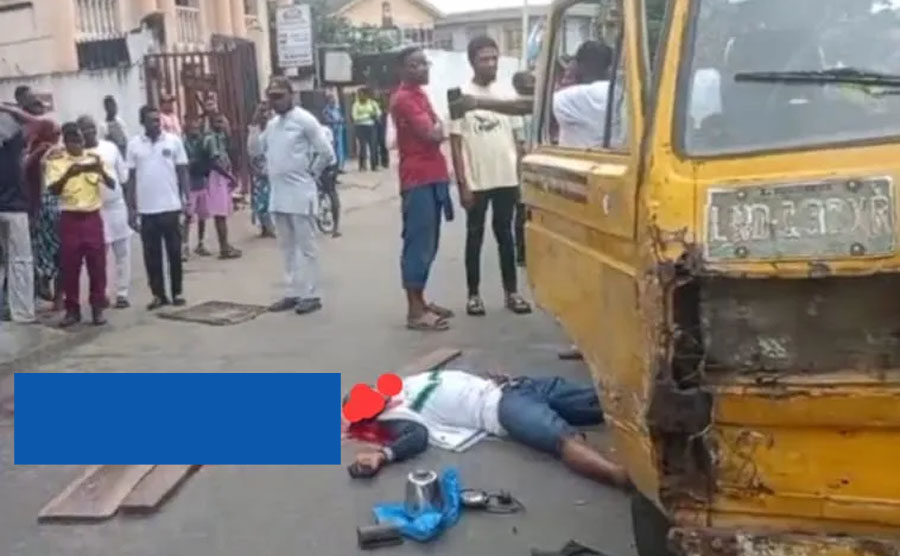
Passenger Dies After Jumping From Moving Bus In Lagos
A passenger has died after jumping from a moving commercial bus at Ogunlana Junction, inward Ojuelegba, in the Surulere area of Lagos.
The incident involved a Volkswagen commercial bus with registration number LND 130 XR, which reportedly crashed into a median pole around the Fallout area of Surulere.
The Lagos State Traffic Management Authority (LASTMA) said preliminary security reports indicated that the driver was allegedly under the influence of alcohol and had been driving recklessly shortly before the crash.
According to the agency, motorists approaching the bus from behind had to exercise caution to avoid colliding with the vehicle as it reportedly moved erratically.
Amid the incident, a male passenger reportedly jumped from the moving bus, apparently attempting to escape from the uncontrolled vehicle. He sustained serious injuries after hitting the ground and later died from his injuries.
LASTMA officials conducting routine traffic surveillance along the Ojuelegba axis responded to the scene after noticing the crash. They secured the area, managed traffic and removed the damaged bus and the deceased passenger from the carriageway to reduce the risk of a secondary collision.
READ ALSO:
- Five Arrested Near US-Used RAF Fairford in UK Terror Probe
- Kano Upgrades Five PHCs to General Hospitals, Begins Assessment
- Iran Claims Capture of Second US Underwater Drone in Strait of Hormuz
Police officers from the Area C Police Division, Ojuelegba, provided security at the scene, while officials of the State Emergency Management Agency evacuated the remains of the deceased.
LASTMA General Manager, Olalekan Bakare-Oki, described the incident as a reminder of the dangers associated with driving under the influence of alcohol, reckless driving and operating vehicles that may not be mechanically fit for the road.
Bakare-Oki urged commercial and private motorists to conduct comprehensive checks on their vehicles before every journey, with particular attention to the braking system, tyres, steering mechanism and other critical safety components.
He also commiserated with the family of the deceased and reaffirmed LASTMA‘s commitment to responding promptly to road crashes, managing traffic and clearing accident scenes.
The agency urged motorists and other road users to report accidents, vehicle breakdowns and other traffic obstructions through its toll-free short code, 3367.
Passenger Dies After Jumping From Moving Bus In Lagos
metro
Kubwa Explosion: Vehicle Crashes Into Gas Outlet, Damages Nine Shops
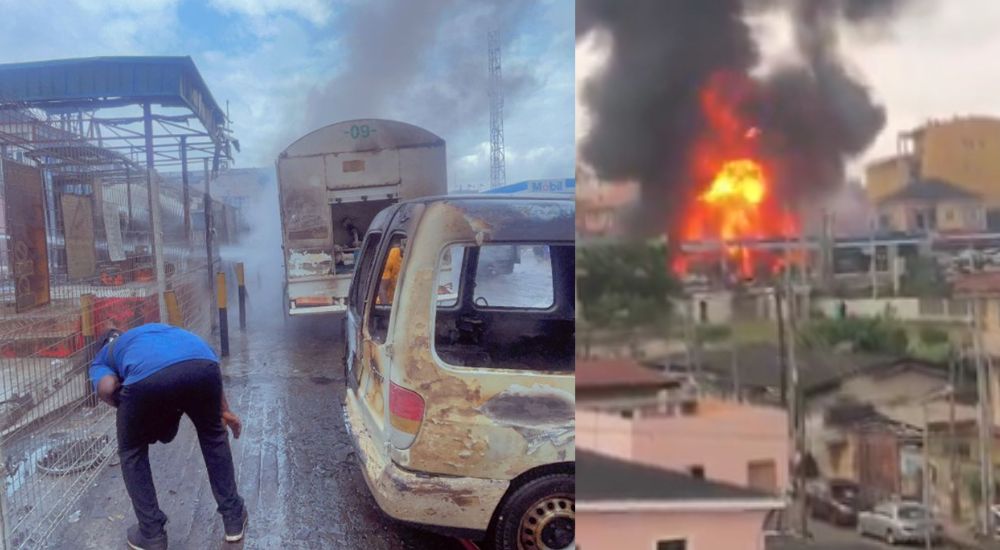
Kubwa Explosion: Vehicle Crashes Into Gas Outlet, Damages Nine Shops
Panic broke out in Kubwa, Abuja, on Sunday morning after a gas explosion rocked the Liberty Junction area, following a vehicle crash into a roadside gas retail outlet.
The incident occurred at about 6:15 a.m., sending a powerful blast through the area and causing nearby buildings to shake, while thick smoke and flames rose from the affected facility.
The vehicle reportedly veered off the road and crashed into the gas outlet, triggering the explosion and subsequent fire.
The impact affected several businesses around the junction, with reports indicating that nine shops were damaged or destroyed by the ensuing fire.
A nearby police traffic post was also reportedly uprooted by the force of the explosion, while other structures and sections of the surrounding area were damaged.
The vehicle involved in the crash was badly burnt in the incident. Emergency responders, however, reportedly rescued the driver and a child from the wreckage.
The injured driver was taken to a medical facility for treatment, while emergency personnel worked to prevent the fire from spreading to other shops and properties in the densely populated area.
READ ALSO:
- Newlywed Arrested After Allegedly Excreting 72 Cocaine Wraps at Enugu Airport
- Bauchi Police Arrest Four Over Alleged Gun-Making, Rape
- Tinubu to Nigerians: We Are Correcting Past Mistakes, Give Us More Time
The explosion triggered panic among residents and commuters, with people reportedly rushing away from the scene as the fire continued to burn.
Emergency response agencies, including the Federal Fire Service, FCT Fire Service, National Emergency Management Agency (NEMA), Nigeria Security and Civil Defence Corps (NSCDC) and the Nigeria Police Force, were deployed to the scene.
Firefighters battled the flames for hours before the situation was brought under control.
The incident also caused significant traffic disruption around Liberty Junction and the Kubwa axis, as motorists slowed down and emergency responders worked at the scene.
Security personnel subsequently moved people away from the immediate area and helped manage traffic while the damaged vehicle and other debris were cleared.
Initial reports did not indicate a confirmed death from the explosion, although the driver was reported to have sustained injuries.
Authorities had yet to provide a detailed official account explaining why the vehicle veered off the road or confirming the full extent of the damage and injuries as of the time of reporting.
The incident has again drawn attention to safety concerns surrounding gas outlets located close to busy roads, shops and residential areas, particularly in densely populated parts of the Federal Capital Territory.
Further assessment by relevant authorities is expected to establish the precise circumstances of the crash, the extent of the property damage and whether any safety breaches contributed to the incident.
Kubwa Explosion: Vehicle Crashes Into Gas Outlet, Damages Nine Shops
-

 News2 days ago
Anambra Releases ₦473m Salary Arrears Document as Obi’s Debt Claim Sparks Fresh Dispute
-
 News2 days ago
Keyamo: ₦70,000 Minimum Wage No Longer Enough as Cost of Living Soars
-
 metro2 days ago
EFCC Chairman Raises Alarm Over Alleged Theft of Nigeria’s Public Funds
-
 Sports2 days ago
AFCON 2027 Qualifier: Nigeria Fight Back to Beat Madagascar 2-1 in Uyo
-
 Politics2 days ago
2027: Otti Explains Why He Supports Tinubu Despite Remaining in Labour Party
-
 metro2 days ago
Umahi Announces First Niger Bridge Reopening Next Week, Orders Tinubu Pictures
-

 Entertainment2 days ago
Jetour Takes Adventure Beyond the Road, Brings Solar-powered Borehole to Ibeju-Lekki community
-
 metro2 days ago
Lagos Police Seal Fake Alcohol Factory, Arrest 48-Year-Old Man