
Opinion
Herdsmen and crabs swimming in Benue’s river of blood
Herdsmen and crabs swimming in Benue’s river of blood
Tunde Odesola
(Published in The PUNCH, on Friday, June 20, 2025)
Long before man dug a hole in every inch of the earth searching for oil, the crab had been in the business of oil drilling. The crab’s house – I mean its burrow – not its shell, is an oil rig at work.
For many Great Akokites, the most beautiful site in the University of Lagos isn’t the 13-storey Senate Building or the golden auditorium – it’s the Lagoon Front. The Lagoon Front is the wide-armed rendezvous where the vast Lagos Lagoon kisses Akoka’s scholarly shoreline, ohing and ahing as water caresses the bank…swoosh, slosh, splosh.
By day, the Lagoon Front is home to thinkers. By night, it’s a love nest to Romeos and Juliets exploring a soft-lit Eden. I was both thinker and wanderer, often tracing the scenic curvy road past the Lagoon Front toward the vice chancellor’s lodge, feet shuffling, thoughts flowing. Great Akokites! Great!
As a student, I was a regular daytime visitor to the Lagoon Front. There, I encountered the crab in its natural habitat. Its burrows were filled with oil water, and I always wondered what the crab had to do with oil. It never occurred to me to research the phenomenon.
But the song of Adawa King, Admiral Dele Abiodun, the Juju maestro, keeps whispering to me, “Epo ti alakan won se, lati bi odun mejo, ko i t’agolo ofo lo ja si,” meaning: “The palm oil being produced by the crab since three years ago, has not filled a single tin – wasted labour.”
Does the crab produce palm oil? I have answers now. The crab does not produce oil. Science says the claw-bearer burrows into mudflats, mangroves or brackish wetlands, where there’s a high amount of decaying organic materials like leaves, algae, or animal waste.
READ ALSO:
- Tinubu chides El-Rufai, says Kaduna no longer toxic, uncontrollable
- Benue killings: Residents harboured killers, fed them, says Defence chief
- FG shuts France, Belgium, Italy visa centres in Abuja
As these materials decompose, they release natural oils, fatty acids and hydrocarbons, forming the shiny or oily film that cloaks the crab’s burrow. Also, some crabs produce mucus-like substances to reinforce their burrows or line the walls. These secretions can reflect light and appear oily, especially when wet. Science washes oil off the burrow.
However, a morality tale in African mythology tells a story of the crab known locally as Akan or Alakan. The Akan isn’t just an armoured crawler, it’s a drunkard, a debtor, a trickster, who frequents the bar of Adaba the Dove, a brewer and merchant of enjoyment.
Regularly, the crab crawls sideways to the dove’s bar, drinks and stands up to go. “Where’s my money?” the dove asks. “I’ll pay you when I come tomorrow,” the crab replies.
The next day, Mr Crab, carrying his pincers like armoured tanks, comes visiting, drinking and enjoying himself. Dove: “Where’s the money for the drinks?” Crab: “I’ll pay you tomorrow.” Days turn into weeks, and Akan fails to fulfil his promise. A shouting match ensues one afternoon. Then, friends advise Akan to go and tell a debt collector — the slithering, cold-blooded Ejo the snake, whose business nomenclature is ògò – debt collecting.
The snake agrees to help Adaba retrieve its money from Akan. So, before Akan arrives the next day to binge, the snake is already seated. After drinking, the crab gets up and heads for the door. “Hey! Where’s my money?” “I’ll give it to you tomorrow.” The dove pounces and calls on the snake to help retrieve all his money. Wahala!
No one has seen the crab run so fast. Maybe the drink was anabolic steroids to its 10 legs. But the snake followed in hot chase, with the dove flapping behind them, cooing, “Bere mu kun-kun, bere mu kun-kun,” meaning – Grab it tightly! Grab it tightly!” But the crab narrowly makes it into its burrow. And, the dove becomes even more agitated, cooing wildly, “Bere mu kun-kun, bere mu kun-kun.”
READ ALSO:
- Chief Imam, 5 others abducted in fresh bandit attack along Gusau–Sokoto highway
- Real reason Tinubu can’t win 2027 election – El-Rufai
- Not the Iran we thought it was: What has changed in the Persian Gulf, by Azu Ishiekwene
This is a tricky test for the debt-collector, who pauses outside the burrow. Eventually, the snake inches its head into the burrow slowly; there was darkness and silence, then a sharp snap – ‘pai’ – and the snake swirls back outside in severe pain, writhing on the ground without its head. The debtor decapitates the debt collector; the crab has done its worst.
Nigeria is a crab republic. Since 1999, corruption wore a green-white-green agbada and sat in the saddle of democracy inside Aso Rock, aiding and abetting the crabs called leaders. Nigerian crabby leaders share similarities with the storied crab. Both sets are debtors, drunkards and tricksters.
Though aeons set the fabled crab and Nigeria’s crab-leaders apart, both are experts in fakery – producing fake oil, selling fake hope, and repaying kindness with evil. Nigerian crab leaders are meaner than the devil.
Where else but in the crabholes of Nigeria do herdsmen slaughter villagers by the hundreds without a single arrest? The crab government knows the killers, but peasant lives don’t matter in the burrows, nor do they matter in Benue, the current scene of bloodshed. Herdsmen are gods. Peasants are dogs.
The serpent swallowed its tail a long time ago when Jona-Dumb looked for his shoelace while the nation burnt, and the skeletal tyrant handed over the country to herdsmen before heading to Katsina ranch. Now, the mafia lord, cigar between clenched lips, presses down his Chicago boots on the masses’ neck, toasting to his impending 2027 electoral victory. “It is my turn!”
Since Olusegun Obasanjo’s reign, herdsmen have painted Nigeria red. Yet no killer has ever worn handcuffs (except once), no machete has been brought to court. But the DSS – Department of Supression and Suffocation – is hounding the call for a shadow government.
READ ALSO:
- Two Islamic clerics arraigned for scamming doctor N280m
- NAF destroys IED factory, terrorists gun trucks in Borno
- Tories want UK to back US action against Iran
There is a WIKEd crab in Abuja, roaming freely and wildly – claws up, ready to fight even its own shadow. He epitomises the crab mentality that defines Nigerian politics – drag others down, cling to power, oppress the oppressed, kill and loot.
For security purposes, the mythical crab safeguards its carapace with its protruding eyes, “oju ni alakan fi n sori,” but the crabs lording it over Nigeria don’t give a hoot if herdsmen level a whole state since they have armed escort, armoured cars and their hands in the till.
If you think that Nigerians don’t know that President Bola Tinubu’s visit to Benue was just a photo opportunity aka photo-op, which will not stop the next bloodbath, take a look at the photo of the mother sitting by the wounded child’s bedside in the hospital when the Secretary to the Government of the Federation, George Akume, came calling. Her stare was icy, helpless and distant as if Akume and his well-fed band never existed. The picture captures Nigerians’ regret and loss of hope in the Tinubu government.
Popular social media influencer, Martins Vincent Otse, aka VeryDarkMan, visited Yelewata and interviewed an unnamed resident in the aftermath of the pogrom. The resident said the police engaged the killers, who later used another route to enter Yelewata and massacre.
Specifically, the resident mentioned Fulani herdsmen as the perpetrators of the mass murder carried out on the rainy night. Yes, rain fell, blood flowed, and the government yawned.
As national leader of the All Progressives Congress, I remember Tinubu disagreeing with those accusing herdsmen of being the killers of the daughter of Pa Reuben Fasoranti in 2022. Tinubu had asked, “Where are the cows?” But the police later arrested the killers, and the court sentenced them to death.
I implore Tinubu’s DSS to carry out a nationwide investigation to unravel if the herdsmen rode into Yelewata on cows. Maybe they will find some chewing cud beside the burnt corpses.
In Nigeria’s crab empire, cows roam, killer herdsmen thrive, lands abound without food, and oil wealth is meaningless. What is the name of a big-for-nothing country?
Email: tundeodes2003@yahoo.com
Facebook: @Tunde Odesola
X: @Tunde_Odesola
Herdsmen and crabs swimming in Benue’s river of blood






Opinion
How opposition Tinubu would treat President Tinubu, By Farooq Kperogi

How opposition Tinubu would treat President Tinubu, By Farooq Kperogi
How opposition Tinubu would treat President Tinubu, By Farooq Kperogi
Opinion
Adelabu’s Power Lines as Laundry Lines
Adelabu’s Power Lines as Laundry Lines
Azu Ishiekwene
In many parts of the country, the rains poured down earlier in the week, bringing much physical and psychological relief from the searing heat.
The absence of electricity from public supply channels made it worse. Average daytime temperatures throughout March ranged from 33 degrees to 38 degrees centigrade in Lagos and Abuja, respectively.
Nigeria’s public electricity grid must rank among the most intractable problems any developing country could face. There is hardly anything more constant than the announcement of grid collapse, which leaves businesses and homes seeking alternatives and incurring unplanned expenses while paying for electricity not supplied.
What Candidate Tinubu promised
During his 2023 campaign, President Bola Ahmed Tinubu said that if he didn’t fix the problem, he shouldn’t be voted in for a second term. He must be regretting that statement now. Since the beginning of his administration in May 2023, there have been multiple grid collapses, with the highest number recorded in 2024 at 12. Even when incidents were fewer, sporadic outages have continued. The failure, on face value, is attributed to a mix of technical, structural and administrative weaknesses in the system. But there is more to it in the sense in which it is said: “The more you see, the less you understand.”
So unreliable is the public electricity supply that the Presidential villa appropriated N10 billion in 2025, and an additional N7 billion in 2026 for the installation of a solar mini grid that will effectively disconnect Nigeria’s seat of power from the national grid, bedevilled by ageing transmission lines which collapse repeatedly from sabotage, poor maintenance, and frequency imbalances.
The joke is on us
Nigerians, ever ready to make a jest of their tragic maladies and long suffering, are beaten when it comes to power outages. They are shocked beyond humour. If the high-tension cables were not too high overhead, people in communities through which they run would not hesitate to hang their laundry on them – knowing from experience that the lines are just part of the landscape and are very likely to be without electricity.
READ ALSO:
- Ondo PDP Rejects Wike Faction, Affirms Loyalty to Turaki‑Led NWC
- Bandits Abduct Seven Family Members, Three Neighbors in Kaduna
- Festus Keyamo Urges ADC to Thank INEC Over Derecognition of Rival Factions
I have seen a video of a masquerade performing on a streetlight pole. Of course, the crowd applauded its invincibility; yet, both the crowd and the masquerade knew better. The lines had not been electrified for months and were unlikely to be for the spell of the circus.
Hope was rekindled at the beginning of the Tinubu administration when news filtered through that the currently embattled former governor of Kaduna State, Nasir El-Rufai, had not only produced a blueprint, but was going to be given the assignment of sorting out Nigeria’s notorious electricity sector. I learnt reliably that, as part of his plan, El-Rufai was discussing a $10 billion investment agreement with the Saudis before he ran into rough weather.
The coming of Adebayo
That was how Adebayo Adelabu took the job – a job at which he has performed so disastrously, saying he failed would be an honour. But it’s not his fault – it’s the fault of the President who appointed him and the Senate that cleared him for a job that he was clearly incompetent to perform, either based on his record or based on any hope of redemption. He is brilliant, but the power sector is littered with the remains of brilliant people, among whom he is now a fossil.
His better years were when he worked as an auditor at PWC. He was also the Executive Director/CFO at First Bank, and later a deputy governor at the Central Bank. He may not have been directly responsible for the misfortunes of these institutions at the time, but he doesn’t exactly smell of roses.
In the normal course of things, his banking career should have been a yellow flag. Still, Nigeria being Nigeria, the quota system and political connections ensured that he defied gravity.
Then, in 2023, Tinubu offered him the position of Minister of Power, after his failed attempt to become governor of Oyo State on the platform of the Accord Party. That only worsened our misery. Adelabu will be best remembered for splitting electricity consumers into parallel payment bands that do not necessarily reflect improved services.
The thing is not that Adelabu failed at his job. It’s the lack of evidence that he tried. Mr Dan Kunle, an energy expert familiar with the history of that sector, told me that, “No one is saying a power minister should provide the resources to fix the sector from thin air. It’s for him to provide a solid framework that would create the right environment and attract sovereign intervention.”
Adelabu, like many of his predecessors, is running the power ministry in 2026 with the 1950 operational manual of the Electricity Corporation of Nigeria (ECN). Yet, even then, when the country had a population of about 50 million, the British knew that electricity was an economic good. To provide meaningful and sustainable service, they had to prioritise not just the key administrative centres but also areas that could pay. That was why, for example, coal was shipped from Enugu to the Ijora Power Station in Lagos.
No roadmap
Adelabu has no roadmap, or if he has one for a population four times what it was under ECN, it’s a roadmap to nowhere. The same old problems persist: gas shortages, moribund plants, infrastructure deficits, massive debts, and frequent grid collapses, limiting supply to about 4,000 MW despite a capacity of 13,000 MW.
READ ALSO:
- INEC Warns ADC Against Holding Convention Without Supervision
- APC Rejects ADC Claims, Says Tinubu Not Responsible for Party’s Legal Troubles
- Fani‑Kayode Fires Back at Peter Obi, Defends NADECO’s Legacy
While Adelabu may wring his hands alongside Nigerians when the lights trip off, the sector has been drowning under the yoke of N6 trillion in debt as of late 2025, fuelled by non-cost-reflective tariffs and unpaid bills to both generating and distribution companies. Some of the problems predate Adelabu, but his incompetence has worsened them.
Yet, he still has ambition. Not to redeem himself after his disastrous three years as minister, but to become the governor of Oyo State. Obviously, he believes the reward for poor performance is a higher office. He is so shameless, it means nothing to him that he holds the Olympic record for national grid collapse. It means nothing to him that Nigerian businesses are powered by Indian generators and their homes by Chinese solar panels.
Examples from Africa
Egypt, with a population of 110 million, has 100 percent universal electricity access, supported by a heavy reliance on gas (81 percent) and growing low-carbon sources like hydropower. This ensures a stable supply amid population pressures.
South Africa serves 85-90 percent of its 62 million residents but faces severe shortages. Frequent load shedding persists due to Eskom’s debt, ageing infrastructure, and maintenance issues, despite high per-capita generation.
Ghana reaches 88-89 percent coverage for 34 million people, with hydro and thermal power dominating. Urban areas enjoy near-99 percent access, while rural areas still have gaps and occasional outages.
Kenya hits 76 percent for 56 million, excelling in urban (97 percent) and geothermal power. Rural expansion lags, though targets aim for full access by 2030.
Compared to the countries above, only 57 percent of Nigerians are grid-connected, with outages occurring 85 percent of the time, and poor metering and corruption that sustain estimated billing and inefficiencies.
After watching Adelabu perform so poorly over the last two years on the national stage, I was hoping he would go away quietly, under the shadow of the darkness he has fostered. But since he insists that he won’t leave quietly – or appears determined to stay on – I’m considering a self-appointed mission to drag him to Oyo State to see how he will turn their night into day.
Adelabu’s Power Lines as Laundry Lines
Ishiekwene is the Editor-In-Chief of LEADERSHIP and author of the book, Writing for Media and Monetising It.
Opinion
Super Bowl: Can Africa Spring Up anew?
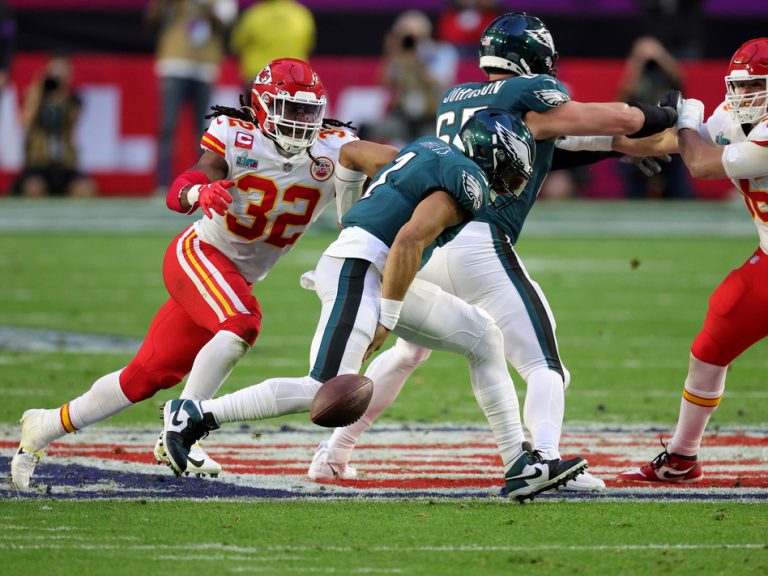
Super Bowl: Can Africa Spring Up anew?
With a landmass of approximately 9.83 million km² and a population of 334–336 million as of 2025—making it the third-largest country in the world—the United States is massive. It is four times the size of Algeria, Africa’s largest country, and dwarfs Nigeria, the continent’s most populous nation.
The United States is a titan among nations. Who knows—perhaps neologists will coin a new term if the U.S. eventually purchases or forcefully takes Greenland from Denmark, further surging its landmass and population. When this massive scale fuses with unparalleled infrastructure, world-class venues, and a vast market, the USA becomes an ideal host for international sporting events with strong returns on investment.
Between 1904 and 2025, the USA hosted one FIFA World Cup (with another to be co-hosted in 2026 with Mexico and Canada), four Summer Olympics, four Winter Olympics, and one FIBA Basketball World Cup. Unlike soccer, which is still finding its footing in the United States—even with Major League Soccer (MLS) having existed for 30 years—American football is the undisputed number-one sport. The Super Bowl—born from Lamar Hunt’s “light-bulb moment”—is the crown jewel. The Super Bowl has become what sociologists call a secular ritual, binding the social fabric of Americans together.
Beyond the Vince Lombardi Trophy, the Super Bowl has evolved into a global marketing masterpiece. From the famous 1984 Apple commercial introducing the Macintosh, which is studied in MBA classes worldwide, to the 1979 Mean Joe Greene Coca-Cola commercial that showed genteel human warmth winning over fearsomeness, the intentionality of brands going head-to-head with rivals has been a recurring feature of every Super Bowl.
While the USA is always attractive for hosting events, the Super Bowl’s success pivots on intellection that results in ingenious marketing. For the recent Super Bowl LX on February 8, 2026, two brands mirrored David Ben-Gurion’s principle of “taking the fight to the enemy.” Pepsi and Anthropic’s Claude entered with an offensive strategy: Claude’s AI ad—“Ads are coming to AI. But not to Claude.”—was a calculated strike in the competitive AI market, while Pepsi’s polar bear blind test revived the sulphurous rivalry with Coca-Cola. Many companies use their ad slots to build brand identity and equity or announce arrival in the business world.
Where does Africa stand in this Super Bowl business and sports calculus? While developed nations are making groundbreaking launches with chutzpah and creativity from creative shops—all resulting in a participatory economy—Africa’s involvement is largely an on-the-field display of Négritude spirit and ravenous passion.
For Africa, the Super Bowl has become a “badge of honor” through representation. Mohammed Elewonibi, a Nigerian raised in Canada, was the first player of African origin to win a Super Bowl (XXVI, 1992, with the Washington Redskins). Since then, nearly 41 players of Nigerian origin or heritage have won—the most of any African country—including six who tasted victory with the recent Seattle Seahawks: Uchenna Nwosu, Nick Emmanwori, Boye Mafe, Jaxon Smith-Njigba (of Nigerian and Sierra Leonean roots), Jalen Milroe, and Olu Oluwatimi.
Yet, as impressive as African athletes are in making the continent proud, we have blatantly failed to translate that audience engagement into commercial windfalls like the Super Bowl on home soil. It is appalling that most of Africa’s sporting events—the Durban July Handicap, Senegalese wrestling (Laamb), or the Safari Rally—have not fully harnessed the intersection of sports and marketing. Even the Africa Cup of Nations (AFCON), despite its 3.45 billion cumulative viewers (far surpassing the Super Bowl’s ~125–127 million), lacks comparable marketing prestige. Why are there no global product launches during our matches? Why aren’t AI giants capitalizing on Africa’s tech startup boom?
Africa is being fed celery when it deserves the whole salad. This asymmetry stems from structural economic factors, but the genie is out of the bottle—we must be forward-looking. To turn African sporting events into “goldmines,” we must reinvent the industry, much as Cirque du Soleil did for the circus. Facing declining audiences, rising costs, and fierce competition, it lost its grip on the circus business. Cirque, however, escaped the dying circus business by reinventing it.
By viewing competition through a new lens, Africa can transform massive viewership into unparalleled economic advantage and value. Just as Cirque du Soleil created uncontested market space, African sports must adopt what W. Chan Kim and Renée Mauborgne called a “Blue Ocean Strategy”—creating uncontested market space and making competition irrelevant. Much as we can not compete toe to toe with advanced economies , we should not follow them like zombies.
In their book Blue Ocean Strategy: How to Create Uncontested Market Space and Make the Competition Irrelevant, the authors highlight how companies in “red oceans” fight for shrinking profits in crowded, defined markets. African sports events currently sit in those crowded red oceans. To elevate them, we need disruptive leaders willing to venture into untapped markets, create new demand, and unlock unlimited growth opportunities.
Joseph Pine and James Gilmore, in their book The Experience Economy, wrote about the need to transform commodities into experiences. As Africans, we have been able to move our sporting events from the commodity stage to the third stage—service delivery—but the experience stage is the North Star we should aspire to reach.
Our cultures, as varied as they are, define us. Despite dilution by Western civilization, our culture stands uneroded, like the mountains that litter our landscape and serve as a canopy to preserve our common heritage. This means our forefathers took culture into the realm of experience—something we are still grappling with in our sporting spectacles today. For us to make headway, our cultures—already bubbling with experience—must mix seamlessly with our sporting spectacles.
Now is the time to merge cultural events like the Eyo Festival, Argungu Festival, Gnaoua World Music Festival, Osun Osogbo Festival, Meskel Festival, and others with our sporting spectacles—that is the Blue Ocean Strategy. This can only be achieved through close collaboration between leaders in sports administration and marketing professionals selling experiences, and the time is now. As this is done, a line from David Diop’s poem Africa—“That is your Africa springing up anew”—would fill our lips.
The experience stage is the nirvana!
Toluwalope Shodunke
Can be reached via tolushodunke@yahoo.com
Super Bowl: Can Africa Spring Up anew?

-
 Africa2 days ago
ECOWAS Recruitment 2026: Over 30 Job Vacancies Open for Nigerians (How to Apply)
-
 metro5 hours ago
JUST IN: FG Publishes List of 48 Individuals, Groups Linked to Terrorism Financing in Nigeria
-

 Health2 days ago
Sleeping Positions: How They Affect Your Health and Which Ones to Avoid
-

 Politics3 days ago
Court Stops ADC Congress, Orders Status Quo in Leadership Row
-
 metro2 days ago
Boko Haram Attack in Borno: Brigadier-General, Soldiers Killed as ISWAP Overruns Military Base
-
 Politics15 hours ago
Did Faleke Just Reveal Lagos’ Next Governor? Party Moves Begin
-
 metro3 days ago
US Evacuates Embassy Staff in Nigeria, Lists 23 States as ‘Do Not Travel’
-

 Education1 day ago
Germany Opens Fully Funded Scholarships for Nigerians, Africans