

Education
‘HNO Must Go’ — WAEC Workers Declare After 9-Hour Talks End in Deadlock

‘HNO Must Go’ — WAEC Workers Declare After 9-Hour Talks End in Deadlock
LAGOS— The crisis rocking the West African Examinations Council (WAEC) in Nigeria has taken a dramatic new turn as workers have called for the immediate termination of the appointment of the council’s Head of National Office (HNO), Dr. Amos Dangut, adding a fresh and explosive dimension to their ongoing grievances over unresolved welfare issues and alleged unfair labour practices.
The workers, operating under the aegis of the Non-Academic Staff Union of Educational and Associated Institutions (NASU) , WAEC branch, made the demand at the weekend following a marathon nine-and-a-half-hour meeting between the union’s branch leadership and WAEC management last Thursday. The meeting, which began at approximately 6:30 p.m. and stretched into the early hours of Friday morning, ending around 3:00 a.m., concluded in a deadlock with no resolution on the majority of the workers’ demands.
According to the Chairman of NASU, WAEC branch, Mr. Kayode Ogunyale, in an exclusive interview with the Nigerian Tribune, workers have now resolved that the only path to peace within the examination body is the removal of the HNO. Ogunyale accused Dr. Dangut of being unwilling to address the contentious issues raised by the workers, noting that while their original demands were nine, the list had increased to 12 issues during the course of the agitation.
“But out of the 12 issues,” Ogunyale pointed out, “management only agreed to address five, which are less critical, leaving out the remaining seven.” He emphasized that the deadlock occurred despite the extraordinarily long hours spent in negotiations. “We started the meeting around 6:30 p.m. on Thursday and ended around 3:00 a.m. on Friday, with three recesses, yet only five minor issues were addressed,” he added.
Ogunyale stated that the matter should not have degenerated to this level if management had handled it with caution, especially with final-year secondary school students nationwide currently taking their terminal examinations. He noted that the union was initially moderate in its approach to show concern for the students, but management’s unfavourable handling of the issues forced their hand.
READ ALSO:
- Verbal Agreement Reached: Mourinho Set For Stunning Real Madrid Return
- El-Rufai Granted N100m Bail in DSS Cybercrime Case
- US, Nigerian Forces Kill 20 ISWAP Terrorists in Fresh Borno Airstrikes
The workers’ demands, which have now expanded, include the suspension of staff upgrade programmes affecting career progression, the introduction of a minimum net pay policy, the formation of disciplinary panels without union representation, and disregard for seniority in promotions. Other grievances include the alleged victimisation of workers, irregular recruitment practices, unfavourable changes in the WASSCE framework (including the reduction of examination subjects from 76 to 38 and corresponding shortening of the exam period), and excessive workload.
Ogunyale declared that the workers are now convinced that the HNO, as the Chief Administrative Officer of WAEC Nigeria, is not “ready to shift ground.” He revealed that the union’s position had fundamentally shifted as a result of the failed negotiation. “So, our number 13 agenda — which is for him to go — has now become the only agenda before us. We informed him of this last Friday during the meeting and have communicated it to our national body. We just do not want him again as our HNO,” Ogunyale said.
While declaring that their next line of action would depend on directives from the NASU national body, Ogunyale vowed that WAEC workers would not back down on their demand for the HNO’s removal, even ahead of the completion of his tenure, which is scheduled to end in September 2026.
The three-day nationwide warning protest conducted by NASU last week — from Wednesday, May 13, to Friday, May 15, 2026 — temporarily paralysed activities at WAEC offices across the country, including the national headquarters in Yaba, Lagos, and regional and state offices nationwide. The protest, which ran daily from 7:30 a.m. to 12 noon, saw workers carrying placards and singing solidarity songs while demanding improved welfare conditions and an end to what they described as “impunity” and “discriminatory practices” within the examination body.
The industrial action followed the expiration of a seven-day ultimatum issued by NASU’s national leadership to WAEC management regarding the nine critical issues. In a letter dated May 5, 2026, and signed by NASU General Secretary, Peters Adeyemi, the union warned that workers would embark on a protest if management failed to address the concerns within the stipulated timeframe. The letter was titled: “Re: A Call For Immediate Stop to the Shady Recruitment Interview Practices.”
The union’s grievances, as contained in the letter, included the suspension of staff upgrade programmes, imposition of a minimum net pay balance policy, unilateral constitution of investigative panels without consultation, reduction of WASSCE duration, coordinated attempts to weaken the union, breach of seniority principle in appointment and placement, incessant dismissals and disproportionate sanctions, examination for promotion, and indiscriminate recruitment of contract Examination Officers and Assistant Examination Officers.
READ ALSO:
- Police Confirm Two Gruesome Family Murders Within Hours in Enugu
- Immigration Service Honours Lasaco Assurance MD Over Product Innovation
- WHO Declares Ebola Emergency as Nigeria Activates Nationwide Monitoring
In response to the initial protest and the union’s demands, WAEC management, in a letter dated May 8 and signed on behalf of the HNO by the Director of Administration, Eucharia Onodu, denied the allegations, insisting that the council operates within established conditions of service and has remained responsive to staff concerns. The management noted that it had looked at the policy on minimum net pay and decided to suspend it forthwith, with a memorandum circulated to that effect.
Regarding the reduction in the number of days for the conduct of WASSCE, WAEC management explained that the decision was based on directives from the Federal Ministry of Education “in view of the realignment/allocation of subjects.” The examination body clarified that the adjustment in examination days was necessitated by the streamlining of WAEC subjects from 76 to 38, and consequently, the shortened number of days reflected the new number of subjects vis-à-vis the hybrid mode of examination conduct.
However, the union rejected this explanation, arguing that the change was implemented without adequate consultation and that students and teachers had not been properly prepared for such a significant shift in the examination framework. This issue was one of the seven that management allegedly refused to address during the marathon meeting.
When contacted on Sunday for a reaction to the union’s demand for his removal, Dr. Amos Dangut told the Nigerian Tribune to contact the council’s spokesperson, Mrs. Moyosola Adesina (also identified as Moyosola F. Adesina), for a response, saying: “Get in touch with the Head of Public Affairs and direct your enquiry to her.”
However, when Mrs. Adesina was reached, she stated that she was not aware of the call for the HNO’s removal. In earlier press statements issued during the three-day protest, Adesina had reassured candidates, parents, school owners, stakeholders and the general public of WAEC’s unwavering commitment to the seamless, hitch-free and successful conduct of the ongoing West African Senior School Certificate Examination (WASSCE) for School Candidates, 2026.
READ ALSO:
- City Boy Movement Empowers 1,000 FCT Women, Backs Tinubu’s 2027 Re-Election
- Oyo School Attacks: Afenifere Urges South-West Govs To Tighten Security
- Makinde Orders Massive Security Crackdown After Oyo School Abduction
Her statement read in part: “While we are concerned about the rights of unions and staff to express their grievances, we are also committed to ensuring seamless and smooth conduct of the ongoing examination.” The council maintained that all disciplinary and career progression matters are handled in line with the WAEC staff handbook and relevant statutory provisions, describing the union’s assertion of “incessant dismissal and inappropriate sanction” as “fallacious.”
The ongoing WASSCE, which commenced on Tuesday, April 21, 2026, involves a total of 1,959,636 candidates from 24,207 schools nationwide. This represents one of the largest examination cohorts in WAEC’s 74-year history of conducting assessments in Nigeria.
The current crisis is not the first industrial action threat by WAEC workers since Dr. Dangut assumed leadership. In December 2024, a salary review committee recommended a 30 per cent salary increase for staff, but WAEC management only implemented a 25 per cent increase, prompting NASU to call for a four-day strike. The strike ended after NASU and WAEC reached a compromise, securing a 27.5 per cent increase.
However, NASU alleged that even after the strike’s resolution, WAEC management continued retaliatory actions, including issuing an internal memo ordering the stoppage of NASU check-off dues deductions. The union noted that WAEC’s actions had violated not only the Memorandum of Understanding signed in March 2025 but also Nigeria’s Labour Act, specifically Section 5(3)(a), which mandates that once a trade union is recognized, employers must automatically deduct and remit union dues without requiring further consent.
As the crisis deepens, Ogunyale has made it clear that the union is prepared to escalate its actions if the demand for the HNO’s removal is not met. “We have communicated this to our national body,” he reiterated. “Further actions will be dictated by the NASU national body, but we will not back down on our demand for the HNO’s removal — even ahead of the completion of his tenure in September.”
Meanwhile, WAEC management has not issued any formal response to the specific demand for Dr. Dangut’s removal. The council’s Public Affairs Department has maintained that dialogue remains open and that management is committed to resolving the issues through established channels.
The unfolding situation represents one of the most serious labour crises in WAEC Nigeria’s recent history, with the potential to disrupt not only the welfare of its workers but also the integrity and smooth conduct of examinations for millions of Nigerian students. As one of Africa’s largest examination bodies, the resolution of this crisis is critical — and with the union now making the HNO’s removal its “only agenda,” the path to resolution appears increasingly uncertain.
‘HNO Must Go’ — WAEC Workers Declare After 9-Hour Talks End in Deadlock






Education
JAMB Aggregate Score 2026/2027: How Nigerian Universities Calculate Your Admission Chances
JAMB Aggregate Score 2026/2027: How Nigerian Universities Calculate Your Admission Chances
Every year, millions of Nigerian prospective students sit for the Unified Tertiary Matriculation Examination with high hopes of securing admission into their dream institution. However, scoring high in JAMB is only the first hurdle in the race. The real determinant of your admission fate lies in your final aggregate score, which institutions use to screen candidates. In this comprehensive guide, newstrends.ng examines the essential components of university aggregate calculation and breaks down how different Nigerian institutions calculate these final screening points in clear, simple terms.
Understanding Your University Aggregate Score
An aggregate score is the total combined percentage mark that a university uses to evaluate a candidate’s readiness for a specific course. It combines various academic assessments into a single standardized percentage scale that allows institutions to rank applicants objectively. Nigerian universities do not rely solely on your JAMB score to grant admission into competitive courses. Instead, institutions combine your JAMB result with your Post-UTME performance and, in many cases, your O’Level grades to form a cumulative score over 100 percent. Understanding this calculation gives you a clear picture of where you stand before departmental cutoff marks are officially released. It helps you gauge whether your combined academic profile meets the requirements of your chosen field of study or if you need to consider a change of course. This knowledge empowers you to make informed decisions about your academic future rather than waiting anxiously for admission lists that may not favor you.
The Core Components That Determine Your Admission Score
The three main elements used by federal, state, and private universities across Nigeria to determine your final admission score are JAMB UTME scores, Post-UTME screening marks, and O’Level results. Your JAMB score is originally calculated out of 400 total marks, and to fit into most university grading formulas, this score is usually scaled down to represent a specific percentage of your overall screening score, most commonly 50 percent. The Post-UTME examination or screening exercise forms another major fraction of the total mark. Depending on the university, this screening may involve a physical computer-based test or an automated grading system based on your WAEC or NECO results. O’Level results are graded based on your top five relevant subjects, including English Language and Mathematics, which are compulsory for most courses. Universities assign specific point values to distinct grades, rewarding distinctions like A1 with higher points than credits like C6, which means candidates with strong O’Level performances gain a significant advantage in the screening process.
READ ALSO:
- Davido Halts London Concert, Threatens to Walk Off Stage Over Fan’s Disrespect to Staff
- Davido Halts London Concert, Threatens to Walk Off Stage Over Fan’s Disrespect to Staff
- 29-Year Kwankwaso Ally Who Swore on Qur’an Defects to APC
The Most Common Calculation Model: 50:50 Ratio
The 50:50 ratio model is the most widely adopted calculation formula among major Nigerian federal universities, including the University of Ibadan and the University of Lagos. In this system, JAMB carries 50 percent of the weight, while the Post-UTME exam accounts for the remaining 50 percent. This balanced approach gives equal importance to your performance in the national entrance examination and the university’s own screening test. To calculate your score under this system, you first divide your JAMB score by 8. For instance, if you scored 280 out of 400 in JAMB, dividing 280 by 8 gives you 35 percent out of the available 50 percent. Next, you take your Post-UTME mark, which is typically scored out of 100, and divide it by 2. If you score 70 out of 100 in your Post-UTME exam, dividing 70 by 2 gives you 35 percent. Finally, you add both derived values together. Adding 35 percent from your JAMB score to 35 percent from your Post-UTME gives you a final aggregate score of 70 percent, which represents your total screening mark. This straightforward calculation makes it easy for candidates to estimate their standing before admission lists are released.
How the O’Level Point System Works
Some institutions, such as Obafemi Awolowo University and several state universities, incorporate O’Level performance directly into the aggregate percentage formula. This model evaluates candidates based on JAMB, Post-UTME, and the grades recorded in their single or combined O’Level sittings. In this variation, institutions allocate specific point allocations to each grade tier. An A1 grade might carry 10 points, B2 carries 9 points, B3 earns 8 points, C4 receives 7 points, C5 gets 6 points, and C6 carries 5 points. The points from your five core subjects are summed up to form a maximum obtainable score for the O’Level component. This total is then converted into a percentage alongside scaled scores from your JAMB and screening tests. Candidates with multiple distinction grades gain a distinct advantage in this system. Having solid grades in WAEC or NECO can boost your overall total and offset a slightly lower score in the UTME. This approach rewards academic consistency across all examination stages rather than placing too much emphasis on a single test.
University-Specific Formulas You Must Know
Understanding that different universities use different formulas is crucial for accurate aggregate calculation. The University of Lagos uses the 50:50 split formula, although some departments incorporate O’Level grades in a 50:20:30 ratio that weighs JAMB at 50 percent, O’Level at 20 percent, and Post-UTME at 30 percent. The University of Ibadan, Nigeria’s premier university, uses the same 50:50 formula, and for highly competitive courses like Medicine, Law, and Engineering, candidates with aggregates below 65 are rarely admitted. The University of Ilorin favours JAMB more heavily with a 60:40 split, giving 60 percent weight to JAMB and 40 percent to Post-UTME. Obafemi Awolowo University uses a three-part formula that weights JAMB at 50 percent, Post-UTME at 40 percent, and O’Level at 10 percent. Ahmadu Bello University Zaria uses a different method where both scores are used directly without scaling, and it is important to note that ABU’s Post-UTME is marked out of 200, not 100. Lagos State University uses a unique aggregate grading system with the formula being JAMB Score multiplied by 0.15 plus O’Level Points, and the minimum JAMB score requirement is 195. These variations mean that you must always verify the exact formula for your specific institution and department.
What Happens in Universities Without Post-UTME
Some institutions skip the Post-UTME exam entirely and screen candidates based only on JAMB and O’Level results. In these cases, universities adopt various weighting systems to ensure fair evaluation. Some institutions use a 50:50 distribution where both JAMB and O’Level scores carry equal weight. Others prefer a 60:40 distribution that favours JAMB performance, while some like UNIZIK use a 70:30 distribution that places heavy emphasis on JAMB scores. These universities calculate your aggregate by applying specific percentages to your JAMB score and converting your O’Level grades to points. The 70:30 distribution gives JAMB a dominant role in the admission process, which means candidates who performed exceptionally well in the UTME but had average O’Level results can still compete effectively. This approach streamlines the admission process and reduces the stress on candidates who would otherwise have to prepare for additional screening tests.
Important 2026/2027 Policy Changes You Should Know
The Joint Admissions and Matriculation Board has announced several significant policy changes effective from the 2026/2027 academic session. The national cut-off marks have been set at a minimum of 150 for universities and 100 for polytechnics and colleges of education. A major reform affecting Colleges of Education states that no admission into 100 or 200 Level is allowed into any College of Education, as all entrants must now enter through the Nigeria Certificate in Education route. Candidates with a minimum of four credit passes seeking admission into NCE programmes are no longer required to sit for UTME, though they must still register with JAMB. Admissions into affiliated degree programmes in Colleges of Education will no longer be allowed. There is now a mandatory O’Level result verification fee of N1,500 for one sitting and N2,000 for two sittings. Public universities must complete their admissions by December 31, 2026, while private universities have a deadline of November 30, 2026. The Post-UTME screening fee has been capped at ₦2,000 to protect candidates from exploitation. These changes reflect JAMB’s commitment to streamlining the admission process and ensuring fairness across all institutions.
Your Final Steps After Calculating Your Score
Once you have computed your aggregate score using your institution’s specific formula, the next step is to monitor official departmental cut-off announcements. Cut-off marks fluctuate annually based on overall applicant performance and available seat capacities, so you should not rely solely on previous years’ figures. If your aggregate score comfortably exceeds the historical cut-off mark for your chosen course, you stand a strong chance of merit admission. If your score falls below the required threshold, you can immediately begin exploring options for a change of course or institution on the JAMB portal before admissions close. Being proactive with your calculation gives you control over your admission journey. It eliminates guesswork and allows you to make informed decisions long before official admission lists are published. Remember to verify the exact formula for the 2026/2027 session on the official university website, as formulas can change annually. When in doubt, calculate using both 50/50 and 60/40 models so you are not caught off guard, and always cross-check your results with the official admission requirements.
JAMB Aggregate Score 2026/2027: How Nigerian Universities Calculate Your Admission Chances
Education
Nigerian Young Academy, LASU to Host 16th International Conference on Convergent Research
Nigerian Young Academy, LASU to Host 16th International Conference on Convergent Research
Five-day event to bring together academics, policymakers, industry leaders to explore interdisciplinary solutions to global challenges
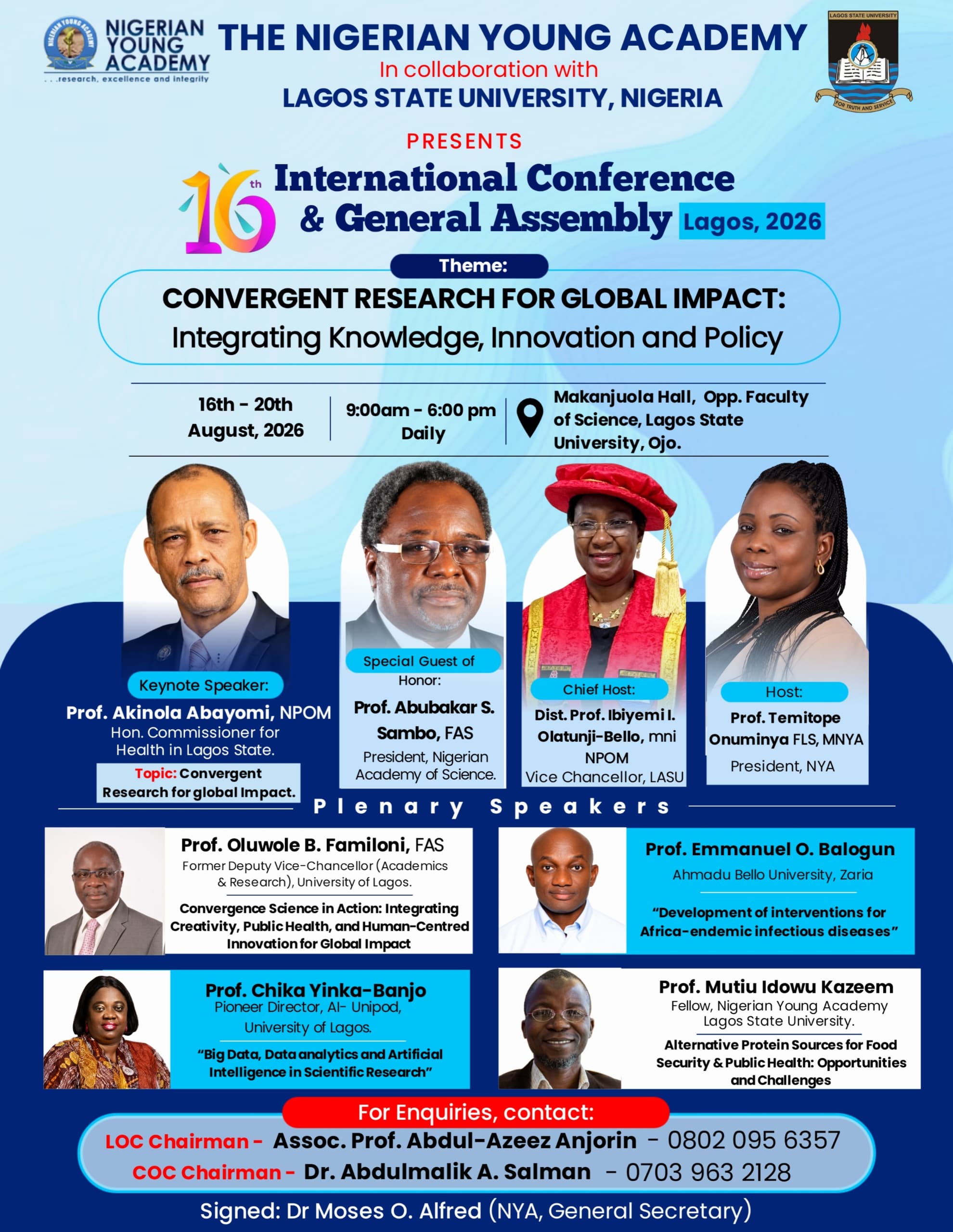
LAGOS — The Nigerian Young Academy (NYA), in collaboration with Lagos State University (LASU), will host its 16th International Conference and General Assembly from 16 to 20 August 2026 at the LASU Ojo Campus, Lagos, the organisers have announced.
The conference, themed “Convergent Research for Global Impact: Integrating Knowledge, Innovation and Policy,” will convene academics, researchers, policymakers, industry leaders, development partners, and civil society organisations from Nigeria and around the world to examine how interdisciplinary research can address complex societal and global challenges.
According to a press release issued by the Academy, the conference aims to showcase cutting-edge research, strengthen collaboration among emerging and established scholars, and promote evidence-based policies that support sustainable development. It underscores the Nigerian Young Academy’s commitment to advancing research excellence, innovation, and leadership.
The five-day programme will feature keynote and plenary sessions, lead paper presentations, oral and poster presentations, scientific awards, networking opportunities, and a pre-conference workshop on “Building Research Capacity in the AI Era: Grant Writing and Practical Data Analysis Using R.”
READ ALSO:
- 2027 Elections: Atiku Raises Alarm Over Outdated BVAS Software, Warns of Manipulation Risks
- Nigerian Army Opens 2026/2027 Short Service Combatant Commission Recruitment – Apply Now
- US, Iran Nearing Peace Agreement, Pakistan Defence Minister
Discussions will span a broad range of themes, including sustainable development, public health systems, disease prevention, urban resilience, smart cities, energy systems, environmental policy, human-centred technology, rural development, food security, agribusiness, ethics in convergence science, and the application of artificial intelligence and machine learning in governance, planning, and risk assessment.
Keynote and Hosts
The conference keynote address will be delivered by Professor Akin Abayomi, Lagos State Commissioner for Health. Professor Temitope Onuminya, President of the Nigerian Young Academy, will host the event, while Professor Ibiyemi I. Olatunji-Bello, Vice-Chancellor of Lagos State University, will serve as Chief Host.
Call for Abstracts and Registration
Researchers are invited to submit abstracts of no more than 250 words between 1 March and 14 June 2026, while submissions for poster presentations will remain open until 24 July 2026. The conference is open to participants from Nigeria and abroad.
According to the Chairman of the Local Organising Committee, Associate Professor Abdul-Azeez Adeyemi Anjorin of Lagos State University, the conference provides an important platform for researchers, professionals, and policymakers to exchange ideas, foster partnerships, and develop innovative solutions that can shape the future of research, innovation, and public policy.
Scholars, students, professionals, and stakeholders across academia, government, industry, and civil society are encouraged to participate. Registration details and additional information are available through the Nigerian Young Academy website.
About the Nigerian Young Academy
The Nigerian Young Academy (NYA) is Nigeria’s foremost interdisciplinary academy for outstanding early-career researchers and professionals. Established in 2010 by the Nigeria Academy of Science, with the support of the Nigeria Academy of Education and the Nigeria Academy of Engineering, the Academy promotes research excellence, leadership, interdisciplinary collaboration, and public engagement.
The NYA is affiliated with the International Science Council, the Global Young Academy, and the Network of African Science Academies (NASAC). Through its conferences, awards, publications, and capacity-building initiatives, the Academy supports the development of young researchers and contributes to national and global development through science, scholarship, and innovation.
For further information, contact:
Dr. Abdulmalik Salman
Conference Organising Committee, Nigerian Young Academy (NYA)
Email: amas2k7@gmail.com
Telephone: +2347039632128
Website: https://nigerianyoungacademy.org
Nigerian Young Academy, LASU to Host 16th International Conference on Convergent Research
Education
Nigerian Mother Gifts Son a Live Goat After Polytechnic Graduation

Nigerian Mother Gifts Son a Live Goat After Polytechnic Graduation
A Nigerian mother has captured the hearts of millions online after she presented her son with a live goat during his sign-out ceremony at the Federal Polytechnic, Nekede, in Imo State. The unexpected gift, captured on video and shared widely across social media platforms, shows Chinyere walking toward her son, Promise Okoro, with the goat in tow as fellow students cheer and celebrate. But behind the unconventional gesture lies a deeply personal story of love, discipline, and a promise kept. This is the full story behind the viral moment, what it meant to the family, and why the mother chose a goat over an expensive car.
Chinyere explained that before her son, Promise, left for the Federal Polytechnic, Nekede, she gave him clear instructions. She warned him against joining cult groups, urged him to remain focused on his studies, and reminded him to always respect his family and others. She made him a promise: if he successfully completed his education and made her proud, she would give him a special surprise. Speaking to BBC News Pidgin on Monday, Chinyere said her son
honoured every instruction. “He has been respectful to the family and everyone. He’s a footballer, and I want to prove my love for him. That is why I bought the goat for him,” she said.
For many, the choice of a live goat as a graduation gift might seem unusual. But for Chinyere, it was a meaningful and practical way to demonstrate her love while fulfilling the promise she had made to her son. “I don’t have money for a 4matic jeep, and I love that guy, my son. I said, let me buy this goat as a gift,” she explained. She noted that although she could not afford an expensive car, she was determined to give Promise something special that would show how proud she was of his achievement. The goat, she said, was a symbol of that pride and a reward for his discipline throughout his academic journey.
READ ALSO:
- Radio Caroline Fined Over False King Charles III Death Announcement
- Osun poll: Adeleke’s wife leads women’s protest over alleged arrests, violence
- FRSC Confirms 15 Dead, 25 Injured in Enagi-Mokwa Road Accident
Chinyere revealed that the goat cost her ₦120,000 – a significant sum that she was willing to pay to keep her word. She told BBC News Pidgin that she was prepared to spend even more if necessary, saying, “I said even if it is ₦200,000, I will try my best to see that I come with that goat.” For a mother who described herself as not wealthy enough to buy a luxury car, the expense was a testament to her commitment to celebrating her son’s success in a way that felt authentic and heartfelt.
The video capturing the moment has since gone viral across platforms like Instagram, Twitter (X), and TikTok. In the footage, Chinyere is seen walking confidently toward her son, leading the goat on a rope, as students erupt in cheers and laughter. She then embraces Promise in a warm hug while fellow students shout in excitement. Chinyere described the students’ reaction as one of the highlights of the surprise. “As I was walking, they were screaming. I was happy, and I knew my son too was,” she recalled.
For Promise, the moment started with complete confusion. He told BBC News Pidgin that he heard students shouting “say yes” and initially assumed they were calling him to witness an engagement ceremony. It was only when a coursemate asked him to come and see his mother that he discovered the reason for the excitement. “I was surprised for her to even call me to come and see my mum because she brought a goat. I was asking if she knew my mum because I wasn’t convinced,” Promise said. Once he realized what had happened, Promise said he felt overwhelmed with happiness and deep emotion. He expressed no embarrassment about his mother’s unconventional gift. “I came, happy and deeply emotional. I wasn’t ashamed. I was extremely happy. I am not even ashamed in school; why then would I be ashamed of my mum or her action?” he said.
The video has sparked widespread reactions online, with many Nigerians praising Chinyere for her creativity and the depth of her love. Commenters described the gesture as a “beautiful display of maternal love” and a “unique graduation memory” that Promise will cherish forever. Some social media users noted that the goat was not just a gift but a valuable asset that could be used for breeding or even sold to support the graduate’s next steps. Others simply celebrated the mother’s determination to keep her promise despite financial constraints.
Promise Okoro has now completed his studies at the Federal Polytechnic, Nekede, and his mother’s gift has turned his sign-out ceremony into a moment that will be remembered not just by his family, but by thousands of people across Nigeria and beyond. While many graduates receive watches, phones, or even cars, Promise received something far more meaningful – a symbol of his mother’s love, sacrifice, and pride in the man he has become.
Nigerian Mother Gifts Son a Live Goat After Polytechnic Graduation
-
 News2 days ago
UK Opens 2026/27 Commonwealth Fellowship Applications for Nigerians – How to Apply
-
![[UPDATED] Osun Election: Police Arrest Lawmaker with 200 PVCs, 146 Suspected Electoral Mercenaries](https://newstrends.ng/wp-content/uploads/2026/08/1786781299004-400x240.jpg)
![[UPDATED] Osun Election: Police Arrest Lawmaker with 200 PVCs, 146 Suspected Electoral Mercenaries](https://newstrends.ng/wp-content/uploads/2026/08/1786781299004-80x80.jpg) Politics2 days ago
Politics2 days agoOsun Decides: Over 100 ‘Imported’ Voters Arrested With New PVCs
-

 Politics2 days ago
Osun Decides 2026: Over 40,000 Security Operatives Deploy as Voters Brave Tensions to Elect New Governor
-

 metro2 days ago
Court Dissolves Marriage After Wife Accused of Nose Ring, Ankle Chain, TikTok Videos with Lover
-

 Entertainment2 days ago
Osun Election: Davido Alleges Soldiers Tried to Stop Him from Entering State
-
metro2 days ago
[UPDATED] Osun Election: Police Arrest Lawmaker with 200 PVCs, 146 Suspected Electoral Mercenaries
-

 metro2 days ago
Working in Canada Without a Permit: IRCC Warns of Serious Immigration Consequences
-

 Politics2 days ago
APC Humiliates Aregbesola, Wins His Polling Unit in Osun Governorship Election