
News
Nigeria to reduce electricity supply to Niger Republic, Benin, Togo

Nigeria to reduce electricity supply to Niger Republic, Benin, Togo
Not more than six per cent of total electricity from the national grid will be supplied to cross-border customers in Benin Republic, Niger and Togo.
The Nigerian Electricity Regulatory Commission (NERC) gave this directive to the System Operator (SO), a department in the Transmission Company of Nigeria (TCN).
NERC said this was done in a bid to increase power availability to Nigerians.
This is coming as the Minister of Power, Adebayo Adelabu, has reportedly disclosed that the Federal Government and the Nigerian Sovereign Investment Authority (NSIA) would make capital injections of N750 billion and N250 billion annual debt financing to bridge the huge electricity metering gap in the country that currently stands at about seven million, according to a ThisDay report.
These details are contained in a document tagged: ‘Interim Order on Transmission System Dispatch Operations, Cross-border Supply and Related Matters’.
The power sector regulator stated that the directive would last for six months in the first instance before a review.
Nigeria supplies a portion of the electricity it generates to some of its neighbours such as the Benin Republic, Niger Republic and Togo.
NERC’s order, dated April 29, 2024, and which became effective from May 1, 2024, was signed by the commission’s Chairman, Sanusi Garba, and Vice Chairman, Musiliu Oseni.
The electricity sector regulator stressed that following the implementation of the April 2024 supplementary order, the commission had observed sub-optimal grid dispatch operation practices.
READ ALSO:
- Edo, Delta areas to experience two-week power outage – TCN
- Coastal highway project to disrupt DStv, GOtv services
- Former Minister of Education Gbagi dies at 62
It argued that this had compromised the Distribution Companies’ (Discos) ability to deliver on its Service Based Tariff (SBT) committed service levels to end-use customers with a significant impact on market revenues.
NERC said the system operator’s sole reliance on limiting Discos’ load off-take/allocation in managing recurring grid imbalances while prioritising international off-takers and Eligible Customers (ECs) is neither efficient nor equitable.
The practice so far adopted by the operator in managing generation availability, it said, had caused significant hardship to Discos’ customers, comprising industrial, commercial, and residential, especially during peak demands while prioritising delivery to other bilateral contracts, including export to international customers.
“The commission hereby orders as follows: The system operator shall develop and present to the commission for approval within seven days from the issuance of this order a pro-rata load-shedding scheme that ensures equitable adjustment to load allocation to all off-takers — Discos, international customers, and eligible customers — in the event of a drop in generation and other under-frequency related grid imbalances necessitating critical grid management.
READ ALSO:
- Russia adds Zelensky to ‘wanted’ list of criminals
- Iheanacho eyes Aston Villa, turns down Leicester’s £65k weekly offer
- 1966 coup: Ohanaeze denies apology to Fulani
“The system operator shall implement a framework to log and publish hourly readings and enforce necessary sanctions for violation of grid instructions and contracted nominations by off-takers in line with the grid code and market,” it stated.
Among others, it further directed that the system operator shall publish and notify all market participants and the commission of the previous day’s hourly log readings of off-take by market participants and the market settlements report by 12:00 noon of the next day.
“The system operator shall ensure that the maximum load allocation to international off-takers in each trading hour shall not be more than six per cent of the total available grid generation.
“The aggregate capacity that can be nominated by a generating plant to service international off-takers shall not be more than 10 per cent of its available generation capacity unless in exceptional circumstances a derogation is granted by the commission.
“The system operator shall henceforth cease to recognise any capacity addition in bilateral transactions between a generator and an off-taker without the express approval of the commission,” it added.
It urged the system operator and TCN to immediately initiate and install integrated Internet of Things (IoT) meters at all off-take and delivery points of eligible customers, bilateral supplies, cross-border trades, and outgoing 33kV feeders of the Discos to provide real-time visibility of aggregate off-take by grid customers.
“The installation of and streaming of data from the IOT meters should be completed within three months from the date of this order,” it added.
Nigeria to reduce electricity supply to Niger Republic, Benin, Togo








News
Teargas, Chaos at EFCC as El-Rufai’s Supporters Clash with Security Operatives
Teargas, Chaos at EFCC as El-Rufai’s Supporters Clash with Security Operatives
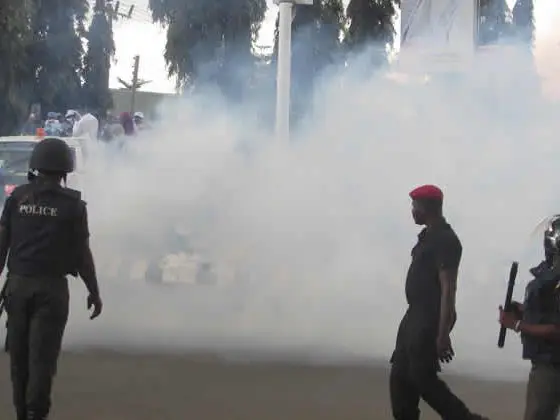
Tension gripped Abuja on Monday as security operatives fired teargas to disperse protesters and supporters of former Kaduna State Governor, Nasir El-Rufai, during a confrontation at the headquarters of the Economic and Financial Crimes Commission (EFCC).
The standoff reportedly occurred when hundreds of El-Rufai’s supporters accompanied him to the anti-graft agency’s headquarters, escalating an already charged political atmosphere in the Federal Capital Territory.
Eyewitness accounts and video footage circulating online showed security personnel deploying teargas canisters as crowds surged toward the EFCC complex.
In one of the videos, agitated voices were heard declaring, “We will come back; when it clears, we will come back,” suggesting the group’s resolve to sustain their protest despite the crackdown.
READ ALSO:
- NSCIA Secretary-General Clarifies Council Receives No Government Funding
- Saudi Supreme Court Calls on Muslims to Sight Ramadan Crescent Moon on Tuesday Evening
- Nigeria Tax Act 2025: FG Clarifies No New Construction or Bank Taxes
The development follows reports last Thursday that El-Rufai was allegedly stopped by security operatives at the Nnamdi Azikiwe International Airport, Abuja, in what his supporters described as an attempted arrest.
While official details surrounding the airport incident remain unclear, the situation appeared to have heightened tensions among his loyalists.
El-Rufai, who served as governor of Kaduna State from 2015 to 2023, remains a prominent political figure and a key voice within Nigeria’s political landscape.
His tenure was marked by sweeping reforms as well as controversy over security challenges and policy decisions in the state.
As of press time, the EFCC had yet to issue an official statement clarifying the circumstances surrounding Monday’s confrontation or addressing reports of any investigation involving the former governor.
Security presence around the commission’s headquarters was significantly reinforced following the clash, with access to parts of the area temporarily restricted.
The incident adds to growing political tensions in the country, particularly as anti-corruption investigations continue to intersect with high-profile political actors.
Teargas, Chaos at EFCC as El-Rufai’s Supporters Clash with Security Operatives
News
NSCIA Secretary-General Clarifies Council Receives No Government Funding

NSCIA Secretary-General Clarifies Council Receives No Government Funding
The Secretary-General of the Nigerian Supreme Council for Islamic Affairs (NSCIA), Prof. Is-haq Oloyede, has clarified that the council has never received financial support from any government, either within or outside Nigeria. Speaking in Lagos at the 31st Annual Pre-Ramadan Lecture of the University of Lagos Muslim Alumni (UMA), Oloyede stressed that the NSCIA operates independently and relies largely on modest private donations to sustain its activities.
Oloyede, who also serves as Registrar of the Joint Admissions and Matriculation Board (JAMB), explained that in his 15-year tenure as NSCIA Secretary-General, the council had not received “a kobo” from any government. He added that fewer than 20 individuals have donated amounts up to ₦500,000 since 2013, highlighting that the council functions without significant external funding. He decried misinformation and divisive narratives suggesting government involvement under the leadership of the Sultan of Sokoto, Muhammad Saad Abubakar, noting that such speculation undermines unity within Nigeria’s Muslim community.
READ ALSO:
- Saudi Supreme Court Calls on Muslims to Sight Ramadan Crescent Moon on Tuesday Evening
- Nigeria Tax Act 2025: FG Clarifies No New Construction or Bank Taxes
- Israeli Airstrikes Kill 12 in Gaza as Violence Persists Despite Ceasefire
Speaking on the theme “Muslims: The Challenge of National Security,” Oloyede warned against viewing insecurity, terrorism, and banditry through a religious lens. He said extremists often cloak their violent acts in religious language, but such actions do not reflect Islam. “Islam cannot be determined by what extremists say or do. We have a duty to correct that narrative,” he said, urging Muslims to reject all forms of extremism while understanding that insurgency thrives on enabling political, social, and economic conditions.
Oloyede stressed that security is central to Sharia, emphasizing that a true Muslim is someone “from whose actions neighbours — regardless of their faith — are safe and secure.” He cautioned against reducing insecurity to regional or religious differences, noting that all parts of Nigeria face security challenges. He called on Muslims to embrace moral responsibility, civic accountability, and practical partnerships to improve national security.
Other speakers at the lecture also highlighted the societal dimensions of insecurity. Dr. Ridwan Jamiu, Chief Imam of Lekki Central Mosque, described insurgents as agents of evil and stressed the need for religious leaders to promote peace and guide followers toward positive community engagement. Lagos State Assembly Speaker Mudashiru Obasa identified poverty and economic inequality as key drivers of insecurity and urged the government and policymakers to focus on job creation, education, and inclusive development as long-term solutions.
The lecture, part of the annual pre-Ramadan engagements, comes at a time when Nigeria continues to grapple with complex security challenges, including insurgency in the Northeast, banditry in the Northwest and North-Central, and rising violent crime in the South. Experts emphasize that national cohesion, interfaith cooperation, and community-led security initiatives are vital to tackling these threats effectively.
NSCIA Secretary-General Clarifies Council Receives No Government Funding
News
Saudi Supreme Court Calls on Muslims to Sight Ramadan Crescent Moon on Tuesday Evening
Saudi Supreme Court Calls on Muslims to Sight Ramadan Crescent Moon on Tuesday Evening
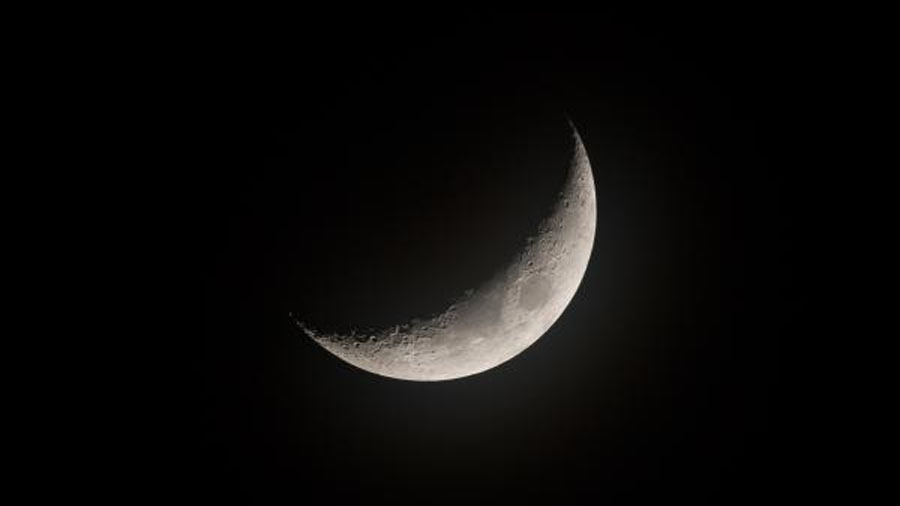
The Supreme Court of Saudi Arabia has urged Muslims across the Kingdom to look for the Ramadan crescent moon on the evening of Tuesday, February 17, 2026, to determine the official start of Ramadan 1447 AH. The court emphasized that community participation in moon sighting is vital for confirming the beginning of the holy month.
In an official statement relayed by the Saudi Press Agency, the Supreme Court instructed anyone who spots the new moon crescent — either with the naked eye or using binoculars — to report their observation to the nearest court and ensure their testimony is recorded. Local centres have also been set up to assist observers in reaching judicial offices.
The Kingdom has established moon sighting committees across regions to coordinate observations and support public involvement. Authorities encouraged citizens to actively participate, noting that their contributions are essential to help Muslims across Saudi Arabia begin Ramadan in unity.
READ ALSO:
- Nigeria Tax Act 2025: FG Clarifies No New Construction or Bank Taxes
- Israeli Airstrikes Kill 12 in Gaza as Violence Persists Despite Ceasefire
- FBI Probe Continues as Ex‑Church Minister Who Confessed to Child Abuse Remains Free
Tuesday corresponds to 29 Sha’ban 1447 AH in the Islamic lunar calendar. If the crescent moon is sighted, Ramadan 1447 AH will commence on Wednesday, February 18, 2026. If the moon is not visible, Sha’ban will be completed as 30 days, and Ramadan will begin on Thursday, February 19, 2026. This aligns with centuries-old Islamic tradition of lunar observation.
Muslims worldwide, including in the Gulf Cooperation Council (GCC) countries, are preparing for Ramadan, a sacred month of fasting, prayer, reflection, and charity. Astronomical forecasts suggest visibility may vary across regions, making local observations and testimonies crucial. Similar calls for crescent moon sightings have also been issued by authorities in countries such as Qatar and the United Arab Emirates.
The Supreme Court’s announcement underscores the importance of lunar observation in Islamic practice and encourages public engagement to ensure a synchronized start of Ramadan across the Kingdom.
Saudi Supreme Court Calls on Muslims to Sight Ramadan Crescent Moon on Tuesday Evening

-
 Education2 days ago
Check Your Name: UNILORIN Releases Updated NELFUND Refund List for 2024/2025 Students
-

 News1 day ago
Osogbo Sons and Daughters Mark 5th Anniversary with Awards, Political Undertones
-

 metro2 days ago
Woman Arrested Over Murder of Nigerian E-Hailing Driver in South Africa
-

 News2 days ago
Afenifere Calls for Immediate Take-Off of State Police as Terror Threats Rise in Yorubaland
-
 metro10 hours ago
US Freezes Assets of Eight Nigerians Over Boko Haram, ISIL, Cybercrime Links
-

 metro2 days ago
Boko Haram Terrorists Release Video of 176 Abducted Kwara Residents
-
 metro2 days ago
US Military Boosts Support for Nigeria’s Fight Against Insurgency With Ammunition, Troop
-
 metro11 hours ago
Terror in Lagos Traffic: Cutlass Gang Unleashes Mayhem on Mile 12–Ketu Road