

metro
Police constables mainly for intelligence gathering, won’t bear arms – Lagos PPRO
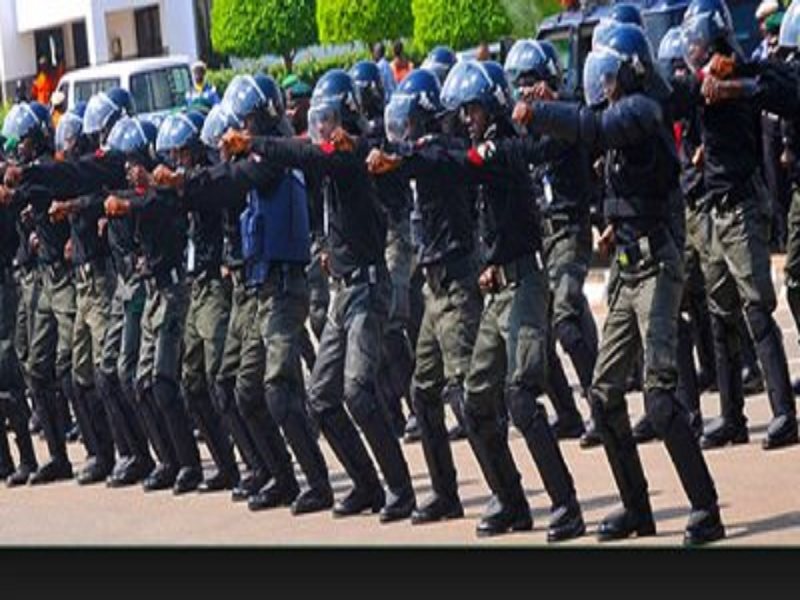
None of the 1,250 special constabulary officers just deployed to boost security in different parts of Lagos will bear arms, the state Police Public Relations Officer, Olumuyiwa Adejobi, has said.
He also said they would be mainly used for intelligence gathering for the regular police to carry out their work effectively.
He said, “For now, there is no provision for that. But everything in life is subject to change; maybe later there will be a law that will back that but for now, there is no provision for them to carry arms.” the PPRO stated
Adejobi spoke in an interview with The PUNCH on Wednesday, adding that the officers deployed on Tuesday by the Lagos State Governor, Babajide Sanwo-Olu, would be attached to divisional headquarters in all of the state’s 20 local government areas.
The constables were deployed as part of the Federal Government’s community policing initiative to combat crime and criminal activities.
The state police command’s spokesman said more constables would be trained to provide more support for the men of the command in the state.
Adejobi said, “They were mopped from all the local government councils in the state. The police assisted in training them and we had a passing out parade yesterday (Tuesday).
“They were trained for almost a month; they were in camp all through the Christmas and New Year season; there were no breaks at all for the one month because they had to finish the programmes. They will be deployed back to their various communities to boost policing in the areas.
“This is the first batch and more batches will be released as long as the state government is willing to assist in mopping them up and release logistics for training.”
He also spoke on the criteria used in the selection process, adding, “There were many criteria used in the selection but academic qualification was not the major thing. In fact, age was not a barrier. All we wanted were those who have mass knowledge of the demographical and geographical nature of their various areas; those who can help us in intelligence policing; those who can help us to have the physique, the stamina to do our job.
“The criteria for selecting them are different from the regular police because they are to complement us.”
“They were selected at various communities with the help of the Obas, the local government chairmen, community leaders, religious leaders, market leaders, youth wings, and all the stakeholders.
“They will be resuming at divisional headquarters in their areas under the various area commanders. They cannot work in isolation. And if at all, we want to go on operations, they can join us but majorly, they will be into intelligence gathering for us and other normal police duties we do, patrols and others.
“We are going to use them judiciously and they are going to be used for the purpose for which they have been recruited to assist the community policing project.”
Also, the Lagos State Government said it would be responsible for the salaries of the constables but said no salary figure had been fixed yet.
The Commissioner for Information and Strategy, Mr Gbenga Omotoso, told The PUNCH on Wednesday that some of the constables were drawn from the Lagos State Environmental Sanitation Corps, Neighbourhood Corps.
“The state government will be responsible for the salaries of the constables but salary figure is not known yet.
“The constables were shortlisted from the Lagos State Environmental Sanitation Corps, Neighbourhood Corps and a few civilians,” he said, adding that more constables would be recruited later in the future for the security coverage of the state.




metro
18 Suspected Bandits Killed as Security Forces Foil Mass Kidnap in Katsina
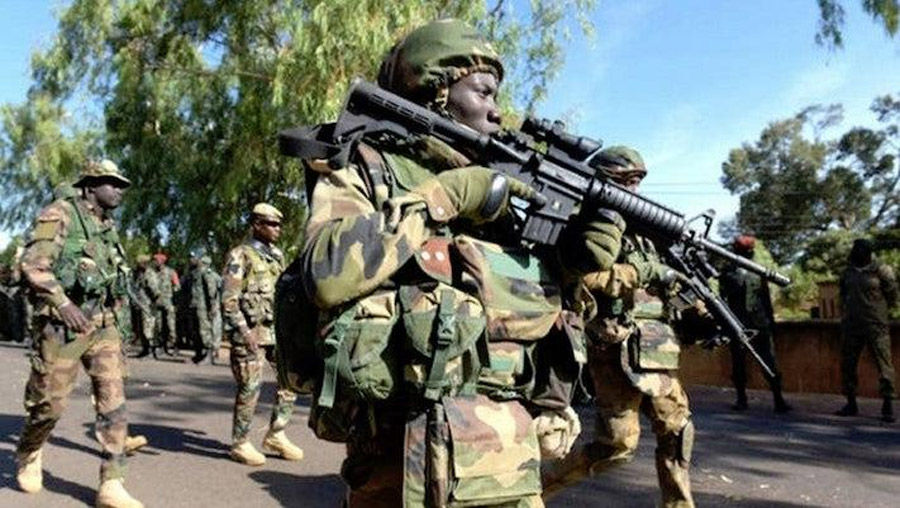
18 Suspected Bandits Killed as Security Forces Foil Mass Kidnap in Katsina
Eighteen suspected bandits have been killed in an intelligence-led ambush that reportedly foiled a planned mass kidnapping in Bakori Local Government Area of Katsina State.
The operation took place at about 1am on Monday, September 21, 2026, at Gidan Iyado, Kakumi Ward, after security personnel received intelligence that an armed group was planning to abduct residents for ransom.
According to the Katsina State Ministry of Internal Security and Home Affairs, the operation involved hunters, members of the Community Watch Corps and local vigilante groups, who laid an ambush and engaged the suspected bandits.
The ministry said 18 members of the group were killed, while no casualty was recorded among the security personnel involved in the operation.
Recovered items included one G3 rifle, two AK-47 rifles, 14 rounds of 7.62mm live ammunition and three motorcycles.
READ ALSO:
- Petrol Depot Prices Fall as Dangote, Marketers Cut Rates, Pump Price Reduction Looms
- 2027: Tompolo-Backed Group Deploys 44 Vehicles for Tinubu-Shettima Campaign in Borno
- MTN, Gates Foundation Launch $25m AI Maternal Health Initiative for 500,000 Nigerian Women
Security personnel also recovered two cows and 94 sheep, which the authorities believe were among livestock allegedly rustled by the group.
The Katsina government identified the alleged leader of the group as Alhaji Musa Duki, whom it described as a former school headmaster who allegedly became a bandit leader operating from Mununu Forest in Faskari Local Government Area.
Authorities said the operation was part of continuing efforts to disrupt bandit networks, kidnapping operations and rural insecurity across Bakori, Faskari and neighbouring communities.
The government said a sustained covert operation was ongoing to locate Duki and other members of the network, identify their hideouts and prevent further attacks.
Katsina State Governor Dikko Umar Radda commended the security personnel and community-based security groups involved in the operation, while urging residents to continue providing timely and credible information to security agencies.
The latest operation comes amid continuing security challenges in parts of Katsina State, where authorities have increasingly relied on intelligence gathering and collaboration between conventional security agencies and community-based security groups to disrupt criminal activity.
The recovered weapons and ammunition have been taken into custody as security agencies continue efforts to dismantle the alleged network and prevent further kidnapping and banditry in the affected areas.
18 Suspected Bandits Killed as Security Forces Foil Mass Kidnap in Katsina
metro
Police Arrest Two Arms Dealers, Recover 300 Rounds of Ammunition in Kaduna
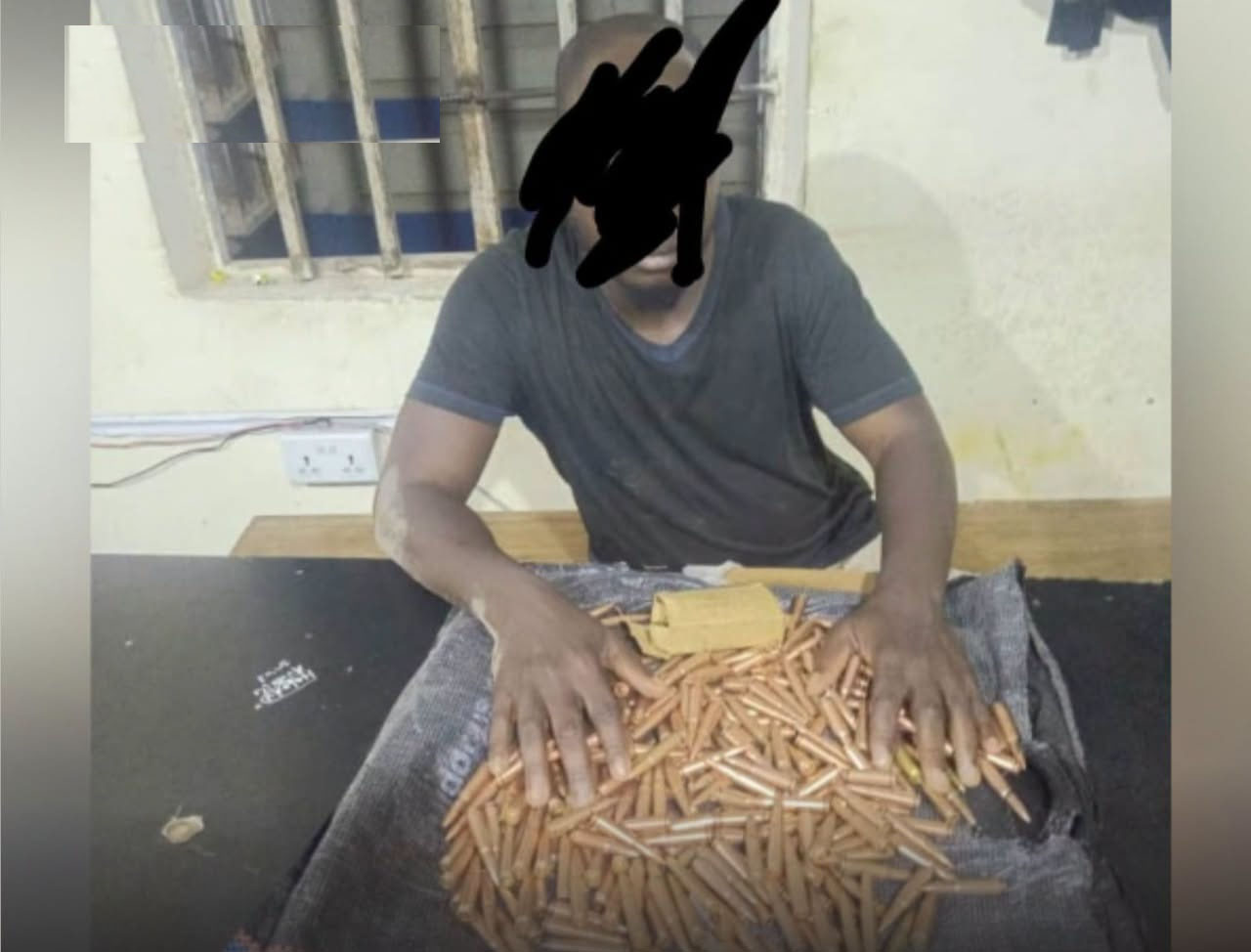
Police Arrest Two Arms Dealers, Recover 300 Rounds of Ammunition in Kaduna
The Kaduna State Police Command has arrested two suspected arms traffickers and recovered 300 rounds of live ammunition in an intelligence-led operation in the state.
The suspects, identified as Rayyanu Adamu and Nasiru Abubakar, were arrested by operatives of the Police Anti-Kidnapping Unit following surveillance around the Giwa and railway station axis.
Police said the operation resulted in the recovery of 270 rounds of AK-47 ammunition and 30 rounds of Type 06 ammunition.
The suspects are being interrogated as investigators work to determine where the ammunition was sourced, its intended destination and whether other people are involved in the alleged trafficking operation.
The arrests come amid increased security operations across Kaduna State against kidnapping, banditry, arms trafficking and terrorist logistics.
READ ALSO:
- Petrol Depot Prices Fall as Dangote, Marketers Cut Rates, Pump Price Reduction Looms
- 2027: Tompolo-Backed Group Deploys 44 Vehicles for Tinubu-Shettima Campaign in Borno
- MTN, Gates Foundation Launch $25m AI Maternal Health Initiative for 500,000 Nigerian Women
In a separate operation, troops of Operation FANSAN YAMMA arrested a suspected terrorist kingpin and two alleged members of his network in Kubau Local Government Area.
Troops also arrested a 50-year-old woman in Igabi Local Government Area who was allegedly transporting 300 rounds of ammunition. The military said preliminary investigations indicated that she had travelled from Zamfara to Lafia before allegedly receiving the ammunition for onward delivery to suspected terrorist elements in Birnin Gwari.
A suspected terrorist logistics supplier was also arrested in Birnin Gwari, with four communication devices recovered during the operation.
The separate operations point to continuing efforts by security agencies to disrupt the movement of arms and ammunition to criminal and terrorist groups operating in Kaduna and neighbouring areas.
The Kaduna Police Command has also recorded other ammunition seizures in recent operations, as security personnel intensify efforts to identify suspected arms suppliers, couriers and their associates.
The two suspects remain in police custody while investigations continue.
Police Arrest Two Arms Dealers, Recover 300 Rounds of Ammunition in Kaduna
metro
Niger Mosque Attack: Bago Says 63 Abducted, 14 Freed, Three Killed

Niger Mosque Attack: Bago Says 63 Abducted, 14 Freed, Three Killed
Niger State Governor, Mohammed Umaru Bago, has said 63 people were abducted during the August 21 attack on worshippers in the Dakera area of Borgu Local Government Area, with three victims killed and 14 others recovered.
Bago’s disclosure provides the first specific official breakdown of the victims following weeks of conflicting reports about the scale of the Niger State abduction.
The governor said 33 worshippers were abducted from a mosque, while the attackers seized another 30 people from a nearby market as they fled, bringing the total number to 63.
He made the disclosure when former Niger State governor and Senator representing Niger North, Abubakar Sani Bello, visited the Government House in Minna to sympathise with the state over recent deaths and security incidents.
Bago also rejected reports circulating on social media that about 500 people had been abducted, describing the figure as exaggerated.
“It was a social media hype. Thirty-three were kidnapped at the mosque, and on their way, they kidnapped an additional 30 in a market, making a total of 63,” the governor said.
He added that three of those abducted had been killed, while 14 had been recovered.
The governor’s account means that, of the 63 people he said were abducted, 17 have been accounted for through deaths or recovery, leaving 46 whose current status was not specified in his latest disclosure.
However, the official figure has not ended concerns over the scale of the wider Borgu mass abduction.
Residents of Dekara and neighbouring communities staged a protest in New Bussa on Monday, September 21, demanding the release of hundreds of people they said remained in captivity more than a month after the attacks.
According to Reuters, residents initially estimated that about 600 people had been abducted during coordinated attacks on several communities. The president of the Borgu Youths Development Association, Abdullahi Yahaya Sadauki, subsequently said community estimates had risen to nearly 700 people allegedly still in captivity.
Reuters said it could not independently verify the higher figure.
READ ALSO:
- UNGA 81: Trump Threatens to ‘Annihilate’ Iran if No Deal Is Reached
- Mambilla: Malami Defends $200m Settlement, Rejects ICC Corruption Findings
- Obasanjo Family, Orji Kalu Among Nigerians Linked to $271m US Property Investigation
The residents are calling for a formal headcount across the affected villages to establish the actual number of people missing, those who escaped and those who were taken into captivity.
The protest also reflected the wider impact of the security crisis in Borgu, with residents saying insecurity has restricted access to markets and healthcare. Shops were reportedly closed in the area as residents observed a shutdown to draw attention to the continued captivity of the victims.
The attack occurred on August 21 when armed men invaded communities in the Dekara district of Borgu, including Gidan-Zana and Kpenya.
Police had initially said armed men stormed Kpenya Mosque during Friday prayers after attacking Gidan-Zana and Kpenya communities. Police spokesperson Wasiu Abiodun said at the time that authorities could not confirm the number of people abducted.
The initial police assessment indicated that no death had been confirmed at that stage, while a joint security team was deployed to the area for assessment and rescue operations.
Residents subsequently told Reuters that more than 60 worshippers had been abducted during what appeared to be coordinated attacks on several communities in Borgu. Reuters noted at the time that it could not independently verify the residents’ account.
The latest developments therefore present two different sets of figures that should not be treated as interchangeable.
Governor Bago’s official account puts the number abducted from the mosque and a nearby market at 63, comprising 33 worshippers and 30 other people. He says three were killed and 14 recovered.
The much higher figure of about 600, later described by community representatives as close to 700 people still in captivity, relates to the broader series of attacks across Dekara and neighbouring communities, rather than necessarily the specific mosque-and-market incident identified by Bago. The higher community estimate remains unverified.
The discrepancy has increased pressure on authorities to establish a comprehensive record of those affected by the attacks.
President Bola Ahmed Tinubu had previously ordered an immediate rescue operation following the August 21 attacks. More than a month later, however, residents say they are still waiting for the safe return of their relatives.
Niger State Commissioner for Information, Obed Nuhu Nana, told Reuters that security agencies had been mobilised and that the government was making efforts to rescue the victims.
Borgu’s location along Nigeria’s western border with the Republic of Benin has also heightened security concerns, particularly because the area covers remote communities where armed groups can operate across difficult terrain.
The continuing uncertainty over the number of victims has left families seeking answers about relatives who have not returned home. Community leaders say a physical headcount remains necessary to determine the true scale of the Borgu kidnapping.
For now, the latest official position is that 63 people were abducted in the mosque and market incidents, three were killed and 14 were recovered. The separate community claim that hundreds more remain in captivity has not been independently verified and requires further official investigation.
The conflicting figures underscore the need for authorities to reconcile community records with security agencies’ information and provide a verified account of the people abducted during the August attacks.
Niger Mosque Attack: Bago Says 63 Abducted, 14 Freed, Three Killed
-
 International2 days ago
18 Suspects Transferred to US Over 2021 Killing of Haitian President Moïse
-

 News2 days ago
NiMet Predicts Thunderstorms, Rain Across Nigeria Till Wednesday
-

 Politics2 days ago
‘Join the Hunt’ — Soludo Urges Igbos to Strategically Align Ahead of 2027
-

 Sports2 days ago
Messi Fires Stunning 75th Career Free-Kick to Reach 930 Goals in Inter Miami Draw
-

 metro2 days ago
My Heart Has Always Been Home With You — Tinubu’s Powerful Message to Oluremi at 66
-

 News2 days ago
Working People United Celebrates Oluremi Tinubu at 66, Commends Her Humanitarian Efforts
-

 News1 day ago
NLC Backs ₦500 Petrol Demand, Workers Propose ₦500,000 Salary
-

 Auto2 days ago
Jetour T1 Storms Abuja as Automaker Accelerates Nigeria Expansion
You must be logged in to post a comment Login