

Business
Senate moves to stop Customs concession of N3tn revenue collection

The Senate Committee on Customs and Excise is set to summon the Comptroller General of the Nigeria Customs Service, Col Hameed Ali (retd.), over the move by the NCS to transfer its tax collection duty to a foreign firm, Sunday PUNCH has learnt.
The Vice Chairman of the committee, Senator Francis Fadahunsi, who disclosed this to a PUNCH’s correspondent on Friday, said the NCS boss was expected to bring all documents relating to the agreement he signed with the foreign firm.
The senator said, “Our committee will write the CG, NCS to demand for the documents with which the agreement was signed. He is expected to bring all the documents relating to the agreement. All of us in the committee did not support the concession idea.
“If the CG, NCS refuses to bring the documents, we will write the Minister of Finance who is the chairman of the board, and a centre point of the deal to bring them. We want to see the agreement. We held a meeting on the issue during the week.
“As soon as we go through the documents and we find out that it is almost the same thing which other administrations had done in the past which is just to find jobs for the ‘boys’, or a special interest for some people to steal our money, we will kick against it.
“There is no amount of money we want to generate in the Customs that the personnel of the Nigerian Customs Service, if properly trained and monitored, cannot generate.
“What is the essence of the seven per cent cost of collection? It is to collect maximum revenue. What the Comptroller General of the NCS should do is to recruit more personnel instead of looking for foreigners to come and spend a false N3.4bn, claiming that they will spend the amount on ICT.
“Meanwhile, the NCS had already awarded a contract of almost N384m early this year on the same scanner that the foreign firm said it would invest money on.”
Foreign firm promises to invest $3.1bn, generate $176bn in 20 years
Investigations by our correspondent recently revealed that the Federal Government had perfected plans to concession the Nigeria Customs Service automation project, also known as the e-customs, to a private firm.
The concessionaires were said to have promised to invest $3.1bn and generate $176bn within the 20-year contract period, estimated at about N3tn per annum.
Findings by our correspondent revealed that the Federal Executive Council had approved the controversial concession contract to Messrs E-Customs HC Project Limited.
It was said to have got the job at the cost of $3.1bn for a period of 20 years under Public Private Partnership arrangement.
However, another firm, Messrs Adani Systems Limited/Webb Fontaine, had faulted the contract award to Messrs E-Customs HC Project Limited.
Adani’s management claimed that it had an existing agreement with the Federal Government to do the same project with nearly the same conditions and insisted that the E-Customs HC wanted to hijack the project.
The development drew the attention of the House of Representatives and it subsequently asked its Joint Committee on Finance and Customs to probe it.
The Joint Committee mandated the parties involved in the controversial contract to maintain status quo ante pending the outcome of the public hearing.
In carrying out their findings, the panels invited the Federal Ministry of Finance, Budget and National Planning, the Attorney General of the Federation and Minister of Justice, the NCS, the Infrastructure Concession and Regulatory Commission and the two contractors.
The panel in its report cited Section 42(1a) of the Procurement Act 2017, the Bureau for Public Procurement on April 11, 2017, which granted certificate of no objection to the CBN recommending Messrs Adani Mega Systems Limited/ Webb Fontaine for the award of the project contract.
It was also discovered by the committee that CBN-TC on the CISS on behalf of the Federal Government engaged and signed contract with Messrs Adani Systems Limited/Webb Fontaine on a Build Operate and Own agreement.
The document indicated that the proposed concession period would last for 20 years on pro- rata sharing of 1 per cent (CISS and NESS) on phase 1 of ($300m) investment.
The committee held that there was a contract agreement entered between the CBB-TC on CISS.
It also held that, although the new consortium presented a letter of engagement from the office of the Chief of Staff to the President and other documents showing the level of work they had done, it was unfortunate that there was no contract agreement with the Federal Government of Nigeria.
Investigations showed that Messrs Adani Systems Limited/ Webb Fontaine had instituted a court case challenging the cancellation of the agreement in December 2018 at the Federal High Court with suit No FHC/ ABJ/CS/2017, demanding $2.5bn as damages.
Based on the suit, the Solicitor General of the Federation wrote the Minister of Finance, urging her to consider the strength and weakness as well as litigation fees.
Meanwhile, the office of the Chief of Staff to the President had issued a letter engaging the consortium to carry out the same project awarded to Messrs Adani Systems Limited/Webb Fontaine seven months after they were engaged by CBN-CISS. The letter, titled, ‘Presidential Initiatives on Customs Modernisation of e-Customs Project,’ was dated September 17, 2019.
The Reps Joint Committee concluded that the Presidency was not duly informed of the existing contract agreement and litigation filed by Messrs Adani Systems Limited/ Webb Fontaine.
It also said there was no evidence before the committee that a contract was signed between the consortium and the Federal Government or CBN- CISS.
The Joint Committee in its recommendations therefore said Messrs Adani Systems Limited/ Webb Fontaine should be allowed to continue with the project so as to avoid unimaginable possible revenue loss to the country.
They also supported a Build-Operate-Transfer delivery method for the project and not Build, Operate and Own.
The report was signed by the chairmen of the House of Reps committees on Finance, Public Petitions and Customs as well as clerks of both committees on Finance and Customs.
Why we are against concession arrangement –Senate committee
But Fadahunsi, in a recent interview, had told our correspondent that the concession plan for the duty collection function would fail because it did not have the blessing of the red chamber and that it ran contrary to the provisions of the Act that established the NCS.
Fadahunsi, a retired deputy comptroller general of the NCS, had said, “As the Vice Chairman of the Senate Committee on Customs and Excise, we are not aware of the concession of the NCS as well as the position taken by the House of Representatives on it. The Senate leadership has not been briefed.
“There were moves in the past to take over the collection of Customs duties by private firms, promoted by people with greedy interest despite the fact that the Act that established the NCS empowers it to collect revenue for the Federal Government; that is why it is enjoying seven per cent cost of collection.
“We don’t need to concession the NCS to any private concern because there are trained customs officers that can collect duties; they have the right environment and modern technology and equipment to do the job more efficiently.
“There was an award of contract early this year for the installation of mobile scanners in Port Harcourt, Tincan and Apapa, Lagos ports. Why should we have such equipment efficient officers and still be thinking of concessioning the NCS?
“I asked the Chairman, House of Representatives Committee on Customs and Excise, who is a retired controller of the NCS and he denied being part of the decision. Members of the committee who don’t know anything about the NCS operations failed to appreciate what our officers can do.
“The other time, the NCS was given a revenue target of N1.6tn and I said giving Customs target is a lazy way of generating revenue because they can collect up to N4tn in a year if they are properly motivated and monitored.
“If the revenue collection of the NCS is transferred to the contractors, they will collect their commission and the Customs will still deduct its seven per cent cost of collection. So, the country would lose.
“The President was not properly briefed that there are adequate and competent hands in Customs that could collect duties. The projection of the private firm is to generate an average of N3tn per year for 20 years whereas officers of the NCS are fully equipped to do more than that.
“The Senate will act appropriately on the proposal whenever it is brought before us. All my colleagues that have spoken with me on the issue have vowed to oppose it, so the arrangement is dead.”
Investigations by our correspondent revealed that past administrations had tried to cede the revenue collection functions of the Nigeria Customs Service to private firms without success since 1999 and foreign firms have been scheming to take over the roles of the second largest revenue generating agency in the country.
Former President Olusegun Obasanjo during his tenure once threatened to scrap the NCS if he had his way.
Shortly after his statement, a foreign firm, Crown Agent, was positioned to take over the revenue collection functions of the Customs in 2001 when Dr Ngozi Okonjo- Iweala was Minister of Finance. The idea was however killed through stakeholders’ intervention.
We’re not aware of any invitation by Senate – Customs
When contacted, the spokesperson for the NCS, Joseph Attah, told one of our correspondents that he was not aware of any invitation by the lawmakers.
He stated, “I’m not aware of any summons or invitation by the Senate or about what you just asked me.”
When asked if the Customs boss would honour the invitation when told about the development, Attah insisted that he would not comment on the matter.
“I said I don’t know of any invitation whatsoever and how am I to comment on what I don’t know about; I’m not aware of what you are talking about,” Attah added.
Customs personnel could do better with adequate training, equipment – Economist
An economist, Prof Sherifdeen Tella, told one of our correspondents that the idea of concessioning collection of customs duties and other levies to a foreign firm was not the best way to go since there are personnel in the NCS who are being paid to do the job.
He said, “Even if the NCS is regarded as underperforming, it does not mean that we have to give their work out to any foreign firm. Such an idea does not augur well for this country. At 60, we are still looking outside for services that we have competent people who could provide in the country.
“We have competent Nigerians who should be able to do the job. There is nothing wrong with concessioning if it is within Nigeria and among Nigerians. We have some experts here who can do it better. Giving the job to a foreign firm is not proper except we have an international aspect of it outside the Nigerian shores and the foreign firm could handle that but if it is within the Nigerian borders, I don’t think that is right.
“Also, it is not as if we are going to disband the NCS, we will still be paying people for not rendering services. It is not right to concession customs duties to any foreign firm. I think someone wants to gain something from that.”
He said the NCS should take advantage of technology to enhance its effectiveness.
Planned concession embarrassing – CACOL, SERAP
The Executive Director, Socio-Economic Rights and Accountability Project, Adetokunbo Mumuni, said no serious-minded government establishment would think of concession any of its units to a foreign organisation. He said it could pose a danger to the territorial integrity of the country and that doing such could merely fall short of concession the running of the country to a foreigner.
He added, “If we could concession collection of duties to a foreign establishment, then the Nigerian government should concession the administration of Nigeria to another foreign body; that is what it means.
“To say you want to concession the collection of your duty, which is your statutory responsibility, to a foreign establishment is a manifestation of unseriousness. It should never be thought of in the current Nigerian enterprise, otherwise the Nigerian government could as well concession the administration of Nigeria to a foreign establishment or a foreign country.”
Also, the Executive Chairman, Centre for Anti-Corruption and Open Leadership, Mr Debo Adeniran, described the move as embarrassing to the country and its people, adding that such would not be acceptable.
He added, “I feel highly embarrassed and it’s embarrassing to the image of Nigeria and to an average educated Nigerian because even the civil servants that are supposed to have been gainfully employed do not have enough job to do and we have enough technocrats that can deal with the collection of duties.
“I don’t believe there is any reason why such a task would be concessioned to a private firm on behalf of the government. If there is any technical expertise that is lacking, there should be capacity building for the customs personnel to be able to carry out their assignment effectively and efficiently.
“More embarrassing is that they are concessioning it to a foreign firm and that is not acceptable. In foreign countries, Nigerians are revered in terms of expertise and technical capacity to carry out any task in any field, so we have what it takes. I hope it’s not the belief that ‘anything foreign is better’ is what is at work here. That move is out of place.”
-Sunday PUNCH








Business
Dangote Refinery Threatens to Export Petrol as Import Surge Disrupts Domestic Market
Dangote Refinery Threatens to Export Petrol as Import Surge Disrupts Domestic Market
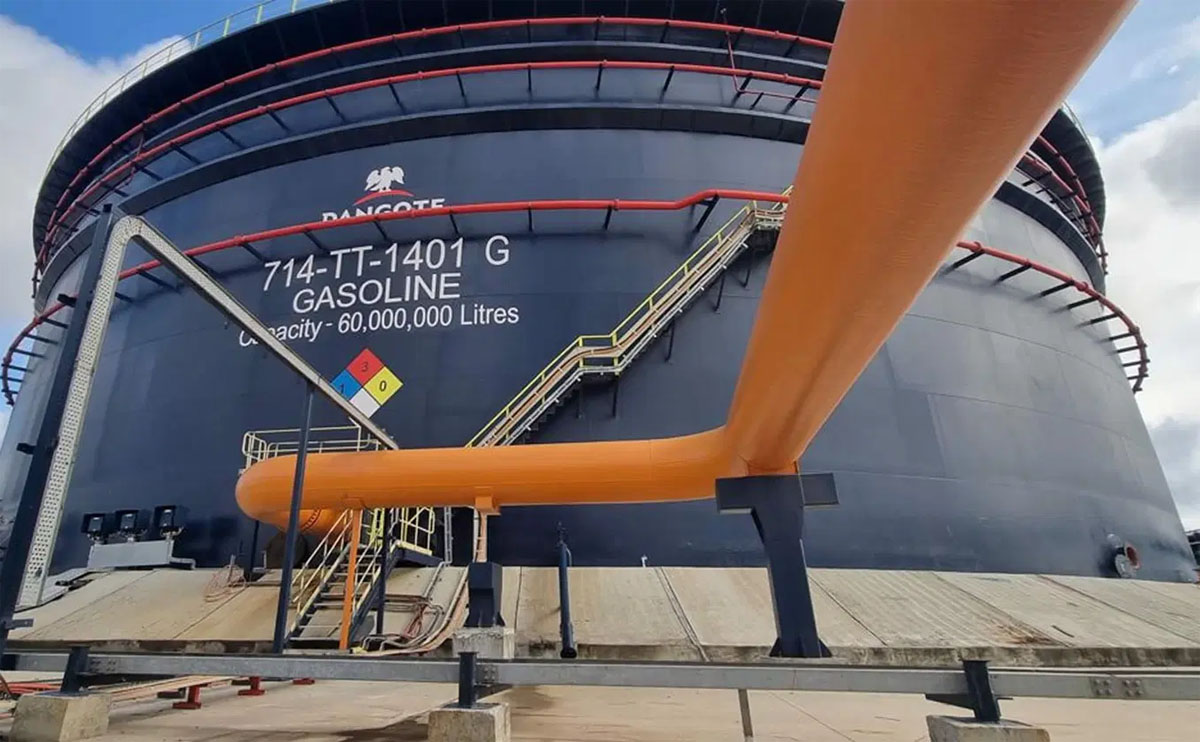
The Dangote Petroleum Refinery has warned that it may increase petrol exports as rising imports create uncertainty over domestic demand, making production and inventory planning increasingly difficult. The company said imported Premium Motor Spirit (PMS) accounted for approximately 43 per cent of fuel supplied into the Nigerian market in July, despite its capacity to meet and exceed domestic requirements. The refinery said the continued issuance of petroleum product import licences had created uncertainty in demand planning and inventory management, forcing it to reconsider how much petrol it should keep in stock for the domestic market. According to the company, it has consistently maintained sufficient inventory and reserved product volumes to guarantee steady supply since commencing operations, requiring significant investments in storage, logistics and working capital.
The company said the lack of transparency over the volume of imported petrol expected into the country was making it difficult to plan production and inventory efficiently. “As a responsible energy provider, we have always endeavoured to keep adequate reserves to satisfy local demand at all times. However, in an environment where significant volumes of imported PMS continue to enter the market through licences issued by the regulator, and where there is limited visibility on future import volumes, it becomes commercially unsustainable to continue holding excess inventory indefinitely,” the refinery said in a statement. The refinery explained that maintaining large stock positions without clear visibility into import volumes imposes substantial carrying costs and ultimately undermines efficient market operations.
READ ALSO:
- Police challenge VDM to prove officers are aiding kidnappers
- ‘I Stand With Him 100%’: Wife Defends Odogwu Asaba Against Rape Allegation
- PFIPC Probe: ICPC Indicts Civil Servants Over ₦1.3bn Fake Agency Scandal
The refinery said surplus products that were not immediately absorbed by the domestic market would have to be exported to regional and international markets. It stressed that the development should not be interpreted as a withdrawal from the Nigerian market, insisting that it remained committed to ensuring adequate fuel supply across the country. “Consequently, DPRP’s export volumes have increased in recent months, not because local demand cannot be met, but because excess inventory generated by market uncertainty must be evacuated to avoid unnecessary storage and financing costs,” it emphasised. The company said exports had become necessary to avoid unnecessary storage and financing costs associated with holding excess petrol stocks. It mentioned that it remained ready and able to meet and surpass Nigeria’s petroleum product requirements, while continuing to invest in reliable supply.
Official data from the Nigerian Midstream and Downstream Petroleum Regulatory Authority (NMDPRA) shows how quickly Nigeria’s petrol supply balance has shifted. In May, imported petrol averaged just 5.9 million litres per day, accounting for about 12 per cent of total supply, while domestic sources provided 41.5 million litres per day. The balance shifted dramatically in June. Imports jumped to 18.1 million litres per day—an increase of more than 200 per cent from May—while domestic supply dropped to 32.5 million litres per day. By July, imports had risen further to 19.7 million litres per day as domestic supply declined again to 25.8 million litres per day. The shift marked a reversal from earlier in the year when Nigeria appeared to be moving rapidly towards eliminating petrol imports. Regulators stopped issuing petrol import licences in February after determining that domestic production was sufficient to meet demand.
The dispute over import licences has escalated into legal action. The Dangote Petroleum Refinery has filed a lawsuit against the Federal Government at the Federal High Court in Lagos, challenging the issuance and renewal of fuel import licences by the NMDPRA. The refinery argues that such approvals violate provisions of the Petroleum Industry Act (PIA), which permits imports only when domestic production is insufficient. It also claims the licences breach an earlier court order directing parties to maintain the status quo. The licences were granted to six marketers—including NIPCO, AA Rano, Matrix, Shafa, Pinnacle, and Bono—covering the importation of between 600,000 and 720,000 metric tonnes of petrol. The Nigerian National Petroleum Company Limited (NNPC) has dismissed Dangote’s assertions, claiming that under the PIA, regulators have the discretion to issue import licences to ensure supply security. It has further accused the refinery of attempting to monopolise the market.
The dispute comes at a particularly significant moment for Nigeria’s petroleum industry. Just days before Dangote’s latest statement, the US Energy Information Administration said Nigeria’s seaborne petroleum product exports had increased more than sevenfold since 2023, driven largely by production from the Dangote refinery. Nigeria exported an average of 350,000 barrels of petroleum products per day during the second quarter of 2026, compared with just 46,000 barrels per day in 2023. At the same time, Nigeria’s seaborne petroleum product imports have fallen substantially from nearly 400,000 barrels per day in 2023 to less than 130,000 barrels per day in the second quarter of this year. The refinery, with a nameplate capacity of 650,000 barrels per day, is expected to play a central role in Nigeria’s energy security and foreign exchange earnings as global fuel trade patterns shift amid geopolitical tensions.
The refinery called for greater transparency, improved market coordination, and policies that support local refining, enhance energy security, conserve foreign exchange, and maximise the economic benefits of Nigeria’s investments in domestic refining capacity. It also warned that any future supply shortfalls resulting from market distortions caused by excessive imports and the inability of local refiners to accurately forecast demand should not be blamed on Dangote Refinery.
Dangote Refinery Threatens to Export Petrol as Import Surge Disrupts Domestic Market
Aviation
FAAN reinstates Bolt at airports, denies fixing taxi fares

FAAN reinstates Bolt at airports, denies fixing taxi fares
The Federal Airports Authority of Nigeria (FAAN) has cleared Bolt to resume operations at all airports under its management after reaching an operational agreement with the ride-hailing company.
The development follows growing complaints from travellers over the temporary disruption of e-hailing services at Nigerian airports, with passengers raising concerns about higher transportation costs and reduced options for getting to and from airports.
FAAN also apologised to passengers affected by the disruption, acknowledging that the temporary interruption caused inconvenience and increased transportation difficulties for some travellers.
In a statement by its Director of Public Affairs and Consumer Protection, Henry Agbebire, FAAN said it had listened to the concerns raised by passengers and made the necessary adjustments following constructive engagements with Bolt.
The authority said the agreement with Bolt provides an operational framework that allows the company to resume services while complying with requirements relating to airport security, passenger safety, accountability and orderly transportation.
FAAN’s latest announcement marks a significant development after the authority had faced mounting public criticism over restrictions affecting e-hailing operations at some of the country’s airports. FAAN had earlier maintained that it had not imposed a blanket ban on Bolt, Uber or other e-hailing platforms, but said operators needed to work within an appropriate framework for airport operations. (FAAN)
According to FAAN, airports are highly regulated environments, making it necessary for commercial transportation providers to operate under arrangements that give the authority adequate visibility over vehicles, drivers and passenger pick-ups.
READ ALSO:
- Probe Me Over $16bn Power Spending If You Have Evidence – Atiku Dares FG
- 20-Year-Old Arrested for Allegedly Macheting Father to Death in Anambra
- How Filling Station Sold Me Water Instead Of Petrol – Lagos Resident Recounts Ordeal
The authority said it had been dealing with challenges including passenger solicitation, touting, random pick-ups, unregulated commercial transportation and concerns about safety, security and accountability.
FAAN said these challenges had become more complicated in situations where drivers operate across multiple ride-hailing platforms, prompting the authority to strengthen its oversight of commercial transportation within airport premises.
At the centre of the controversy is the Airport Car Hire Rank Management System (ACHRAMS), which FAAN introduced to bring greater structure and visibility to airport car-hire operations.
FAAN stressed that ACHRAMS is not an e-hailing application and was not created to compete with Bolt, Uber or any other mobility platform. Rather, the authority describes it as an airport-specific system for managing car-hire ranks, dispatch, identification and operational oversight within FAAN-managed airports. (FAAN)
The authority has also rejected suggestions that ACHRAMS was introduced to create a monopoly in airport transportation.
FAAN said it supports competition and does not intend to prevent passengers from choosing between different transportation providers.
The controversy intensified after passengers began complaining about the cost of airport taxi fares, particularly during the period when access to conventional e-hailing services was disrupted.
Reports from Lagos indicated that some passengers were being quoted fares as high as N30,000 for trips from Murtala Muhammed International Airport to parts of Ikeja, while travellers reported substantially lower prices through alternative ride-hailing services. (Aboki Forex)
FAAN, however, has denied claims that it fixed or introduced the airport taxi fares being discussed.
The authority said the fares existed independently of ACHRAMS and were not newly created by the system. According to FAAN, ACHRAMS merely brought greater visibility and transparency to existing airport taxi rates, making the applicable charges more apparent to passengers.
FAAN acknowledged that the comparison with the lower prices many travellers had become accustomed to through e-hailing platforms understandably fuelled public concern over the cost of airport transportation.
The authority said its actions were motivated by regulatory, safety and security considerations, rather than economic interests.
It nevertheless acknowledged that the immediate effect of the temporary disruption was significant for passengers.
FAAN therefore apologised to travellers and said it appreciated their patience and understanding while discussions with e-hailing operators continued.
The authority said the resolution with Bolt demonstrates that it is possible to maintain the integrity and security of the airport environment while preserving the convenience and freedom of choice associated with e-hailing services.
The latest development is also consistent with FAAN’s earlier position that it wanted to establish a workable framework rather than permanently exclude e-hailing companies from airports. On August 20, the authority said discussions with operators were aimed at resolving issues involving passenger safety, security, operational visibility, accountability and the management of pick-up activities. (FAAN)
Bolt’s own airport guidance already requires its drivers operating at Murtala Muhammed International Airport to comply with FAAN rules, including using designated parking areas for pick-ups and drop-offs. Bolt also warns drivers that violations of airport rules can result in penalties or vehicle impoundment. (Bolt)
Bolt’s official Nigeria platform also lists several Nigerian airports where airport transfers are available, including Murtala Muhammed International Airport, Nnamdi Azikiwe International Airport, Mallam Aminu Kano International Airport, Port Harcourt International Airport and Sam Mbakwe International Airport. (Bolt)
FAAN said it remains in discussions with other e-hailing operators and expects outstanding engagements to be concluded in the coming days.
The authority reiterated that passengers remain free to choose from available authorised transportation options that best meet their needs.
FAAN said its responsibility is to ensure that whichever authorised service passengers choose operates within a safe, secure, orderly and accountable airport environment.
The reinstatement of Bolt is expected to give air travellers greater choice and restore access to app-based transportation at FAAN-managed airports, while the authority continues efforts to regulate commercial transportation without compromising passenger safety and convenience.
FAAN assured travellers that their safety, security, convenience and overall airport experience would remain at the centre of its decisions.
FAAN reinstates Bolt at airports, denies fixing taxi fares
Business
Dangote Refinery drives sevenfold surge in Nigeria’s petroleum product exports
Dangote Refinery drives sevenfold surge in Nigeria’s petroleum product exports
Nigeria’s petroleum product exports have surged nearly sevenfold since 2023, with the Dangote Petroleum Refinery playing a major role in the country’s rapid shift from dependence on imported refined products to increased domestic supply and exports.
The latest figures from the United States Energy Information Administration (EIA) show that Nigeria’s seaborne petroleum product shipments averaged 561,000 barrels per day (bpd) in the second quarter of 2026, compared with an annual average of 79,000 bpd in 2023.
The EIA based its assessment on shipping data from energy intelligence firm Vortexa Analytics, which showed that about 350,000 bpd of the products shipped during the second quarter were exported. That compares with an annual average of just 46,000 bpd in 2023.
The dramatic increase has strengthened Nigeria’s position in the international refined petroleum market, with the EIA attributing much of the growth to the commencement of operations at the Dangote refinery in January 2024.
The 650,000-barrels-per-day refinery, located in the Lekki Free Zone in Lagos, has significantly increased Nigeria’s domestic refining capacity and enabled the country to produce larger volumes of petrol, diesel, aviation fuel and other refined products.
“With increased supply of petroleum products in Nigeria from the country’s largest refinery, imports fell, exports increased, and Nigeria became more self-sufficient in refined petroleum products,” the EIA said.
Before the Dangote refinery began operations, Nigeria’s state-owned refineries collectively shipped less than 100,000 bpd of petroleum products to domestic and international destinations, according to the EIA.
The increase in shipments accelerated after the Dangote facility commenced operations and received another boost following the completion of maintenance and expansion work in February 2026.
The work increased the refinery’s crude distillation capacity from 650,000 bpd to 700,000 bpd, allowing the facility to process more crude and increase the volume of refined products available for domestic consumption and export.
READ ALSO:
- Dangote Raises Petrol to N1,200/Litre Despite Crude Price Decline – Second Hike in Five Days
- Atiku Disowns Aide, Vows to Restore Subsidy — But With a Crucial Difference
- Poco Lee to face UK court September 15 over alleged rape and assault charges
- Nigerian Journalism Mourns: Eagle Online Publisher Dotun Oladipo Dies Suddenly at 56
The rise in production has coincided with a sharp decline in Nigeria’s dependence on imported petroleum products. Seaborne imports, which were close to 400,000 bpd in 2023, fell to less than 130,000 bpd in the second quarter of 2026, according to the EIA.
At the same time, the volume of petroleum products transported between Nigerian ports has increased substantially.
Intra-Nigerian petroleum shipments reached 211,000 bpd in the second quarter of 2026, compared with 81,000 bpd in 2025 and only 33,000 bpd in 2023.
The increase indicates that more refined products are being distributed by sea within Nigeria, particularly from coastal refining and storage facilities to other parts of the country.
Nigeria’s growing refining capacity has also opened up greater opportunities in overseas markets, particularly Europe.
EIA data showed that Nigerian seaborne petroleum product exports to Europe averaged 130,000 bpd in the second quarter of 2026. This was up from 40,000 bpd in 2025 and 15,000 bpd in 2023, representing an increase of roughly 767 per cent over the 2023 level.
Nigeria also increased shipments to other African markets. Exports to African destinations outside Nigeria reached nearly 120,000 bpd in the second quarter, compared with 89,000 bpd in 2025.
The country also shipped significant volumes of petroleum products to Asia and Oceania, further demonstrating the expanding reach of Nigeria’s refined fuel exports.
The EIA said the growth occurred partly amid disruptions to petroleum product flows through the Strait of Hormuz, which created opportunities for alternative suppliers as some international markets faced tighter supplies.
The development marks a significant change in Nigeria’s petroleum trade. For decades, the country exported crude oil while importing substantial quantities of refined products because its domestic refineries operated below capacity or remained shut for extended periods.
The Dangote refinery has altered that pattern by increasing the volume of refined products available within Nigeria while creating surplus volumes for export.
The EIA had previously reported that Nigeria’s petroleum product exports almost quadrupled in 2024 following the Dangote refinery’s commencement of operations, rising to an average of 146,000 bpd from 46,000 bpd in 2023.
The refinery’s growing contribution is also coming as its owners prepare for another major expansion. Dangote Group plans to add a second 750,000-bpd crude distillation unit by 2028, which would further increase the complex’s potential refining capacity.
The company is also preparing for a potential initial public offering (IPO). Recent reports indicate that Dangote Refinery is targeting an October 2026 IPO as investors continue to assess the refinery’s crude supply arrangements, production costs and long-term growth prospects.
Despite the significant rise in domestic refining, the refinery still relies partly on imported crude oil to maintain operations. Recent reports indicate that between 30 and 40 per cent of the refinery’s crude supply currently comes from imports.
Nevertheless, the latest EIA data show that the refinery has become an increasingly important component of Nigeria’s downstream oil sector, contributing to higher domestic product availability and a substantial increase in exports.
The development could strengthen Nigeria’s role as a major supplier of refined petroleum products in Africa, particularly as demand for fuels continues to grow across the continent.
For Nigeria, the combination of rising exports, falling imports and increasing domestic shipments represents a major transformation in the country’s petroleum products market.
The latest figures therefore underline the growing economic significance of the Dangote Refinery and its potential to reshape Nigeria’s position in both the domestic and international petroleum market.
Dangote Refinery drives sevenfold surge in Nigeria’s petroleum product exports
-
 News3 days ago
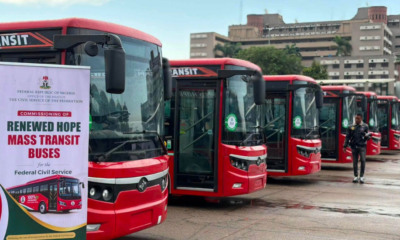
Renewed Hope Mass Transit: FG Launches 100 Electric Buses for Federal Workers
-

 News2 days ago
PFIPC Probe: ICPC Indicts Civil Servants Over ₦1.3bn Fake Agency Scandal
-

 Africa3 days ago
Xenophobic attacks: Ghana rejects MTN’s $1.8m donation for affected citizen
-

 Aviation2 days ago
FAAN reinstates Bolt at airports, denies fixing taxi fares
-

 Politics3 days ago
Ogun 2027: Radio Interview that Triggered APC Move for Hunye’s Arrest, Prosecution
-

 metro3 days ago
Mother, teacher allegedly stage son’s kidnapping, demand N15m ransom from father
-

 metro3 days ago
Several Bandits Feared Killed as Security Forces Repel Attack in Sokoto
-

 metro3 days ago
One killed, three injured as gunman opens fire at Kano wedding
You must be logged in to post a comment Login