Dozens killed again in Gaza as war enters 10th month - Newstrends
Connect with us

International

Dozens killed again in Gaza as war enters 10th month
Published

on

Dozens killed again in Gaza as war enters 10th month

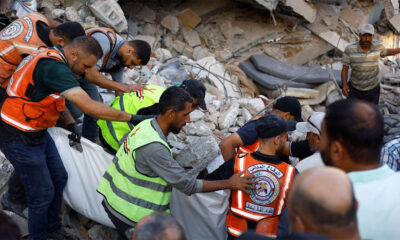
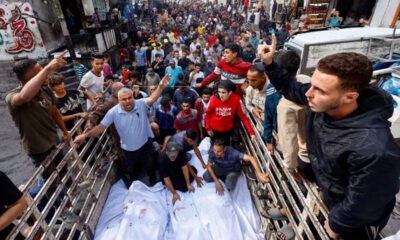
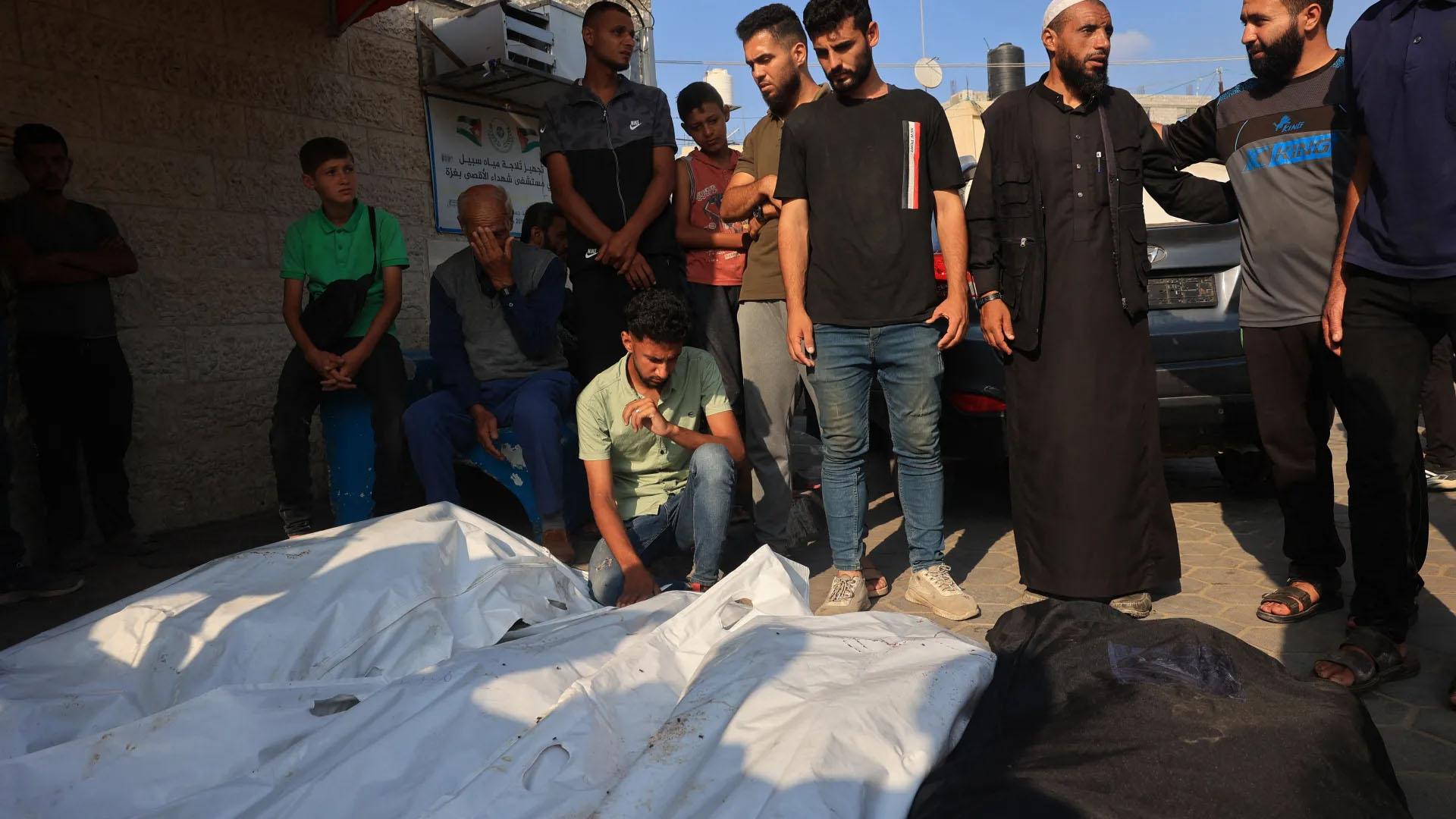
At least 27 Palestinians have been killed in Israeli strikes across Gaza, marking another grim day as the war on the besieged territory enters its 10th month.

One of the attacks since dawn on Sunday targeted a school sheltering displaced people west of Gaza city, killing at least four Palestinians.

In central Gaza, the Israeli army struck a residential building in the al-Zawayda area, killing six people. The Palestine Red Crescent Society said the dead included two children.

The killings came a day after the targeting of a United Nations-run school for displaced Palestinians, in which at least 16 people were killed and dozens wounded.

Paramedics said six other Palestinians were killed in a strike on another house in Gaza City. Israeli jets also targeted a group of civilians on the city’s Street 8 in the Sabra neighbourhood, killing at least two people, according to the Wafa news agency.

READ ALSO:

The Israeli military said it attacked a Khan Younis municipality building in southern Gaza overnight, claiming it was used by Hamas for “military activity”.

There were no immediate details on the casualties in the Khan Younis attack. Hamas denies allegations that its fighters seek shelter in civilian areas, including schools and hospitals.

Meanwhile, the total death toll from the Israeli attacks on Gaza since October 7 has reached 38,153, the territory’s health ministry said on Sunday.

The war has uprooted 90 percent of Gaza’s population, left almost 500,000 people enduring “catastrophic” hunger and shuttered most hospitals, United Nations agencies say.

The increasing casualties have overwhelmed Gaza’s largest remaining health facility, the Al-Aqsa Hospital, which is already filled with the wounded from the relentless Israeli strikes.

Dozens killed again in Gaza as war enters 10th month

Loading

International

US Intercepts Iranian Missiles, Drones Targeting Kuwait, Bahrain

Published

on

US Intercepts Iranian Missiles, Drones Targeting Kuwait, Bahrain

US Intercepts Iranian Missiles, Drones Targeting Kuwait, Bahrain

The United States military says it has intercepted multiple Iranian missiles and drones allegedly launched toward Kuwait and Bahrain, marking a major escalation in already fragile tensions across the Gulf region despite ongoing ceasefire efforts.

The development was disclosed by the U.S. Central Command (CENTCOM), which stated that Iran fired seven ballistic missiles toward the two Gulf nations shortly after earlier drone attacks were directed at maritime routes near the strategic Strait of Hormuz.

CENTCOM said six of the missiles were successfully intercepted, while the seventh did not reach its intended target. The command added that there were no reports of casualties among U.S. personnel or allied forces in the region. It also dismissed Iranian media claims alleging damage to the U.S. Fifth Fleet headquarters in Bahrain, describing them as false.

Before the missile strikes, U.S. forces reportedly intercepted and destroyed four Iranian one-way attack drones heading toward the Strait of Hormuz, a vital global energy shipping corridor. According to CENTCOM, the drones posed an “immediate threat to regional maritime traffic,” raising concerns over the safety of commercial vessels navigating one of the world’s most sensitive waterways. The Strait of Hormuz remains a critical route for global oil exports, with a significant portion of the world’s petroleum supply passing through it daily.

In response to the aerial and missile activity, U.S. forces carried out targeted strikes on Iranian coastal surveillance infrastructure, including radar installations in Goruk and on Qeshm Island. CENTCOM said the strikes were conducted to “defend against further maritime attacks and restore deterrence,” adding that the facilities were being used to monitor naval movement in the Gulf. Military analysts say the exchange represents one of the most serious direct military confrontations between U.S. and Iranian forces in recent months.

READ ALSO:

Iran has strongly denied responsibility for the attacks and condemned the U.S. response, accusing Washington of escalating the crisis and violating international law. Tehran claimed that U.S. operations targeted an Iranian oil tanker in the Strait of Hormuz and a telecommunications tower on Qeshm Island, alleging that the strikes were launched from regional partners in Kuwait and Bahrain. Iran further warned that any country assisting U.S. military operations could be considered complicit in acts of aggression, raising diplomatic tensions across the Gulf.

The latest exchange comes amid a fragile ceasefire arrangement between Washington and Tehran, which has faced repeated accusations of violations from both sides. Security experts describe the situation as a “low-intensity conflict,” with intermittent drone activity, missile launches and cyber incidents continuing despite diplomatic engagement efforts. The escalating Iran–US tensions have raised fears of a broader regional confrontation involving Gulf allies and critical maritime trade routes.

Alongside military action, the United States announced new sanctions targeting Iran’s oil smuggling and financial networks. Washington said it is dismantling a “sophisticated network” accused of moving hundreds of millions of dollars’ worth of Iranian liquefied petroleum gas (LPG) to Asia through front companies based in the United Arab Emirates and China. The U.S. Treasury Department said Iran’s “shadow fleet” of tankers has been used to disguise oil exports and bypass international sanctions. Additional sanctions were imposed on Iranian currency exchange operators accused of facilitating illicit financial transactions linked to oil revenues.

Despite rising tensions, diplomatic efforts over Iran’s nuclear programme are still ongoing, though progress remains limited. The International Atomic Energy Agency (IAEA) Director General, Rafael Grossi, said discussions are continuing toward a possible preliminary framework agreement but warned that significant technical and political hurdles remain. A key challenge remains restoring full inspection access to Iranian nuclear sites and clarifying the status of Iran’s stockpile of highly enriched uranium.

Former U.S. President Donald Trump also commented on the situation, saying he rejected proposals to deploy American troops into Iran to recover enriched uranium. He warned that any Iranian attack resulting in the deaths of American troops would justify a return to military action, while also signalling openness to future diplomatic engagement with Tehran.

Security analysts warn that continued missile and drone exchanges near the Strait of Hormuz could destabilise global energy markets and maritime security. The Gulf region remains one of the most strategically important areas in the world for oil exports, and any escalation could lead to disruptions in shipping, insurance costs and global oil prices. Experts say the combination of military confrontation, sanctions pressure and stalled nuclear talks leaves the region in a highly volatile and unpredictable state.

US Intercepts Iranian Missiles, Drones Targeting Kuwait, Bahrain

Loading

Continue Reading

International

Nigerian Priest Sentenced to Life in Prison for Sexually Assaulting Women in Texas

Published

on

Nigerian Priest Sentenced to Life in Prison for Sexually Assaulting Women in Texas
Roman Catholic priest Anthony Odiong

Nigerian Priest Sentenced to Life in Prison for Sexually Assaulting Women in Texas

WACO, Texas – A Nigerian-born Catholic priest has been sentenced to life in prison after a Texas jury convicted him of repeatedly sexually assaulting female parishioners who sought his spiritual guidance. Father Anthony Odiong, 57, who served in the United States for nearly 17 years, was found guilty of first-degree sexual assault and two counts of second-degree sexual assault following a four-day trial in Waco’s 19th State District Court. The jury handed down the life sentence on Tuesday, along with two concurrent 20-year terms and $30,000 in fines.

The severity of the sentence reflects the legal framework in Texas, where it is a felony for clergy members to engage in sexual relationships with adults under their spiritual care. The law recognizes that individuals seeking pastoral guidance cannot legally consent due to the inherent power imbalance. Prosecutors successfully proved that Odiong exploited this trust for more than a decade, using his role as a priest to groom, manipulate, and sexually assault vulnerable women who came to him for help. “He used the collar as a weapon,” one prosecutor told the jury during closing arguments.

The trial brought forward harrowing testimony from multiple women. One survivor, a mother of nine identified as “Mary Doe,” testified that Odiong began a sexual relationship with her in 2008 after she sought his counsel following an abusive marriage. She said he told her the relationship was “holy and special.” Her son testified that he walked in on Odiong and his mother when he was just 14 years old. In a separate case, DNA evidence presented by prosecutors confirmed that Odiong fathered a child with another woman under his spiritual direction in Louisiana, with a certainty of greater than 99.99 percent. Nearly a dozen women have publicly accused Odiong of sexual misconduct spanning more than a decade.

READ ALSO:

Odiong will not be eligible for parole until he has served at least 30 years of his life sentence. His defense attorney, Gerald Villarial, said he will file an appeal against both the conviction and the sentence. “We believe there were legal errors that affected the outcome,” Villarial told reporters after the sentencing.

The Catholic Church has responded publicly to the verdict. Bishop Daniel E. Garcia of the Diocese of Austin issued a statement assuring parishioners that the sacraments administered by Odiong remain valid, explaining that “the validity of the Sacrament depends on Christ… not on the moral status of the minister.” However, Bishop Garcia acknowledged that while the diocese had received some allegations of misconduct before Odiong left Waco, “the information known to us at the time did not indicate the level of criminality revealed in court testimony.” The Archdiocese of New Orleans, where Odiong later served as pastor of a church in Luling, Louisiana, called his actions “reprehensible” and confirmed he was removed from his pastoral role in 2023.

Odiong was originally ordained in the Diocese of Uyo, Nigeria. He began ministering in Waco, Texas in 2006 before relocating to Louisiana. At the time of his arrest in Florida in 2024, authorities also alleged they found child pornography in his possession, though that charge was not part of the Texas trial.

For readers seeking a quick summary of the case, the key details are as follows. Father Anthony Odiong, age 57, is a Nigerian priest from the Diocese of Uyo. He was sentenced to life imprisonment in Waco, Texas, with parole eligibility only after 30 years. He was also fined $30,000. His convictions include one count of first-degree sexual assault and two counts of second-degree sexual assault. The trial took place in the 19th State District Court in Waco. Key evidence included DNA proof that he fathered a child with a parishioner and emotional testimony from multiple survivors. His defense attorney has filed an appeal.

Nigerian Priest Sentenced to Life in Prison for Sexually Assaulting Women in Texas

Loading

Continue Reading

International

UK Tightens Immigration Rules, Threatens Universities Over Foreign Student Recruitment

Published

on

UK Tightens Immigration Rules, Threatens Universities Over Foreign Student Recruitment

UK Tightens Immigration Rules, Threatens Universities Over Foreign Student Recruitment

The United Kingdom has introduced tougher immigration measures that could restrict universities from recruiting international students if they fail to meet stricter compliance requirements under a revised visa monitoring system.

The new rules, announced by the UK Home Office, form part of broader efforts to reduce rising asylum claims linked to study, work and tourist visas, with foreign students identified as the largest group associated with such applications in recent data.

Under the updated framework, universities risk losing their student sponsor licence if more than 5 per cent of visa applications linked to their institution are refused, compared to the previous threshold of 10 per cent.

The Home Office said it will now use enhanced monitoring systems to track both visa refusal rates and the performance of individual institutions, allowing authorities to identify universities that fail to properly vet or support applicants.

Officials also warned that institutions could face sanctions if large numbers of international students either fail to enrol after securing visas or fail to complete their academic programmes.

In addition, the government has raised compliance benchmarks for universities recruiting foreign students. The required enrolment rate has been increased to 95 per cent, up from 90 per cent, while the course completion rate threshold has risen from 85 per cent to 90 per cent.

READ ALSO:

According to the Home Office, poor enrolment or high dropout rates may indicate abuse of the student visa route, including cases where applicants use study visas as a pathway to seek work or remain in the UK irregularly.

The government also linked the tightening measures to concerns about abuse of the immigration system, saying it is working to ensure that the student visa route is used strictly for genuine education purposes.

The reforms follow a series of earlier restrictions, including an “emergency brake” introduced on study visas for nationals of countries such as Afghanistan, Cameroon, Myanmar and Sudan, after officials reported increased asylum applications from some student visa holders.

UK authorities said asylum claims from individuals on student visas have fallen significantly following recent enforcement actions, which include stricter scrutiny of visa applications and compliance checks.

The Home Office also confirmed that it has contacted more than 300,000 international students whose visas are nearing expiry, warning them against submitting unfounded asylum claims and urging those without legal status to either regularise their stay or leave the country.

The latest policy shift is expected to increase pressure on UK universities, many of which depend heavily on international student tuition fees to support funding, research and institutional budgets.

Education stakeholders have previously warned that tighter immigration controls could affect the UK’s attractiveness as a destination for global students, particularly as countries such as Canada and Australia continue to expand international student pathways.

The UK government has not yet confirmed full implementation timelines, but said consultations and enforcement planning are ongoing across education and immigration agencies.

UK Tightens Immigration Rules, Threatens Universities Over Foreign Student Recruitment

Loading

Continue Reading

Trending