

Politics
Electoral laws alone cannot guarantee credible elections — Omo-Agege
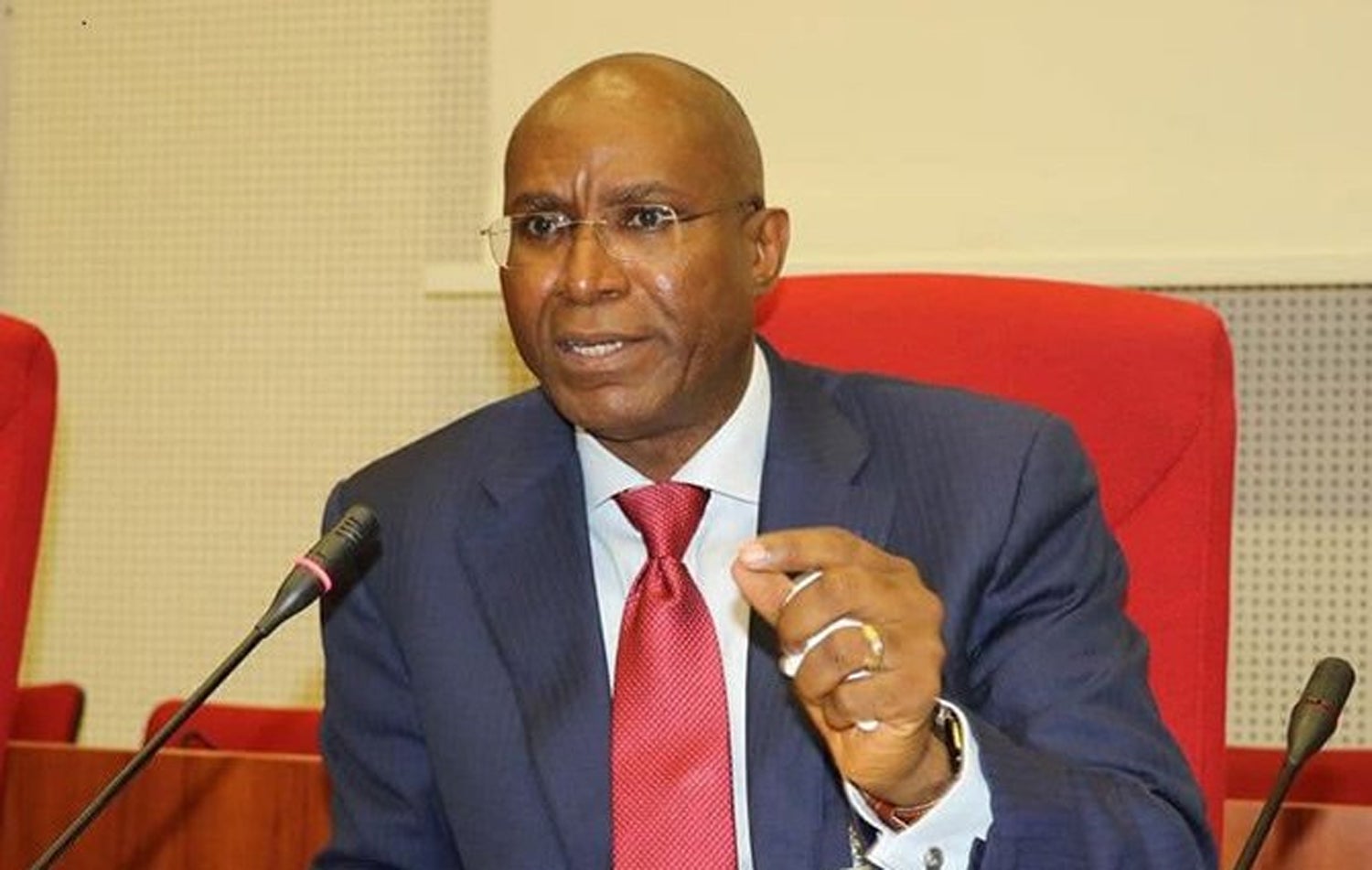
Deputy President of the Senate, Ovie Omo-Agege, has said electoral laws alone cannot guarantee credible elections.
He said a sustainable electoral process was only possible if it was founded on an adequate electioneering culture.
Omo-Agege said this at the public presentation and inaugural meeting of the Electoral Hub, in Abuja, FCT.
Represented by Dr Daniel Bwala, Special Adviser on Legal and Constitutional Matters, Omo-Agege said, “No matter how good the clauses were in the electoral laws, if the other aspects of the electioneering process were flawed, the electoral process itself will ultimately be flawed.
“While there have been many more issues in our electoral history, it seems to me that if we have had adequate and unambiguous clauses, plus adequate advocacy, understanding and the will to comply, we would have had less controversies, fewer post-election court cases and generally, a more credible electoral process.
“This is to say that we need adequate and generally acceptable rules of engagement in the electioneering process. I refer to how candidates emerged on party platforms, campaign rally rules and generally political actions toward a fair and credible political participation by voters.
“I am glad, for instance, that the National Assembly is now dealing with the issue of direct primaries.”
Omo-Agege stressed the need to join hands to work out an electoral system that would not only agree with global best practice, but make Nigeria a stronger nation.



Entertainment
“We Don’t Want to See You in Edo Again” — Gov Okpebholo’s Aide Declares War on Davido

“We Don’t Want to See You in Edo Again” — Gov Okpebholo’s Aide Declares War on Davido
Politics
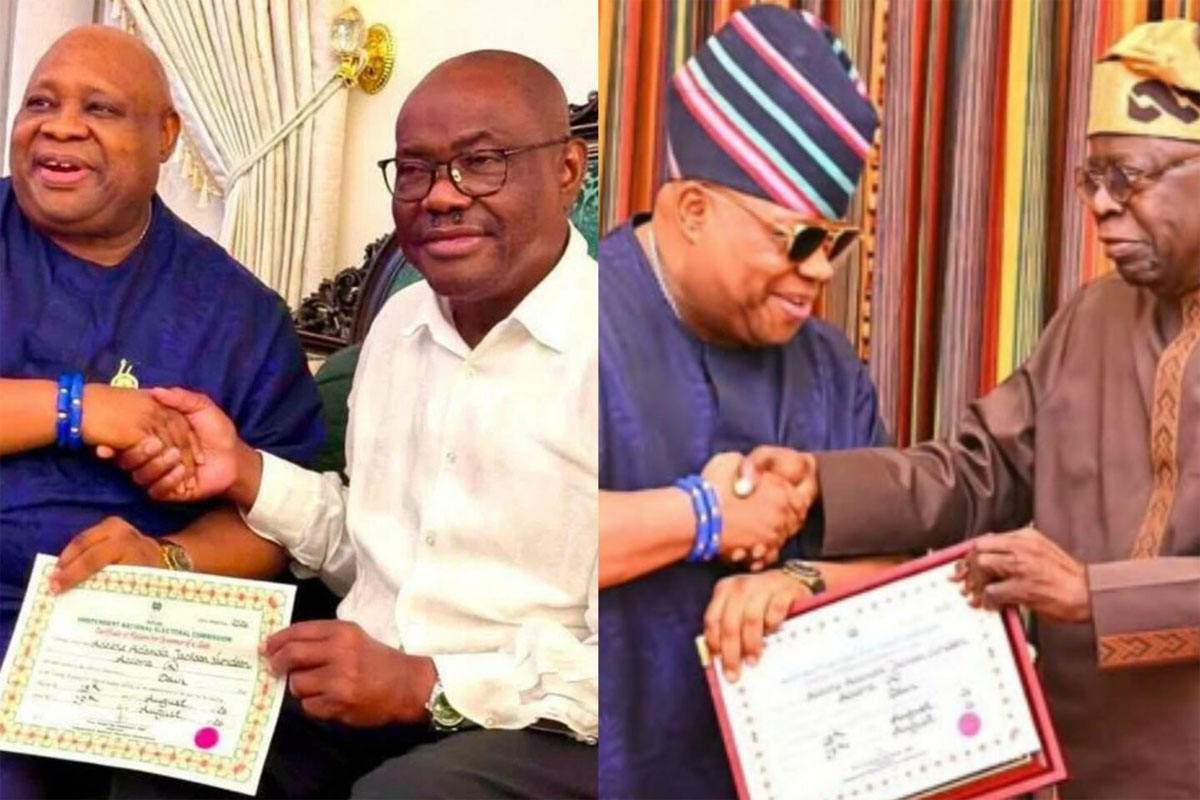
2027: Wike Declares Adeleke Belongs to Tinubu Camp, Predicts ‘Largest Rainbow Coalition’
Politics
2027: South-East Leaders Clash Over Igbo Presidency Feasibility
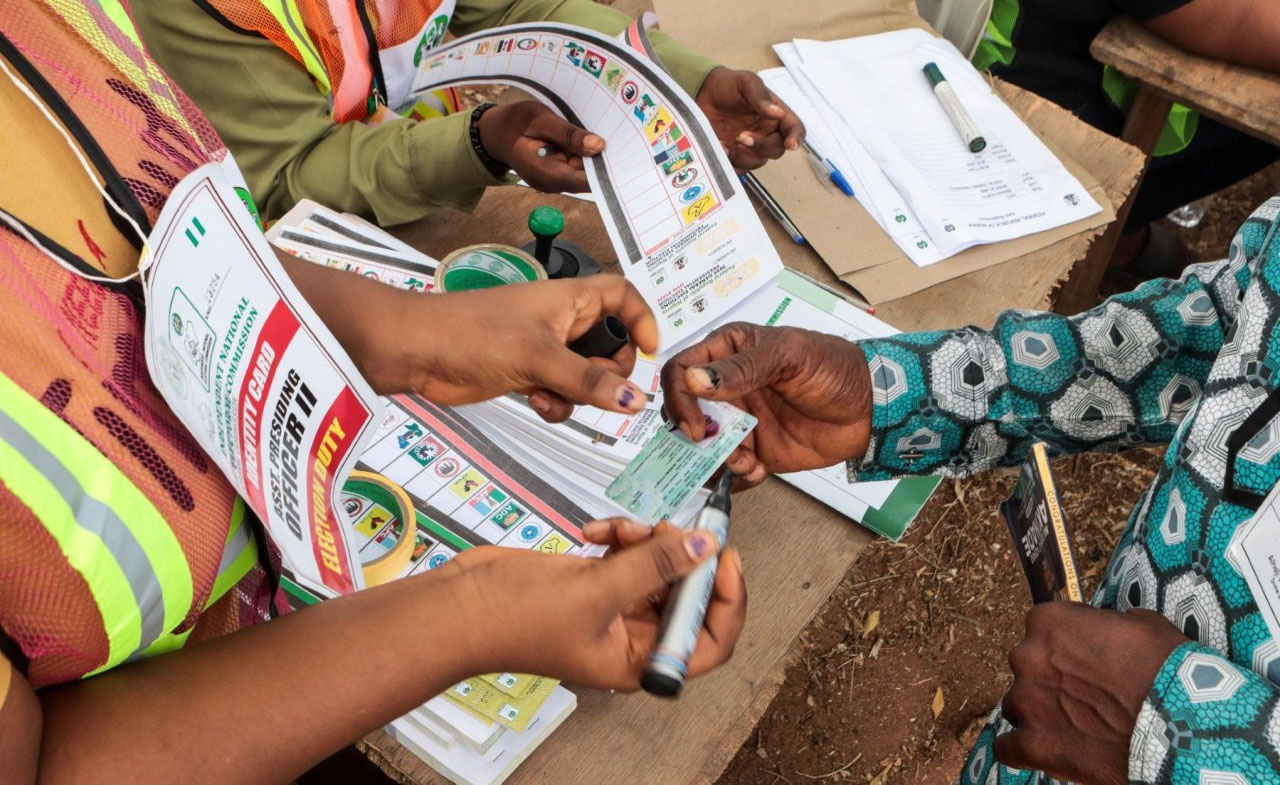
2027: South-East Leaders Clash Over Igbo Presidency Feasibility
As the 2027 presidential election draws closer, a fierce debate has erupted over the prospects of an Igbo presidency, with political stakeholders divided on whether the dream is attainable or destined to fail. The controversy took centre stage on an Enugu-based Dream FM radio programme, monitored by THE WHISTLER, where contributors offered sharply contrasting views on the political future of the South-East. The discussion comes at a critical juncture, with the Nigeria Democratic Congress (NDC) having zoned its presidential ticket to the South for a single four-year term, clearing the way for Peter Obi, while prominent Igbo figures like Minister of Works David Umahi and a faction of Ohanaeze Ndigbo have publicly endorsed President Bola Tinubu’s re-election.
Dr. Amos Ogbonna, a human rights lawyer and Executive Director of the Centre for Non-Violence and Justice, made a passionate case for Igbo presidency during the radio programme. According to Ogbonna, there is a secret pact by the Nigerian federation to ensure that an Igbo man never becomes president. “Many people across the regions say they would never be alive to see an Igbo man emerge president of Nigeria. When you talk about long-term aspirations of Ndigbo, it is a mirage. Nigeria has a conspiracy and phobia against the Igbo,” Ogbonna declared. The lawyer argued that 2027 represents the only realistic opportunity for an Igbo presidency. He traced the history of power rotation since 1999, noting that the South-East has consistently been sidelined despite supporting other regions. He recalled that after the June 12 injustice, the Yoruba were compensated with the presidency, but the Igbo have never been similarly compensated for the civil war. Ogbonna also claimed that former President Muhammadu Buhari once promised that after his tenure, the Igbo would produce the president, a promise he said was later abandoned. He urged South-Easterners to unite and fight for the presidency, insisting that power would not be handed over voluntarily. “We are left with the remaining four years. By 2031, power will definitely return to the North. This is not a call for violence, but a reminder that we have to struggle for this power; they will not give us. If we don’t get it, we should be happy that we have tried,” he said.
Comrade Fidelis Edeh, a former labour leader and Executive Director of Service Accord Initiative, offered a more pragmatic perspective. He called on the Igbo to organise themselves strategically, acknowledging that the region must not run away from the consequences of the civil war. “We operate a multiparty system. We don’t need anybody to promise us. We usually contest. We must never run away from the consequences of the civil war,” Edeh said. Edeh also criticised the Peoples Democratic Party (PDP) for sabotaging the Igbo presidency. He noted that from 1999, the Igbo camped in the PDP, which later abandoned zoning principles that would have favoured an Igbo candidate. He also accused Peter Obi of political inconsistency, noting that Obi has changed political parties multiple times, unlike Tinubu who has remained in one party. “President Bola Tinubu has remained in one political party up to this point. Obi was chairman of the Southeast Governors’ Forum when he was governor. But immediately he left office, he joined PDP, and abandoned APGA. This is the time to negotiate,” Edeh said.
READ ALSO:
- 2027: Senator Saliu Mustapha quits APC after losing Kwara governorship ticket
- 2027 Election: NDC Tells Atiku to Step Aside, Support Peter Obi to Remove Tinubu
- Delta Governor Reveals ₦503,000 Monthly Salary, Says Permanent Secretaries Earn ₦900,000
Minister of Works David Umahi, a former governor of Ebonyi State, has emerged as one of the most vocal opponents of Peter Obi’s presidential ambition. Speaking during an inspection tour of federal projects in Ebonyi State, Umahi insisted that the South-East votes alone cannot make Obi president. “Our brother, Peter Obi, is contesting for the presidency of the entire country, not the presidency of the South East. The votes of the South East alone cannot produce a president. We must be strategic,” Umahi stated. Umahi further claimed that Obi is not as popular in the South-East as he believes, describing his 2023 performance as an “accident of history.” He predicted that the South-East would massively vote for President Tinubu in 2027. “Who is after him? Nobody is after him. Because, you know, we want him to be on the ballot, to make the victory very sweet, you know, because he says that South East is his catchment area, and I’m saying that South East is not his catchment area,” Umahi said. Umahi urged South-Easterners to align strategically with the ruling APC to sustain the tempo of infrastructural development in the region. He pointed to ongoing federal road projects worth over N248 billion in Ebonyi State as proof of Tinubu’s commitment to the South-East.
Senator Onyekachi Nwebonyi, representing Ebonyi North, echoed similar sentiments in an interview with Channels Television. He argued that the current political arrangement does not favour an Igbo candidate for the presidency. “Peter Obi is coming at the wrong time. Even if our son comes to contest, it is very clear that the political permutation, as at present, does not favour an Igbo man. President Bola Tinubu and other APC candidates will win the south-east come the 2027 general election,” Nwebonyi declared.
A faction of Ohanaeze Ndigbo, led by Deputy President-General Mazi Okechukwu Isiguzoro, has declared that an Igbo presidency is “not feasible” under the NDC. The group described the NDC as a regional party driven by Ijaw interests under the leadership of Senator Seriake Dickson. “We therefore urge Mr. Peter Obi to reconsider his 2027 presidential ambition in the greater interest of the Igbo people,” the faction said in a statement. The same faction has backed Tinubu’s re-election, describing it as a “strategic pathway” for the South-East. It even proposed a “2031 Vice Presidency Initiative” to position an Igbo leader for the vice-presidential slot under the APC, with Umahi and Chimaroke Nnamani identified as potential contenders. However, another faction of Ohanaeze Ndigbo Worldwide, led by President General Senator Azuta Mbata, has dismissed reports suggesting no Igbo person would contest the 2027 election.
Despite the opposition, the Obi-Kwankwaso Movement (OK Movement) has intensified grassroots mobilisation in the South-East. At a summit in Enugu, the group declared its commitment to championing the ideals of a Peter Obi-Rabiu Kwankwaso alliance, which it said centres on inclusiveness and equal opportunity. The movement has directed its coordinators at state, local government, ward, and polling unit levels to commence aggressive sensitisation and membership mobilisation under the NDC. Additionally, the NDC has formally zoned its presidential ticket to the South for a single four-year term, with the vice-presidential slot zoned to the North. The party said the decision reflects its commitment to justice, inclusiveness and national stability. In his remarks at the party’s convention, Obi said: “We are not changing political platforms for transactional reasons. We are making a principled decision to find a platform that gives us the opportunity to build a new Nigeria that is possible.”
Adding another layer to the debate, Hon. Kasimu Maigari, a member of the ADC National Legislators’ Forum, claimed that Peter Obi’s political trajectory has set the Igbo presidency ambition back by two decades. “My worry is not if Peter Obi will win the presidency; my worry is that Peter Obi has pushed Igbo’s 20 years backwards from getting the Presidency,” Maigari said during an interview on ARISE News. He argued that many of Obi’s supporters are driven by personal political ambitions rather than long-term ideological commitment, and that if Obi were not on the ballot, many of them would struggle to win elections independently.
The camp of former Vice President Atiku Abubakar has also weighed in, warning opposition parties that insisting on zoning the 2027 presidential ticket to the South would amount to entering the contest “already defeated.” In a statement by his media aide Olusola Sanni, Atiku’s camp argued that no incumbent president has ever been defeated by an opposition challenger from the same geopolitical bloc. It also accused proponents of southern zoning of “intellectual dishonesty,” noting that the South would have held power for approximately 18 years by 2027, against roughly 10 years for the North. “The Southeast deserves a sustainable and credible pathway to national leadership — not symbolic tokenism or bespoke arrangements tailored to satisfy one individual’s ambition,” the statement said.
As the 2027 election approaches, the opposition faces mounting pressure to present a united front. The Igbo Presidency Project (IPP), a non-political group, has called for rotation of power among regions, arguing that granting the South-East the opportunity to produce a president would deepen national unity. However, with key stakeholders divided and political realignments shifting, the dream of an Igbo presidency remains uncertain. As Ogbonna put it: “We are going to get united and fight for the presidency of Nigeria for the remaining four years. If we don’t get it, we should be happy that we have tried.”
2027: South-East Leaders Clash Over Igbo Presidency Feasibility
-
 metro3 days ago
Palace Chaos: Police Say Cultists Targeted Davido, Not Gov Adeleke, in Deadly Osogbo Shooting
-
 metro3 days ago
PFIPC Scandal: Tinubu Orders Forensic Probe as ICPC Uncovers Multiple Fake Agencies
-

 News3 days ago
Tinubu orders transfer of EFCC cash recoveries, N242bn unclaimed dividends to NELFUND
-
 Politics3 days ago
Atiku Dismisses Obasanjo’s Political Clout, Says Ex-President Has ‘No Electoral Value’
-

 metro2 days ago
History in Makkah: Nigerian Teen Wins Prestigious Qur’anic Contest, Breaks 46-Year Gender Barrier
-
 metro2 days ago
Former MFM Pastor Femi Jimoh Dies After Years of Detention, Legal Dispute
-

 News2 days ago
Delta Governor Reveals ₦503,000 Monthly Salary, Says Permanent Secretaries Earn ₦900,000
-

 Africa3 days ago
M23 Rebels Impose Ebola Movement Restrictions as DRC Conflict Complicates Outbreak Response