

News
FCCPC Warns Petrol Marketers Against Exploitative Pricing, Threatens Sanctions

FCCPC Warns Petrol Marketers Against Exploitative Pricing, Threatens Sanctions
The Federal Competition and Consumer Protection Commission (FCCPC) has issued a stern warning to petroleum marketers across the country, cautioning them against exploitative pricing of Premium Motor Spirit (PMS), popularly known as petrol, and vowing to sanction operators found engaging in unfair market practices.
The Commission expressed concern over the continued high retail price of petrol despite recent improvements in global crude oil prices and local supply conditions, insisting that consumers should begin to benefit from changing market realities.
The warning comes amid growing public dissatisfaction over the cost of fuel, which has remained significantly high months after international oil prices stabilised and supply chain disruptions eased.
According to the FCCPC, the sharp increase in petrol prices witnessed earlier this year was largely driven by rising crude oil prices triggered by geopolitical tensions in the Gulf region between April and May. During the period, pump prices of petrol surged to between ₦1,350 and ₦1,500 per litre in many parts of Nigeria, while diesel prices climbed to almost ₦2,000 per litre.
The Commission recalled that before the market disruptions, petrol sold for between ₦800 and ₦900 per litre in February. However, despite relative stability returning to the international oil market and improvements in domestic supply, the average retail price of petrol has remained around ₦1,200 per litre nationwide.
The FCCPC noted that current pricing by some local refineries suggests there should be greater room for downward adjustments in retail pump prices. According to the Commission, several domestic refiners are presently selling petrol at gantry prices ranging between ₦1,025 and ₦1,075 per litre, a development that should ordinarily encourage more competitive pricing among marketers.
While acknowledging that the pricing of petroleum products is influenced by multiple economic variables, including foreign exchange rates, transportation costs, financing expenses, refining costs and distribution logistics, the Commission maintained that these factors do not justify arbitrary or exploitative pricing.
It stressed that the deregulation and liberalisation of Nigeria’s downstream petroleum sector do not grant marketers unrestricted freedom to impose excessive prices on consumers.
Speaking on behalf of the Commission, Mr. Bello emphasised that operators in the downstream petroleum industry remain bound by the provisions of the Federal Competition and Consumer Protection Act, regardless of the liberalised nature of the market.
He said market liberalisation must go hand in hand with fair competition and responsible business conduct, warning that the Commission would not hesitate to investigate any credible allegation of anti-competitive practices or consumer exploitation.
According to him, “Market liberalisation does not diminish businesses’ obligations to compete fairly or consumers’ right to fair treatment. Where credible evidence indicates conduct that undermines competition, exploits consumers or otherwise contravenes the Federal Competition and Consumer Protection Act, the Commission will investigate and take appropriate enforcement action.”
The FCCPC further warned that any evidence of price fixing, collusion among marketers, cartel behaviour or other anti-competitive agreements designed to keep fuel prices artificially high would attract severe regulatory sanctions.
The Commission also called on Nigerians to play an active role in protecting consumer rights by reporting suspicious pricing patterns, misleading price claims and other unfair market practices through its official complaint channels.
Industry observers believe the Commission’s intervention could increase regulatory scrutiny in the downstream petroleum sector, particularly as Nigerians continue to grapple with the rising cost of living and demand greater transparency in fuel pricing.
The FCCPC reiterated its commitment to promoting fair competition, protecting consumers from exploitation and ensuring that the benefits of market liberalisation are reflected in competitive prices rather than excessive profit-taking at the expense of ordinary Nigerians.
FCCPC Warns Petrol Marketers Against Exploitative Pricing, Threatens Sanctions






News
Rivers Police Parade Two Suspects Over Murder of Okada Rider, Theft of Motorcycle

PORT HARCOURT – The Rivers State Police Command has paraded two young men arrested over the alleged murder of a commercial motorcycle operator, whose motorcycle they reportedly stole after luring him into a remote forest in the state.
The suspects, identified as 24-year-old Abubakar Sani and 20-year-old Yusuf Magaji, were arrested following an intelligence-led operation by operatives of the Violent Crime Response Unit (VCRU), Emohua.
The police said Sani allegedly confessed to participating in the killing of the victim, identified as Sani Musa, before the suspects escaped with his motorcycle.
Musa, a native of Zago Town in Kafin Hausa Local Government Area of Jigawa State, was reportedly operating as a commercial motorcycle rider in Rivers State before his death.
According to the police, preliminary investigations revealed that the suspects allegedly lured the rider to a remote forest in Mbiama, Ahoada West Local Government Area, where they attacked and stabbed him to death.
His body was subsequently dumped in thick bushes, while the suspects allegedly fled with his motorcycle.
The police further disclosed that the suspects planned to transport the stolen motorcycle to Kano State through a waybill arrangement, allegedly hoping to evade security checks and conceal the motorcycle’s origin.
READ ALSO:
- South Africa Releases Fani-Kayode’s Speech After Protest Over Livestream Snub
- Tinubu Failed to Honour Our Agreement After I Took Political Risk for Him – Makinde
- Court Admits Supreme Court Judgment Against Emefiele in $4.5bn, N2.8bn Fraud Trial Despite Defence Objection
The alleged criminal operation was uncovered at about 1pm on October 22, when police operatives received intelligence that some individuals were dismantling a suspected stolen motorcycle at Choba Motor Park.
Acting on the information, operatives of the VCRU moved to the location and arrested Sani and Magaji, who were both said to be from Kano State.
During interrogation, the suspects allegedly confessed to their involvement in the murder and subsequently led investigators to the Mbiama forest, where the decomposing remains of the deceased were recovered.
The recovery of the body provided investigators with further evidence in the ongoing investigation into the killing.
The command said arrangements were being made to release the deceased’s remains to his family for burial in accordance with Islamic rites, following a request by his relatives.
The Commissioner of Police in Rivers State, Olugbenga Adepoju, has ordered a comprehensive investigation to establish the full circumstances surrounding the murder, identify possible accomplices and ensure that everyone connected to the crime is brought to justice.
The police command reiterated its commitment to combating murder, armed robbery, cultism and other violent crimes across Rivers State.
It also urged residents to provide credible and timely information to security agencies to help prevent criminal activities and improve public safety.
The two suspects are expected to face prosecution upon the conclusion of investigations.
Rivers Police Parade Two Suspects Over Murder of Okada Rider, Theft of Motorcycle
News
Tinubu’s Aide Challenges Reports of Presidential Convoy Stoning at Abuja Mosque

Tinubu’s Aide Challenges Reports of Presidential Convoy Stoning at Abuja Mosque
ABUJA, NIGERIA — Presidential aide O’tega Ogra has dismissed reports that President Bola Tinubu’s convoy was attacked with stones by angry youths following his attendance at Friday prayers at a mosque in Abuja.
Ogra, the Senior Special Assistant to the President on Digital Engagement, Strategy and New Media, described the reports as an opposition-driven narrative, insisting that footage of Tinubu leaving the mosque presented a different picture of what transpired.
The controversy followed the President’s visit to the Shehu Shagari Central Mosque in Area 1, Garki, Abuja, on Friday, November 13, 2026, where he observed the Juma’at prayer.
Shortly after the visit, a video shared by former Kogi West senator and African Democratic Congress chieftain, Dino Melaye, circulated widely on social media, purportedly showing youths throwing stones at a convoy believed to be carrying the President.
Some individuals in the footage were also heard chanting slogans, including “Ba ma yi, ba ma so”, an expression of rejection.
However, Ogra challenged the account, releasing another video showing Tinubu waving to a crowd of youths as he departed the mosque in his official vehicle.
In a post accompanying the footage, the presidential aide accused opposition elements of promoting a misleading account of the incident.
“Contrary to the narrative being pushed by the opposition, with videos of their alleged paid thugs at the National Mosque today, here is footage of Mr President leaving the mosque after Friday prayers this afternoon,” Ogra wrote.
The footage showed the President, dressed in a white outfit and black cap, acknowledging people gathered around his vehicle, with some cheering and taking photographs with their mobile phones.
The conflicting accounts have generated debate over what actually happened during the presidential visit, particularly whether stones were thrown at the convoy.
While reports of hostile chanting have emerged from the scene, the allegation of stone-throwing remains disputed, with no independently verified evidence conclusively establishing that the President or his convoy was struck by stones.
The development comes amid heightened political tension ahead of the 2027 general elections.
Earlier on Friday, Tinubu warned politicians and their supporters against political violence, thuggery and other activities capable of undermining the country’s democratic process.
In a statement personally signed by him, the President said security agencies had been authorised to confront acts of political violence and other anti-democratic activities with full force.
He condemned reported violence at political gatherings across the country, stressing that political campaigns should focus on issues that promote citizens’ welfare and national development.
Tinubu maintained that violence should have no place in Nigeria’s democratic process.
Tinubu’s Aide Challenges Reports of Presidential Convoy Stoning at Abuja Mosque
News
South Africa Releases Fani-Kayode’s Speech After Protest Over Livestream Snub
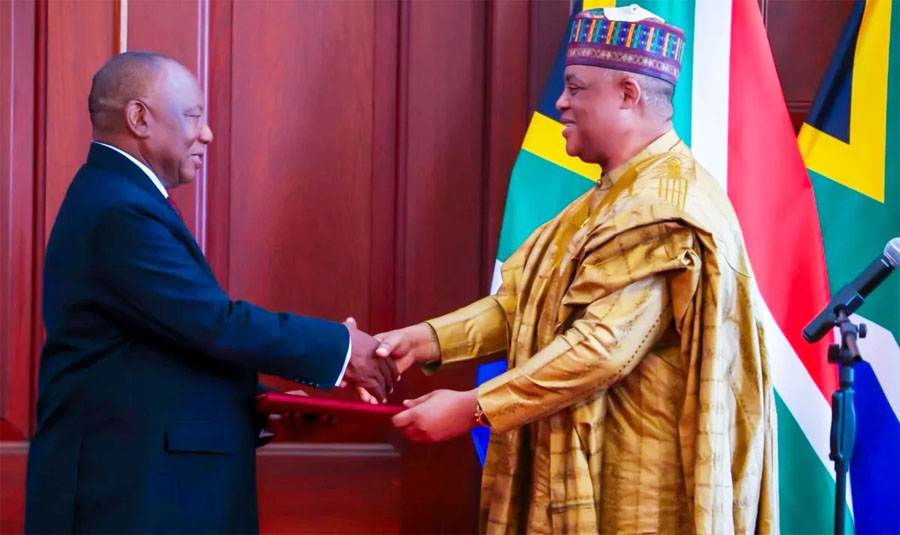
PRETORIA – The South African authorities have released the speech delivered by Nigeria’s Ambassador to South Africa, Lesotho and Eswatini, Chief Femi Fani-Kayode, after he protested the omission of his address from the official livestream of a diplomatic ceremony attended by President Cyril Ramaphosa.
The development followed complaints by Fani-Kayode that Nigeria was the only country among 15 participating diplomatic missions whose ambassador’s introduction and speech were excluded from the live broadcast of the presentation of Letters of Credence.
The ceremony, held on Friday, November 13, 2026, at the Sefako Makgatho Presidential Guest House in Pretoria, brought together ambassadors and heads of diplomatic missions from 15 countries, alongside the European Union, to formally present their credentials to President Ramaphosa.
Fani-Kayode had expressed displeasure after observing that the official livestream captured the introductions and speeches of other diplomats but was interrupted when it was Nigeria’s turn.
According to the Nigerian envoy, the transmission resumed immediately after he had completed his presentation to the South African President.
Describing the development as disturbing, Fani-Kayode said Nigeria was singled out in the broadcast, raising concerns about the treatment of the country and its diplomatic representation.
“The entire event was livestreamed, but of all the 15 introductions and speeches made that morning, only Nigeria’s was cut out,” he said.
The ambassador suggested that the omission might reflect the attitude of some individuals towards Nigeria, although no independent evidence has established that the country was deliberately censored.
“Clearly, some elements in South Africa do not want to hear what we have to say or see our faces, but we are here to stay as long as we are welcome and have the confidence of President Ramaphosa, which I am sure we do,” he added.
Fani-Kayode Raises Complaint With Ramaphosa
The Nigerian diplomat disclosed that he personally drew President Ramaphosa’s attention to the missing broadcast during the official photograph session that followed the presentation of credentials.
READ ALSO:
- Tinubu Failed to Honour Our Agreement After I Took Political Risk for Him – Makinde
- Court Admits Supreme Court Judgment Against Emefiele in $4.5bn, N2.8bn Fraud Trial Despite Defence Objection
- Agunbiade Celebrates Wife, Raheem Adepeju, on M.Ed. Graduation from University of Ibadan
According to Fani-Kayode, the South African leader reacted immediately, confronted officials responsible for the broadcast and questioned them about why Nigeria’s segment had been omitted.
He said Ramaphosa directed the relevant officials to address the situation.
However, the intervention came after the Nigerian ambassador’s presentation had already been excluded from the live transmission.
Fani-Kayode maintained that the omission did not mean his address was unavailable, as media organisations covering the ceremony, including Nigerian television crews, recorded the proceedings.
He also disclosed that he declined an interview request from the South African Broadcasting Corporation (SABC), advising its representatives to watch the speech that had been left out of the official livestream.
The subsequent release of the speech has brought the development into renewed focus, although the circumstances surrounding its initial exclusion from the broadcast have not been independently established.
Tinubu’s Message to Ramaphosa
Despite the controversy, Fani-Kayode used the diplomatic occasion to reaffirm Nigeria’s commitment to strengthening relations with South Africa.
He conveyed fraternal greetings from President Bola Ahmed Tinubu to Ramaphosa, emphasising the historical relationship between both countries and Nigeria’s contributions to South Africa’s struggle against apartheid.
The ambassador said his diplomatic assignment would focus on rebuilding confidence, addressing areas of disagreement and expanding cooperation between the two African nations.
He identified trade, industrial development, economic cooperation and regional stability as important areas requiring greater collaboration.
Fani-Kayode also stressed that Nigeria and South Africa must maintain mutual respect, given their historical contributions, strategic importance and influence across the African continent.
He acknowledged Ramaphosa’s personal intervention following his complaint but maintained that his respect for South Africa and its people would not prevent him from speaking against actions he considered disrespectful to Nigeria and its citizens.
The diplomatic incident comes amid heightened concerns over the treatment and safety of Nigerians living in South Africa, following reported xenophobic attacks and killings that have strained relations between the two countries.
Fani-Kayode has previously warned that Nigeria’s patience was wearing thin over attacks on its citizens but cautioned against calls for a complete breakdown of diplomatic and economic relations.
The ambassador has consistently advocated dialogue, mutual respect and stronger Pan-African cooperation, arguing that the historical sacrifices made by Nigeria and other African countries towards ending apartheid should remain a foundation for lasting friendship.
With the release of his speech following the protest, attention is now expected to focus on the circumstances surrounding the broadcast omission and the need to ensure that diplomatic engagements involving Nigeria receive appropriate representation.
South Africa Releases Fani-Kayode’s Speech After Protest Over Livestream Snub
-
 metro3 days ago
Court Orders Final Forfeiture Of 48 Properties Worth N212bn Linked To Malami
-

 metro3 days ago
Ogbomosoland Grand Chief Imam, Sheikh Teliat Ayilara II, Marks Five Years in Office
-
 metro3 days ago
Agunbiade Celebrates Oyo Grand Chief Imam Akeugberu at One, Says His Impact Equals a Decade
-

 Sports3 days ago
Tinubu Rewards Flamingos With ₦100m Each After Historic World Cup Triumph
-

 News3 days ago
Tinubu’s Chicago Varsity Certificate Row: Omokri Challenges Journalists to Verify Fresh Allegations
-
 Auto3 days ago
After-Sales Support Will Define Future of Nigeria’s Auto Industry – Carloha Marketing Chief
-

 News2 days ago
BREAKING: Manchester United Sack Michael Carrick After Disastrous Start to Season
-

 Politics3 days ago
Sowore Says ‘Half-Dead’ Tinubu Should Be Taken to Old People’s Home