

International
Five journalists among 20 killed in Israeli strike

Five journalists among 20 killed in Israeli strike
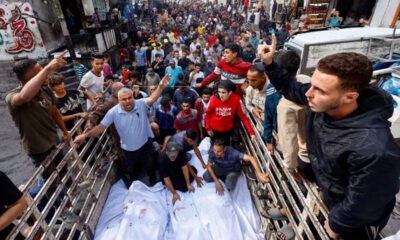
At least 20 people, including five journalists working for the international media, have been killed in an Israeli strike on Nasser hospital in the southern Gaza Strip, the territory’s Hamas-run health ministry says.
Four of the journalists worked for Reuters, AP, Al Jazeera and the Middle East Eye, the news outlets confirmed.
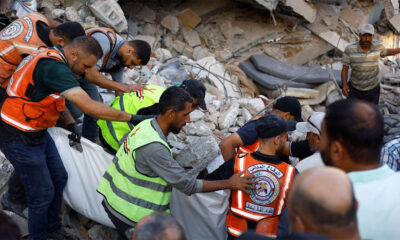
Footage of the attack shows a second strike, after the initial hit, which happened as rescuers attended the scene.
The Israel Defense Forces (IDF) says an investigation is being carried out into its attack on the hospital.
It added that it “does not target journalists as such”, but did not give details about the strike.
The latest deaths brings the number of journalists killed in Gaza since the start of the war there in October 2023 to nearly 200.
According to the Committee to Protect Journalists (CPJ), a leading body which promotes press freedom, the war in Gaza has been the deadliest conflict for journalists ever documented. It says more press members have been killed there in the past two years than were killed worldwide in the prior three years.
International journalists have been banned by Israel from entering the Gaza Strip independently since the start of the war.
Some journalists have been taken into Gaza by the IDF under controlled access, but international media outlets rely on local reporters for much of their coverage in Gaza.
Video from the scene of Monday’s attack shows a doctor standing at an entrance to the hospital – the main one in southern Gaza – holding up bloodied clothes to show journalists following the first strike. Suddenly there is a blast, sending people running for cover as glass shatters. A man injured by the blast is seen trying to drag himself to safety.
READ ALSO:
- 2027: MURIC demands Muslim governors in South West
- Banditry: Katsina launches 8 new armoured vehicles
- AC Milan cancel Victor Boniface move after failed medical
Another graphic video, captured on a livestream by al-Ghad TV, shows several emergency workers responding to the first strike near the top floor of Nasser hospital as a number of journalists in the background capture the scene.
A staircase, where journalists often gather to get views across Khan Younis, is visible in the footage. A strike then directly hits the emergency workers and journalists, sending smoke and rubble in the air. At least one body is visible in the aftermath.
Reuters news agency said its cameraman, Husam al-Masri, was among those killed. He had been operating a live TV feed on the roof and it shut down at the instant of the initial strike. Hatem Khaled, another contractor also working for Reuters as a photographer, was injured in the second strike, according to witnesses.
The agency said it was devastated and “urgently seeking more information”.
AP said Mariam Dagga, a freelance journalist working for it, was also killed. The news agency said it was “shocked and saddened” by the 33-year-old’s death.
The others killed include Al Jazeera’s Mohammad Salama, Middle East Eye freelancer Ahmed Abu Aziz and photographer Moaz Abu Taha. US TV network NBC said Taha did not work for it, as had been initially reported.
The Hamas-run Civil Defence said one of its members was among those killed, AFP news agency reported.
The head of the World Health Organization said four health workers were also killed, and condemned the strike.
Tedros Adhanom Ghebreyesus said the area that was hit houses the hospital’s emergency department, the inpatient ward and the surgical unit – in addition to the emergency staircase which had also been damaged.
READ ALSO:
- NLC condemns proposed salary increment for political officeholders
- Mbappé brace guides Real Madrid past Oviedo to maintain perfect start
- Priscilla Ojo, Juma Jux welcome baby boy
A programme officer for British-based charity Medical Aid for Palestinians says she was visiting the ICU “when explosions tore through the operating theatre right next to us”.
In a statement sent to media, Hadil Abu Zaid described “trails of blood” over the floor following the strikes, adding the scene was “unbearable”.
Monday’s attack comes two weeks after six journalists, including four from Al Jazeera, were killed in an Israeli targeted attack near al-Shifa Hospital in Gaza City.
The UN’s human rights office condemned that attack, calling it a grave breach of international law.
The IDF said it had targeted Anas al-Sharif, a prominent Al Jazeera reporter, alleging he had “served as the head of a terrorist cell in Hamas”.
The CPJ said Israel had failed to provide evidence to back up its allegations.
The war was triggered by the Hamas-led attack on Israel on 7 October, in which about 1,200 people were killed and 251 others taken to Gaza as hostages.
Israel responded with a massive military offensive, which has killed more than 62,686 Palestinians, according to figures from Gaza’s Hamas-run health ministry, which the UN considers reliable.
Five journalists among 20 killed in Israeli strike









International
Trump Links French Protests To Islam ‘Taking Over’ France
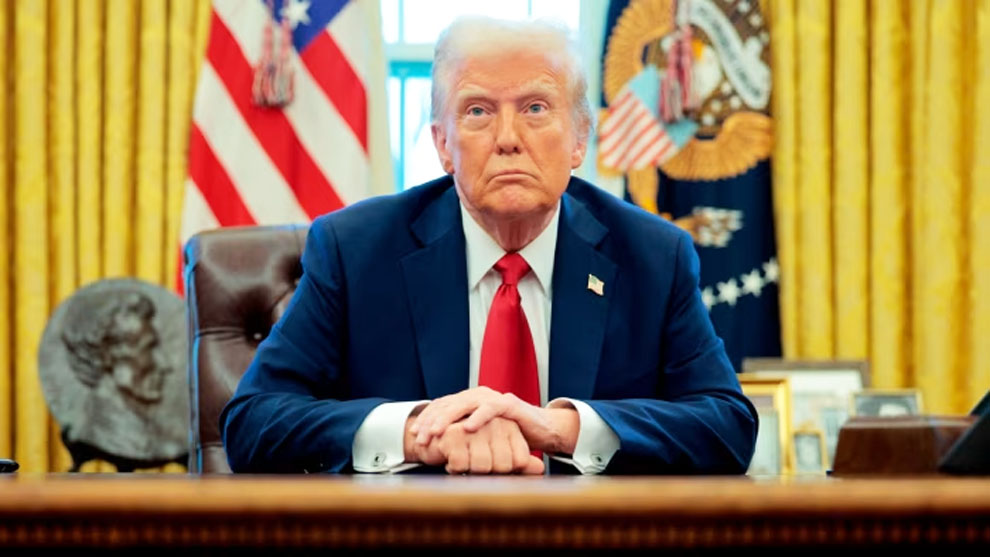
Trump Links French Protests To Islam ‘Taking Over’ France
US President Donald Trump has linked the ongoing student protests in France to what he described as “out of control” mass migration and an alleged attempt by Islam to take over the country.
Trump made the claim Tuesday in a post on his Truth Social platform, rejecting the view that the protests are primarily about education and school conditions.
The protests have spread across France since late September, with students, teachers and parents demanding better-funded schools, more teachers, improved infrastructure and action over overcrowded classrooms.
More than 250,000 people took part in demonstrations across the country on Tuesday, according to French authorities, while organisers put the turnout at about 450,000.
Trump wrote that the unrest was “nothing less than out of control mass migration” and claimed: “This isn’t about schools, this is about Islam wanting to take over a once great Country!”
READ ALSO:
- Troops Take Down Zamfara Bandit Kingpins Baban Love, Mai Zamani, Three Others
- FG Gives N250m To Families Of 37 Miners Who Died In NSCDC Custody
- Tompolo’s PBAT Movement Suspends Campaign Over Ondo Military Crash
However, there has been no established link between the protests and religious or identity-based demands. The grievances publicly cited by student groups have centred on teacher shortages, overcrowded classrooms, deteriorating school buildings and inadequate resources.
The demonstrations have nevertheless escalated in some areas, with clashes between protesters and police reported in cities including Paris, Strasbourg, Rennes and Toulouse.
French authorities said hundreds of people were arrested Tuesday, while hundreds of students, school staff and police officers have reportedly been injured during the unrest.
The protests have also become part of a wider debate over France’s public finances, government spending and political direction ahead of the country’s next presidential election.
Trump’s comments add an international political dimension to the crisis, as the US president continues to make migration in Europe a major focus of his political messaging.
French Foreign Minister Jean-Noël Barrot said France was working to present its own account of the unrest rather than allowing foreign governments and political actors to define the narrative around the protests.
For now, the central demands of the protest movement remain focused on education, even as the unrest has become increasingly entangled with broader political disputes over immigration, public spending and France’s future.
Trump Links French Protests To Islam ‘Taking Over’ France
International
Kemi Badenoch: I Don’t Want Migrants Turning UK Into Nation Of ‘Little Ghettos’

Kemi Badenoch: I Don’t Want Migrants Turning UK Into Nation Of ‘Little Ghettos’
UK Conservative Party leader Kemi Badenoch has warned against the emergence of what she described as “little ghettos” of separatist migrant communities in Britain, arguing that newcomers must integrate and respect the country’s culture and values.
Badenoch made the remarks while opening the Conservative Party’s annual conference in Birmingham, where she set out her vision for rebuilding the party and Britain.
Speaking about immigration and integration, the Conservative leader said she wanted Britain to remain a “high-trust” society in which people coming into the country accept the social expectations and responsibilities that come with living there.
“I don’t want lots of little ghettos of separatist communities where they are recreating the place that they came from. That will ruin the United Kingdom,” Badenoch said.
She added that Britain was “not a dormitory” or “a hotel” and argued that migrants who come to the country, including those who come primarily to work, should respect British culture and values.
Badenoch stressed that she was not advocating race-based citizenship, saying Britain had never operated such a system. However, she argued that British culture, norms and expectations remained important to maintaining social cohesion.
READ ALSO:
- Trump Approves Firing Squad Execution For Fort Hood Shooter Nidal Hasan
- Nigeria Climbs Africa Investment Ladder, Overtakes Four Nations
- Ogun Crash: Nine Die As Bus Collides With Truck On Ijebu-Ode-Ore Road
“It is not just about the values and the principles,” she said, arguing that the way people conduct themselves and the expectations they share also form part of British culture.
The remarks form part of Badenoch’s broader attempt to establish a tougher Conservative Party position on immigration, integration and national identity as the party seeks to regain political ground.
She has also acknowledged failures by previous Conservative governments to deliver promised reductions in immigration. In her newly published policy document, The Right Way, she argues that the party needs clearer principles and a more consistent approach to government.
The Conservatives are also proposing tougher conditions for migrants seeking permanent settlement in the UK, including changes to the rules governing indefinite leave to remain.
Badenoch’s comments have drawn attention because of the sensitivity surrounding immigration and multiculturalism in Britain, with critics arguing that language about migrant communities risks stigmatising minority groups.
Her supporters, however, say the emphasis on integration rather than race is intended to reinforce a shared national identity and social cohesion.
The debate comes as immigration remains a major political issue in the UK, with the Conservatives facing pressure from Reform UK over migration while the Labour government continues to face questions over legal and irregular immigration.
Badenoch, who became Conservative leader in November 2024, used the conference to present her party as a political alternative focused on economic growth, stronger national security, reduced bureaucracy and stricter immigration policies.
Her comments on migrant communities are expected to remain a significant part of the Conservatives’ political message as the party seeks to redefine its approach to immigration, integration and British identity.
Kemi Badenoch: I Don’t Want Migrants Turning UK Into Nation Of ‘Little Ghettos’
International
Trump Approves Firing Squad Execution For Fort Hood Shooter Nidal Hasan
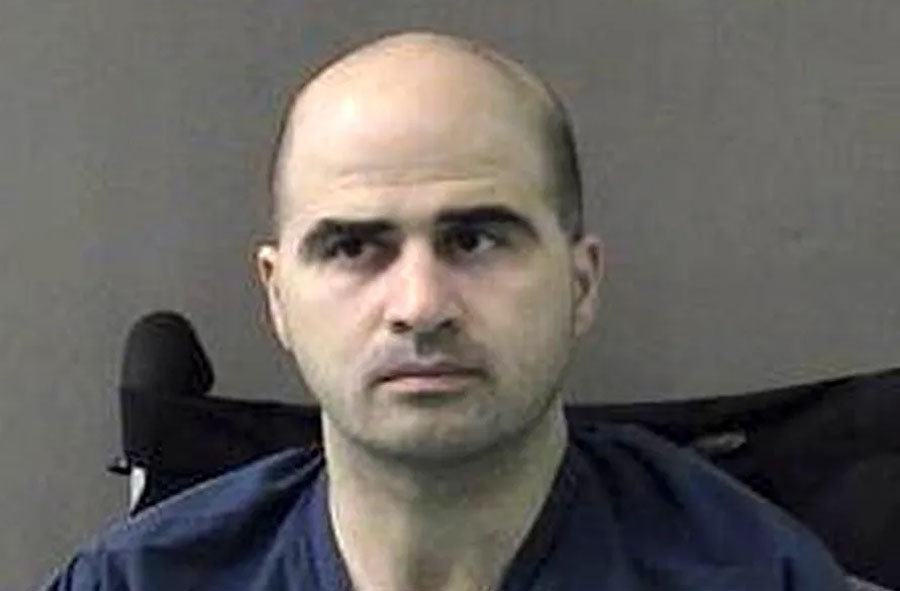
Trump Approves Firing Squad Execution For Fort Hood Shooter Nidal Hasan
President Donald Trump has approved the execution by U.S. Army firing squad of former Army Major Nidal Malik Hasan, who was sentenced to death for the 2009 mass shooting at Fort Hood, Texas, that left 13 people dead and 32 others wounded.
The Pentagon announced the decision on Monday, saying Defense Secretary Pete Hegseth had recommended the firing-squad execution and Trump approved it.
Pentagon spokesman Sean Parnell said the Secretary of the Army would determine the date and location of the execution.
Hasan, a former Army psychiatrist, opened fire at a medical facility at Fort Hood on November 5, 2009, shortly before he was due to deploy to Afghanistan.
The attack killed 12 active-duty soldiers and one retired serviceman, while 32 others were wounded. Hasan was shot and seriously injured by a responding civilian police officer and has been partially paralysed since the attack.
READ ALSO:
- Nigeria Climbs Africa Investment Ladder, Overtakes Four Nations
- Ogun Crash: Nine Die As Bus Collides With Truck On Ijebu-Ode-Ore Road
- Gunmen Open Fire At Lagos Bus Stop, Kill NURTW Member, Injure Three
A military jury convicted Hasan in 2013 of 13 counts of premeditated murder and 32 counts of attempted premeditated murder and sentenced him to death.
During his court-martial, Hasan represented himself and did not call witnesses in his defence. He acknowledged that he carried out the shooting and argued that his actions were intended to protect Muslims whom he believed were being targeted by U.S. military operations.
Hasan has remained on military death row at the U.S. Disciplinary Barracks at Fort Leavenworth, Kansas, while pursuing legal challenges to his conviction and sentence.
Trump’s approval does not mean the execution will take place immediately. Further legal and administrative procedures remain, and Hasan could seek relief through the federal courts, potentially delaying the execution.
If carried out, Hasan’s execution would be an extraordinary event in the history of the U.S. military justice system.
The U.S. military has not carried out an execution since 1961, when Army Private John Bennett was hanged. The last known U.S. military execution by firing squad took place in 1945.
The decision also comes amid renewed debate in the United States over methods of execution. The Trump administration has expanded the available methods for carrying out federal executions, while recent difficulties surrounding lethal injection have intensified scrutiny of capital punishment.
Hasan’s case has remained one of the most prominent military death-penalty cases in the United States since the Fort Hood attack nearly 17 years ago.
The Army is now expected to determine when and where the execution will take place, subject to the remaining legal process.
Trump Approves Firing Squad Execution For Fort Hood Shooter Nidal Hasan
-

 metro2 days ago
Tragedy Strikes FMC: Medical Director Loses Two Daughters—A Doctor and a Pharmacist—Within 48 Hours
-
 metro2 days ago
Transporters Urge IGP Disu to Arrest Illegal Highway Tax Collectors
-
 Politics2 days ago
2027: Soludo Govt Accuses Peter Obi Of Plot To Destroy APGA
-
 metro2 days ago
Army, DSS, Amotekun Kill ISWAP Commander Planning Attacks in Southern Nigeria
-
 metro2 days ago
Kidnappers torture abducted corps members, slash ransom to N100m
-
 News2 days ago
BREAKING: Many Feared Dead as Helicopter Crashes in Ondo Community
-
 metro1 day ago
Ondo Air Tragedy: Soldiers, Families Among 32 Killed In NAF Crash
-

 metro2 days ago
Grand Chief Imam of Oyoland Urges Rabitah 1964 to Regulate ‘Yorubaland’ Islamic Titles