

Business
From Cloud to AI: Milestones shaping Africa’s next tech revolution, By Abideen Yusuf

From Cloud to AI: Milestones shaping Africa’s next tech revolution, By Abideen Yusuf
What we can learn from the last 30 years of technology evolution to position Africa for success in the next 30
1995 was in some respects a banner year for the nascent technology industry – the PalmPilot was a smash hit, PlayStation took the world by storm, and a company named after a rainforest started selling books online. The desktop computer was revolutionising access to computing, and Windows 95 had just been launched, rapidly becoming the world’s most popular operating system.
Thirty years later, people have a powerful computer in their back pocket – their smartphone, gamers across the globe can play together online, and technology is present in every facet of our lives. Life as we know it has been transformed by crucial innovations at key moments, enabling technology to be more accessible to billions of people, and opening avenues towards a vibrant global digital economy. These innovations have changed technology from something you use – hardware – to something that is accessible through many channels.
Today, the world is on the brink of another transformative era. Harnessing the power of AI, not only can companies and corporations introduce new efficiencies and speed of operations, but anyone with an idea can build something, opening the door for non-technical people to get involved in the technology world, from anywhere in the world. Harnessing local skills, ideas, innovation and know-how, entrepreneurs and companies can stoke the fires of a global AI economy. So, what can we learn from previous key innovations that changed the landscape?
The move to cloud computing
A pivotal moment in the tech industry was the move to the cloud. With this evolution, it was no longer about hardware, it was about solutions. The adoption of cloud technology provided scalable, cost-effective solutions that are accessible to individuals and enterprises of all sizes.
This would not have been possible without the development of critical infrastructure including improved broadband connectivity and the establishment of datacentres to provide cloud access.
The focus of hyperscale cloud providers on developing datacentres early on played a critical role in the rapid diffusion of cloud in Africa and enabled African enterprises to leapfrog some of the traditional IT constraints, fostering innovation and economic growth.
Microsoft was the first hyperscale cloud provider to launch an enterprise-grade datacentre region on the continent, while the launch of Edge Nodes in Nigeria and Kenya has enhanced network speed and cloud service accessibility for local businesses.
This infrastructure has enabled countless businesses to leverage secure, enterprise-grade cloud services, accelerating their AI transformation journeys.
Robust technology infrastructure ecosystem development continues to be vital to economic growth, with future plans for additional data centres and edge nodes across the continent scaling infrastructure for the AI digital economy.
Mobile delivered widespread access
Mobile technology is the next innovation that dramatically increased access to digital services, which is particularly relevant in Africa, where remote locations and underdeveloped infrastructure were barriers to entry.
With mobile phones being more affordable and widespread than traditional computers, millions of people could now find information, education, and services that were previously out of reach.
African entrepreneurs have developed life-changing services using mobile technology, with pioneers like M-PESA revolutionising the way people conduct transactions, allowing those without access to traditional banking to save, transfer money, and pay for goods and services.
It’s hardly surprising that even today, mobile connectivity is a key driver of digital transformation and socioeconomic growth in Africa. In its recent report on the mobile economy in sub-Saharan Africa, the GSMA found that the mobile ecosystem supported 1.5 million jobs directly and more than 2.2 million jobs in other sectors in 2023.
Now, integration of AI in mobile technology is transforming smartphones into highly intelligent and adaptive devices, while governments and businesses are increasingly using 4G and 5G networks alongside technologies like AI and IoT to enhance productivity and service delivery.
What cloud computing and mobile technologies have in common is the democratisation of access to technology. Both have been pivotal in increasing the reach of technology, yet both are dwarfed by the possibility introduced by widespread access to, and adoption of, artificial intelligence.
The era of AI builds on previous innovation
By harnessing local skills, ideas, innovation and know-how, African entrepreneurs and companies can stoke the fires of a global AI economy. The opportunity is enormous. According to PwC’s Global Artificial Intelligence Study, it is estimated that AI will contribute more than $1.2 trillion to Africa’s economy by the year 2030. With the IDC forecasting global AI-centric system spending to surpass $300 billion by 2026 and ICT spending in Sub-Saharan Africa to exceed $110 billion by 2027, Microsoft is focused on helping organisations fully leverage AI’s potential, with investments into critical areas such as skills development, infrastructure and support for startups and entrepreneurs.
In Nigeria, we are already seeing the green shoots of AI opportunity. By fostering tech start-ups through initiatives such as Microsoft’s Founders Hub, working with organisations to take advantage of AI tools, and leveraging AI to address local challenges in sectors such as finance, healthcare, agriculture and infrastructure, Africa can create sustainable economic growth that provides opportunities for people to thrive without seeking greener pastures elsewhere in the world.
Partnerships such as the one between the Microsoft Founders Hub and the NVIDIA Inception programme will help startups develop innovative African AI solutions.
The African financial services industry (FSI) is making positive strides, with local and pan-African fintech startups such as Wall-X and CoTrust Equity adopting AI tools to offer new and personalized services for consumers and small businesses alike. Companies like Terragon and Trucki are helping drive African-led innovation in fields as diverse as marketing and haulage management, while others like ICE Commercial Power are helping small businesses and underserved communities to connect to reliable and affordable clean energy.
A unique opportunity to evolve from being a tech consumer to a producer
The challenges that Africans face – financial inclusion, access to quality education, access to healthcare, AI-enabled agritech, and growing the formal and informal economies – are relevant to countries worldwide. The solutions that Africans develop can be applied globally to solve these societal and economic challenges. Of course, technology without skills is a hollow promise. Support from private sector partnerships such as the AI National Skilling Initiative (AINSI) will help to build a generation of AI-skilled digital natives.
If Africa can deliver on the promise of its youth population, and develop the digital skills and innovations needed globally, the next 30 years promise to be a new golden era for the continent.
Developing a thriving digital economy that provides opportunities for Africans to stay in their communities while benefitting from much-needed jobs and revenues, the continent could become a net exporter of mutually beneficial AI-driven solutions.
- Abideen Yusuf is Country Manager, Microsoft Nigeria










Auto
Electric Mobility: Spiro Unveils Expansion Plan, Names Nigeria New MD
Electric Mobility: Spiro Unveils Expansion Plan, Names Nigeria New MD
Spiro, Africa’s leading electric mobility company, is stepping up plans to expand its footprint in Nigeria, strengthen its battery-swapping infrastructure and deepen partnerships to make electric motorcycles more accessible and affordable to riders.
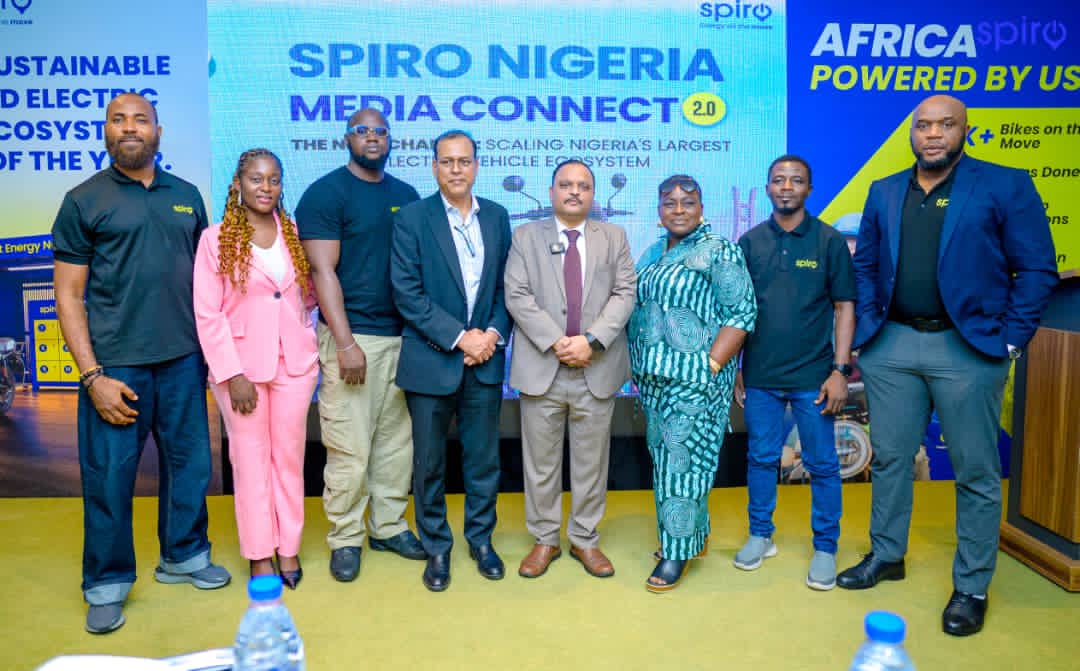
The company unveiled the growth strategy at the second edition of its Media Connect event in Lagos, where it formally introduced its new Country Head and Managing Director, Mr Prasad Sane, who will lead its operations and expansion drive in the country.
Sane said Spiro would consolidate its presence in Lagos, Ogun and Oyo states while exploring opportunities to extend its operations to additional markets, as it seeks to accelerate Nigeria’s transition to cleaner and more sustainable transportation.
The event brought together journalists covering business, technology, mobility and sustainability to discuss the company’s progress, infrastructure development and long-term ambitions for Nigeria’s electric mobility market.
Addressing the gathering, Sane said the company was moving beyond the deployment of electric motorcycles to building an integrated mobility ecosystem designed to improve riders’ earnings, reduce operating costs and create economic opportunities.
“Today is about progress, partnership and purpose. A year ago, we shared our vision for electric mobility in Nigeria. Today, we are demonstrating tangible results and a clear path forward,” he said.
He added that his mandate was to make Spiro one of the most trusted, affordable and accessible electric mobility solutions for Nigerians, beginning with its existing focus markets.
“My mandate is simple: to make Spiro the most trusted, affordable and accessible electric mobility solution for Nigerians, beginning with Lagos, Ogun and Oyo states.
“We are moving beyond electric bikes to build a complete ecosystem centred on our promise of ‘Energy on the Move’,” Sane stated.
A major pillar of the company’s strategy is its battery-swapping technology, which allows riders to exchange depleted batteries for fully charged ones in under a minute, reducing downtime and eliminating the need to wait for conventional recharging.
According to Sane, the model offers riders an alternative to rising fuel and maintenance costs while supporting efforts to reduce carbon emissions and improve the economics of commercial motorcycle operations.
“Electric mobility is no longer the future. It is the present, and Nigeria is poised to lead the transition,” he said.
Under its expansion plan, Spiro intends to accelerate the deployment of battery-swapping stations and service centres across Lagos, Ogun and Oyo states to improve accessibility, operational efficiency and customer support.
The company also plans to extend its geographical reach beyond the three states, bringing its electric motorcycles and related services to more Nigerian markets.
Another priority is strengthening partnerships with financial institutions, logistics companies and rider communities to improve access to electric motorcycles and its Battery-as-a-Service solutions.
The approach is expected to support wider adoption by riders who may face financial barriers to acquiring electric motorcycles outright, while helping businesses explore cleaner and potentially more cost-effective transportation options.
Spiro also plans to scale up local assembly operations, technical training and after-sales support, with a focus on creating employment opportunities, particularly for young Nigerians and women.
The company said the measures would help strengthen its operational capacity while developing local skills and supporting the growth of Nigeria’s electric mobility ecosystem.
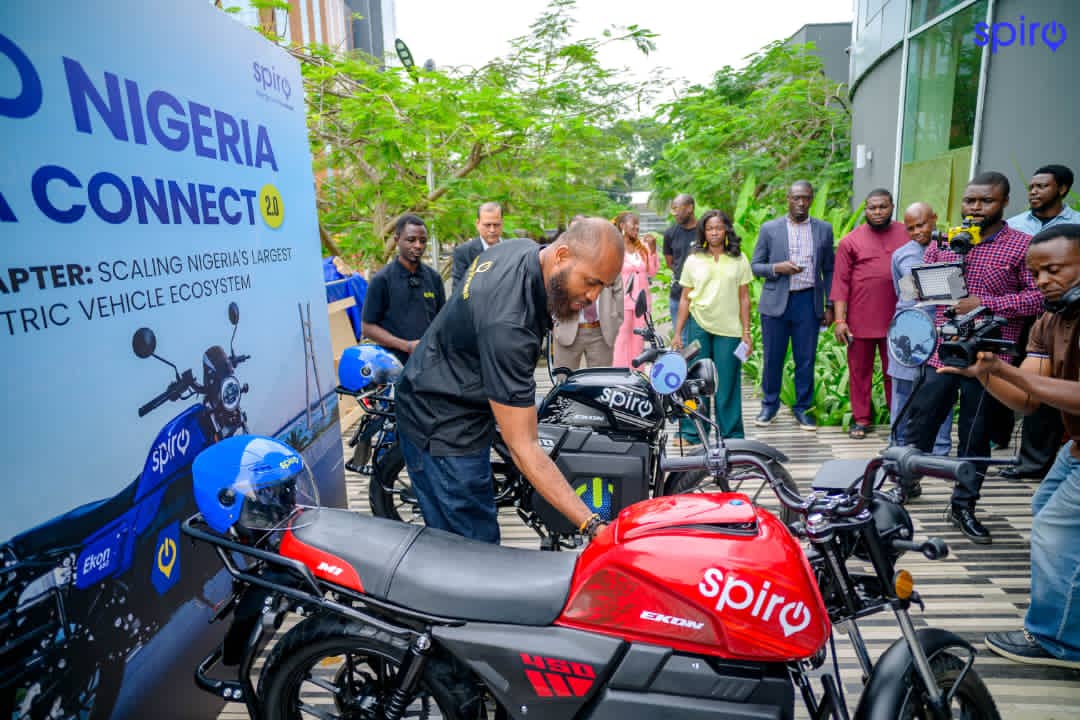
The Media Connect event featured live product demonstrations and operational showcases, alongside the unveiling of the Spiro Ekon M1 Version 3, highlighting the company’s efforts to develop its electric motorcycle offerings for the Nigerian market.
Spiro, which received the West Africa Sustainable Award (WASA), is positioning its expansion around electric motorcycles and battery-swapping infrastructure as it seeks to contribute to the growth of sustainable mobility across Nigeria.
Business
NNPCL: We Introduced ₦66 Fuel Discount Before FG’s Announcement
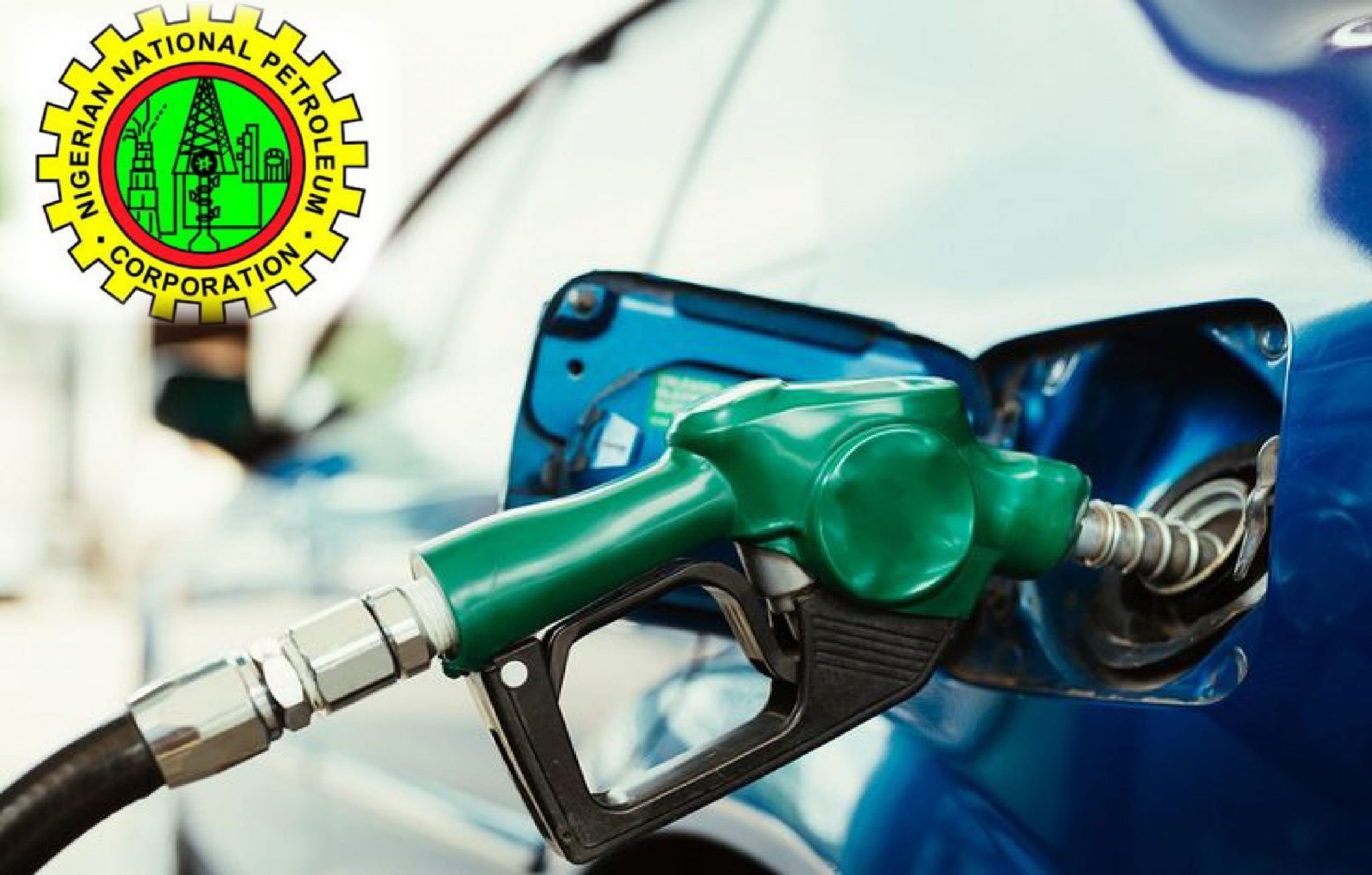
NNPCL: We Introduced ₦66 Fuel Discount Before FG’s Announcement
The Nigerian National Petroleum Company Limited (NNPCL) has said it introduced a ₦66-per-litre petrol discount on October 1, before the Federal Government announced a separate fuel price-relief measure aimed at cushioning Nigerians against rising petrol prices.
The national oil company said the initial discount was introduced to commemorate Nigeria’s 66th Independence Anniversary and would remain in effect until October 31, 2026, at NNPC Retail filling stations nationwide.
NNPCL’s clarification followed the Federal Government’s announcement of a 30-day petrol discount arrangement on October 8, under which the company’s retail arm would temporarily forgo its profit margin and sell petrol at cost to provide relief to consumers.
In a statement issued on Friday, October 9, NNPCL’s Chief Corporate Communications Officer, Andy Odeh, said the company’s earlier discount was a customer-relief initiative and should not be interpreted as a restoration of petrol subsidy.
“Before the announcement, NNPC Limited had introduced a sales discount on 1 October 2026 to commemorate Nigeria’s 66th Independence Anniversary. This will now continue until 31 October 2026 across NNPC Retail stations nationwide,” the company said.
NNPCL explained that the initiative was designed to ease the financial pressure on motorists and other customers amid rising global crude oil prices and their impact on domestic petrol costs.
READ ALSO:
- ‘Mad People’: Presidency Fires Back at Amaechi Over Tinubu Re-Election Remarks
- ‘What Happens on Day 31?’ Atiku Slams Tinubu’s 30-Day Fuel Discount as Election-Laced Package
- Ronaldo Breaks Silence on Portugal Row as Pelé, Maradona Comparison Sparks Meme Frenzy
The company stressed that the discount applied to its retail outlets and did not establish a uniform petrol price nationwide or change the market-based pricing framework governing petroleum products.
It also urged Nigerians not to confuse the temporary price reduction with the return of the fuel subsidy regime, which the Federal Government ended in May 2023.
The Federal Government’s separate intervention, announced by the Minister of Finance and Coordinating Minister of the Economy, Taiwo Oyedele, provides for NNPC Retail to forgo its retail profit margin for an initial 30-day period. Public transport operators are to receive priority under the arrangement.
The government has maintained that the new measure is not a subsidy because the discount is to be absorbed through NNPC Retail’s profit margin rather than funded by public revenue.
NNPCL said it would continue working with the Federal Government and other stakeholders to help cushion the impact of elevated fuel prices on households, businesses and the wider economy.
The clarification comes amid mounting concern over petrol prices and transportation costs, which have increased the financial burden on Nigerian households and businesses.
The company reaffirmed its commitment to reliable fuel supply, responsible customer service and clear communication about the scope and duration of its pricing initiatives.
NNPCL: We Introduced ₦66 Fuel Discount Before FG’s Announcement
Insurance
Lasaco Assurance Retains A(NG) Rating as Revenue Rises 35.2% to N30.8bn

Lasaco Assurance Retains A(NG) Rating as Revenue Rises 35.2% to N30.8bn
Lasaco Assurance Plc has retained its A(NG) national-scale financial strength rating for the 2025/2026 rating period, following an affirmation by Global Credit Rating Co. (GCR), with a stable outlook, in a development that highlights the insurer’s capital position and ongoing growth strategy.
The rating affirmation reflects the company’s risk-adjusted capital base, adequate liquidity and efforts to strengthen its underwriting capacity amid competition and evolving demands in Nigeria’s insurance industry.
According to the company, its financial performance was supported by a significant capital injection in 2026, which strengthened its capacity to underwrite larger and higher-value risks. The additional capital is expected to support its expansion plans and improve its ability to manage the financial risks associated with its insurance operations.
Lasaco Assurance recorded a 35.2 per cent increase in insurance revenue to N30.8 billion in 2025, reflecting growth across its business lines. The performance underscores the company’s efforts to expand its business portfolio and deepen its presence in the Nigerian insurance market.
Despite the revenue growth, the insurer continues to face underwriting performance pressures, making improved risk selection, pricing discipline and cost management important to its drive for stronger profitability.
The company is pursuing a range of strategic initiatives aimed at expanding retail insurance penetration, accelerating digitalisation and strengthening partnerships to attract new customers and improve service delivery.
READ ALSO:
- Man Allegedly Caught Using Old Tyres to Scam POS Operator
- BREAKING: FG Unveils 10 Measures to Cushion Fuel Price, Inflation Pressures
- 2027: ADC Vows to Collate, Share Polling-Unit Results Despite INEC Warning
These initiatives are also expected to support wider access to insurance products, improve operational efficiency and strengthen the company’s competitive position in a market where insurers are increasingly seeking innovative ways to reach individuals and businesses.
Lasaco Assurance’s diversified business portfolio remains a key component of its growth strategy, with several business lines contributing to its revenue. The company is also prioritising improved underwriting discipline and more effective use of reinsurance capacity to manage exposure to large claims and reduce earnings volatility.
Reinsurance enables insurers to transfer part of their risks to other insurance providers, helping them manage large exposures and preserve their financial capacity. For Lasaco Assurance, effective deployment of reinsurance arrangements is part of its broader effort to balance business expansion with risk management.
Commenting on the rating affirmation, the company’s Managing Director, Ademoye Shobo, expressed satisfaction with the recognition, describing it as a validation of the efforts and resilience of the company’s workforce.
“Lasaco Assurance is proud of this recognition, which validates the hard work and resilience of our team. Nonetheless, we remain fervently committed to continuous improvement and are actively working to elevate our rating through enhanced underwriting practices, operational excellence, and strategic growth,” Shobo said.
The company said its strengthened capital base and improved liquidity coverage had positioned it to pursue sustainable growth over the rating outlook period.
However, sustaining the positive momentum will depend on its ability to translate revenue growth into improved underwriting results, maintain adequate liquidity and manage risks effectively as its business expands.
The insurer’s emphasis on operational efficiency and disciplined underwriting reflects the need to balance growth with profitability, particularly in an industry where claims obligations, pricing pressures and changing market conditions can affect financial performance.
Lasaco Assurance also aims to increase its market share while delivering value to policyholders through improved products and service delivery. Its digitalisation strategy and retail market expansion are expected to play important roles in reaching more customers and strengthening its distribution channels.
The continued affirmation of its A(NG) rating provides a positive signal about the company’s financial strength within the national rating scale. However, the rating does not eliminate the operational and underwriting risks associated with its business.
As Lasaco Assurance advances its growth agenda, its ability to sustain revenue expansion, strengthen underwriting profitability and maintain sound capital and liquidity positions will remain important to its long-term performance and standing in Nigeria’s insurance sector.
Lasaco Assurance Retains A(NG) Rating as Revenue Rises 35.2% to N30.8bn
-

 metro2 days ago
[UPDATED] 20 NYSC Prospective Corps Members Freed After Seven Days in Captivity
-

 Politics3 days ago
‘No Decent Wages, No Credible Elections’ — Sowore Threatens 2027 Boycott
-

 metro3 days ago
Seven Years With Parkinson’s: Man Seeks N65m for Brain Surgery in Türkiye
-

 Politics3 days ago
2027: Obi Makes U-Turn, Vows to Restore Fuel Subsidy If Elected
-

 Africa1 day ago
FBI Raids Ghana Scam Centre, Detains Over 130 in $10m Fraud Probe
-

 metro2 days ago
Yayi, Adebule, Muslim Leaders, Others for Imodi-Ijebu Turbaning, ₦1bn Fundraiser
-

 metro2 days ago
EFCC Re-Arraigns Two Over Alleged £110,000 Money Laundering, ₦500m Fraud
-

 Politics3 days ago
2027: Galadima Alleges APC Offering N50m, N200m to Lawmakers to Step Aside