

International
More deaths as Israel unleashes massive bombs on Gaza

More deaths as Israel unleashes massive bombs on Gaza
Israel resumed its deadly bombardment of Gaza on Friday, saying it struck more than 200 targets in the densely inhabited Palestinian territory despite international calls for a renewed truce.
The Hamas-run health ministry said that at least 109 people had been killed in Gaza since the pause in hostilities expired in the morning and ground battles and Israel air strikes resumed.
Israel alleged that Hamas had attempted to break the truce even before it ended at 0500 GMT by firing a rocket and that it had failed to produce a list of hostages that could have been released on Friday in exchange for Palestinian prisoners.
But both the United Nations chief and the White House called for the break in fighting to be restored, and UN agencies warned of a “catastrophic” humanitarian situation as bombs fell and hospitals again struggled to cope with the wounded after a week-long respite.
“We continue to work with Israel, Egypt, and Qatar on efforts to extend the humanitarian pause in Gaza,” a White House National Security Council spokesperson said after US Secretary of State Antony Blinken left Israel following diplomatic efforts to shore up the truce.
In a social media post, United Nations Secretary-General Antonio Guterres said: “I deeply regret that military operations have started again in Gaza. I still hope that it will be possible to renew the pause that was established.”
Under the truce, Hamas militants released hostages in exchange for Palestinian prisoners held in Israeli jails, and greater aid flows into war-devastated Gaza.
But with explosions audible and a dark column of smoke rising over northern Gaza, Israel’s army said its warplanes were striking Hamas targets across the Palestinian territory and AFP journalists saw, and visited the aftermath, of several bombings.
READ ALSO:
- Fake US military officer jailed in Kaduna
- IPOB kicks as Enugu governor calls group ‘proscribed’
- Mohbad’s wife requested DNA tests from US hospital, 2 others — Iyabo Ojo
Outgoing missiles fired by Palestinian groups towards Israel were also seen.
“The healthcare service is on its knees,” Rob Holden, a World Health Organisation (WHO) senior emergency officer, told journalists in Geneva on a video link from Gaza as explosions were heard in the background. “It is like a horror movie.”
Israeli officials, however, took a tough line, insisting Hamas was to blame for the new eruption of fighting and vowing to destroy the Islamist movement.
“Unfortunately, Hamas decided to terminate the pause by failing to release all the kidnapped women,” Israeli government spokesman Eylon Levy told reporters. “Having chosen to hold onto our women, Hamas will now take the mother of all thumpings.”
The Israeli military said: “Over the last few hours, ground, air and naval forces struck terror targets in the north and south of the Gaza Strip, including in Khan Yunis and Rafah.”
Combat resumed shortly after Israel’s army said it had intercepted a rocket fired from Gaza, the first from the territory since a missile launched minutes into the truce on November 24.
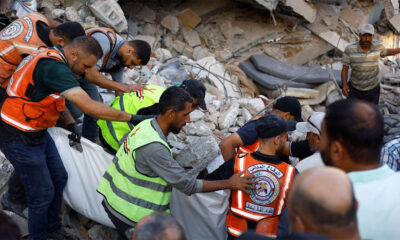
In the rubble of a house destroyed by bombs in the southern Gaza city of Rafah, a man screamed: “Where are my children?”
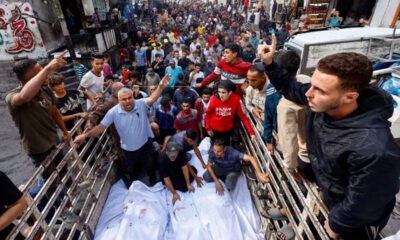
In Khan Yunis, a group of men chanted “God is greatest” as they rushed through the streets carrying a body wrapped in a white shroud. War has returned, even more fiercely”, Anas Abu Dagga, 22, told AFP.
On a bed at Khan Yunis’s Nasser hospital, a member of the same family, Amal Abu Dagga wept, her beige veil covered in blood.
“I don’t even know what happened to my children,” she said. Another relative, Jamil Abu Dagga, told AFP the family had been at home when the bombs started falling.
In Israel, sirens warning of potential missiles sounded in several communities near Gaza, and authorities said they were restarting security measures in the area including closing schools.
A rocket strike destroyed a van in one Israeli community near Gaza.
The office of Israeli Prime Minister Benjamin Netanyahu said fighting had restarted after Hamas violated the truce.
“The Government of Israel is committed to achieving the goals of the war: Releasing the hostages, eliminating Hamas and ensuring that Gaza never again constitutes a threat to the residents of Israel,” it said.
READ ALSO:
- Gunmen abduct catholic priest, driver in Imo
- Kano governorship dispute : APC files cross-appeal at Supreme Court
- Police, ICPC clear D’banj of N-Power fraud, rape allegations
Despite the resumption of fighting, talks between Qatari and Egyptian mediators were “ongoing”, said a source briefed on the talks.
During the seven-day truce, Hamas freed 80 Israeli hostages in exchange for 240 Palestinian prisoners, and more aid entered Gaza, where 1.7 million people are displaced and short of food, water and other essentials, according to the United Nations.
Twenty-five other hostages, mostly Thais, were also freed during the truce but outside the scope of its terms.
On Thursday, Washington’s top diplomat Antony Blinken, meeting Israeli and Palestinian officials, called for the truce to be extended, and warned any resumption of combat must protect Palestinian civilians.
Other world leaders, and aid groups, had also sought an extended pause in the fighting that began on October 7 when Hamas militants broke through Gaza’s militarised border into Israel.
During the unprecedented attack, Hamas killed about 1,200 people, mostly civilians, and kidnapped around 240, according to Israeli authorities.
In response, Israel vowed to eliminate Hamas and unleashed an air and ground military campaign in Gaza that the Hamas authorities who run Gaza say has killed more than 15,000 people, also mostly civilians.
– ‘Evacuation zones’ –
On Thursday eight more Israeli hostages, some holding dual nationality, were released.
READ ALSO:
- Women are witches, manipulators – Ooni
- Ekiti pastor arrested for allegedly killing his pregnant wife for ritual
- Gunfire breaks out in Guinea-Bissau’s capital amid coup scare
- BREAKING : Gunmen attack residence of INEC REC
Not long after the hostages arrived in Israel, the country’s prison service said another 30 Palestinian prisoners — 23 minors and seven women — had been freed.
Hamas said it had also offered to hand over the bodies of a mother and her two sons — one of them a baby — in talks to extend the now-expired truce.
Shiri Bibas, her 10-month-old son Kfir and his four-year-old brother Ariel, along with their father Yarden, have become emblematic of the October 7 attacks due to the age of baby Kfir. Israeli officials refused to comment on Hamas’s “propaganda”.
The Israeli military published a map of “evacuation zones” in the Gaza Strip. The military said it would enable residents to “evacuate from specific places for their safety if required”.
Residents in multiple areas were sent SMS warnings on Friday.
Israeli forces “will begin a crushing military attack on your area of residence to eliminate the terrorist organisation Hamas,” the warnings said.
“Stay away from all military activity of every kind.”
More deaths as Israel unleashes massive bombs on Gaza
(AFP)








International
Russian Bomb Kills 33 in Ukraine, Hits Two Passenger Buses
Russian Bomb Kills 33 in Ukraine, Hits Two Passenger Buses
At least 33 people have been killed and 18 others injured after a Russian guided bomb struck a road in Kramatorsk, eastern Ukraine, hitting two passenger buses in one of the deadliest attacks on civilians reported in the country this year.
The attack occurred at about 10am in the Donetsk region, where two scheduled buses were operating when the Russian munition struck the road.
The blast triggered fires in the buses and surrounding area, leaving passengers and other civilians dead or injured. Emergency workers were deployed to the scene to extinguish the fires, recover victims and evacuate the wounded.
The death toll rose from an initial figure of 12 as rescuers continued their search of the area.
Preliminary investigations indicated that the weapon may have been a UMPB D-30SN guided aerial bomb, although authorities said investigations were continuing to establish the exact type of munition used.
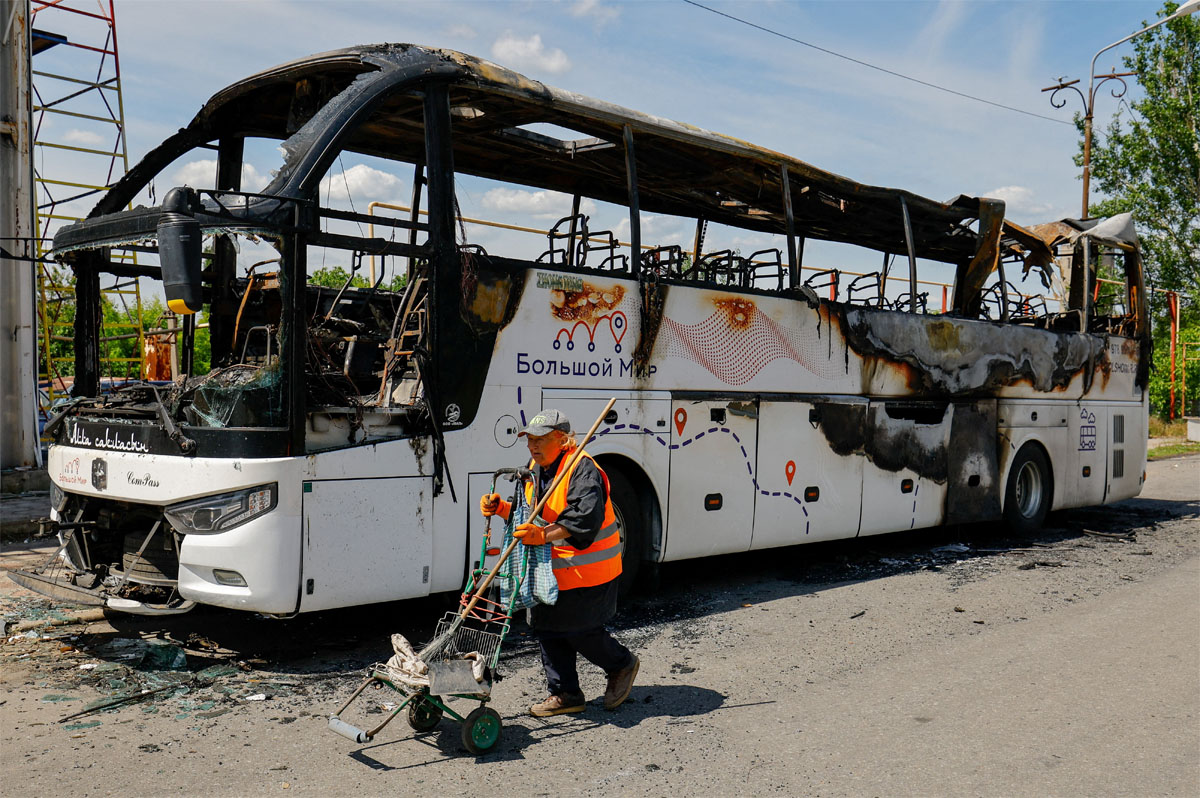
Images from the scene showed a badly burned bus, debris scattered across the road and bodies lying near the site of the explosion.
Donetsk Governor Vadym Filashkin accused Russian forces of deliberately targeting civilians, while Ukrainian President Volodymyr Zelenskyy condemned the attack and described the location as a bus stop.
READ ALSO:
- How Six Members of a Family Were Murdered in Oyo
- World Bank Raises Nigeria Growth Forecast, Demands More Jobs, Poverty Reduction
- Flood Submerges Enugu Road, Strands School Children, Passengers
Russia has not immediately commented on the attack or the reported casualty figures. Moscow has consistently denied deliberately targeting civilians during its war against Ukraine.
Authorities suspended public transportation in Kramatorsk and neighbouring Sloviansk following the attack as a precaution against further strikes.
Kramatorsk, an important Ukrainian-controlled city in the Donetsk region, has faced repeated Russian drone and guided-bomb attacks as fighting intensifies along the eastern front.
The latest attack came a day after another deadly Russian strike on Pryluky, in Ukraine’s Chernihiv region, where a missile hit a five-storey residential building.
The death toll in Pryluky rose to 22 people, including five children, while 54 others were injured. Several people were rescued from the damaged building as emergency crews continued search-and-rescue operations.
The attacks came amid an intensified Russian aerial campaign involving missiles, drones and guided bombs against Ukrainian cities and infrastructure.
Ukrainian authorities have appealed for stronger air-defence support from international partners as the country faces renewed attacks ahead of winter.
The latest strikes have also renewed concerns over the safety of civilians and critical infrastructure nearly five years after Russia launched its full-scale invasion of Ukraine.
Russian Bomb Kills 33 in Ukraine, Hits Two Passenger Buses
International
US Proposes $70,000 OPT Fee for Nigerians, Other Foreign Students

US Proposes $70,000 OPT Fee for Nigerians, Other Foreign Students
The administration of US President Donald Trump has proposed a $70,000 fee for international students seeking to participate in a programme that allows them to work in the United States after completing their studies.
The proposed rule by the US Department of Homeland Security (DHS) targets the Optional Practical Training (OPT) programme available to eligible foreign students on F-1 visas, including Nigerians studying in the US.
Under the proposal, US educational institutions would be required to pay $70,000 for each student’s initial OPT participation, while an additional $30,000 fee would apply for each renewal or further training.
The proposal does not initially require students themselves to pay the $70,000 directly. Instead, the financial obligation would fall on the schools recommending students for OPT, although education groups warn that the cost could ultimately affect students and universities.
The OPT programme allows eligible international students to obtain temporary work experience in jobs related to their fields of study. Most students can participate for up to one year after graduation, while graduates in qualifying science, technology, engineering and mathematics (STEM) fields can receive an additional two years.
READ ALSO:
- EFCC Re-Arraigns Two Over Alleged £110,000 Money Laundering, ₦500m Fraud
- Three Killed, 36 Injured as Houthi Attacks Hit Saudi Airports
- Bandits Kill Three in Fresh Attack on Kebbi Community
DHS said the proposed fees are intended to combat fraud, strengthen the integrity of the immigration system and protect US workers.
The department has also argued that OPT has been misused as a source of cheap foreign labour and that the proposed fees would encourage universities to exercise greater scrutiny when recommending students for the programme.
The proposed charge represents a sharp increase from the current cost associated with OPT applications, which is around $500.
The plan could have significant implications for international students from countries such as Nigeria, India and China, whose graduates make substantial use of OPT, particularly in technology and other specialised fields.
American universities and business groups have raised concerns that the proposed fee could discourage international students from studying in the US and make it harder for companies to recruit skilled graduates.
Education groups have also warned that the measure could affect American universities that rely on international enrolment for tuition revenue and employers that depend on foreign graduates to fill specialised positions.
The proposal is part of the Trump administration’s broader effort to tighten US immigration policies and impose greater restrictions on foreign students and workers.
The DHS proposal is subject to a public comment period before it can be finalised. If approved, the rule would take effect after an additional implementation period, while legal challenges are also expected.
The proposed OPT fee is separate from other changes to the H-1B visa programme, which has also faced increased costs and restrictions under the Trump administration.
US Proposes $70,000 OPT Fee for Nigerians, Other Foreign Students
International
Three Killed, 36 Injured as Houthi Attacks Hit Saudi Airports
Three Killed, 36 Injured as Houthi Attacks Hit Saudi Airports
Three people have been killed and 36 others injured after attacks struck two major airports in Saudi Arabia, with Yemen’s Houthi rebels claiming responsibility for the strikes.
The attacks targeted Abha International Airport in the southern Asir province and King Khalid International Airport in the capital, Riyadh, according to Saudi Arabia’s General Authority of Civil Aviation.
Two women, identified as Moroccan and Algerian residents, were killed in the attack on Abha Airport, where 28 people were also injured.
A separate attack on King Khalid International Airport killed a Sudanese national and injured eight others, including five Saudi citizens, two Egyptian residents and a Pakistani resident.
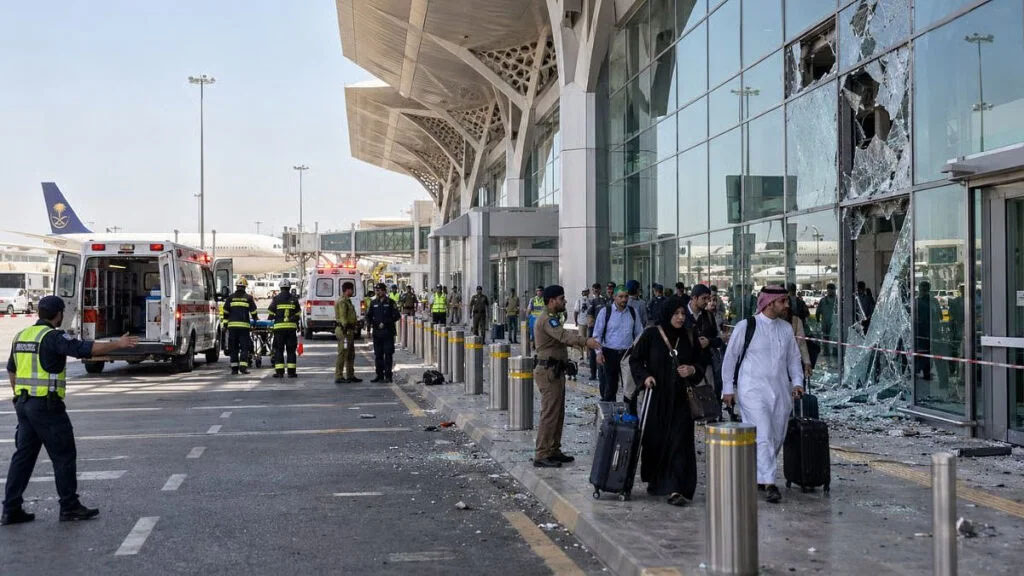
The Saudi aviation authority said the attacks caused material damage and that emergency and security agencies were assessing the impact while taking measures to protect passengers and airport workers.
READ ALSO:
- Bandits Kill Three in Fresh Attack on Kebbi Community
- Ronaldo Pays Emotional Tribute to Messi After Argentina Farewell
- US Set to Charge Maduro, Wife Over Alleged Torture of Americans
The Houthis, who control large parts of Yemen, claimed responsibility for the attacks. Houthi military spokesman Yahya Saree said the group had targeted King Khalid Airport with drones and attacked Abha Airport with ballistic missiles and drones.
Saudi authorities did not directly attribute the attacks to the Houthis in their initial statement, although the claims by the group came shortly before the Saudi casualty figures were announced.
The attacks came amid a sharp escalation in the Yemen conflict, after Saudi-backed Yemeni government forces launched an offensive against Houthi fighters holding territory along the strategically important Red Sea coast and near the Bab el-Mandeb Strait.
The Houthis have also claimed attacks on other Saudi targets, while Saudi-led forces have intensified air operations against Houthi positions in Yemen.
The renewed fighting has raised fresh concerns about the security of Saudi airports and regional air travel, with airlines and aviation authorities monitoring developments closely.
The latest violence marks another escalation in a conflict that has repeatedly threatened civilian infrastructure and vital shipping routes in and around the Red Sea.
Three Killed, 36 Injured as Houthi Attacks Hit Saudi Airports
-

 metro3 days ago
Tragedy Strikes FMC: Medical Director Loses Two Daughters—A Doctor and a Pharmacist—Within 48 Hours
-
 metro2 days ago
Ondo Air Tragedy: Soldiers, Families Among 32 Killed In NAF Crash
-

 metro3 days ago
27-Year-Old Woman Allegedly Kills Newborn Hours After Giving Birth in Abuja
-

 metro2 days ago
Gunmen Open Fire At Lagos Bus Stop, Kill NURTW Member, Injure Three
-

 News3 days ago
President Tinubu Mourns 32 NAF Personnel in Ondo Jet Crash, Orders Immediate Probe
-

 metro3 days ago
No Survivors Found in Ondo NAF Plane Crash — Ondo Governor
-

 metro3 days ago
Adeleke Signs New Law to Regulate Motor Parks Across Osun
-

 Politics3 days ago
2027: Ajaero Questions Tinubu, Atiku, Obi’s Economic Approach, Highlights Adebayo’s Ideas