

International
US weapons used in Israeli attack on Gaza school – Report
US weapons used in Israeli attack on Gaza school – Report
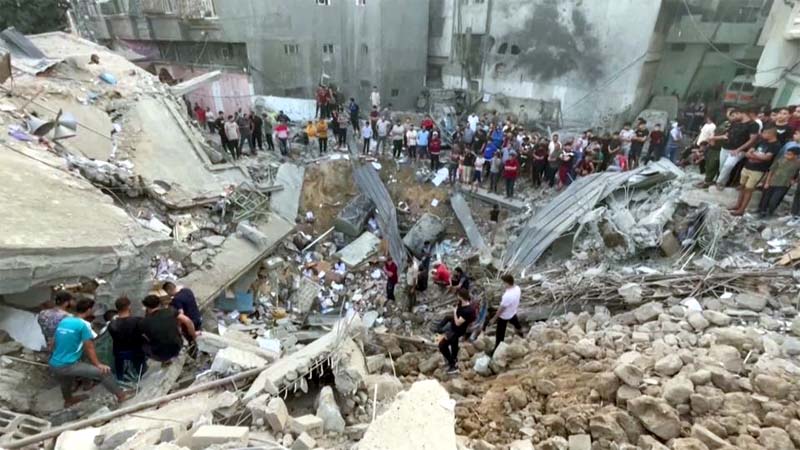
Among the rubble of the United Nations-run al-Sardi school in central Gaza’s Nuseirat refugee camp were the remnants of the weapons that killed at least 40 Palestinians.
The Israeli attack in the early hours of Thursday gave the displaced people sheltering in the school no prior warning. Fourteen children were killed, as well as nine women and at least 74 other people were wounded. The weapons used to carry out the attack – according to an Al Jazeera analysis of the fragments left behind – were US-made.
An inertial measurement unit from the missile, used to aid with precision targeting, was manufactured by Honeywell, an American conglomerate that specialises in the design and delivery of sensors and guidance devices that are used in a variety of military weapons.
Al Jazeera’s Sanad verification unit discovered that one of the fragments found in Nuseirat bore the manufacturer and category number HG1930BA06, tracing it back to Honeywell. HG1930 refers to the specific sensor manufactured by the company.
The same part was found after the Israeli bombing of a Palestinian home in Shujayea, Gaza in 2014. The two pieces, in the most recent and the 2014 bombing, have the same manufacturer part number inscribed on them.
“We see also other numbers like the MFR, HG 1930 and then BA 06. This is the manufacturer part number that provides more specific details about the component of the missiles,” Elijah Magnier, an independent military and political analyst, told Al Jazeera. “Now, if you look at the manufacturer identification … it is a format used by the aerospace and defence sector in the United States connected to Honeywell.”
READ ALSO:
- CBN will implement bold economic reforms, says Cardoso
- 200 babies born one month in Benue IDP camp – Report
- US sanctions Palestinian group under decree used to target Israeli settlers
“Honeywell is known for the supply of IMU in the various military applications, and particularly the guided missiles that it has been providing to the Israeli Air Force since the year 2000.”
Al Jazeera has reached out to Honeywell for comment, but has yet to receive a response.
Israeli attacks on UN spaces have become commonplace during Israel’s war on Gaza, which has now killed more than 36,000 Palestinians.
The United States has been criticised for its role in supporting Israel, and particularly its continued supply of weapons.
Major rights groups have repeatedly accused Israel of violating international law, and Israel is currently facing a genocide case at the International Court of Justice. The International Criminal Court’s chief prosecutor has also sought arrest warrants for Prime Minister Benjamin Netanyahu and Defence Minister Yoav Gallant for their actions in Gaza.
In May, a US government report found possible Israeli violations of international law in Gaza, but stopped short of identifying the violations that would end its continuing military aid. US President Joe Biden has threatened to stop the supply of some offensive weapons to Israel if it continues its Rafah operation, but has not carried out the threat, despite Israel pressing on in the area, which lies in southern Gaza.
Central Gaza under attack
Central Gaza has most recently come under severe Israeli bombardment, which Palestinians have described as similar to the early days of the war.
The attack on al-Sardi school in Nuseirat is part of that assault.
“The bombardment came from here,” said Naim al-Dadah, a survivor of the attack.
“We were sleeping. The flying metal reached the roof on the other side and all these nets landed over there, on the other side. What happened to us is beyond anyone’s imagination.”
Other witnesses say the attack tore people to pieces. Survivors collected body parts, including those of many children, until the early hours of the morning. Weapon debris was scattered throughout shattered rooms and the blood-stained mattresses. Multiple rooms were targeted, though the building’s structure remained intact.
Israel’s Arabic language spokesperson Avichay Adraee, claimed the UN school was targeted because it housed a Hamas command post and fighters involved in the Palestinian group’s October 7 attack on Israel, which killed 1,139 people. He also claimed Israel took several steps to minimise the possibility of civilian casualties. The director of Hamas’s government media office, Ismail al-Thawabta, rejected Israel’s claims.
In April, the media outlet +972 Magazine reported that Israel uses an artificial intelligence-targeting system called Lavender in its Gaza-bombing campaign. The report quoted Israeli military officials who said that the system generates targets to kill. For low-level Hamas targets, the report said, the army was permitted to kill 15 to 20 civilians. An attack on a more senior Hamas official with the rank of battalion or brigade commander was used to justify the killing of more than 100 civilians.
US weapons used in Israeli attack on Gaza school – Report
SOURCE: AL JAZEERA






International
Teen Gunman Kills Two Students, Injures Eight in Philippine School
Teen Gunman Kills Two Students, Injures Eight in Philippine School
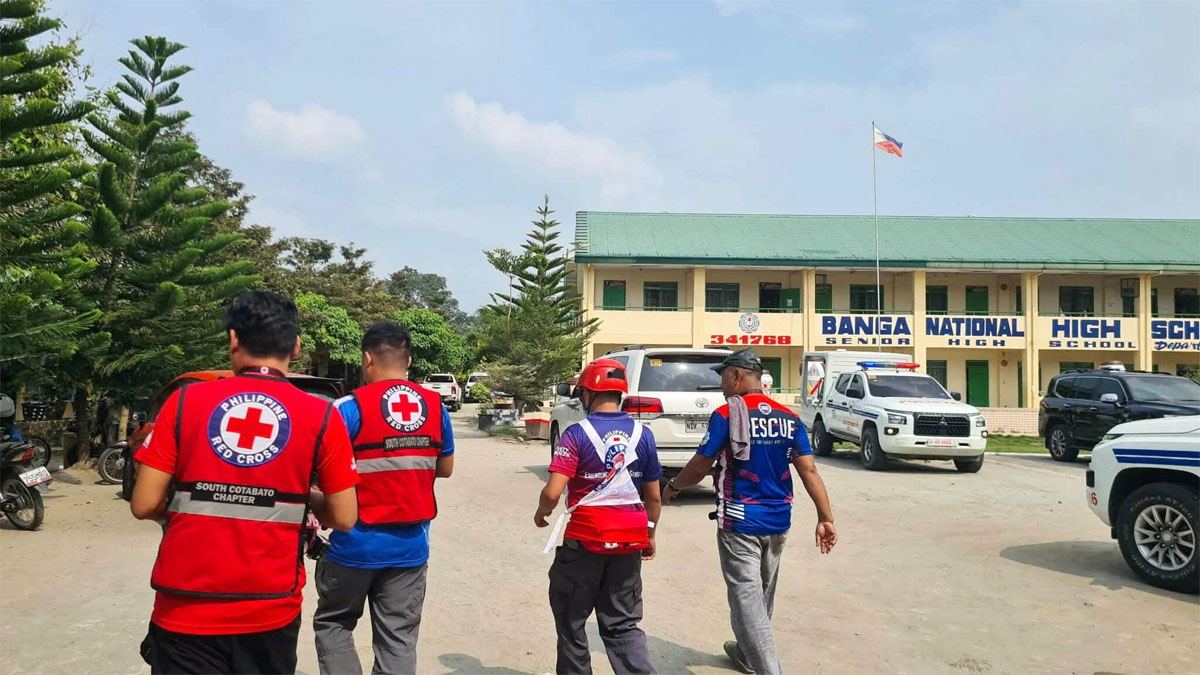
A school shooting in the Philippines has left two 14-year-old students dead and eight others injured after a 16-year-old student opened fire at Banga National High School in South Cotabato before taking his own life.
The incident happened at about 1:30 p.m. on Friday, September 18, in Banga town on the southern island of Mindanao, sending students fleeing from the school as emergency responders moved in to attend to the victims.
South Cotabato Governor Reynaldo Tamayo said the two students killed were a boy and a girl, both aged 14. The suspected shooter, a Grade 9 student at the school, also died after shooting himself following the attack.
Banga Mayor Albert Palencia said the teenager opened fire inside a classroom neighbouring his own, hitting 10 students. Two of the victims died while eight others were wounded. Four of those injured were reported to be in critical condition.
The mayor said the teenager had reportedly warned some of his friends before the shooting that he intended to carry out a plan after lunch and advised them to go home because they could become involved. His friends reportedly dismissed the warning, believing he was joking.
After lunch, the teenager reportedly left his classroom and entered a neighbouring classroom, where he began shooting at fellow students. He then changed the magazine of the firearm before shooting himself.
Authorities are investigating how the teenager obtained the firearm and brought it into the school.
According to local officials, the gun belonged to the teenager’s father, an employee of the Philippine Department of Education. The firearm had reportedly been kept in a secured vault, which the teenager allegedly broke open before taking the weapon to school.
The circumstances surrounding the weapon have become a major focus of the investigation, particularly because the suspected shooter was a minor.
South Cotabato Governor Tamayo urged gun owners and parents to ensure that firearms are securely stored and inaccessible to children, stressing that school security personnel alone cannot prevent every possible threat.
Authorities are also investigating reports about the teenager’s involvement in an online True Crime Community, described by officials as an internet group where young people discuss violent crimes and, in some cases, glorify school shooters.
READ ALSO:
- Xenophobia: FG Brings 33 More Nigerians Home From South Africa
- Falconets Thrash England 3-0, Face Colombia in U-20 World Cup Quarter-Finals
- Replace Fuel Subsidy With Vehicle Credit to Drive Mobility, Jobs,LCCI, Ilekuba tell FG
Authorities have not established that the online activity caused or directly motivated the attack, and investigations into the teenager’s background and possible motive remain ongoing.
The teenager’s mother had reportedly expressed concern about him and was considering taking him for psychiatric assistance, according to information cited by local officials. The circumstances surrounding his behaviour and possible motive remain under investigation.
Emergency responders took the injured students to hospitals in the area, including the South Cotabato Provincial Hospital and Surallah Community Hospital.
The Philippine Department of Education said the safety and wellbeing of students, teachers and school personnel remained its immediate priority. In-person classes in the affected area were suspended, while authorities coordinated medical assistance and psychosocial support for students and staff affected by the incident.
President Ferdinand Marcos Jr. ordered a thorough investigation into the shooting, particularly how a minor was able to obtain a firearm and bring it inside a school.
Marcos also expressed condolences to the families of the victims and directed relevant authorities to establish the circumstances surrounding the incident.
The shooting has renewed concerns over school security, gun storage and minors’ access to firearms in the Philippines, particularly as the country has experienced several deadly school attacks in recent months.
The Banga incident is the third deadly school shooting in the Philippines since June.
In June, a shooting at a public high school in Tacloban City left three students dead and about 20 others injured after two students reportedly opened fire on the campus.
In August, another student in Zamboanga reportedly livestreamed the killing of a fellow student before taking his own life.
The incidents have prompted increased attention to school security and emergency preparedness. The Philippine Department of Education conducted nationwide school safety drills earlier this month as part of efforts to improve responses to armed attacks and other emergencies.
Authorities are now expected to examine not only the circumstances of the Banga shooting but also how the teenager gained access to the weapon, how it was taken into the school and whether any online activity contributed to his actions.
Early reports from authorities gave different casualty figures as emergency teams responded to the shooting. Later reports from local officials, police and national news agencies converged around two student deaths, the death of the 16-year-old suspected gunman and eight injured students, although some reports continued to carry different figures while the investigation was ongoing.
The Banga community is now mourning the two young students killed in the attack, while the injured students remain under medical care and authorities continue their investigation into the country’s latest deadly school shooting.
Teen Gunman Kills Two Students, Injures Eight in Philippine School
International
Ninth Body Discovered in South Africa: Nigeria Issues Urgent Safety Alert to Nationals
Ninth Body Discovered in South Africa: Nigeria Issues Urgent Safety Alert to Nationals
Police cordon off Kempton Park and post a $56,000 combined bounty as the Nigerian Consulate warns citizens to exercise heightened vigilance.
South African police recovered the body of a ninth woman on Thursday along a roadside in Dawn Park, intensifying public alarm and prompting the Nigerian Consulate-General in Johannesburg to issue an emergency safety advisory to its citizens.
In response to the discoveries, law enforcement teams placed Kempton Park in the Ekurhuleni municipality under lockdown and established roadblocks to inspect vehicles and restrict suspect movement.
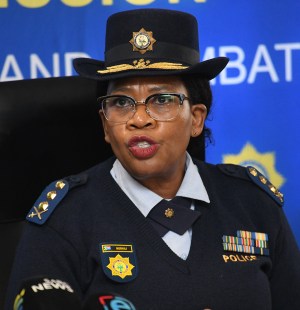
Deputy Police Chief Tebello Mosikili declared during a press conference that authorities will deploy specialized investigative units to track down those responsible.
To accelerate breakthroughs, police offered a 400,000 rand ($25,000) reward for credible tips, while South Africa’s Democratic Alliance provided an additional $31,000, establishing a combined bounty of $56,000.
Detectives are now evaluating forensic evidence to determine whether one perpetrator committed the murders or whether independent offenders copied earlier attacks.
Meanwhile, the Nigerian Consulate-General urged Nigerian residents, especially women and young people who commute, exercise, or study around Ekurhuleni, to take deliberate personal precautions.
The mission advised community members to travel in groups, stay clear of isolated trails, and share real-time travel details with trusted family members.
Furthermore, diplomatic officials emphasized that safety precautions must not shift the burden of crime prevention onto women, calling on South African authorities to ensure thorough investigations and justice for every victim.
Ninth Body Discovered in South Africa: Nigeria Issues Urgent Safety Alert to Nationals
Health
Fiji Declares National HIV Emergency as Diagnoses Surge Sixteenfold
Fiji Declares National HIV Emergency as Diagnoses Surge Sixteenfold
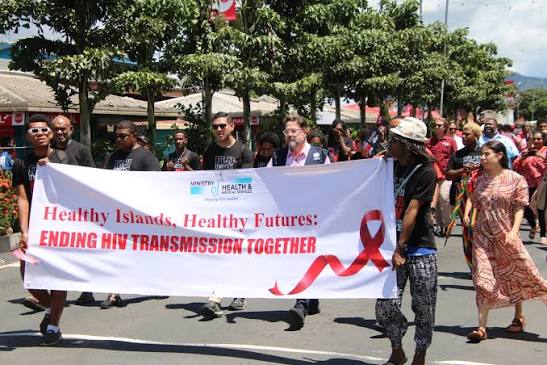
Authorities launch a multi-agency public health campaign to expand free testing, treatment, and harm-reduction services
Fiji has announced a nationwide health response to address a significant rise in HIV cases and ensure that all residents can access essential medical care.
On Wednesday, Health Minister Dr. Atonio Lalabalavu shared the emergency declaration, explaining that national agencies are joining forces to provide rapid medical support, expand testing, and protect community well-being across the islands.
Official reports indicate that about one in every 60 adults in Fiji currently lives with HIV, following an increase in new infections over recent years. Health specialists explain that the virus spreads primarily through intimate sexual contact and shared needles among individuals using illicit substances.
Additionally, routine screenings revealed that two out of every 100 expecting mothers carry the virus, highlighting an urgent need for early maternal healthcare to protect newborns from infection.
To safeguard public health, authorities are delivering free daily treatments, distributing protective preventive medications, and setting up clean needle programs to stop infections before they start.
Furthermore, global partners, including Australia, New Zealand, India, and United Nations health bodies are providing financial resources and medical supplies to back the local effort.
By encouraging open community conversations and delivering accessible healthcare without judgment, health workers aim to ensure that everyone receives the care and dignity they deserve.
Fiji Declares National HIV Emergency as Diagnoses Surge Sixteenfold
-

 International2 days ago
Islamic Council Condemns Attempted Attack on Holy City of Mecca
-

 News2 days ago
Keep Politics Out of My Office — Ogbomoso Grand Chief Imam Warns Politicians, Bloggers
-

 metro2 days ago
Niger Mosque Abductions: Terrorists Execute 30 of 500 Captive Muslim Worshippers
-

 Entertainment2 days ago
BREAKING: Olu Jacobs Dies at 84, Atiku Mourns Cultural Icon
-
 Business1 day ago
Fuel Prices Climb to ₦1,500 per Litre Across Nigeria, Sparking Calls for Urgent Action
-

 News2 days ago
Blue Line Rail, Hospitals Get Boost as Lagos Approves ₦200bn Bond and Budget Reordering
-
 News2 days ago
OAU Investigates Death of Final-Year Student as Police Begin Probe
-

 Interview2 days ago
He Does Not Lose Elections”: Abdulmumin Jibrin Predicts 65% Landslide for Tinubu in 2027