

News
We are paying ransoms with loans—Niger State residents
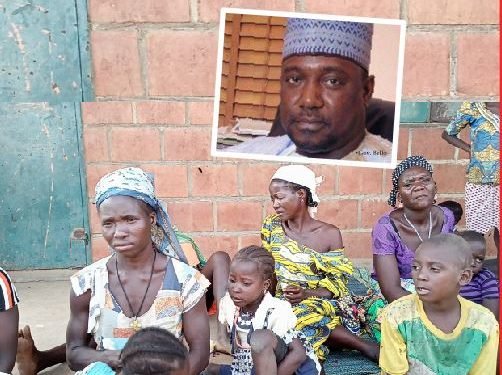
– Bandits’ attacks in Niger State have escalated in recent months with deadly cases recorded almost on a daily basis. The bandits attack and ransack villages, abducting the inhabitants for ransoms and subjecting even the women and children to untold horror. The security apparatus appears to be overwhelmed by all this and seems to be losing the battle. JUSTINA ASISHANA visited Munya, one of the most affected local government areas, and reports on the plight of its inhabitants.
Asabe Mathew, a middle-aged woman sat in a pensive mood in front of a classroom at the Internally Displaced Persons (IDP) camp at Central Primary School, Sarkin Pawa, Munya Local Government Area, Niger State gazing intensely at something that only her own eyes could see. She was brooding over the horror she had passed through since the bandits that hold a significant part of Niger State to ransom abducted her daughter and son, forcing her to sell everything she owned to pay for their release.
“They have finished me, as I am now,” she said as her eyes glistened with tears. “I have sold all my farm produce and I have loans to pay because I had to borrow money to pay the ransom for my children abducted by bandits. Now I have absolutely nothing left.”
Recalling how her two children were kidnapped by bandits and how she had to raise money as ransom to redeem them, she said: “My son was kidnapped when he was returning from school, and we were asked to pay one million naira to rescue him. What can I do? I had to pay because if I didn’t, they would kill him. I sold my farm produce, added my salary to the proceeds and also obtain a loan to raise the sum demanded as ransom.
“My daughter was also kidnapped. But that happened before they kidnapped my son. We also had to pay a ransom to rescue her. Right now, I don’t have anything left. It has not been easy for us in Munya.”
But Asabe was not alone in her plight. Mohammed Isah currently has two of his sons in the den of the bandits while he currently stays at the IDP camp at the Central Primary School, Sarkin Pawa. His two sons were taken in a recent attack on his Dangunu community in Munya Local Government Area.
He said: “Yesterday, before I ran to this camp, two of my sons were taken on motorcycles when the thieves came to our village. They have not been released because we do not have money to pay for their release. What they asked for is in millions. Where will I get it from? I cannot go back to the village to take my farm produce and sell because that will be equal to dying.”
The Vice-Chairman of Munya Local Government Council, Hon. Luka Garba, is not left out of the ordeal. Two months ago, he lost his younger brother to the bandits. According to him, his younger brother was a member of the local vigilantes in Kachu village and was killed during an ambush.
Rising spate of insecurity in Munya LG
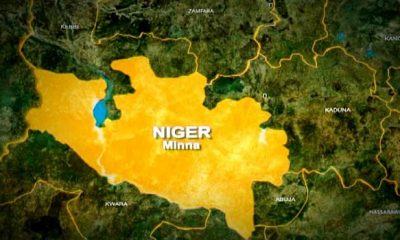
Munya is a local government area on the border between Niger and Kaduna states. Because it shares border with Kaduna State, many inhabitants of the local government area believe that most of the bandits come from Kaduna to carry out their attacks.
Banditry attacks in Munya Local Government Area began about six years ago and have literally turned the area into a terror zone everyone avoids like leprosy. The bandits make sporadic attacks in villages, maiming, killing and abducting people with reckless abandon.
The situation has crippled socio-economic activities in the local government as the farmers can no longer go to their farms for fear of being attacked. Traders who used to go to the local government area to buy farm produce are no longer turning up, causing revenue generation in the local government to reduce drastically.
On April 21, bandits invaded a military camp in Zazzaga community in the local government area barely two weeks after they attacked the military base in Allawa, Shiroro Local Government Area, killing five soldiers and a mobile policeman and burning down the base before they moved into the communities where they also killed seven people and abducted several others.
The majority of bandit attacks occurring in Munya Local Government Area go unreported because much of the focus is on Shiroro Local Government Area of the state probably because of the latter’s economic importance as the host of one of the country’s major power stations.
The attacks are usually carried out with the aid of motorcycles.
When the reporter visited Munya Local Government’s headquarters two days after the attack in the military camp in Zazzaga community, some women were seen running back from their farms. Asked what the matter was, they said some bandits had invaded their farms and they had to run for dear lives.
One of the women, who identified herself as Louis, said: “We were working on the farm when we saw them coming. We had no option but to run. We had harvested some of the crops, but we could not carry them because we had to run.”
Other Munya residents who spoke with the reporter said that is the way they live now because they can no longer farm in peace in an area where the majority of the people are farmers.
A youth leader, who asked not to be named for security reasons, said that the invaders move like breeze and usually carry out their attacks on new motorcycles.
He said: “They all ride on new motorcycles. That is why before you have the time to react to their invasion, they are by your side. They move like breeze.”
The Vice-Chairman of Munya Local Government Council, Hon. Luka Garba, said that the people in the communities are currently running away from their homes and they are either entering Sarkin Pawa, Gwada and Kuta or running to Minna, Niger State capital, for safety.
“At Kuchi two weeks ago, bandits killed three mobile policemen. They slaughtered one of them with a knife. That is why security has moved from Kuchi to Sarkin Pawa. Even yesterday, they killed one man called Jacob in Zazzagi, then they went to the military camp and burnt the army vehicles and properties,” Garba said.
‘Does government still care about us?’
One question that is constant on the lips of Munya Local Government residents is whether the government is unaware of what is happening to them or simply does not care since there has been no visible effort made by the government to safeguard their lives and properties.
Garba said whenever the chairman of the council takes their complaint to the government they pay deaf ears, adding that the council was overwhelmed with the spate of insecurity.
He asked: “What is the government waiting for? We don’t know what is happening. Does that mean that there is no government or what? As a local government, we are trying our best. As the vice-chairman, I sleep here with my people to know what they are facing. This is more than us. The governments at state and federal levels need to look into this issue.
“Another question we are asking is where are they getting the weapons they use from? Who is providing these guns for them? Is it that the government cannot retrieve these weapons and give them to the security people?”
Asabe Mathew noted that since the insecurity problems began in the council, the people had not felt the presence of government in any way, adding that the government seemed to have abandoned them to their fate.
She said: “Government should look into this security challenge for us. We are suffering and they are supposed to be there for us. Why can’t they help us? If the bandits kill us all, who will they govern? We are the ones who elected them, why are they treating us like this? Why have they abandoned us?
“People are no longer coming here to trade. Government is not helping us to solve this insecurity problem. Are we not human beings? Can’t the government do something to help us?”
Ransom payments have rendered us bankrupt, say residents
Many families in the Munya Local Government Area are currently bankrupt as they have had to sell their farm produce, lands and other forms of property and even obtain loans to pay the ransom for kidnapped loved ones.
Kidnapping incidents in the area have become so rampant that the people no longer ask when the next kidnapping will occur but whose family would be affected. It was learnt that the residents have now hit on the idea of contributing money for anyone whose family member is kidnapped.
The youth leader said: “If they kidnap anyone, we contribute money for those that are kidnapped to enable their families pay for their ransoms and secure the release. If I don’t do it, when it is my turn, no one will join hands to help me. I must help others so that when it is my turn, they will help me.
“You don’t usually hear about small amounts but large ones between one and five million naira. Just one family cannot pay it. A lot of people don’t have any farm produce anymore because they sold them to raise ransoms.”
Garba said that there were currently about 20 women with the bandits and they were asking for N20 million as ransom.
“Presently, we have about 20 women with the bandits and they are asking for N20 million for their release. We are trying our best to raise money for their release,” he said.
Youths to government: Give us the weapons, we’ll face them
The youths in the area expressed their readiness to battle the bandits if they are given weapons. Mathew John, one of the youth leaders, said that the youths do not have the weapon to face the bandits, but if given the weapons, they can defend the council.
He said: “Our youths can take action against these bandits, but they are afraid because we have no weapon to face them. However, if given the weapon, we are ready to defend ourselves. But we cannot go there with catapults. We can’t face them with sticks or cutlasses. This suffering is too much.”
Garba is in support of the idea that security agencies equip the youths in the council to help in securing it, saying: “I will support the youths if they want to defend the council because I am telling you that this suffering is too much. Anyone who is not here cannot feel what we are feeling.
“I can tell you sincerely that if we have weapons, we would face these criminals. But the security agencies always have a problem with us mentioning rifle or guns, and the moment you hold a rifles or gun in public, they will start challenging you.
“That is why they are killing us anyhow because we have no weapon to face them.”
Churches, mosques deserted
In the past four months, it was learnt that four churches in the local government area have been burnt while Christians and Muslims have become scared to gather for worship in the villages. According to Garba, the Christians suffer it more as the bandits attack churches on Sundays, pursue and shoot at worshippers.
He said: “At Dongulu, they burnt a church to ashes. They also burnt the Cherubim and Seraphim Movement Church in Kampana. They destroyed another church in Tantana. In all, they have burnt about three churches.
“Anytime these bandits see people worshipping on Sunday, they will come and surround the church, pursue the people and shoot at them. How can we worship God when there is no peace in Munya?
“In terms of religion, they are disturbing us because most of these people in the communities affected cannot worship God properly.”
Musa Luka, another youth leader, said that the churches burnt were up to five.
Munya is known to be one of the top producers of yam, corn and rice in Niger State and its markets were highly patronised before the banditry attacks. However, this has changed as the markets are no longer full like before while the majority of the farmers no longer have farm produce to sell. Others have to take their produce to Minna, the state capital.
A female farmer, Martha Egbe, recalled that people used to come to their farms in the past to buy crops even before they were harvested, but now, it is hard to get a buyer as everyone cites insecurity as the reason why they cannot go to Munya.
Asabe, stating the difficulty in selling her crops, said: “I have to take my goods to Minna because people have refused to come because of insecurity. It has affected the sales of our goods. Sometimes, getting transportation to Minna is a problem because some of the vehicles will refuse to carry your goods or they will charge extravagant fees.
“People are no longer coming here. They are scared of being caught up in bandit attacks. But we that are here are human beings. We have goods to sell and need people to come. We cannot go anywhere because this is our fatherland.”
IDPs seek government’s help to return home
The Internally Displaced Persons (IDPs) at the Central Primary School in Sarkin Pawa have cried out for hunger and are seeking government’s help to return home. They are also seeking help for their children and relatives who have been kidnapped by the bandits who are demanding ransoms they cannot afford.
Ladi Shehu, a farmer from Geshu, said that they left their village for Zazzaga, and after the Zazzaga attack, they had to move to Sarkin Pawa.
Shehu said: “The bandits chased us out of our homes and we cannot return home because going back is like inviting death. We are not happy to be here. We have no food here, and in our home where there is food, we cannot go there to get the food. Our children are not feeding well.”
Another IDP said the bandits kidnapped their children and killed their young men and husbands, adding that they did not know what to do since the government has refused to come to their aid.
He said: “If the government would come and end this problem, we will be okay. If these bandits are no more here, we will be able to stay in our communities and live normally.
“It is sad that we have not got anything from the government apart from this building we are given to stay in. The government has not done anything for us, and we want them to act.”
Isah Mohammed, a native of Dangunu community, said that all they need is security as their community has been repeatedly attacked by bandits.
“We are managing here. We have food problem here whereas in our homes, we have no such problem. We are not enjoying ourselves here. We need security to return to our homes.”
Calls heighten for declaration of state of emergency
Various people across Niger State have called on the state government to declare a state of emergency in the Niger East Senatorial Zone which has been taken over by bandits. Top among the voices is the lawmaker representing Bosso Constituency in the state House of Assembly, Hon. Madaki Malik Boss.
Boss said the declaration of a state of emergency will enable the government to tackle the insecurity problem bedeviling the zone. Bosso, who visited the IDP camps, explained that insecurity in the zone was getting worse by the day and had spread to most of the local government areas in the zone.
He noted that all the schools in the zone had been turned into camps for internally displaced persons (IDPs), lamenting that the people could no longer sleep with their eyes closed.
– The Nation








News
Tinubu appoints Enitan as Head of Civil Service
Tinubu appoints Enitan as Head of Civil Service
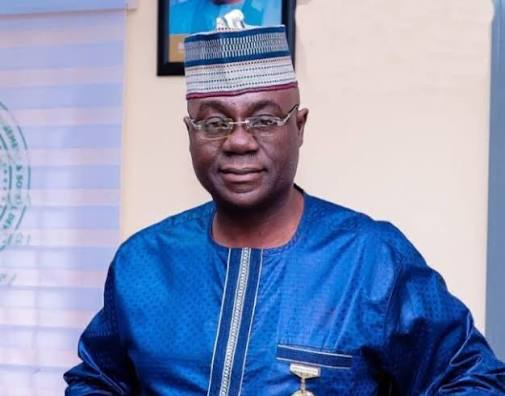
President Bola Ahmed Tinubu has appointed the Permanent Secretary in the Federal Ministry of Education, Abel Olumuyiwa Enitan, as the new Head of the Civil Service of the Federation.
Enitan, who is the most senior Permanent Secretary in the Federal Civil Service, will assume office on August 27, 2026, following the retirement of the incumbent Head of Service, Mrs Didi Esther Walson-Jack.
The appointment was announced in a statement by the Special Adviser to the President on Information and Strategy, Bayo Onanuga, on Wednesday.
A native of Osun State, Enitan has spent more than seven years as a Permanent Secretary, serving in the Ministry of Police Affairs, Ministry of Humanitarian Affairs and the Office of the Vice President before his current posting to the Federal Ministry of Education.
With seven years and seven months of experience at the Permanent Secretary level, Enitan is expected to bring extensive institutional knowledge and experience to the leadership of the Federal Civil Service.
Onanuga said President Tinubu appreciated Walson-Jack for her “distinguished service” to the nation, particularly her contributions to reforms, innovations and improved performance within the Civil Service during her tenure.
The President wished the outgoing Head of Service a fulfilling post-retirement life and expressed the nation’s gratitude for her years of dedicated public service.
Tinubu charged Enitan to sustain and build on the reforms and innovations already introduced in the Civil Service, while deepening professionalism, efficiency and responsiveness across the system.
The President also urged the incoming Head of Service to promote a Civil Service that is merit-driven, accountable, innovative and capable of responding effectively to the needs and aspirations of Nigerians.
The administration said the appointment was part of efforts to strengthen the Federal Civil Service and improve its capacity to deliver on the Renewed Hope Agenda.
News
FCCPC probes cement price manipulation as Nigerians pay more than African peers

FCCPC probes cement price manipulation as Nigerians pay more than African peers
The Federal Competition and Consumer Protection Commission (FCCPC) has launched a deeper investigation into the Nigerian cement industry following preliminary findings that the rising price of cement may not be fully explained by legitimate production and market costs.
The commission said its three-month inquiry raised concerns about possible manipulation of cement prices after receiving widespread complaints over the soaring cost of the building material despite Nigeria’s substantial limestone deposits and large installed production capacity.
The investigation was carried out by the FCCPC’s Anticompetitive Practices Department (ACP) and included a cross-border comparison of Nigeria’s cement market with those of Kenya, Tanzania, South Africa, Egypt, Morocco, Algeria and Togo.
The study examined factors including limestone availability, population, production capacity, domestic consumption and retail prices to determine whether prevailing prices in Nigeria were consistent with market conditions.
According to the commission, the findings showed a notable disparity between cement prices in Nigeria and those in some other African markets.
A 50kg bag of cement that sold for between ₦9,300 and ₦9,700 in January 2026 rose to between ₦10,500 and ₦13,000 by the middle of the year. By July, prices of between ₦13,000 and ₦15,000 were reported in some parts of the country.
The FCCPC said its comparison found that a 50kg bag sold for about $5.40, equivalent to ₦7,344, in Kenya, while the same quantity was around $4.80, or ₦6,528, in Tanzania.
READ ALSO:
- Sokoto APC suffers fresh setback as over 700 members reportedly defect to ADC
- US Court Grants Four-Day Extension for Release of Tinubu Drug-Trafficking Records
- Osun Poll: Fayose Says Federal Might Could Have Swayed Result If Deployed
In Togo, where the commission noted the absence of significant limestone deposits, a 50kg bag sold for approximately $6.75, equivalent to ₦9,180.
The price disparity has prompted the regulator to question why Nigeria’s substantial natural-resource base and production capacity have not resulted in stronger downward pressure on domestic prices.
The FCCPC estimates that Nigeria has installed cement production capacity of between 60 million and 65 million metric tonnes annually, compared with domestic consumption of approximately 25 million to 30 million metric tonnes.
The commission also noted that Nigeria is a net exporter of cement and clinker, making the continued high domestic prices a key issue in its investigation.
However, the FCCPC stressed that it has not concluded that any cement manufacturer has violated competition laws. The preliminary findings, it said, only provide sufficient grounds for further investigation.
The commission is examining whether prevailing prices can be justified by legitimate costs or whether there is evidence of coordinated conduct, abuse of market power, restriction of domestic supply or anti-competitive distribution practices.
Cement producers and other industry participants have cited several factors behind the higher prices, including energy costs, naira depreciation, imported machinery and spare parts, transportation and logistics expenses.
The FCCPC said it was testing those explanations against verified information on production costs, pricing, capacity utilisation, exports and broader market conditions.
READ ALSO:
- NAICOM revokes Universal Insurance licence over ₦15bn capital shortfall
- US indicts 17 Iranians over $20m cyber-theft campaign targeting 322 global institutions
- Police Nab 49-Year-Old With Pump-Action Rifle, 50 Ammunition Rounds In Anambra
As part of the investigation, the commission has issued Notices of Commencement of Investigation and Summons to Produce to key industry participants.
The companies are expected to provide information covering their pricing methodologies, production levels, capacity utilisation, exports and commercial relationships.
FCCPC Executive Vice Chairman and Chief Executive Officer Tunji Bello said the investigation was necessary because cement plays a strategic role in the Nigerian economy.
According to Bello, the cost of cement directly affects housing, commercial property development, public infrastructure and the wider cost of doing business.
The probe also comes amid repeated calls from the Federal Government for cement manufacturers to reduce prices.
In June 2026, Minister of Works David Umahi urged cement producers to reduce prices, arguing that the high cost of the material was increasing the cost of government infrastructure projects and contributing to demands for contract variations.
The government had previously reached an understanding with major cement producers, including Dangote Cement, BUA Cement and HBM Nigeria, that cement should generally sell within the ₦7,000 to ₦8,000 range per 50kg bag, depending on location.
Despite those discussions, retail prices have remained considerably higher in several parts of Nigeria.
Industry financial results also show that major cement producers have continued to record strong revenues amid sustained construction demand and higher prices. The development, however, does not by itself establish that any company has engaged in anti-competitive conduct.
The FCCPC must now determine whether the high cost of cement in Nigeria is primarily the result of legitimate economic pressures or whether unlawful practices are contributing to the price disparity.
The outcome of the investigation could have significant implications for consumers, builders, contractors, property developers and the construction industry, particularly as high building-material costs continue to affect housing affordability and infrastructure development.
For now, the commission has emphasised that its findings remain preliminary and that the investigation is ongoing. Any regulatory or enforcement action will depend on the evidence gathered during the process.
FCCPC probes cement price manipulation as Nigerians pay more than African peers
News
Adeleke withdraws EFCC suit after Tinubu’s intervention

Adeleke withdraws EFCC suit after Tinubu’s intervention
Osun State Governor, Ademola Adeleke, has directed the state Attorney-General to withdraw the lawsuit filed against the Economic and Financial Crimes Commission (EFCC) over the restriction placed on a state government account.
Adeleke disclosed this in an interview with Channels Television on Sunday, shortly after he was declared the winner of the Osun State governorship election, saying he was no longer interested in pursuing the case following President Bola Tinubu’s intervention.
The governor said Tinubu personally intervened in the matter and contacted him, adding that he considered the President’s intervention sufficient reason to discontinue the legal action.
“What else do I want? I’ve instructed my Attorney-General to drop it. Mr President has done well; he called me. What more do I want?” Adeleke said.
The dispute followed the decision by the EFCC to place a Post-No-Debit restriction on an Osun State Government account as part of an investigation into the alleged handling of about ₦11 billion in Ecology Funds, Intervention Funds and allocations from the Federation Account.
The anti-graft agency said its investigation had been ongoing since March 2026. It said the restriction became necessary after it detected what it described as the “precipitate and unwarranted movement of funds” from the account into several corporate entities.
The EFCC maintained that the restriction was connected to its investigation and was aimed at preventing further movement of funds while the probe continued.
READ ALSO:
- Osun Woman Found Dead With Severed Wrist Inside Church
- BREAKING: Edo Assembly leadership shake-up: Agbebaku out, Idaiyi emerges new Speaker
- Kebbi Woman Arrested for Allegedly Stealing Newborn to Deceive Husband
Adeleke had strongly opposed the action, directing the state Attorney-General and Commissioner for Justice to challenge the restriction in court.
The governor had described the EFCC’s action as unlawful and politically motivated, particularly because it occurred shortly before the Osun governorship election.
The legal dispute subsequently became a major point of contention between the Osun State Government and the anti-graft agency, with the state seeking judicial intervention over the restriction on its account.
However, Adeleke has now opted to discontinue the case after Tinubu’s intervention.
The governor also addressed reports concerning some of his aides who had been invited or detained by the EFCC in connection with the investigation.
He said his lawyers were engaging with the commission and had been directed to visit the agency to address the matter.
“Well, we are… we’ve been talking. I’ve been calling all my lawyers to go there,” Adeleke said.
The governor also questioned the decision to invite some of his aides, particularly his spokesperson, for questioning by the anti-graft agency.
“Can you imagine my spokesperson? You are inviting my spokesperson to EFCC. Is my spokesperson a finance minister or accountant? So I told him, ‘Go,’” he said.
Adeleke, however, said his aides had complied with the invitations because they had nothing to hide.
The governor further clarified that his renewed support for Tinubu should not be interpreted as an indication that he intends to return to the All Progressives Congress (APC).
When asked whether he would return to the APC, Adeleke said, “I’m not even thinking about it right now.”
He nevertheless stressed that remaining outside the APC would not prevent him from supporting Tinubu ahead of the 2027 presidential election.
“But that doesn’t mean I can’t express my support… Mr President,” Adeleke said.
The governor, who previously contested political positions under the APC before moving to the Peoples Democratic Party (PDP) and later the Accord Party, said his support for Tinubu was independent of his party affiliation.
Adeleke also alleged that some individuals had been using Tinubu’s name in connection with the EFCC matter without the President’s knowledge.
His comments came after he defeated the APC candidate, Bola Oyebamiji, in Saturday’s governorship election to secure a second term as Osun governor.
According to the Independent National Electoral Commission (INEC), Adeleke polled 511,067 votes, while Oyebamiji secured 444,815 votes.
The governor’s decision to withdraw the lawsuit is expected to ease the immediate legal confrontation between the Osun State Government and the EFCC, although the anti-graft agency’s investigation into the alleged handling of public funds remains a separate matter.
The development also comes at a significant political moment for Adeleke, who is preparing to begin his second term after another closely contested election in the state.
Adeleke withdraws EFCC suit after Tinubu’s intervention
-

 metro2 days ago
Customs Names Importers of 399 Pump-Action Rifles, Hands Over Weapons to NSA Office
-

 metro3 days ago
Police to prosecute Kogi man for allegedly setting wife ablaze
-

 Sports3 days ago
Arsenal thrash Man City 3-0 to win Community Shield
-

 metro3 days ago
NDLEA arrests businessman with cocaine, seizes N3.6bn drugs in Lagos
-

 metro1 day ago
Palliative Care, Not Abandonment: Doctor Clears the Air on Ogogo’s Stage-Four Cancer Treatment
-

 Insurance16 hours ago
NAICOM revokes Universal Insurance licence over ₦15bn capital shortfall
-

 Education2 days ago
WAEC 2026 results: Schools raise alarm over alleged grading anomalies
-
 metro1 day ago
Lagos Pensioners Give Sanwo-Olu 19-Day Ultimatum: Implement Wage Award or Face ‘Mother of All Protests’