

metro
Bandits Kill Two, Injure One in Renewed Attack on Kwara Community (Video)
Bandits Kill Two, Injure One in Renewed Attack on Kwara Community (Video)
The Kwara State Police Command has confirmed that suspected bandits killed two people and injured one during coordinated attacks in Eruku, a border town in the Ekiti Local Government Area of the state.
A parish of the Christ Apostolic Church (CAC) was among the locations targeted in the violent assault.
In a statement released on Tuesday, the Police Public Relations Officer, SP Adetoun Ejire-Adeyemi, said the attack occurred around 6 p.m. on November 18, 2025.
According to the police, a worshipper identified as Mr. Aderemi was shot dead inside the church, while another victim, Mr. Tunde Asaba Ajayi, was later found dead in the bush. A vigilante member, Segun Alaja, sustained gunshot wounds and was taken to ECWA Hospital in Eruku for medical treatment.
Ejire-Adeyemi said operatives from the Eruku Division, working with local vigilantes, responded swiftly to gunshots from the town’s outskirts, forcing the attackers to retreat into the bush.
Kwara State Commissioner of Police, CP Adekimi Ojo, commended the rapid intervention of security teams and assured residents that operations to flush out the criminals will continue until the attackers are completely neutralised.
READ ALSO:
- Two Kebbi Schoolgirls Escape as Search Intensifies for Remaining Abducted Students
- FCT Police Debunk Viral Video Claiming Officers Blocked Bauchi Governor at PDP Secretariat
- Nigeria rejects allegations as Nicki Minaj, Trump decry Christian killings
Earlier reports by PUNCH Online indicated that the first assault occurred during a special service at a CAC parish, where gunmen stormed the church, opened fire on worshippers, and abducted the pastor along with an unspecified number of congregants. Eyewitnesses said three worshippers died instantly during the attack.
The attackers later struck again along the Ilorin–Kabba Road, forcing travellers to abandon their vehicles and flee into nearby bushes. A traveller returning from Niger State said in a voice note:
“They came around 6:30 pm and started shooting. Two people were killed instantly, and we don’t know how many were taken. They are still shooting—you can hear it.”
Community leaders say Eruku has suffered repeated attacks over the past three weeks.
One resident, Benjamin Ayeoribe, appealed for urgent government intervention, saying:
“We are living in fear every day. We need federal help. These attacks are becoming too much for us to bear.”
Despite joint efforts by police, vigilantes, and local hunters, bandits continue to exploit the vulnerable border area, contributing to the surge in banditry, killings, and kidnappings that has plagued Kwara State in recent months.
Bandits Kill Two, Injure One in Renewed Attack on Kwara Community (Video)
Punch








metro
Sambisa Forest: Over 23 terrorists reportedly killed as Boko Haram, ISWAP clash in Borno
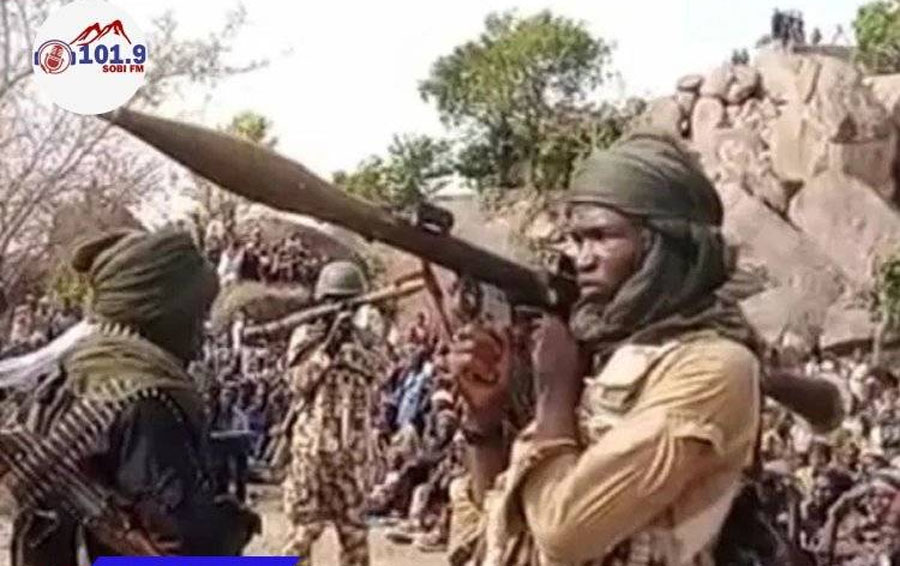
Sambisa Forest: Over 23 terrorists reportedly killed as Boko Haram, ISWAP clash in Borno
More than 23 terrorists have reportedly been killed in renewed fighting between rival Boko Haram and Islamic State West Africa Province (ISWAP) factions in the Sambisa Forest area of Borno State.
The latest confrontation reportedly occurred around the Chingolo axis of Bama Local Government Area, where Boko Haram fighters attacked ISWAP members who were advancing into the area.
Counter-terrorism expert Zagazola Makama disclosed the development in a post on X, saying the confrontation was part of a renewed wave of hostilities between the two rival terrorist organisations.
According to Makama, the latest fighting began about two days ago and involved sustained exchanges of gunfire as the factions battled to consolidate their positions and prevent each other from expanding their influence within the forest.
Preliminary intelligence indicated that more than 23 terrorists had been killed on both sides since the latest round of fighting began.
However, the exact casualty figures for Boko Haram and ISWAP could not be independently verified.
Makama said the confrontation reportedly started after ISWAP fighters moved into the Chingolo area, prompting Boko Haram fighters operating in the vicinity to launch an attack against the advancing group.
The latest clashes highlight the continuing rivalry between the two insurgent factions over territory, access routes, resources and control of fighters operating in the Sambisa Forest and surrounding areas.
The rivalry between Boko Haram and ISWAP dates back several years and has periodically resulted in deadly clashes between fighters belonging to the two groups.
ISWAP emerged from a split within Boko Haram after some commanders and fighters pledged allegiance to the Islamic State. Since then, the two factions have competed for influence, territory and access to resources across parts of Borno State and the wider Lake Chad Basin.
READ ALSO:
- NAF recruitment 2026: Step-by-step guide to applying for BMTC 47/2026
- Oyo kidnap rescue: Five security personnel, four civilians killed — DSS DG
- Amaechi: Atiku will restore electricity subsidy if elected in 2027
The Sambisa Forest remains strategically important because of its difficult terrain and its history as a base for insurgent activity. The expansive forest has been the target of repeated military operations aimed at dismantling terrorist camps, disrupting logistics networks and restricting the movement of insurgents.
The latest internal fighting could further weaken both factions by inflicting casualties and disrupting their command structures, logistics and freedom of movement.
It could also provide security forces with an opportunity to gather intelligence on the locations and movements of fighters weakened by the confrontation.
The development comes amid continued Nigerian military operations against Boko Haram and ISWAP in the North-East.
Troops operating under Operation Hadin Kai have continued to conduct ground and air operations against terrorist positions in Borno and neighbouring areas, targeting fighters, camps, weapons and logistics networks.
Despite sustained military pressure, however, both Boko Haram and ISWAP have retained the ability to operate in remote areas and launch attacks, particularly around the Lake Chad Basin and parts of Borno State.
Recent security assessments have also pointed to continued militant activity across the Lake Chad Basin, with northeastern Nigeria remaining one of the major theatres of insurgent violence in the region.
The renewed Boko Haram-ISWAP confrontation therefore presents a complex security situation. While fighting between the rival factions could reduce their strength, prolonged instability could also create opportunities for surviving fighters to regroup, recruit new members or seek control of additional territory.
Security agencies are reportedly monitoring developments around the Sambisa Forest and Bama axis, while intelligence gathered from the clashes could assist ongoing counter-terrorism operations.
Communities in and around areas bordering the Sambisa Forest are also expected to remain vigilant and report suspicious movements or activities to the relevant security authorities.
The casualty figure remains subject to further verification as security agencies continue to assess the extent of the fighting and its impact on the two rival insurgent factions.
Sambisa Forest: Over 23 terrorists reportedly killed as Boko Haram, ISWAP clash in Borno
metro
Oyo kidnap rescue: Five security personnel, four civilians killed — DSS DG
Oyo kidnap rescue: Five security personnel, four civilians killed — DSS DG
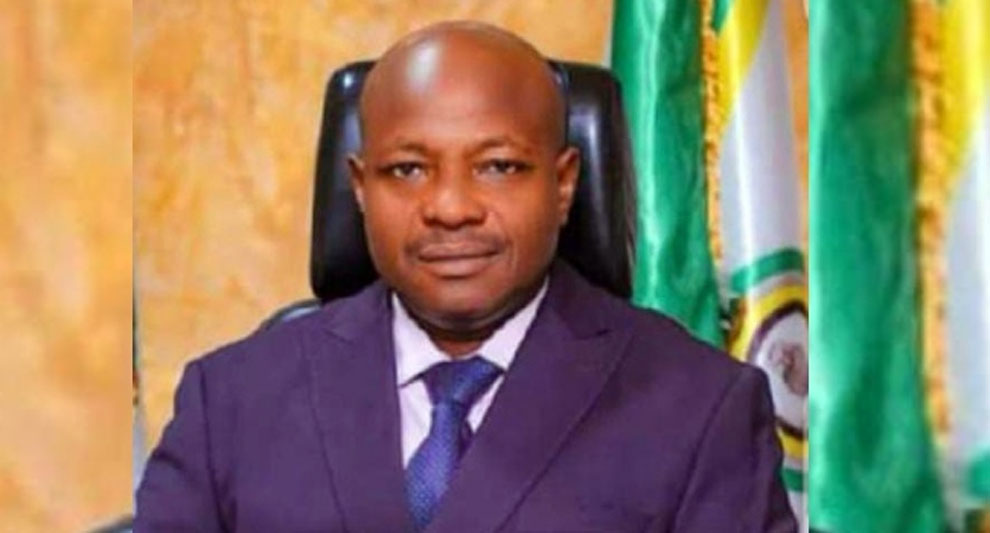
IBADAN — Nine people, including five security personnel and four civilians, were killed during an operation to rescue pupils and teachers abducted by suspected members of an international terrorist organisation in Oyo State, the Director-General of the Department of State Services (DSS), Tosin Ajayi, has disclosed.
Ajayi made the disclosure while speaking on the operation in an interview published by Premium Times, providing fresh details about the security operation that eventually led to the rescue of the Oyo kidnap victims.
The victims were abducted on May 15, 2026, after suspected terrorists invaded schools in Oriire Local Government Area of Oyo State.
Following the abduction, security agencies launched an intelligence-led operation to locate the victims and track down the perpetrators.
Ajayi said security operatives immediately pursued the kidnappers after receiving credible intelligence about the incident.
He disclosed that a vigilante member and a police officer were killed during the initial pursuit, while additional casualties occurred when security forces subsequently raided the kidnappers’ hideout.
“Immediately after the incident happened, based on credible intelligence, troops chased them immediately, and sadly, a vigilante and a policeman were killed. During the second raid, more were killed, making a total of nine fatalities, four civilians and five security personnel,” Ajayi said.
The DSS director-general described the operation as particularly challenging because of the presence of very young children among the abducted victims.
According to him, one of the hostages was a two-and-a-half-year-old child, making it necessary for security agencies to carefully weigh the risks of launching a direct assault on the kidnappers’ location.
“It was a complex operation involving a two-and-a-half-year-old infant who could not run much if we invaded the place,” Ajayi said.
READ ALSO:
- Amaechi: Atiku will restore electricity subsidy if elected in 2027
- I woke up daily to leaked NECO questions during 2025 exams — Minister
- Presidency breaks silence on Tinubu’s US FOIA case, denies criminal trial
The security agencies subsequently succeeded in rescuing the abducted pupils and teachers after weeks of sustained intelligence and operational efforts.
The Nigerian Army had earlier said the rescue operation involved several security and intelligence agencies, including the Nigerian Army, Nigerian Air Force, Nigerian Police Force, DSS, National Intelligence Agency and National Counter-Terrorism Centre, alongside local security groups.
The operation also involved local vigilantes, hunters and members of the Amotekun Corps who provided intelligence and assistance in navigating the difficult terrain where the victims were being held.
The abducted pupils and teachers were eventually released after spending 56 days in captivity.
The rescue attracted widespread attention because of reports that the kidnappers had demanded the release of detained members of their organisation in exchange for the victims.
Security authorities, however, maintained that the government did not grant the reported demand and that the victims were recovered through sustained pressure on the criminal network.
The operation also resulted in the arrest of several suspected members of the kidnapping group.
The Presidency previously said eight suspected members of the group were arrested and handed over to the DSS for investigation and prosecution.
Ajayi, while discussing the operation, also raised concerns over the spread of misinformation and deepfake videos on social media during the period the victims were being held.
READ ALSO:
- Ex-Benue councillor remanded for allegedly pushing woman into fire
- 20-year-old arrested over alleged gang-rape of 19-year-old woman in Ogun
- Ebonyi Man Stages Own Kidnap, Demands N25m Ransom From Family — Police
He said videos showing children allegedly being tortured and injured were circulated online and falsely presented as footage from the Oyo kidnapping.
According to the DSS chief, some of the videos were actually old footage from another country and had no connection with the incident in Oyo State.
“As expected, the rescue operation attracted a lot of social media disinformation. You have to sieve the information there,” Ajayi said.
He further alleged that some of the videos circulated during the crisis had been manipulated or misrepresented to create the impression that the abducted children were being subjected to brutal treatment.
“While that incident lasted, they were posting deepfake videos of children beaten with lacerations on their bodies. They were actually footage from a particular country on witchcraft-related incidents passed off as real-time crude events here,” he said.
Ajayi urged media organisations to strengthen their verification processes when reporting sensitive security and kidnapping incidents, particularly where unverified videos and social media claims are involved.
He said journalists had a responsibility to separate verified information from false narratives and avoid amplifying material that could create unnecessary panic or distress for victims’ families.
“Recall the victims recounted how well-treated they were by the criminals. So, one of the things I’d like you to do in the media is fact-finding and separating facts from fiction,” the DSS director-general said.
Ajayi also provided further information about the group accused of carrying out the Oyo school abduction, describing it as an international terrorist organisation with links to Al-Qaeda.
He said the DSS had previously arrested some of the organisation’s leaders and that their detention had helped prevent other planned high-profile attacks.
According to him, some of the detained leaders were allegedly connected with the Abuja-Kaduna train attack and were planning further abductions involving foreigners, students, women and children.
“Citizens ought to know that the incarcerated leaders of the kidnap group who were requested in exchange for the victims were arrested last year by the Service; their arrest helped to prevent high-profile attacks,” Ajayi said.
He added that the suspects were allegedly found complicit in the Abuja-Kaduna train attack and had been planning additional mass kidnappings.
Ajayi also alleged that the organisation sought recognition as a state and wanted freedom to practise its religion within a designated territory.
He disclosed that the organisation’s alleged kingpins and three other collaborators had been sentenced to life imprisonment, while the DSS would seek stiffer punishment.
“The kingpins are the ones now sentenced to life imprisonment. The three other collaborators earned life imprisonment, and the Service will push for a stiffer penalty,” he said.
The Oyo kidnapping has renewed concerns over the expansion of organised kidnapping and terrorist activities into parts of the South-West.
The incident was particularly significant because large-scale school abductions have historically been more closely associated with parts of northern Nigeria, while Oyo and neighbouring states have generally experienced different forms of insecurity.
The successful rescue also underscored the importance of intelligence gathering and cooperation among Nigeria’s security agencies in hostage situations.
The nine deaths disclosed by the DSS DG, however, highlight the risks involved in kidnap rescue operations, particularly when security forces are attempting to recover children and other vulnerable victims from armed groups.
The DSS has continued to emphasise the importance of intelligence-led operations, inter-agency cooperation and accurate information in tackling terrorism and kidnapping.
The agency has also warned that the spread of fake videos, fabricated reports and other forms of online misinformation can complicate security operations and cause additional trauma to victims and their families.
For the families of the rescued pupils and teachers, the eventual release of the victims brought an end to more than seven weeks of uncertainty.
But the latest revelation about the casualties recorded during the operation provides a fuller picture of the dangers faced by civilians and security personnel in the fight against kidnapping and terrorism in Nigeria.
Oyo kidnap rescue: Five security personnel, four civilians killed — DSS DG
metro
Presidency breaks silence on Tinubu’s US FOIA case, denies criminal trial

Presidency breaks silence on Tinubu’s US FOIA case, denies criminal trial
The Presidency has clarified that the ongoing Freedom of Information Act (FOIA) litigation involving President Bola Ahmed Tinubu before a United States federal court is a civil dispute over access to government records and does not constitute a criminal case against the Nigerian President.
The clarification was issued by Bayo Onanuga, Special Adviser to the President on Information and Strategy, amid renewed controversy over records sought from the Federal Bureau of Investigation (FBI) and Drug Enforcement Administration (DEA) concerning Tinubu.
According to the Presidency, the case before the US District Court for the District of Columbia does not amount to a criminal charge or trial, and no court has found Tinubu guilty of any criminal offence.
“For clarity, the matter is a civil records-disclosure dispute under the United States Freedom of Information Act. It is not a criminal case against President Bola Ahmed Tinubu, nor has the court found him guilty of any criminal wrongdoing,” the statement said.
The Presidency said the matter dates back to 2022, when Aaron Greenspan submitted FOIA requests to several US government agencies seeking records relating to Tinubu.
It said some agencies withheld records or declined to confirm or deny whether certain records existed, prompting Greenspan to file Civil Action No. 23-1816 before the US District Court for the District of Columbia in 2023.
READ ALSO:
- Ex-Benue councillor remanded for allegedly pushing woman into fire
- 20-year-old arrested over alleged gang-rape of 19-year-old woman in Ogun
- Ebonyi Man Stages Own Kidnap, Demands N25m Ransom From Family — Police
The court subsequently allowed Tinubu to intervene in the proceedings, giving him an opportunity to assert his interests concerning the disclosure of records.
The Presidency also referred to a February 4, 2003 letter from the American Consulate in Lagos to the then Inspector-General of Police, Tafa Balogun, concerning an FBI records search relating to Tinubu.
According to the Presidency, the letter stated that the FBI search found no criminal arrest records, wants or warrants for Tinubu, who was then Governor of Lagos State.
The issue has resurfaced amid renewed public debate over historical US records concerning Tinubu and events dating back to the early 1990s.
The Presidency further explained that some US law enforcement agencies initially relied on what is known as the “Glomar defence” in responding to the FOIA requests.
A Glomar response allows a government agency, in certain circumstances, to refuse to confirm or deny whether particular records exist where acknowledging their existence could itself reveal information protected under law.
According to the Presidency, the US District Court subsequently granted summary judgment in favour of several agencies, including the CIA, Executive Office for United States Attorneys, Department of State, Department of the Treasury and Internal Revenue Service, effectively removing them from the remaining dispute.
It said certain aspects involving the FBI and DEA remained under consideration.
The Presidency said the FBI and DEA subsequently produced 399 pages of records pursuant to the court’s directions, although portions of the documents were redacted.
READ ALSO:
- Federal Workers Demand N300,000 Minimum Wage as Cost of Living Bites Harder
- IPMAN Plans Petrol Price Review as Dangote Refinery Raises Depot Cost
- FBI Arrests Podcaster Over Alleged Threats to Kill President Trump
The plaintiff later challenged the agencies’ decisions to redact portions of the records and sought access to the unredacted material.
The FBI and DEA, through the US Department of Justice, opposed the request, relying on several exemptions contained in the US FOIA.
The exemptions cited include protections for information relating to grand jury proceedings, certain surveillance-related information, attorney-client and attorney-work-product privileges, law-enforcement records, personal privacy, confidential sources and investigative techniques.
The Presidency said Tinubu also relied on FOIA Exemption 7(C), which protects personal information contained in law-enforcement records where disclosure could constitute an unwarranted invasion of personal privacy.
It stressed that the release or withholding of government records under FOIA does not, by itself, establish criminal liability.
“The release or withholding of records under FOIA does not, by itself, establish criminal liability. The case concerns access to government records and the proper application of statutory exemptions,” the Presidency said.
It added that the current proceedings do not amount to a criminal prosecution, criminal trial or judicial finding against Tinubu.
Rather, the remaining dispute centres on whether the FBI and DEA lawfully redacted portions of the records produced in response to the FOIA requests.
The Presidency said the case remains before Judge Beryl A. Howell of the US District Court for the District of Columbia, who will determine the outstanding issues based on the court filings, evidence, applicable US law and arguments presented by the parties.
“The Nigerian media should note that this case is exclusively within the control of Judge Beryl A. Howell of the United States District Court. She will determine its outcome, based on the evidence, applicable law, and the parties’ arguments,” the statement said.
The Presidency also rejected recent comments by Karl Von Batten, arguing that he and his client were not parties to the FOIA proceedings.
It accused Von Batten of inaccurately portraying himself and his client as central figures in the case.
“Recent public commentary by Mr. Karl von Batten has inaccurately portrayed him and his client as central to the proceedings. Neither is a party to the case,” the Presidency said.
According to the Presidency, the plaintiff has until September 11, 2026, to file opposition and responses to processes filed by the defendants and Tinubu as an intervenor.
It added that the FBI, DEA and Tinubu would have until September 18, 2026, to respond to any processes filed by the plaintiff.
The Presidency urged the Nigerian media and the public to distinguish between the actual court proceedings and political commentary surrounding the case.
It maintained that the court, rather than political actors, would determine whether the disputed redactions complied with US law.
The clarification, however, does not determine what information may ultimately be contained in the portions of the FBI and DEA records that remain redacted. It also does not constitute a judicial finding about whether any historical investigation involving Tinubu existed.
Instead, the Presidency’s position is that the current US court proceedings are civil FOIA litigation over access to government records, rather than a criminal prosecution of Tinubu.
The court is expected to determine whether the FBI and DEA were legally entitled to withhold or redact the disputed portions of the records under applicable US law.
Presidency breaks silence on Tinubu’s US FOIA case, denies criminal trial
-

 Education3 days ago
JAMB, WAEC introduce one-off ₦4,000 WASSCE result verification for admission seekers
-
 International3 days ago
US Teen Indicted for Aiding and Abetting Deadly San Diego Mosque Shooting
-

 Auto2 days ago
Uber exits Nigeria after 12 years
-

 metro3 days ago
FBI confirms Tinubu was subject of US criminal investigation in 1990s
-

 Entertainment2 days ago
Nollywood Actress Atinuke Kareem Dies After Brave Battle with Breast Cancer
-

 Politics2 days ago
Atiku, Obi Unite in Fresh Bid to Unseat Tinubu as 2027 Election Campaign Heats Up
-

 Education2 days ago
2027: Atiku vows to review NELFUND, forgive qualifying student loans
-
 News2 days ago
Ogogo’s N25m Surfaces After Death, Ilaro Chief Imam Returns Actor’s Money