Lawyer: We have CCTV evidence of how Kanu was abducted from Kenya - Newstrends
Connect with us

News

Lawyer: We have CCTV evidence of how Kanu was abducted from Kenya

Published

on

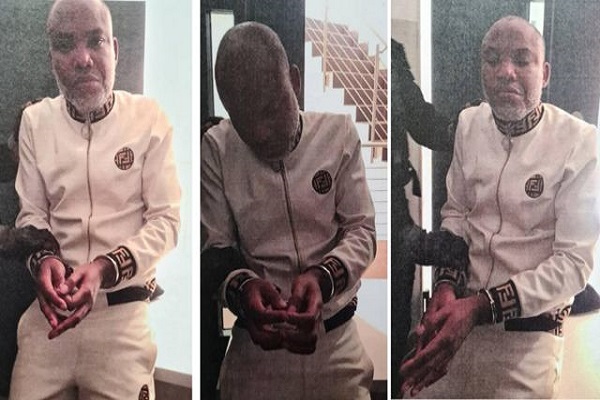
Details of a N5 billion suit filed by the leader of the Indigenous People of Biafra (IPOB) against the Kenyan government have hinted on the torture the IPOB leader allegedly went through in the custody of security agents in the East African country.

Kanu’s lawyer, George Wajackoyah, claimed in an audio tape that he had CCTV and other evidence of how his client was abducted in Nairobi, Kenyan capital by the Muhammadu Buhari government.

“We have copies of his passport and a stamp that he was indeed in Kenya. We also have evidence he was in his residence on a particular day.

“We also have material proof that he was at the airport on a particular day to meet a friend and there he was arrested.

“Definitely, he was kidnapped,” Wajackoyah said.

The Kenyan government had strongly denied involvement in the process that led to the arrest and repatriation of Kanu back to Nigeria, with its High Commissioner to Nigeria, Wilfred Machage, describing the claim that Kanu was arrested in the East African country as “deliberately concocted to fuel antagonistic feelings in the minds of certain sections of the Nigerian people against the people of Kenya.”

The high point of Kanu’s ugly experience, according to the law suit, was that he got his body smeared with his own urine and faeces because the security agents allegedly denied him permission to use the toilet.

The suit, which was filed in Umuahia, Abia State by Kanu’s counsel Aloy Ejimakor on September 7, revealed that Kanu was beaten severely until he fainted and was revived with cold water.

The suit is seeking to enforce Kanu’s right to life, dignity of the human person, personal liberty and fair hearing.

The affidavit in support of the originating motion, which was done by Kanu’s brother, Emmanuel, stated: “That the facts and violations deposed to in this affidavit started at the applicant’s residence in Isiama Afaraukwu Ibeku, Umuahia North Local Government Area of Abia State; to wit; the military invasion of the applicant in September 2017 by a combined team of Ohafia-based 14 Brigade of the Nigerian Army, the Abia State Command of Nigeria Police Force and the Abia State Directorate of the State Security Service.”

“That it was the said invasion that nearly took the life of the applicant that caused him to seek refuge abroad which ultimately to Kenya, where the respondents lawfully pursued him, abducted him, disappeared with him and ultimately brought him to Nigeria and detained him.

“That in October 2015, the applicant was arrested in Lagos upon his return from the United Kingdom, detained in Abuja and ultimately charged for certain offences Charge No: FHC/ABJ/CR/383/2015 (Federal Republic of Nigeria vs Nnamdi Kanu).

“That the applicant was detained for 18 months, but was later released on bail whereupon he returned to his home in Isiama Afaraukwu Ibeku, Umuahia North, Abia State, and there awaiting his next trial date set for October 2017.

“That on or about 10 September, while the applicant was resting at home with some family members and friends, the Ohafia-based Nigerian Army, police and DSS launched military invasion and assaults at the applicant’s residential building and premises.

“That in the course of the military action, 28 people were killed and several others, including the applicant, were wounded. Both of the applicant’s parents sustained grave injuries from the military invasion and both of them eventually succumbed to those injuries and are now late.

“That in the course of the invasion, the applicant managed to escape to a safe location from where he managed to flee overseas to save his life. That there was neither a court order revoking the applicant’s bail nor any arrest warrant that could have justified the deadly military assault.

“That had the President implemented the provisional measures, the applicant would have felt safe enough to voluntarily end his exile and return to Nigeria to face prosecution in the said charge under reference therein.

“That in the course of his exile, the applicant on or about May 5, 2021, entered the Republic of Kenya on his British passport and was admitted as such at Jomo Kenyatta International Airport, Nairobi. After his admission, the applicant settled in at a temporary location in Nairobi, Kenya.”

Giving details of the alleged abduction of Kanu from the East African country as well as his ordeal at the hands of the Nigerian security operatives at a private residence where he was taken to, Emmanuel said: “That on June 19, 2021, the applicant drove himself and without any companion to Jomo Kenyatta International Airport, to drop off a friend at the airport.

“That as soon as the applicant pulled to stop at the parking lot and alighted from his vehicle, about twenty respondent’s agents (hereafter abductors) violently accosted and abducted the applicant, handcuffed and blindfolded him, bundled him in a vehicle and sped away, while telling onlookers that the applicant is a “terrorist separatist.”

“That the applicant’s abductors took him to a nondescript private house (not a police station) somewhere in Nairobi, Kenya, and chained him to the floor. That while chained to the floor, the applicant’s abductors took turns to beat him torturing him to a point that he fainted several times and was intermittently revived when they poured cold water on him.

“That to prevent the applicant’s anguished screaming from being heard in the vicinity, the applicant’s abductors tied a cloth over his mouth and so close to covering his nostrils that the applicant struggled to breathe.

“That the applicant remained chained to the floor for eight days and was thus forced to relieve himself of urine and excrement where he was chained with same being smeared all over his body.”

That throughout the duration of the applicant’s captivity, he was not allowed to bathe and was fed only on bland bread once a day and given non-sanitary water to drink.”

Advertisement

News

U.S. Court Orders ICE to Release Nigerian Detained Since 2012

Published

on

Immigration and Customs Enforcement (ICE)

U.S. Court Orders ICE to Release Nigerian Detained Since 2012

A U.S. District Court in Minnesota has ordered U.S. Immigration and Customs Enforcement (ICE) to release Michael Opeoluwa Egbele, a Nigerian national who entered the United States illegally in 2003 and had been held under immigration detention since his arrest in 2012. The court ruled that his detention was unlawful due to prolonged enforcement delays and lack of proper legal notice.

Senior U.S. District Judge John M. Gerrard delivered the ruling on February 18, 2026, giving ICE until February 20 to free Egbele and file a status report confirming his release. The judge highlighted that ICE had no legal grounds to hold him, noting the unique circumstances of his long-standing supervision arrangement.

Egbele’s legal troubles began in 2012 after his arrest on a drug-related offence, which triggered deportation proceedings. At the time, he applied for asylum and requested that his removal be withheld, but his claim was denied, and he was issued a final deportation order in July 2012. However, ICE did not enforce the removal, and Egbele did not appeal.

Instead, he was released on supervision in December 2012, under which he was required to report regularly to ICE. This arrangement continued for more than a decade until January 2026, when ICE detained him during a routine check-in.

READ ALSO:

Egbele argued in court that he was never notified of any revocation of his pre-existing order of supervision and was not given a legal explanation for his detention. ICE claimed the supervision was revoked partly because Egbele failed to obtain a travel document to Nigeria, as required under his supervision.

Following his arrest, Egbele was unable to contact his wife, a U.S. citizen, or his lawyer for several days. He was initially held at an ICE facility in Montana and later transferred to a detention center in New Mexico, with his location undisclosed for days.

The federal government argued that the Minnesota court lacked jurisdiction because Egbele was held outside the state, but the judge rejected this, stating that ICE could not unilaterally terminate a decades-long supervisory arrangement without due process. The court emphasized that Egbele’s right to proper notice and legal protections had been violated.

Judge Gerrard ordered that Egbele be released immediately under the conditions of his original supervision and directed ICE to file a compliance report by February 20, 2026.

Legal experts say the ruling highlights broader concerns about long-term immigration detention, due process rights, and the enforcement of removal orders in the U.S., particularly when individuals have established long-term ties or arrangements with immigration authorities.

U.S. Court Orders ICE to Release Nigerian Detained Since 2012

Continue Reading

News

Nigeria Wins $6.2 Million Arbitration Against UK Tech Firm

Published

on

Attorney-General of the Federation, Lateef Fagbemi, SAN

Nigeria Wins $6.2 Million Arbitration Against UK Tech Firm

Nigeria has scored a landmark legal victory, securing $6.2 million in an international arbitration against UK-based technology firm European Dynamics UK Ltd over a disputed national electronic government procurement (e-GP) contract. The ruling reinforces Nigeria’s commitment to performance-based government contracts and protecting public resources.

The arbitration decision, delivered on February 3, 2026, by sole arbitrator Funmi Roberts at the International Centre for Arbitration and Mediation, dismissed all claims by the UK contractor. The award is final and not subject to appeal, according to the Attorney-General of the Federation, Lateef Fagbemi, SAN.

The dispute originated from a Bureau of Public Procurement (BPP) contract to design, develop, and implement a national e-procurement platform, supported by the World Bank to enhance transparency and efficiency in federal procurement.

READ ALSO:

European Dynamics had claimed over $6.2 million, including:

  • $2.4 million for alleged milestone completions
  • $3 million in general damages
  • $800,000 in settlement costs

However, the tribunal ruled the claims lacked merit, citing deficiencies during User Acceptance Testing (UAT) such as functional gaps and performance errors, which the contractor was required to fix at no additional cost.

The BPP insisted payments must be strictly tied to verified deliverables, rejecting earlier efforts at an out-of-court settlement. The tribunal upheld this stance, emphasizing that software development and customization contracts are performance-based and must meet technical and statutory standards before payments are made.

Nigeria’s legal team, led by Johnson & Wilner LLP with Basil Udotai heading the arbitration, achieved what the BPP Director-General, Adebowale Adedokun, described as a historic victory. European Dynamics had previously won arbitration cases in other African countries but lost against Nigeria, signaling a shift in how government procurement disputes are handled.

Attorney-General Fagbemi stated that this ruling sends a clear message that Nigeria will no longer be taken for granted, demonstrating strengthened legal and technical capacity in managing complex international contracts. Experts suggest the outcome will influence future e-procurement reforms to ensure compliance, accountability, and efficient management of public contracts.

Nigeria Wins $6.2 Million Arbitration Against UK Tech Firm

Continue Reading

News

Yoruba Muslim Group Dismisses Viral Ramadan Date Claim, Reaffirms Sultan of Sokoto’s Authority

Published

on

Sultan of Sokoto and Chief Imam of Ibadanland

Yoruba Muslim Group Dismisses Viral Ramadan Date Claim, Reaffirms Sultan of Sokoto’s Authority

A Yoruba Muslim group, Concerned Indigenous Yoruba Muslims, has dismissed as false, misleading, and divisive a viral social media report alleging that the Chief Imam of Ibadanland and the League of Imams in Yorubaland rejected the authority of the Sultan of Sokoto in determining the commencement of Ramadan in South-West Nigeria.

The report, which circulated online ahead of Ramadan 1447AH, claimed that Yoruba Muslim leaders had resolved to disengage from the Sultan’s traditional role of announcing moon sighting for the fasting period and instead align with indigenous religious structures. The group, however, said the claim was entirely fabricated and designed to sow discord within the Muslim community.

In a statement issued on Saturday, February 21, 2026 — the fourth day of Ramadan, and signed by public affairs analyst Nasrudeen Abbas, the group said the comments attributed to the Chief Imam of Ibadan, reportedly over 90 years old, could not have emanated from him. It described the publication as a calculated attempt to create unnecessary religious tension and misrepresent the position of Yoruba Muslims.

The group reaffirmed that Islamic affairs in Nigeria operate under established leadership structures, particularly the Nigerian Supreme Council for Islamic Affairs (NSCIA), which is headed by the Sultan of Sokoto, Muhammad Sa’ad Abubakar, as President-General. It explained that the NSCIA structure includes the President of the Muslim Ummah of South West Nigeria (MUSWEN) as Deputy President-General (South), the Shehu of Borno as Deputy President-General (North), alongside other national officers.

READ ALSO:

According to the group, any attempt to distance Yoruba Muslims from this nationally recognised structure threatens the unity of the Muslim Ummah in Nigeria and contradicts Islamic principles that emphasise cohesion, collective leadership, and obedience to constituted authority.

The group also faulted claims that the Sultan’s position is merely a traditional title limited to Sokoto State. It stressed that the Sultan’s authority in Islamic matters is rooted in scholarship and the historical caliphate system, noting that emirs in Northern Nigeria often combine traditional authority with religious leadership. As an example, it cited Muhammadu Sanusi II, who regularly delivers Friday sermons and performs Islamic rites.

It further explained that in Yorubaland, traditional rulers generally do not head religious affairs, except in rare cases. The group referenced the late Awujale of Ijebu Land, who once served as President-General of the Ogun State Muslim Council, stressing that such roles remain exceptions rather than the norm.

The statement also recalled the position of the late Kazeem Yayi Akorede, former President-General of the League of Imams and Alfas in the South West. According to the group, Sheikh Akorede initially questioned the Sultan’s leadership role but later accepted it after clarifications that the position was based on Islamic scholarship and caliphate leadership, not mere traditional kingship. It added that until his death, he consistently aligned with the Sultan’s announcements on the commencement and termination of Ramadan.

Describing the viral publication as unethical, the group criticised claims that Yoruba Muslims are not religiously bound to the Sultan’s authority and that religious leadership should go beyond duties such as moon sighting announcements. It alleged that such narratives were politically motivated and aimed at advancing a separatist agenda under the guise of religious autonomy.

The group warned that politicising religious matters could undermine religious harmony and national unity, urging those behind the report to desist from actions capable of creating discord among Muslims across the country. It concluded by stressing that the unity of the Muslim Ummah in Nigeria remains paramount and must not be compromised by what it described as sectarian or politically engineered narratives.

Yoruba Muslim Group Dismisses Viral Ramadan Date Claim, Reaffirms Sultan of Sokoto’s Authority

Continue Reading
HostArmada Affordable Cloud SSD Shared Hosting
HostArmada - Affordable Cloud SSD Web Hosting

Trending