

International
US veteran ships Hollywood military gear for real-life use in Ukraine

Jon Barton spent his days reading scripts, advising costuming departments and thinking through fight choreography for top military movies.
The retired US marine took his expertise after four tours in the Middle East to Hollywood, consulting and providing military equipment to film sets – a mission to help the entertainment industry better depict military life.
Until late February, when Russia’s President Vladamir Putin launched his invasion of Ukraine.
Duty called again, Barton said.
Barton, owner of Night-Fire Media, a military consulting and rental company, is sending most of his company’s tactical gear to Ukrainians fighting Russian troops – backing a David-versus-Goliath fight for democracy that has the whole world watching.
“There is this inherent belief that something is wrong,” he said. “And if you’re someone who’s been trained to fight wrong and to stand up in the face of evil, you inherently get drawn into it.”
Earlier this week, Barton hurried around the Ukrainian Orthodox church in Echo Park, balancing two cellphones and juggling boxes of rifle slings, boots and camouflage uniforms. The supplies were to be boxed and flown to the border between Ukraine and Poland and distributed by volunteers. He said he hadn’t slept for two days.
“It’s super cold, so imagine fighting in those conditions,” Alex Dubov, a professor at Loma Linda University, who has family in Ukraine, said outside the church. “The boots that Jon was just bringing in is like, sent by heaven.”
Barton is not sending weapons or ammo – by law, he can’t – but this is crucial gear civilians often forget, he said. Many are everyday Ukrainians suddenly facing relentless shelling.
READ ALSO:
- APC Chairmanship Race: Why I Won’t Step Down For Buhari’s ‘Anointed Candidate’ – Al-Makura
- Malami: I Didn’t Clear Abba Kyari, But Asked For Further Probe
- Father remanded in Edo for defiling 15-month-old daughter
He’s donating about 80% of his inventory, including about 620 uniforms of various camouflage colors, 118 boots of different vintage and 300 pairs of gloves.
“Sometimes we forget the details – the slings, the canteens, the belts, the shoelaces. All that’s important,” Barton said.
The idea emerged after a friend asked if he had extra camouflage uniforms. Barton had already been stirred by an image of young Ukrainian men, clad in knee pads to fight Russian troops, and videos of Russians firing at the press.
“I said hold on, not just that, could you guys use knee pads? Could you guys use belts?” he said. “I have tactical gear, and I have it by the bucket-full.”
Barton was soon heading to Ventura county, where his company houses its inventory of gear from military base stores and third-party contractors, including phased-out colors and equipment for each branch of the military.
“My neighbors kept coming by like, ‘Are you planning for war?’ I’m like, ‘I’m giving it to Ukraine.’ They flipped out,” Barton said.
Bridging fantasy and reality
Barton has made a living advising Hollywood since he first worked as a set extra and realized the uniforms weren’t authentic. He’s worked with actors including Aaron Eckhart and Chris Hemsworth, and his credits include NCIS and Criminal Minds.
“When you’ve got a character using weapons … you want them to have adequate training, and the really important thing that Jon brings to table is that he understands it’s not the military – these actors are playing a role and you can’t treat each one the same way,” said producer Gale Ann Hurd, who first met Barton on the set of Punisher: War Zone.
It’s not about putting a gun in someone’s hand, he said – it’s about authentically bridging fantasy and reality.
READ ALSO:
- NDLEA nabs General Overseer of popular Anambra Church with drugs at Lagos airport
- Anglican Church Suspends Priest For ‘Impregnating Lady’ Who Approached Him For Help
- Lagos dispatch rider caught with child inside delivery box
“You could tune in Friday night at 9pm and watch JAG, but it didn’t look like CBS News at 7. What fantasy world are you living in?” he said.
Now, fantasy and reality are colliding again, and the threat of world war, or nuclear fallout, usually reserved for the big screen, feels close to home, he said.
“A lot of people don’t get too scared about this, but the marine in me used to sit through classified briefings and seeing satellite imagery,” he said.
There’s a part of him, too, that wishes he were there.
“My kneejerk reaction is always, let’s go in there, kick some ass,” Barton said. “And then I think about it and [realize], we can’t do that because this and this, and then the politics come into play and I totally get that.”
He also knows his involvement isn’t without professional risk. Barton has noticed some clients aren’t returning his phone calls.
“I’m less desirable to be hired on to a show where they try to take an apolitical stance, even though I’m not doing anything political,” he said. “I’m just trying to help humans.”
Still, Barton hopes larger film studios will follow his lead and donate their fleet of gear.
“Some of these prop companies have acres and acres of equipment, especially just uniforms and boots, something that we wouldn’t even bat an eye at in the film industry,” he said. “Oh, it’s just costumes.”
They say costumes, he said. “I say uniforms.”
The Guardian








International
Trump Warns Iran: Open Hormuz or Get ‘Hit Very Hard’ as 48-Hour Deadline Looms
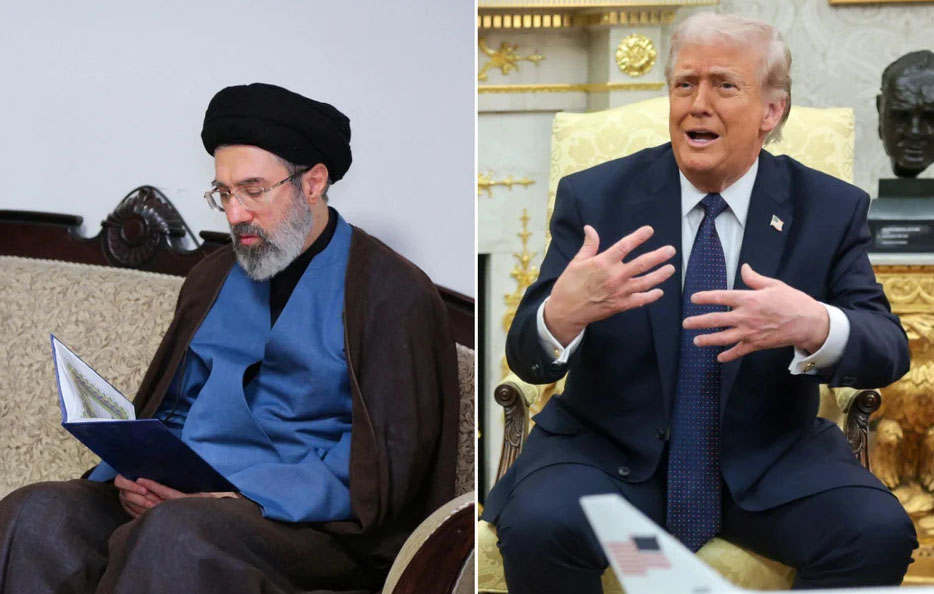
Trump Warns Iran: Open Hormuz or Get ‘Hit Very Hard’ as 48-Hour Deadline Looms
United States President Donald Trump has warned Iran it will be “hit very hard” unless the Strait of Hormuz is reopened “very soon,” while insisting that talks between the two sides were ongoing despite Tehran flatly denying any direct negotiations were taking place. Speaking in an interview with Fox News on Tuesday during a visit to California, Trump said he preferred a diplomatic resolution but left no doubt about the consequences of failure. “The strait is going to be open very soon, or they are going to get hit very hard, and then the strait’s going to be open,” he said. “If they back out again, they are going to get hit really hard. They know that. They understand that. I have no choice.” The president also described the planned military operation as extensive and still on the table despite his decision to pause it over the weekend. “It’s very tough to do what we have planned, still planned. We’ll see what happens,” he said, adding that he was “very proud” of giving Iran a chance to negotiate before launching what he suggested would be a large-scale assault. “We hit them very, very hard. But the hard hit is yet to come, and hopefully we won’t have to use it.” Trump simultaneously accused Iran of duplicity for publicly denying it was in talks with Washington. In a post on Truth Social, he wrote: “Iranian Leadership is unbelievably duplicitous! They ask for a meeting, some would say ‘beg,’ talks begin, with more scheduled in the immediate future, and they say, openly and proudly, that they’re not having any discussions, that nothing is being talked about, and they’re only dealing with ‘Oman’.” He added that “nothing gets through to Iran, unless we want it to, and nothing will get through, unless a Deal, or Total Surrender, is accomplished.”
Iran’s Foreign Ministry flatly rejected Trump’s characterisation. Spokesperson Esmaeil Baghaei said Tehran was not holding direct discussions with the United States and was only engaged in talks with Oman regarding a temporary safe route through the strait. “Discussions are currently focused on a possible navigation corridor for two-way vessel traffic. That initiative is unrelated to negotiations on fully reopening the strait. It is a separate issue,” Baghaei said. Baghaei added that all Iranian negotiators were currently in the country, with Foreign Minister Abbas Araghchi on a religious pilgrimage in Iraq and unavailable for negotiations at least until the end of the week. The only exception, he said, was the ongoing bilateral discussions with Oman as the two coastal states responsible for the waterway.
READ ALSO:
- Primate Ayodele Predicts Obi, Kwankwaso Will ‘Go Nowhere’ in 2027
- Police Probe AIG Jimoh Over VeryDarkMan’s Corruption Allegations
- N78 Million Solar Inverters, 410 Cattle, 10 Guns Recovered as Kaduna Police Arrest 25 Suspects
According to Axios, which cited unnamed regional and US officials, the United States, Iran, and Oman are nearing an interim agreement to reopen the Strait of Hormuz, with Washington hoping to announce the deal as early as Wednesday. The proposed arrangement would be a 60-day agreement for safe passage in the strait between Iran and Oman, with negotiators working on final details. Under the reported framework, ships entering the Persian Gulf would travel north through Iranian territorial waters, while outbound vessels would travel south through Omani waters in coordination with Tehran. The agreement would not involve the collection of transit fees or tolls, and the parties would clear mines from the central shipping lane within 30 days. A US official and one regional source told Axios that Iranian leadership had completed the approval process for the agreement on Tuesday. While US Secretary of State Marco Rubio confirmed that progress had been made in discussions with Iran, he noted that talks had not yet been finalized but that the White House was “hoping” for an agreement “in the very near future.”
Iran’s senior officials have taken a defiant stance, warning the United States against any adventurous actions. The Iranian Foreign Ministry reiterated that Tehran views Hormuz as a crucial source of strategic leverage that it cannot afford to surrender, while Washington insists that Iran must not be allowed to control an international waterway. Iran continues to insist that any agreement must leave it in control of the Strait of Hormuz. Regional officials told The Associated Press that any agreement to reopen Hormuz would also require the removal of the current US blockade on Iranian ports. Meanwhile, Iranian military sources have denied Trump’s claim that Tehran asked Washington to call off its strikes, calling his remarks “a new lie,” according to Iran’s semi-official Mehr news agency.
The diplomatic confusion was underscored when another cargo vessel was attacked near the strait’s Omani coast on Tuesday. The United Kingdom Maritime Trade Operations Centre (UKMTO) reported receiving multiple reports that a tanker had been struck by an unknown projectile approximately eight nautical miles east of Oman’s Limah. The tanker’s crew abandoned the vessel and boarded a lifeboat, with the vessel’s main engine disabled and a bunker tank on fire. The UKMTO did not identify the ship or its owner, and authorities are investigating. Separately, Iran’s Revolutionary Guards said on Tuesday that two oil tankers had caught fire after explosions while attempting to transit the southern route of the strait, though Reuters could not independently verify the Guards’ statement.
The disruption of the Strait of Hormuz has sent oil prices soaring and placed heavy pressure on Trump to stop the fighting, partly because of the effect rising energy prices could have on American voters ahead of the November congressional midterm elections. Treasury Secretary Scott Bessent had earlier told CNBC that a deal to reopen the strait could come as early as Tuesday or Wednesday, saying there were “hundreds if not 1,000 ships sitting in there waiting to go out,” including tankers carrying oil, fertiliser, refined products and industrial gases. Trump has vowed that Iran will not be permitted to collect transit fees in the strait, declaring, “If anyone is allowed to collect fees, it will be us. We have complete control.” The president had previously said he expected to know by Tuesday how the talks were going, “one way or the other,” but insisted that the path forward is clear. As the 48-hour window unfolds, the world watches to see whether the negotiations will yield a breakthrough or whether Trump will follow through on his threat to unleash a devastating military campaign. “If they don’t make a deal, it’s going to be too bad. And we have much more on Iran coming up,” Trump said. All parties remain on high alert, with the potential for a catastrophic escalation in West Asia now greater than at any point since the conflict began.
Trump Warns Iran: Open Hormuz or Get ‘Hit Very Hard’ as 48-Hour Deadline Looms
International
Iran Denies US Talks After Trump Announces Negotiations as War Enters Sixth Month
Iran Denies US Talks After Trump Announces Negotiations as War Enters Sixth Month
Tehran rejects Washington’s claim of imminent talks, says discussions with Oman over Strait of Hormuz are separate and ongoing
Iran has firmly denied that it is currently holding negotiations with the United States, contradicting President Donald Trump’s announcement that talks would begin on Monday afternoon. The conflicting claims come amid heightened tensions over the Strait of Hormuz and Iran’s nuclear program, with the war between the two countries now in its sixth month. The war began on February 28, 2026, when the United States and Israel launched surprise strikes against Iran, targeting key leadership, air defence capabilities, missile sites, and the Islamic Revolutionary Guard Corps (IRGC) Navy. The opening salvo included an attack on a leadership meeting in Tehran that killed Supreme Leader Sayyid Ali Khamenei, Iran’s defence minister, the chief of staff of the armed forces, and the commander of the IRGC. Since then, months of on-off diplomacy have led to periods of relative calm, though fighting has continued to flare.
Iranian Foreign Ministry spokesman Esmaeil Baqaei stated during a televised press conference on Monday that “Iran is not currently holding talks with the United States”. He elaborated that Tehran has no plans to host or send delegations, and members of Iran’s negotiating delegation remain inside the country. Baqaei clarified that Iran’s current discussions are focused exclusively on Oman regarding a temporary safe route through the Strait of Hormuz. He emphasized that reaching an agreement with Oman would not mean the reopening of the strait, as the situation would remain unchanged while US “aggression” continued. “So long as the United States continues to violate its commitments, the situation in the Strait of Hormuz will not change,” Baqaei told his weekly press conference. The spokesman also warned Gulf states against allowing the United States to use their territory for attacks on Iran, urging countries in the region not to facilitate US military action.
READ ALSO:
- NiDCOM confirms release of Nigerian girls detained in Mauritius
- Power Struggle Threatens Peter Obi-Kwankwaso Alliance Ahead of 2027 Polls
- Gumi: Clerics who join politics are better than those praying for politicians
On Sunday, President Trump told reporters aboard Air Force One that negotiations with Iran would begin Monday afternoon. He claimed that the talks would cover the Strait of Hormuz and ultimately the denuclearisation of Iran. “The deal is imminent, having to do with the Hormuz Strait and also, ultimately, the denuclearization of Iran,” Trump said. Trump stated that he had been asked by Iran as well as US partners Saudi Arabia, the United Arab Emirates, and Qatar to hold off on strikes, which he claimed would have been “the biggest attack since World War II”. In a post on Truth Social, Trump wrote: “Based on this request, I have agreed, for the future benefit of the WORLD and, likewise, the survival of a successful and prosperous Iran, to cancel the attack, subject to being able to rapidly make a DEAL”. However, Iranian media has denied that Tehran asked Trump not to strike. Trump has repeatedly predicted that a negotiated settlement is within reach, although previous diplomatic efforts have been followed by renewed exchanges of military strikes.
While denying US talks, Iranian officials confirmed progress in discussions with Oman over a new shipping route through the Strait of Hormuz. Iranian Foreign Minister Abbas Araghchi said negotiations with Oman on a mechanism for ships to transit the waterway were “nearing completion and in their final stages,” according to Iranian state media. The talks have been ongoing for months between Tehran and Muscat, the two littoral states bordering the strait, with discussions continuing at both the technical and political levels. Baqaei told state television that a deal was close with Oman over a new route through the strait, describing it as “one path with entry and exit lanes” that would respect the sovereign rights of both sides. The route under discussion will be temporary, he said, and through it, Iran will ensure safe navigation. Baqaei emphasized that Iran and Oman, as coastal states of the strait, are required to cooperate to ensure the safe passage of vessels through the waterway and reach a defined mechanism. He noted that Tehran needs to ensure that the Strait of Hormuz would not be exploited by the parties that have carried out aggression against Iran, adding that “this requires us to adopt a mechanism in which Iran’s sovereign rights are fully respected”.
The conflicting claims come against the backdrop of a war that has significantly disrupted global energy markets. Before the war, the Strait of Hormuz served as a conduit for approximately 20% of the world’s oil and liquefied natural gas. Iran has largely closed the strait, causing energy prices to rise and stoking broader inflation. On June 18, Iran and the United States signed a memorandum of understanding (MoU) on ending the conflict, under which the two countries were scheduled to hold negotiations within a 60-day period to reach a final agreement. Under the understanding, Iran agreed to allow fee-free maritime transit through the Strait of Hormuz for a period of 60 days. However, the talks’ fate has been uncertain due to recent military escalation. The US attempted to undermine Iran’s sovereignty by establishing an unsafe corridor near Omani shores, prompting Iran’s firm response to re-impose restrictions on the strait.
Iranian President Masoud Pezeshkian posted on X that “We must strive to compel the enemy to remain committed to what it has signed”. He expressed belief that the MoU would be the focal point of Iran’s foreign relations in the future. Baqaei also revealed that over the past 24 hours, “we have received numerous calls from the United Kingdom, Bulgaria, and Ukraine stating that they will not be part of the war against Iran”. Iranian lawmaker Hassan Ghashghavi, spokesman for the parliament’s national security commission, said on Sunday that mediators were trying to revive the US-Iran memorandum of understanding that was agreed in June. That agreement was not intended as a final peace deal, but as a stepping stone to negotiations on a comprehensive agreement, though it did include provisions on Hormuz. “They know that the main issue and, in fact, the key to the matter right now is the issue of the Strait of Hormuz, so yes, there is an exchange of views,” Ghashghavi said.
Trump’s announcement had immediate market effects, with oil prices falling at the opening of Asian trade. The president said he had been asked by Iran as well as US partners Saudi Arabia, the United Arab Emirates, and Qatar to hold off on further strikes. Eli Cohen, Israel’s energy minister and a member of Prime Minister Benjamin Netanyahu’s security cabinet, said there was close security and intelligence coordination between Israel and the US on everything happening in the region. However, he added: “With or without an agreement, and regardless of any external commitments, if Iran attempts to renew its nuclear programme or advance its ballistic missile industries, we will be there. We will take action, and we will strike”. In his call with Trump, Saudi Crown Prince Mohammed bin Salman stressed the “necessity of prioritising dialogue to de-escalate tensions” in the Middle East, according to Saudi Arabia’s state news agency. Many observers have expressed skepticism about the latest diplomatic push. Vali Nasr, an Iran expert at Johns Hopkins University, stated there was “no clear path” for Trump to achieve his goals, noting that “He is trying his hand now at a diplomatic solution to avoid military escalation. But there’s no clear path, either diplomatically or militarily, to get Trump to a place where he can declare victory”.
Iran Denies US Talks After Trump Announces Negotiations as War Enters Sixth Month
Additional reporting by Reuters, AFP, Ynetnews, and The New Arab
International
Oil Prices Slide as Trump Announces Fresh Iran Talks, Easing Supply Fears

Oil Prices Slide as Trump Announces Fresh Iran Talks, Easing Supply Fears
Global oil prices fell sharply in early Asian trading on Monday after United States President Donald Trump announced fresh negotiations with Iran, raising hopes of easing tensions in the Middle East and restoring normal shipping through the strategically vital Strait of Hormuz.
Brent crude, the international oil benchmark for September delivery, dropped 4.69 per cent to $83.81 a barrel as of 2250 GMT on Sunday, while the US benchmark, West Texas Intermediate (WTI), declined 4.67 per cent to $80.72.
The decline followed Trump’s announcement on Sunday that Washington would resume diplomatic engagement with Tehran instead of pressing ahead with major military strikes against the Islamic Republic.
READ ALSO:
- Political Realignments: Kwankwaso Receives APC Defectors into NDC in Kano
- DSS, Vigilantes Ambush, Kill Notorious Bandit Kingpin Idi Abasu Aiki, Over 60 Fighters in Katsina
- Nigeria Shines in Commonwealth Games, Tops Africa with 10 Gold Medals
“Now what we’re doing is we’re talking to them in the form of a negotiation. It begins tomorrow afternoon,” Trump said, without disclosing the venue or those expected to participate in the talks.
Oil markets have remained highly volatile since the conflict between the United States, Israel and Iran escalated in late February, disrupting traffic through the Strait of Hormuz—a critical maritime corridor for global crude oil and liquefied natural gas exports.
The renewed diplomatic push has fuelled optimism that the waterway could soon reopen fully, reducing the risk of prolonged disruptions to global energy supplies.
Adding to the positive sentiment, Iran said on Sunday that it was close to reaching an agreement with Oman on establishing a new shipping arrangement through the Strait of Hormuz, a development that could further stabilise oil exports from the region.
Oil Prices Slide as Trump Announces Fresh Iran Talks, Easing Supply Fears
-

 News2 days ago
Oloyede clears air on JAMB’s ₦36m ‘snake swallowed money’ controversy
-

 News2 days ago
475 Police Officers Recalled After Controversial Retirement, Ordered for Mandatory Induction
-

 metro2 days ago
MURIC Hails Oloyede as ‘Game Changer,’ Says He Proved Muslims Can Excel in Public Office
-

 Sports2 days ago
Nigeria Shines in Commonwealth Games, Tops Africa with 10 Gold Medals
-

 Auto2 days ago
Lanre Shittu Motors Leads Drive to Steer Lagos Students Away from Crime, Donates books to public Schools
-

 Education2 days ago
UNIOSUN ranks third among state universities in latest Webometrics ranking
-

 metro2 days ago
DSS, Vigilantes Ambush, Kill Notorious Bandit Kingpin Idi Abasu Aiki, Over 60 Fighters in Katsina
-

 Auto2 days ago
FRSC Boss: Tinubu’s CNG, EV Drive Creating Jobs, Attracting Investment