

News
Boko Haram killing more Muslims than Christians – US envoy













News
Supreme Court Ruling: INEC Moves to Clarify Fate of 2027 Candidates
Supreme Court Ruling: INEC Moves to Clarify Fate of 2027 Candidates
The Independent National Electoral Commission (INEC) has said it will determine how the recent Supreme Court ruling on the Electoral Act 2026 affects candidates after reviewing the certified true copy of the judgment.
The development has heightened uncertainty among some political parties and 2027 election candidates, particularly those whose nominations could be scrutinised over party membership registers and the procedures used to conduct their primaries.
The Supreme Court, in its September 24 judgment, restored Sections 77(5), 77(6), 77(7) and 84(2) of the Electoral Act 2026, which had earlier been struck down by the Court of Appeal. The provisions deal principally with political party membership registers and candidate nomination procedures.
Under Section 77(5), only members whose names appear on a party’s membership register submitted to INEC at least 21 days before a primary, congress or convention are eligible to participate in the exercise.
Section 77(6) requires parties to use the membership register submitted to INEC for their primaries, congresses and conventions, while Section 77(7) provides consequences for a party that fails to submit its register within the prescribed period.
Section 84(2), meanwhile, provides for the nomination of candidates through direct primaries or consensus.
The Supreme Court’s decision did not name or automatically disqualify any individual candidate. Questions surrounding particular nominations are expected to depend on the facts of each case, including party membership records, the timing of registration or defection and how the relevant primary was conducted.
READ ALSO:
- Omokri Defends Tinubu Over Pension Record, Faults Linking President to 89-Year-Old’s Death
- Tantita Operations Push Oil Export Earnings to $9.39bn in Q2
- Fifty Years After “Africa Has Come of Age”: A Personal Reflection on Nigeria’s Silence at the United Nations
INEC has therefore refrained from announcing a blanket decision on candidates whose nominations could be affected.
The commission is expected to engage political parties and other stakeholders on October 6, while also addressing the issue publicly as preparations continue for the 2027 general elections. INEC is also expected to publish the final list of governorship and State House of Assembly candidates on October 10.
Several candidates have already attracted attention because of circumstances surrounding their party membership or nomination.
Among those mentioned are Kingsley Chinda, the APC governorship candidate in Rivers State; Isa Pantami, the PDP governorship candidate in Gombe State; Donald Duke, the PRP presidential candidate; Ovie Omo-Agege, the NDC senatorial candidate in Delta Central; and Victor Ochei, the NDC candidate for Delta North.
In Chinda’s case, questions have centred on the timing of his movement from the PDP to the APC and whether his membership status complied with the restored provisions before the party’s governorship primary.
The Rivers APC has maintained that Chinda registered with the party on April 27, ahead of the May 21 primary, and therefore met the relevant 21-day requirement.
Pantami’s case is also subject to separate legal proceedings. He left the APC for the PDP after withdrawing from the APC governorship primary and subsequently emerged as the PDP’s candidate in Gombe. A Federal High Court ruling in Gombe had already nullified his nomination and ordered a fresh primary, meaning his situation involves issues beyond the Supreme Court judgment alone.
For Omo-Agege and Ochei, attention has focused on their movement from the APC to the NDC and the waivers granted to enable them to contest the NDC nomination exercises. Their cases raise questions about the interaction between party membership, waivers and the restored provisions of the Electoral Act.
Former Inspector-General of Police Mohammed Abubakar Adamu, the SDP governorship candidate in Nasarawa State, has also insisted that his candidacy remains valid. The SDP has said he had been a member of the party for about three months before its governorship primary.
The key issue for INEC is whether nominations conducted while the disputed provisions were temporarily invalidated will be assessed under the provisions subsequently restored by the Supreme Court.
For now, the Supreme Court judgment should not be interpreted as an automatic cancellation of the affected candidates’ tickets.
The final position will depend on INEC’s review of the judgment, the relevant party records and the specific circumstances surrounding each nomination, as well as any separate court proceedings that may arise.
With the 2027 elections approaching, the commission’s forthcoming clarification is expected to provide greater certainty for political parties, candidates and other stakeholders over the status of nominations affected by the ruling.
Supreme Court Ruling: INEC Moves to Clarify Fate of 2027 Candidates

News
Omokri Defends Tinubu Over Pension Record, Faults Linking President to 89-Year-Old’s Death

Omokri Defends Tinubu Over Pension Record, Faults Linking President to 89-Year-Old’s Death
Former presidential aide and political commentator Reno Omokri has defended President Bola Ahmed Tinubu’s administration over its record on pension payments, while criticising attempts to link the President to the death of an 89-year-old woman.
Omokri spoke while mourning the death of Dame Ezinne Mary Oduah Amaechi, who died on July 16, 2026, at the age of 89.
He argued that the Tinubu administration had made progress in addressing outstanding pension liabilities and ensuring that retirees receive their entitlements more regularly.
Omokri cited his personal experience, saying his mother recently celebrated her 90th birthday and received a video call from Lagos State Governor Babajide Sanwo-Olu, who reportedly asked whether she had been receiving her pension. According to him, she answered in the affirmative.
The former presidential aide said regular pension payments had improved the financial independence of many retirees, allowing them to meet essential needs such as food and medication without relying entirely on their children.
He attributed the development to measures introduced by the Tinubu administration, particularly efforts to settle outstanding pension liabilities.
READ ALSO:
- Tantita Operations Push Oil Export Earnings to $9.39bn in Q2
- Fifty Years After “Africa Has Come of Age”: A Personal Reflection on Nigeria’s Silence at the United Nations
- Family seeks N10m to free kidnapped newlywed, other victims
“Under His Excellency, Bola Ahmed Tinubu, Nigerians at both the Federal and Local Government levels, including military and paramilitary retirees, have been receiving their upgraded pensions as and when due,” Omokri said.
He maintained that the President inherited rather than created many of the outstanding pension obligations.
According to Omokri, President Tinubu approved a N758 billion Federal Government bond to address outstanding pension liabilities and arrears under the Contributory Pension Scheme.
He said the measure reflected the administration’s commitment to ensuring that retirees who served the country could live with greater dignity after leaving active service.
Omokri also referred to comments attributed to Godwin Abumusi, President of the Nigeria Union of Pensioners, who reportedly commended the administration over the regular payment of monthly pensions and efforts to address historical pension debts.
Against this background, Omokri criticised claims seeking to associate Tinubu with the death of Amaechi.
He described such claims as unfortunate, particularly because the deceased was 89 years old.
“Thus, I find it most sad that anybody would, in the face of the above facts, accuse the President of being responsible for their mother’s death at 89,” Omokri said.
He also referred to Nigeria’s relatively low average life expectancy, arguing that reaching 89 represented a significant milestone.
“In a country where the average life expectancy is still below 60, though rising, for one to attain the ripe old age of 89 is a thing of joy to be celebrated,” he said.
Despite his criticism of the allegation against Tinubu, Omokri expressed sympathy to Amaechi’s family and described her as a dearly beloved mother.
He prayed for the peaceful repose of her soul and for strength for her surviving relatives and friends.
“May God bless the memory of Dame Ezinne Mary Oduah Amaechi, who passed away peacefully on July 16, 2026, at the age of 89,” he said.
“May God also grant her surviving family and friends the fortitude to bear the loss of a dearly beloved mother.”
Omokri Defends Tinubu Over Pension Record, Faults Linking President to 89-Year-Old’s Death
News
Adeleke Rejects Ataoja Palace Appointment, Reaffirms Oyebode as Osun Iyaloja-General
Adeleke Rejects Ataoja Palace Appointment, Reaffirms Oyebode as Osun Iyaloja-General
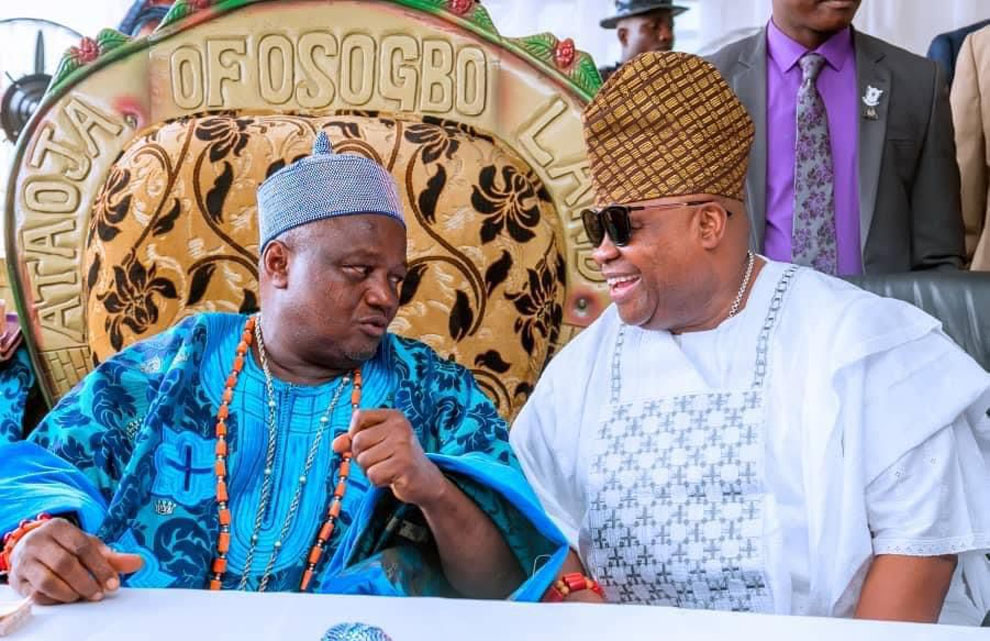
OSOGBO — Osun State Governor, Senator Ademola Adeleke, has reaffirmed Mrs Oyebode Mary as the Iyaloja-General of the state, declaring that any purported appointment of another person to the position is invalid.
The governor’s position followed an announcement reportedly emanating from the palace of the Ataoja of Osogbo concerning the appointment of a new Iyaloja-General.
In a statement issued on Friday by his spokesperson, Mallam Olawale Rasheed, Adeleke maintained that the authority to appoint the Iyaloja-General of Osun State rests with the state government.
The governor specifically warned market associations, traders and women across the state against recognising or acting on any announcement of a new Iyaloja-General from any quarter other than the state government.
READ ALSO:
- Flydubai Co-Pilot Attacked Captain With Axe in Attempted Terrorist Act, UAE Says
- Nigerian-Born Ex-Professor Jailed 78 Months Over $1.3m US Student Aid Fraud
- Police Arrest Man Caught Sexually Assaulting 12-Year-Old Girl in Car
According to him, “any announcement from any other quarter including the Osogbo Royal Palace is null and void.”
Adeleke further declared that Mrs Oyebode remains the legally recognised Iyaloja-General of Osun State and continues to enjoy the full backing and recognition of his administration.
The governor urged market leaders and womenfolk across the state to disregard any purported appointment of another person to the position, stressing that Mrs Oyebode remains the duly appointed Iyaloja-General under the authority of the state government.
He also appealed to traditional institutions, organisations and individuals to respect the law and remain within the boundaries of their respective mandates.
Adeleke cautioned against actions capable of creating tension or disturbing the peace of the state, urging all parties involved in the development to exercise restraint.
The governor’s statement could further deepen attention around the authority and processes governing the leadership of market associations in Osun State, particularly amid the conflicting positions attributed to the state government and the Osogbo traditional institution.
Adeleke Rejects Ataoja Palace Appointment, Reaffirms Oyebode as Osun Iyaloja-General
-

 metro2 days ago
NYSC Kidnap: Abductors Demand N950m for 19 Prospective Corps Members in Imo
-

 Politics2 days ago
2027: Oshiomhole Dares Opposition Over ₦500 Petrol Promise, Says APC Will Take Argument to Nigerians
-

 Entertainment3 days ago
Olu Jacobs Laid to Rest in Lagos as Dignitaries, Nollywood Stars Honour Screen Icon
-

 International3 days ago
Trump Threatens Iran With ‘Very Hard’ Response Over Flydubai Attack
-

 metro3 days ago
Nigeria Launches 11-Character Digital Postcode System for Every Addressable Building
-

 metro2 days ago
Amaechi: Tinubu’s Policies Made My Mother’s Drugs Unaffordable
-

 Entertainment2 days ago
Less Than Four Months After Wedding, Jarvis Threatens Peller With Lawsuit Over Second-Wife Plan
-

 metro1 day ago
‘I Thought I Was Dead’ — Hairstylist’s Daring Escape From Kidnappers After Benin-Ore Ambush