
News
No region can claim ownership of natural resources – Obasanjo tells Clark
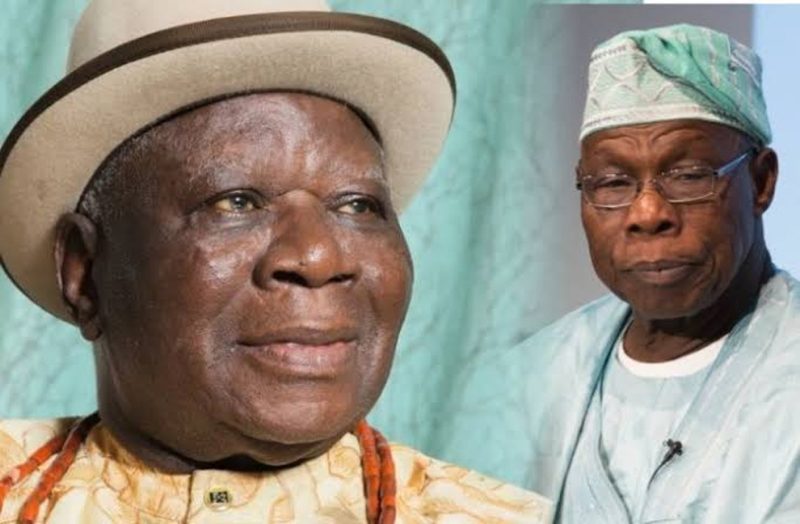
The oil in the Niger Delta belongs to Nigeria and no region can claim ownership of natural resources found in their area, former President Olusegun Obasanjo has said.
He said this in response to the Ijaw leader, Edwin Clark, who alleged that Obasanjo hates the Niger Delta region.
Obasanjo said Nigeria and the Niger Delta expected Clark to be a statesman and not a tribesman.
The 94- year- old Clark is the leader of the Pan Niger Delta Forum and Chairman of the Board of Trustees of Ijaw National Congress.
He had served as federal commissioner of information in 1975 and was involved in politics even before Nigeria’s independence.
Obasanjo, 84, in a lengthy letter to Clark, cautioned the Ijaw leader against deploying “offensive and uncouth languages” to describe his personality.
Clark had on Wednesday, December 22, attaked Obasanjo over what he termed “A disappointing display of hatred against the people of the oil-producing states in Nigeria.”
He was reacting to the former president’s position in Abuja, at a peace and security parley convened by the Global Peace Foundation and Vision Africa.
In an open letter to Obasanjo titled, ‘My disappointment over your unprovoked outburst against the people of the Niger Delta region’, Clark accused the former president of double standards over resource control in the country.
He had said, “Natural resources found in regions were controlled by the people of the regions in the country as enunciated in Section 140 of the 1960 Constitution.”
But reacting to Clark, Obasanjo, in a six-page letter, said his position at the occasion was misconstrued, even as he declared that he had no grudge against the Niger Delta.
Obasanjo stated in the letter, titled ‘My response to the open letter by Chief (Dr) E. N Clark’, that it remained a constitutional matter that the oil in Niger Delta Region belongs to Nigeria as it “affects Zamfara State where gold is found.”
According to him, the tribe has to be suppressed for the state to emerge, and until the state emerges, Nigeria will not make the desired progress as tribesmen will always sacrifice the state for the tribe.
Obasanjo said, “Let me proceed with the most basic constitutional fact that you cannot have two sovereign entities within a state, which is what your position of Niger Delta ownership claim of the crude oil found in that location amounts to.
“All those who purchase crude oil from Nigeria enter into a contractual relationship with Nigeria, not with the Niger Delta. The territory of Nigeria is indivisible inclusive of the resources found therein.
“No territory in Nigeria including the minerals found therein belongs to the area of location and this remains so until the federation is dissolved.
“This is the position of the Nigerian Constitution and international law. If there is a threat of violence to any part of Nigeria today including the Niger Delta, it is the Nigerian military backed by any other machinery that can be procured or established at the federal level that will respond to any such threat.
“In principle and practice, the position I have taken on the location of mineral resources in any part of Nigeria is the legal and constitutional position.”
Recalling his stand on the contentious issue in his long letter to Clark, Obasanjo said, “I have always stood for equity and justice in our federation and, for me, the tribe has to be suppressed for the state to emerge.
“And until the state emerges, Nigeria will not make the desired progress as tribesmen will always sacrifice the state for the tribe. This has always been my position and it will remain my position until I breathe my last.”
He chided Clark for using “Bad, imprudent, unwise and immature” words to describe him.
“Some of the languages you (Clark) have deployed to describe me in your letter are offensive, uncouth and I totally and completely rejected them. I am not inconsistent, hypocritical, unstatesman and nor am I anybody’s lackey.”
It was learnt that Niger Delta has an estimated 38 billion barrels of oil reserves and people in the region have for long been agitating for resource control.
The Niger Delta is the delta of the River Niger sitting directly on the Gulf of Guinea on the Atlantic Ocean. It is typically considered to be located within nine coastal southern Nigerian states, which include: all six states from the South-South geopolitical zone, one state (Ondo) from the South-West geopolitical zone and two states (Abia and Imo) from South East geopolitical zone.
The clamour for resource control had led to a violent uprising in the Niger Delta, which led to the loss of lives, equipment and billions of dollars in oil revenue.
The amnesty programme initiated by late President Umaru Yar’adua and the 13 per cent derivation being given to the states had to a greater extent calmed frayed nerves but have not resolved the impasse as politicians normally bring the matter to the front burner especially ahead of general elections to bargain for recognition.
For instance, President Muhammadu Buhari had last week in Maiduguri, Borno State said that the discovery of oil in two North East states of Bauchi and Gombe will balance the politics of oil in the country and create stability.
He had said, “I was amazed and even overwhelmed that I was so ignorant when a certain professor told me that only 2.5 per cent of Nigeria’s arable land is being used. I didn’t know that even when I was a governor, a minister, and head of state.
“To be honest, I didn’t know. We were indoctrinated that we are oil-rich and don’t need to work on the farms. This made everybody rush to the cities to drink oil money.
“Now oil has almost become irrelevant, but we thank God that oil is now discovered in Bauchi and Gombe and that will help to balance the politics of oil in the country.”








News
Yoruba Muslim Group Dismisses Viral Ramadan Date Claim, Reaffirms Sultan of Sokoto’s Authority
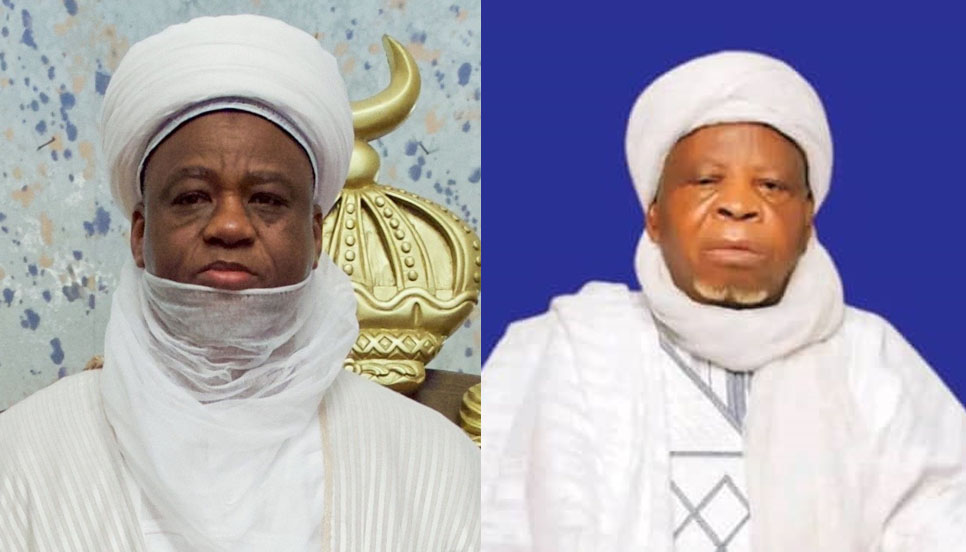
Yoruba Muslim Group Dismisses Viral Ramadan Date Claim, Reaffirms Sultan of Sokoto’s Authority
A Yoruba Muslim group, Concerned Indigenous Yoruba Muslims, has dismissed as false, misleading, and divisive a viral social media report alleging that the Chief Imam of Ibadanland and the League of Imams in Yorubaland rejected the authority of the Sultan of Sokoto in determining the commencement of Ramadan in South-West Nigeria.
The report, which circulated online ahead of Ramadan 1447AH, claimed that Yoruba Muslim leaders had resolved to disengage from the Sultan’s traditional role of announcing moon sighting for the fasting period and instead align with indigenous religious structures. The group, however, said the claim was entirely fabricated and designed to sow discord within the Muslim community.
In a statement issued on Saturday, February 21, 2026 — the fourth day of Ramadan, and signed by public affairs analyst Nasrudeen Abbas, the group said the comments attributed to the Chief Imam of Ibadan, reportedly over 90 years old, could not have emanated from him. It described the publication as a calculated attempt to create unnecessary religious tension and misrepresent the position of Yoruba Muslims.
The group reaffirmed that Islamic affairs in Nigeria operate under established leadership structures, particularly the Nigerian Supreme Council for Islamic Affairs (NSCIA), which is headed by the Sultan of Sokoto, Muhammad Sa’ad Abubakar, as President-General. It explained that the NSCIA structure includes the President of the Muslim Ummah of South West Nigeria (MUSWEN) as Deputy President-General (South), the Shehu of Borno as Deputy President-General (North), alongside other national officers.
READ ALSO:
- FCT Council polls: APC Wins Four Chairmanship Seats as PDP Takes Gwagwalada
- Dangote Opens Refinery Investment to Nigerians With Public Share Sale Plans
- SERAP Urges Tinubu to Repeal ‘Unlawful’ Mass Surveillance Regulations
According to the group, any attempt to distance Yoruba Muslims from this nationally recognised structure threatens the unity of the Muslim Ummah in Nigeria and contradicts Islamic principles that emphasise cohesion, collective leadership, and obedience to constituted authority.
The group also faulted claims that the Sultan’s position is merely a traditional title limited to Sokoto State. It stressed that the Sultan’s authority in Islamic matters is rooted in scholarship and the historical caliphate system, noting that emirs in Northern Nigeria often combine traditional authority with religious leadership. As an example, it cited Muhammadu Sanusi II, who regularly delivers Friday sermons and performs Islamic rites.
It further explained that in Yorubaland, traditional rulers generally do not head religious affairs, except in rare cases. The group referenced the late Awujale of Ijebu Land, who once served as President-General of the Ogun State Muslim Council, stressing that such roles remain exceptions rather than the norm.
The statement also recalled the position of the late Kazeem Yayi Akorede, former President-General of the League of Imams and Alfas in the South West. According to the group, Sheikh Akorede initially questioned the Sultan’s leadership role but later accepted it after clarifications that the position was based on Islamic scholarship and caliphate leadership, not mere traditional kingship. It added that until his death, he consistently aligned with the Sultan’s announcements on the commencement and termination of Ramadan.
Describing the viral publication as unethical, the group criticised claims that Yoruba Muslims are not religiously bound to the Sultan’s authority and that religious leadership should go beyond duties such as moon sighting announcements. It alleged that such narratives were politically motivated and aimed at advancing a separatist agenda under the guise of religious autonomy.
The group warned that politicising religious matters could undermine religious harmony and national unity, urging those behind the report to desist from actions capable of creating discord among Muslims across the country. It concluded by stressing that the unity of the Muslim Ummah in Nigeria remains paramount and must not be compromised by what it described as sectarian or politically engineered narratives.
Yoruba Muslim Group Dismisses Viral Ramadan Date Claim, Reaffirms Sultan of Sokoto’s Authority
News
NNPC CEO Ojulari Receives Prestigious Energy Institute Fellowship in London
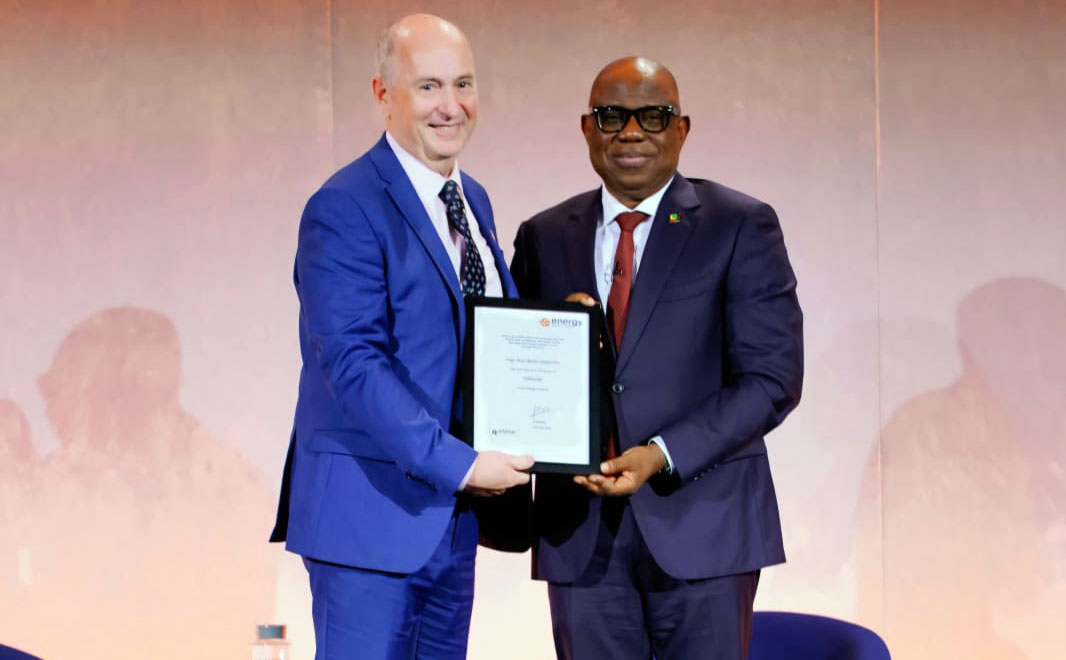
NNPC CEO Ojulari Receives Prestigious Energy Institute Fellowship in London
The Nigerian National Petroleum Company Limited (NNPC Ltd.) has earned international acclaim as its Group Chief Executive Officer, Engr. Bashir Bayo Ojulari, has been conferred with the Fellowship of the Energy Institute (FEI), United Kingdom — one of the highest honours in the global energy industry.
The Fellowship recognises senior energy leaders who have demonstrated sustained, high-impact contributions to the advancement of the energy sector. It was formally conferred on Ojulari during International Energy Week (IEW) in London, a leading platform for energy policy, finance, and industry leadership. (punchng.com)
The honour was presented by Andy Brown, President of the Energy Institute, who praised Ojulari’s transformative leadership of NNPC Ltd., highlighting his role in strengthening governance, embedding a performance-driven culture, and repositioning the company for long-term value creation.
Under his stewardship, NNPC Ltd. has implemented investor-focused reforms, enhanced operational excellence, and expanded strategic global partnerships, all contributing to increased confidence in Nigeria’s energy sector. The recognition reinforces NNPC’s ongoing transformation into a commercially driven, globally competitive, and transparent energy company.
READ ALSO:
- FCT Polls: CSO Situation Room Flags Late Voting, Vote Buying, Logistical Challenges
- ADC Defeats APC to Win First Polling Unit in FCT Area Council Election
- Trump Moves to Indefinitely Suspend Work Permits for Asylum Seekers
Significance for Nigeria and Africa
Experts note that the FEI Fellowship is not only a personal achievement for Ojulari but also a major institutional endorsement of NNPC Ltd.’s reform agenda. Being recognised at International Energy Week, which convenes policymakers, financiers, regulators, and industry leaders, positions the company at the centre of critical global energy discussions on sustainability, energy transition, and capital formation.
The award also signals growing international confidence in NNPC Ltd. and highlights Nigeria’s strategic role in Africa’s energy security and global energy transition ambitions. (vanguardngr.com)
Ojulari’s Leadership Achievements
Since assuming office, Engr. Ojulari has overseen multiple strategic reforms at NNPC Ltd., including:
- Driving governance and operational reforms to boost accountability.
- Expanding strategic partnerships and investor-focused initiatives.
- Enhancing execution efficiency across the company’s subsidiaries.
- Positioning NNPC Ltd. as a credible, investment-ready energy enterprise.
These efforts have not only improved the company’s profitability and performance but also strengthened Nigeria’s energy security and market competitiveness. (punchng.com)
Ojulari described the Fellowship as a reflection of collective effort within NNPC and reiterated his commitment to sustainable value creation, global best practices, and energy sector innovation.
NNPC CEO Ojulari Receives Prestigious Energy Institute Fellowship in London
News
FCT Polls: CSO Situation Room Flags Late Voting, Vote Buying, Logistical Challenges
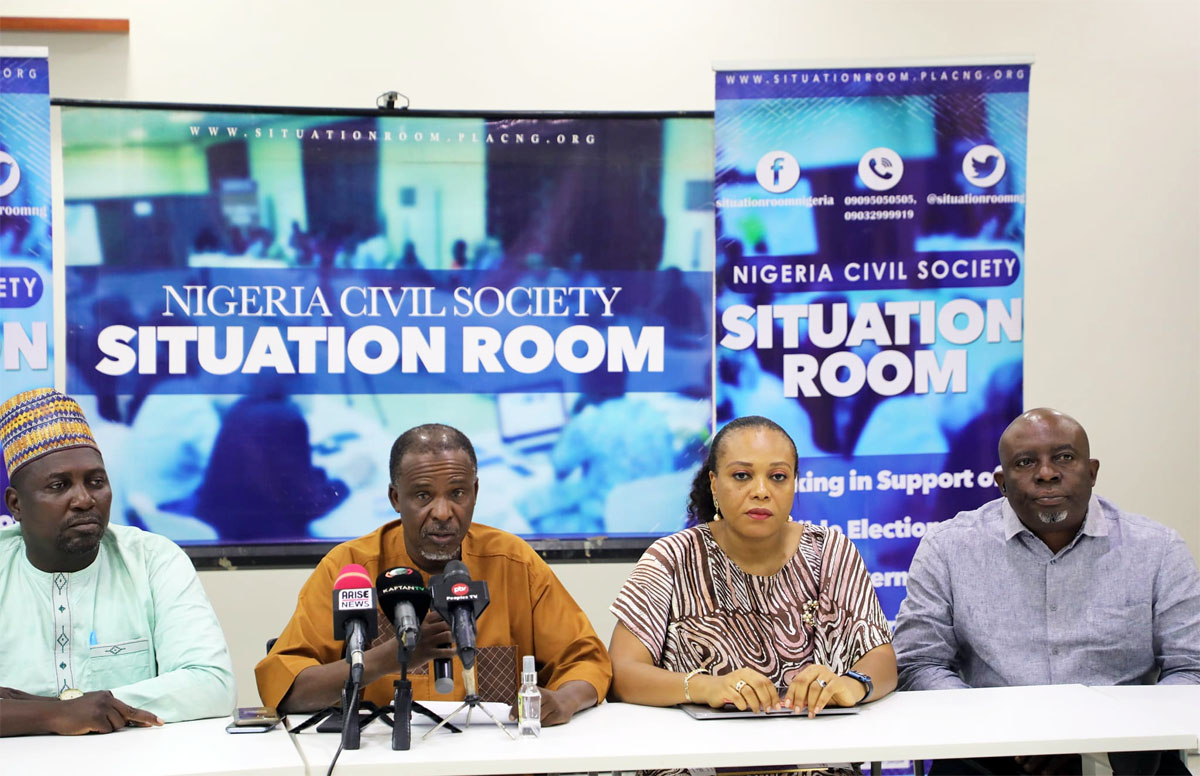
FCT Polls: CSO Situation Room Flags Late Voting, Vote Buying, Logistical Challenges
The Nigeria Civil Society Situation Room has raised concerns over multiple irregularities in the ongoing Federal Capital Territory (FCT) Area Council Elections, citing late polling unit openings, reports of vote buying, and logistical challenges that could affect voter participation.
According to the Situation Room, a coalition of over 70 civil society organisations advocating for credible elections in Nigeria, many polling units opened late, with an average start time of 9:15 a.m., well after the official 8:30 a.m. schedule. Observers also noted low voter turnout in several areas, particularly in AMAC, although queues began forming later in Kuje, Kwali, Gwagwalada, and Abaji Area Councils.
Vote Buying Observed
The coalition reported instances of vote buying, with voters allegedly offered up to ₦10,000 in exchange for ballots in units such as PU008, PU056, PU057, and PU058 in Gidan Mangoro Ward, AMAC. While some of the transactions were open, others were conducted discreetly.
The Situation Room warned that such electoral malpractice undermines the integrity of the election and called on electoral officials, political parties, and security agencies to intervene and prevent further incidents.
READ ALSO:
- ADC Defeats APC to Win First Polling Unit in FCT Area Council Election
- Trump Moves to Indefinitely Suspend Work Permits for Asylum Seekers
- Peller Escapes Generator Fire at Lagos Home, Recalls Earlier Lekki–Epe Scare
Logistical and Accessibility Issues
Observers noted that some voters struggled to locate their polling units after last-minute changes communicated by INEC via text messages. The Bimodal Voter Accreditation System (BVAS) generally performed efficiently, with a one-minute average accreditation time, though malfunctions were reported in a few units including Gwako Town Primary Schools II & IV and PU143, Gwagwalada.
The Situation Room also highlighted accessibility challenges for voters with disabilities, noting that braille ballot guides, magnifying glasses, and other assistive materials were largely absent, even in designated disability communities such as Karimajiji and PU052, Wuse.
Security and Election Conduct
Security personnel, including officers from the Nigeria Police, Civil Defence, Immigration Service, and Fire Service, were present in significant numbers and generally maintained order and professionalism.
Isolated incidents of intimidation and harassment were reported in locations such as Grade 1 Area Court, Rubochi (Kuje); Naharati Sabo School II, Rimba/Ebagi; and PU3, UNG Liman/UNGWAR LIMAN 1, Abaji Central, but security agents swiftly resolved these situations.
Call for Calm and Integrity
The Situation Room commended the INEC FCT Help Desk for promptly addressing reported issues and called on all stakeholders to maintain calm, resist vote buying, and ensure that the will of the people is respected as the polls continue and results are collated.
The report was jointly signed by Mma Odi and Celestine Odo, co-conveners of the coalition.
FCT Polls: CSO Situation Room Flags Late Voting, Vote Buying, Logistical Challenges

-

 Business13 hours ago
Dangote Opens Refinery Investment to Nigerians With Public Share Sale Plans
-

 Politics2 days ago
Peter Obi Launches ‘Village Boys Movement’ to Rival Tinubu’s City Boys Ahead of 2027
-

 Education1 day ago
UTME: JAMB Clarifies Position on Hijab During Biometric Capture
-

 News3 days ago
Police to Arrest TikToker Mirabel After She Recants False Rape Claim
-

 International3 days ago
Epstein, Ex-Israeli PM Named in Alleged Profiteering From Boko Haram Crisis
-
 Politics7 hours ago
Tinubu Hails Wike as APC Dominates 2026 FCT Area Council Elections
-

 Education2 days ago
Ogun Gov Rewards Nigeria’s Best Primary School Teacher with Car, Bungalow
-

 Entertainment2 days ago
Tacha Condemns False Rape Allegations After Mirabel Admits Fabrication