Opinion: Nigerian embassies of shame by Tunde Odesola (2) - Newstrends
Connect with us

Opinion

Opinion: Nigerian embassies of shame by Tunde Odesola (2)
Published

on

(Published in The PUNCH on Monday, September 20, 2021)

With a tongue roughly twice the length of its body, and a brocade of dubious colours for skin, the chameleon is the ultimate invisible animal predator.

Without premonition, small creatures like worms and insects searching for daily bread disappear suddenly into the Bermuda Triangle in the belly of the dodgy chameleon via a sticky, snappy tongue.

Like worms and insects, in June 2021 alone, 1,032 Nigerians met sudden death in the hands of gunmen and kidnappers across the country, according to a fresh security report.

Approximately, the 1,032 casualty figure translates to 34.4 wasted lives per day, excluding deaths by sicknesses, auto accidents, extrajudicial killings, ritual killings, etc in a peaceful country in pieces.

Home or abroad, the fate of the average Nigerian is mournful.

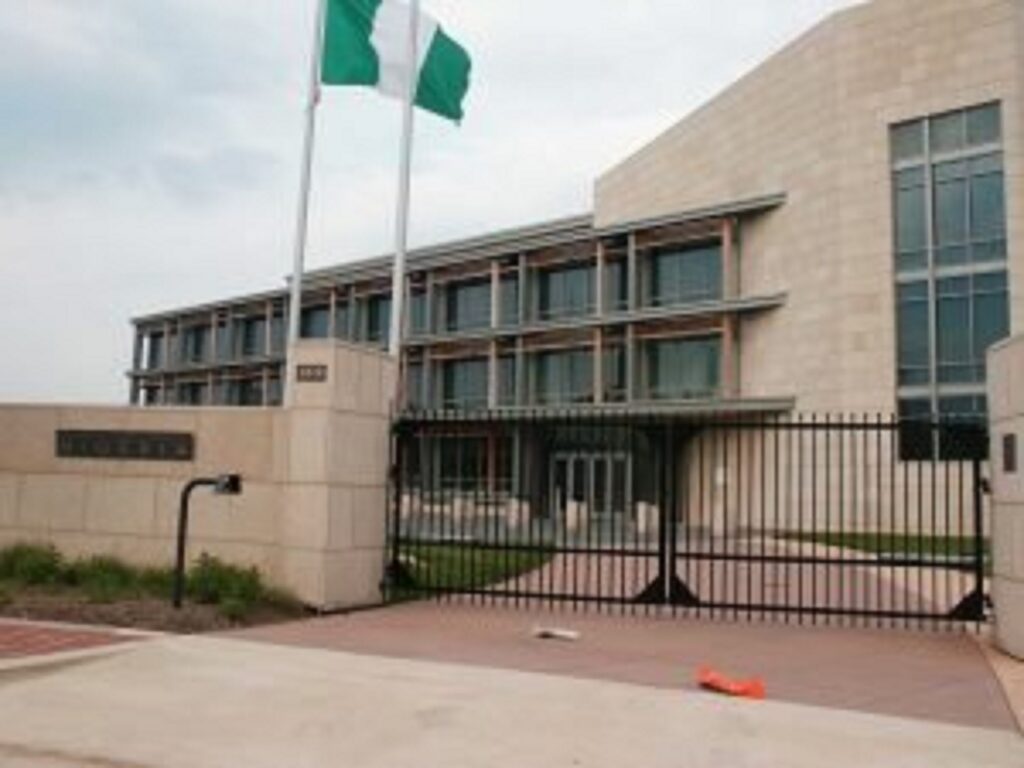
Home-based Nigerians are plagued by physical and psychological deaths just like Nigerians abroad are not spared psychological torture and humiliation in Nigerian embassies.

The overwhelming corruption yet pervading most Nigerian embassies despite numberless media reports in the last six years attests to the failure of the retired Major General Muhammadu Buhari led-regime in curbing dishonest dealings that have cemented the green passport in the hall of infamy.

Lamenting the nasty treatment she went through in the hands of officials at the Nigeria High Commission in the UK, a registered nurse, Kemi Samuel, who has lived in England for over three decades, said she suffered Post-Traumatic Stress Disorder whenever she visited the commission.

A registered nurse with more than 30 years under her belt, Samuel recalled that every Nigerian in England, notwithstanding their locations, was required to physically come to obtain visas, renew passports or get new ones.

Samuel explained that it was ridiculous that she renewed her 10-year British passport within two hours at Her Royal Majesty Passport Office, Globe House, London, while she laboured to renew her five-year Nigerian passport after visiting the high commission on seven different occasions.

She said, “If you want your British passport to be done as an emergency, you need to visit the passport office, but if you want to follow the normal process, it will arrive in your mail within four to five days.

“The reverse is the case in the Nigeria High Commission, where officials allow applicants to shunt the queue after bribing them. The officials were nasty to young and old, and they’ve no regard for children, women and the physically challenged. I was breastfeeding my baby and I had to leave my work each time I visited, meaning that I was losing money.

“In 1997, an immigration officer wanted to steal my passport at the Murtala Muhammed International Airport, Lagos. He hid my passport among the documents he was clutching and he said I didn’t give him my passport, and he was trying to walk away. I raised my voice and told him to bring out my passport from among the papers in his hands.


“In 2010 when I wanted to renew my passport, they said there were no booklets from Abuja, so I had to use my British passport.


“Between February and August of 2016, my daughter and I visited the high commission over 20 times to renew our passports! Nigerians came from other European countries to renew their passports, too.


“There was the pitiable case of a female Nigerian student who needed her passport to renew her studentship. She said that was the 11th time she had come to the commission.


“When we got to Nigeria, the carousel didn’t work as there was no light at the airport, prompting passengers to use the light of the phones. All that was strange to my daughter who suddenly felt pressed to use the toilet. She ran out of the toilet when she saw heaps of maggots.”


A Nigerian resident in Houston, Texas, who doesn’t want his name in print, lamented that he was asked to pay an unreceipted $20 as car park fee at the Nigerian embassy in Atlanta, Georgia.


The 50-year-old applicant, who is from southern Nigeria, said, “The embassy won’t process applications for more than one year, and after the expiration of one year, the applicant will be required to pay a fresh $195 as passport fee. Since it was the embassy that failed to produce passports as and when due, applicants should not be made to pay twice for passports.”


Nicknamed BB, the sad Nigerian also alleged that his online application was changed and ‘sold’ by embassy officials to another applicant who had bribed them.


“I picked up my American passport that can enable me to enter about 200 countries visa-free in my mailbox. I don’t know why my Nigerian passport, which nobody wants to see, is so problematic,” he  said.


Complaining about the terrible treatment meted out to visa and passport applicants at the Nigeria High Commission in London, a Nigerian, Sunday John, said applicants were never given appointment when they apply online.


He said, “They won’t give you an appointment when you apply online because they make money by giving appointments to those who have bribed them.


“Passport fee is 75 pounds but they will charge you between 300 and 700 pounds through the backdoor. I refused to pay, and I’ve since not been able to take my wife and three children to see my mum in Nigeria.


“I wanted to open a business account but because I’m not British yet, my nationality was required. The non-issuance of a passport to me has put the business I’m planning to do on hold. I’ve vowed not to bribe them because if I do so, I’ll be encouraging corruption. Sadly, other African nationals in England get their passports in a matter of days.”


Sharing his ordeal, another Nigerian, Mr Frederick Oluwole, who has lived in New York for over 30 years, said passport production at the Nigerian embassy in Manhattan was delayed because of lack of ‘nylon’ covering for passport pages.


Oluwole said, “They took my unsigned money order from me. They didn’t allow me to write my name on it. What they would later do is to write their own name on it and collect the money on the order, and pocket it.


“They talk down on you as if they’re doing you a favour. An official had to fly to Nigeria to bring common ‘nylon’ which could have been sent through courier.”


It’s the same hopeless song in Ottawa where the Nigerian embassy in Canada is located.

Narrating his nightmare, a Nigerian, Valentine Abiodun, disclosed that calls to the embassy were never picked.

“When someone eventually picked my call after weeks of calling, I told him I had been calling the embassy repeatedly, the officer said he travelled. I was shocked, and I told him the embassy wasn’t a private business that should be held up by an official.

“I told him I had sent in my passport for renewal. He told me they’ve not received it. Because I was tracking the passport, I told him who received it at the embassy.

“Then, he said I should call back. When I called back, he said he had seen it, adding that he would stamp and send it to me through mail. I said he shouldn’t. By 2am that night, I got a car and travelled down to Ottawa, getting to the embassy in the morning to pick my passport.”

A young Nigerian living in Mississauga, Ontario, Emmanuel Ogunlade, said he just received his renewed passport, which he had been processing since January 2020, two weeks ago.

Ogunlade said, “It was a terrible experience. I travelled to the Nigerian embassy, Ottawa, a journey of 427km, thrice after uncountable calls that were not answered before my passport was renewed even as I paid $23 twice for prepaid envelopes. They sent an email saying that they’ve sent my passport to me, but it was false. They later admitted they’ve not sent it.”

An anonymous female resident of Dubai said Nigerians now go to Abu Dhabi from Dubai to obtain their passports because of the hardship encountered at the Nigerian embassy in Dubai.

Uhhmm, Nigeria, under Buhari, is rich in corruption, home and abroad.

Sai chameleon!

(Concluded)


Email: tundeodes2003@yahoo.com

Facebook: @tunde odesola

Twitter: @tunde_odesola

TundeOdesola.com

Loading

Health

Don’t add lies to the terrorist horror in Oyo, By Farooq Kperogi

Published

on

The Shettima danger for Tinubu, By Farooq Kperogi
Farooq Kperogi

Don’t add lies to the terrorist horror in Oyo, By Farooq Kperogi

The kidnapping of schoolchildren and teachers in Oyo State is horrifying enough by itself. It does not need the embellishment of lies, half-truths, conjectures and opportunistic propaganda to make it more horrifying than it already is.

But that is precisely what appears to be happening with the viral, social-media-amplified list of “demands” allegedly made by the terrorist bandits who kidnapped schoolchildren and teachers in Oyo State.

According to the social media version of the story, the bandits have demanded four things as preconditions for releasing the innocent people in their captivity: one billion naira to be paid into an account in the Republic of Benin, the release of bandits supposedly being held in Agodi and Abolongo prisons, two Hilux vehicles and the amendment of Oyo State laws to introduce Sharia.

This list has travelled far and wide because it has all the elements that make rumors combustible in Nigeria. It involves money, foreign conspiracy, terrorism, prisons, Sharia and the implicit insinuation that some local Muslims must know more than they are saying. It is almost a perfect specimen of panic engineering.

The problem is that it has no firm evidentiary foundation. The abduction is, of course, real. So are the communal grief and the horrors people in Oyo and the Southwest are contending with now. But the four-point demand list that is now being hawked across social media as fact is not supported by any credible reporting.

The source of the social media-fueled four-point demand list appears to be a vague statement attributed to the Speaker of the Oyo State House of Assembly, Debo Ogundoyin. He was reported to have asked whether anyone would negotiate with terrorists if they asked for weapons, money or concessions on future laws of the land as part of their ransom.

That is a general, hypothetical-sounding formulation. But some people somewhere with a predetermined agenda sat down and chose to stretch this conjectural formulation from the Speaker as evidence of disclosure of a precise list of specific demands.

There is a world of difference between saying terrorists asked for “weapons, money or concessions on future laws” and saying they demanded “one billion naira into a Benin Republic account, two Hilux vehicles, release of detainees in Agodi and Abolongo prisons and the introduction of Sharia in Oyo State.” One is vague, perhaps even rhetorical. The other is specific, explosive and politically loaded. You cannot responsibly move from the first to the second without foolproof evidence.

READ ALSO:

Even the few newspaper reports that published the more sensational version were cautious and guarded in their language. They said, “reports indicate,” “reportedly attributed” and “according to the report” without once mentioning any “report.” That is lazy journalism’s way of saying, “We have no facts for this story.”

But certain people on social media have laundered the uncertainty into certainty, the allegation into fact, the list as a means to attract and monetize eyeballs, and the rumor into a psychological weapon.

The Sharia claim is the most suspicious part of the whole thing. Where will the Sharia be implemented? In the classrooms from which the children were abducted? In the Old Oyo National Park where the homicidal, blood-stained criminals are believed to be hiding? In the kidnappers’ forest camps? Or across Oyo State through a ransom note from bandits? The absurdity should detain us before outrage overtakes our capacity for critical thought.

The demand is also historically and empirically incoherent. Bandits and terrorists (who, in my dictionary, are indistinct) have murdered Muslims in states where Sharia already exists. They have attacked mosques. They have killed imams while they are leading prayers in mosques during Ramadan, Islam’s holiest month. They have kidnapped Muslim women, Muslim children, Muslim clerics and Muslim farmers.

They have devastated Zamfara, Katsina, Sokoto, Kebbi, Niger, Kaduna and other Muslim-majority communities such as Kwara North. Just last week, these insensate beasts abducted the wives and children of the Emir of Yasikiru in my natal local government of Baruten. Not done, they also burned the emir’s palace. This happened only a few months after murdering nearly 300 people and abducting nearly 300 women and children, most of whom are Muslims, in neighboring Kaiama Local Government.

To suddenly believe that the same species of criminals has discovered the virtues of Sharia and are championing its enshrinement in Oyo State’s laws is to suspend judgment in the service of prejudice.

READ ALSO:

The Benin Republic bank account story is also suspicious. Of course, no banking system is immune to criminal manipulation. Criminals use “mule accounts,” stolen identities and corrupt intermediaries everywhere. So, the existence of KYC and anti-money-laundering rules does not make the claim impossible. But it does make it evidentially demanding. If anyone claims that kidnappers asked for one billion naira to be paid into a named or unnamed Benin Republic account, the burden of proof should be higher than “according to reports.”

The danger of this rumor is not merely that it is false or unverified. It is that it has already acquired a social function. It is being used to suggest that Yoruba Muslims, especially those who have advocated the introduction of the civil aspects of Sharia to adjudicate issues like marriage and inheritance among Muslims, are somehow complicit in the crimes of these bandits.

It is also being used to imply that the abduction of Yoruba schoolchildren is part of an Islamic plot that local Muslims either endorse or secretly facilitate. This is how societies descend into self-sabotaging moral idiocy. Criminals commit crimes and innocent people who share a religion, ethnicity or language with the imagined identity of the criminals are made to bear the brunt of unjustified transferred aggression.

It bears stressing that Yoruba Muslims are not responsible for the abduction of schoolchildren in Oyo State. Muslim communities in Yorubaland are not accessories to banditry merely because a rumor says kidnappers demanded Sharia. The mere mention of Sharia in a viral post does not convert every Muslim in Oyo, Osun, Ogun or Lagos into a suspect. To argue otherwise is to accept the same collective guilt logic that has poisoned Nigeria’s intergroup relations for decades.

Terrorists murder Muslims, Christians, traditional worshippers and non-religious people. They murder Hausa, Fulani, Yoruba, Igbo, Tiv, Berom, Nupe, Baatonu and everyone else when doing so advances their greed, sadistic urges, murderous impulses or tactical objectives. They are not equal-opportunity humanists, of course. They often manipulate religion and ethnicity. They sometimes speak the language of faith while practicing the ethics of beasts. But their victims are not drawn from one religious community alone.

The fight against terrorism is weakened when we isolate innocent groups for demonization. It dissipates much-needed moral energy and produces enemies where allies are needed. It also encourages communities to hide behind siege mentalities instead of cooperating across religious and ethnic lines to expose criminals. The people who should be angry together are made to be angry at one another.

The people who kidnapped children in Oyo State are reprehensible, homicidal outlaws. The state must rescue the victims, punish the perpetrators, expose their collaborators and secure schools and forests. That is the task, and it is immense, urgent, ever-present and already morally overwhelming. It should not be complicated by people who are eager to graft their pre-existing animus onto other people’s pain.

Someone I discussed this issue with yesterday told me that the rumors of the list of demands are activated by an unusually heightened sense of vigilance. I get that. There is nothing wrong with vigilance. In fact, vigilance is now a condition for survival in Nigeria. But vigilance without verification can provoke self-annihilating hysteria and mob psychology.

The children and teachers in captivity deserve our full attention. Their families deserve empathy unpolluted by propaganda. Oyo State deserves security, not rumor-fed religious suspicion. Nigeria deserves a serious conversation about the collapse of state protection, the spread of kidnapping economies, the mass helplessness in the face of terror and the ungoverned spaces that have become refuge for terrorists and bandits.

What Nigeria does not need is another lie added to an already unbearable tragedy.

Don’t add lies to the terrorist horror in Oyo, By Farooq Kperogi


Kperogi is a renowned Nigerian columnist and United States-based Professor of Journalism.

Loading

Continue Reading

Opinion

The Shettima danger for Tinubu, By Farooq Kperogi

Published

on

The Shettima danger for Tinubu, By Farooq Kperogi

The Shettima danger for Tinubu, By Farooq Kperogi

Sometime in January this year, a senior Lagos-Ibadan journalist called my attention to a news story in which President Tinubu’s Minister said with earnest certainty that dropping Vice President Kashim Shettima as Tinubu’s running mate would gravely imperil Tinubu’s reelection chances. He wanted to know what I thought about it.

I promised I would share my thoughts in a column the following week, but more urgent matters that needed my discursive interventions came up, and I didn’t get round to doing it. In the intervening months, several other people have echoed Musawa’s sentiments. As maneuvers for the 2027 election intensify, the question of Shettima’s place in Tinubu’s 2027 calculus keeps taking center stage.

To my knowledge, no one has sufficiently articulated the socio-historical, political, strategic, ethnographic and even emotive reasons for the choice of Shettima as Tinubu’s running mate, or why his replacement, especially with a northern Christian as is being rumored, would convulse the foundations of the Tinubu presidency.

I have pointed out in many past columns that in Nigeria’s emotional cartography, there are five broad ethnographic cocoons, which I like to sometimes call emotional maps, that have evolved independently and have broadly shaped voting and other kinds of national behavior.

There is the Northern Muslim Bloc that largely transcends northern ethnic boundaries, the Yoruba Bloc that mostly papers over religious differences, the Northern Christian Bloc that collapses ethnic and subregional borders, the Igbo Bloc that is self-explanatorily ethnically and religiously homogenous and the Southern Minority Bloc that encompasses a multiplicity of ethnicities that are neither Yoruba nor Igbo.

This emotional cartography isn’t intended to be a simplistic, self-sufficient and unnuanced mapping of diverse people into unproblematized boxes where there are no internal differences. It is intended only to show that, generically speaking, these broad collectivities tend to coalesce around the same affectional bonds in relation to national issues.

READ ALSO:

In the politics of emotional affiliation to, or connection with, the center of power, feelings of group representation draw on these maps. For example, the appointment of General Christopher Gwabin Musa first as Chief of Defense Staff and later as Minister of Defense has been a source of recognizable representational nourishment for most northern Christians across ethnic and subregional divides, even though Musa is from Kaduna, which is supposed to be in the Northwest.

So, based on my mapping of the emotional contours of Nigeria’s ethnographic landscape, the Tinubu-Shettima ticket actually is not, strictly speaking, the Muslim-Muslim ticket people say or think it is. It is, in reality, a Yoruba-Muslim ticket. Here’s why.

Tinubu, like most Yoruba people, defines himself first and foremost as a Yoruba person before he is anything else. That was why, in his 2022 Abeokuta speech, he prefaced “Emi lo kan” with “Yoruba lo kan.” In other words, he derived the social, political and emotional basis for the legitimacy of his presidential aspiration from his Yoruba identity.

Islam is incidental, even expendable, to Tinubu’s identity. This was dramatized this week when the presidency had to debunk a bizarre rumor that Tinubu had converted to Christianity.

Shettima, on the other hand, can’t afford to define himself as Kanuri in the context of national politics. On the national stage, he is the symbolic representation of collective northern Muslims, although this does not erase his Kanuri and cosmopolitical credentials. In other words, Shettima is primarily a northern Muslim who provides the symbolic conduit through which Muslims in the North identify with the administration he is a part of.

Some, maybe even most, northern Muslims may disagree with the administration and even with Shettima himself. But that’s in the region of the head. In their hearts, however, it’s a different matter. It’s like having a mother you disagree with but whose presence you cherish nonetheless because her absence would create a crushing emptiness in you.

In fact, no northerner, whether Christian or Muslim, can stake his or her national political aspiration on an ethnic platform. They would usually choose a pan-northern platform or a religious justification for their aspirations, depending on the context.

It needs to be pointed out that I am not making any moral judgments here. Tinubu’s appeal to Yoruba nationalism is not inferior to northern politicians’ appeals to regional or religious solidarity. The differences merely reflect how differently we have evolved politically and emotionally.

Now, replacing Shettima with a northern Christian running mate is fair in view of what appears to be the systematic exclusion of northern Christians at the top since the return of democracy in 1999. However, even at the risk of being misunderstood, it needs to be pointed out that such a move would signal two things.

First, contrary to what many people are inclined to assume, it won’t be a Muslim-Christian ticket. It would be a Yoruba-Christian ticket. As I pointed out earlier, Tinubu’s self- and collective identity-definition is primarily Yoruba, and it’s the basis for his claim to the presidency. Until fairly recently, he didn’t even publicly identify with Islam and still stumbles when he tries to perform his secondary Muslim identity.

READ ALSO:

Second, Tinubu has to contend with the altered demographic calculations for the 2027 election that the choice of a northern Christian running mate would present. In the 2023 election, most northern Christians voted for Peter Obi, with Benue State being the notable exception. In Benue, Tinubu rode on the coattails of the then wildly popular APC governorship candidate Rev. Fr. Hyacinth Iormem Alia to victory.

Since 63.6 percent of Tinubu’s 8,805,420 votes in 2023 came from the North, it is safe to assume that most of those votes came from the Northern Muslim Bloc. To get rid of the ethnographic, emotional symbol of such a bloc in your quest for a second term, you have to be able to compensate for the electoral loss such a move would most certainly provoke. That seems like a tall order.

True, northern Christians seem to have warmed up to the Tinubu administration, perhaps because the anxieties that activated their hostility haven’t materialized. In fact, in May 2025, as Tinubu prepared to travel to Rome for the inauguration of Pope Leo XIV, the presidency reportedly supplied THISDAY with data that showed 62 percent of Tinubu’s appointees were Christians.

Bayo Onanuga later echoed the same claim at the Vatican when he said he had read that 62 percent of the president’s cabinet members were Christians.

Tinubu’s handlers can point not only to presidency-supplied claims about Christian appointments but also to a trail of public statements by some northern Christian bodies and clerics who said, in varying degrees of intensity, that his appointments had softened, answered or “allayed” fears over the Muslim-Muslim ticket.

For example, Rev. Kelvin Pwajok of the Northern Christian Forum thanked Tinubu in September 2023 for appointing northern Christians such as George Akume and Christopher Musa to strategic positions. Dominic Alancha of All Christian Youths in Northern Nigeria said the group’s earlier reservations had been eased by Tinubu’s appointments. Rev. Yakubu Pam of Northern CAN said in January 2025 that Tinubu had shown reasonable inclusiveness.

Archbishop John Praise Daniel of the Northern Christian Religious Leaders’ Assembly said in October 2025 that Christians did not feel sidelined and that Tinubu’s appointments had allayed many fears. Rev. Amos Mohzo of COCIN also thanked Tinubu for supporting northern Christians through appointments such as Akume as SGF and Nentawe Yilwatda as APC national chairman. In May 2026, the Christian Northern Nigeria Progressive Forum backed Tinubu’s re-election and framed its support around inclusion, fairness and national stability.

By contrast, Muslim groups and clerics have complained that the Muslim-Muslim ticket has not translated into commensurate representation for Muslims in Tinubu’s appointments.

For example, the Supreme Council for Shari’ah in Nigeria said Muslims remained politically marginalized despite their support for the ticket, while Professor Mansur Ibrahim Sokoto argued that Tinubu won Muslim votes but had since sidelined Muslims and the North.

Yoruba Muslim bodies have made a more specific regional case. MURIC has repeatedly alleged that South-West Muslims have been shortchanged. It even described some appointments as “Christian-Christian” under a Muslim-Muslim presidency. The Concerned Yoruba Muslim Scholars in Nigeria said Yoruba Muslims had expected Tinubu’s presidency to redress their long-standing marginalization but have instead faced deeper exclusion. MUSWEN also said South-West Muslims are underrepresented in federal appointments relative to their demographic strength and intellectual weight.

In other words, dropping Shettima in favor of a Christian running mate would effectively create a perceptual “Christian-Christian” ticket in the North. Northern politicians like Musawa who have an intimate familiarity with the sociology of northern politics know that this would sound the death knell of Tinubu’s second term bid, especially in light of Peter Obi’s dominance in the Southeast, which will deprive Tinubu of bloc votes from the South.

This choice comes with an even more poignant existential implication. Historically, in moments of political trauma, northern elites tend to instrumentalize religion to rouse the masses to popular action. Should Tinubu somehow manage to “win” without a northern Muslim running mate, he could have an unprecedentedly convulsive Nigeria to preside over.

The Shettima danger for Tinubu, By Farooq Kperogi

Kperogi is a renowned columnist and United States-based Professor of Journalism.

Loading

Continue Reading

Opinion

Don’t Label Oyo Kidnappers as ‘Islamic Jihadists’ – Saudi-Based Nigerian Scholar Warns

Published

on

MURIC Denounces Joint Statement With Fulani Group, Clarifies Identity Confusion With AMURIC
Saudi-based Nigerian Islamic scholar, Mallam Ibrahim Agunbiade

Don’t Label Oyo Kidnappers as ‘Islamic Jihadists’ – Saudi-Based Nigerian Scholar Warns

  • Says criminality remains criminality, warns against dangerous religious profiling

A Saudi-based Nigerian Islamic scholar, Mallam Ibrahim Agunbiade, has cautioned against the growing tendency to brand criminal gangs operating in Oyo State and other parts of the South-West as “Islamic jihadists,” warning that such narratives are misleading and capable of igniting dangerous religious tension.

In a statement issued on Sunday, Agunbiade, a Taalib (student) at Jami’ei, Islamic Propagation Rabwa in Saudi Arabia, expressed deep concern over the direction of public discourse surrounding insecurity in Oyo State, particularly following the recent abduction of pupils and teachers from three schools in the Oriire Local Government Area.

The scholar specifically referenced a programme on Splash FM 105.5 FM, “State of the Nation,” anchored by Edmund Obilo, where, according to him, repeated references were made to kidnappers and criminal gangs as “Islamic jihadists” allegedly bent on conquering the South-West and establishing dominance.

“Such sweeping and emotionally charged narratives may attract public attention, but they are not only misleading; they are also capable of creating dangerous religious tension in an already fragile society,” Agunbiade wrote.

He described the recent attacks in Oriire as “indeed tragic and condemnable,” adding that every responsible citizen must rise against such barbaric acts. However, he questioned the logic of automatically labelling criminal activities as religious missions.

“Since when did kidnapping schoolchildren become an Islamic mission? Since when did abducting innocent teachers and pupils become a religious obligation?” he asked.

“It is both irresponsible and intellectually dishonest to automatically label every violent criminal activity involving suspected Fulani bandits or kidnappers as ‘Islamic jihad.’ Criminality should remain criminality. Evil should be called evil without dragging religion into matters where religion itself clearly stands opposed to such actions.”

READ ALSO:

Agunbiade pointed out what he described as a critical irony: many of the victims of these attacks are themselves Muslims. He noted that among the kidnapped pupils and affected families are Muslims whose lives have been shattered by the same criminals.

“So, how does one logically arrive at the conclusion that these kidnappers are fighting an ‘Islamic cause’ while terrorizing Muslim communities and targeting Muslim children?” he queried.

The scholar emphasised that Islam has never permitted the kidnapping of innocent people, attacks on schools, or the creation of fear and instability in society. He stressed that those who commit such crimes are enemies of humanity and enemies of peace, regardless of the language they speak or the religion they claim.

He further noted that respected Islamic bodies and leaders in Oyo State have openly condemned these criminal acts. He cited the Oyo State chapter of the Muslim Rights Concern (MURIC), which has issued statements condemning insecurity and calling for urgent government intervention. He also mentioned the Grand Imam of Oyo, Sheikh (Barrister) Bilal Husayn Akinola Akeugberu, as well as prominent Islamic organizations including MUSWEN, who have publicly expressed concern and called on authorities to intensify efforts toward rescuing victims and restoring peace.

“These are the voices that deserve amplification in our public discourse — voices of reason, peace, unity, and responsibility,” Agunbiade said.

He warned that when media narratives lean toward religious profiling instead of objective analysis, they risk inflaming ethnic and religious suspicion among citizens who have coexisted peacefully for decades.

“The role of the media in times of insecurity is not merely to sensationalize fear or promote divisive assumptions. Journalism carries a moral burden. Broadcasters and public commentators must exercise caution in their choice of words, especially in a multi-religious and multi-ethnic society like Nigeria. Words are powerful. A careless narrative repeated consistently can gradually poison public perception and sow seeds of hatred among innocent people,” he cautioned.

Agunbiade acknowledged the seriousness of insecurity in the South-West, noting that communities are under pressure, farmers are afraid, travellers are anxious, and parents are worried. However, he insisted that solving insecurity requires facts, intelligence gathering, effective policing, and sincere governance — not religious stereotyping.

“We must avoid turning a security crisis into a religious war narrative. Once criminality is wrongly framed as a battle between religions, the real perpetrators hide behind the confusion while innocent citizens suffer discrimination and hostility,” he said.

The scholar called on government at all levels to strengthen local security architecture, equip law enforcement agencies adequately, improve intelligence operations, and ensure that criminal elements are arrested and prosecuted. He also urged traditional rulers, community leaders, religious institutions, and civil society groups to work together in promoting vigilance and unity instead of suspicion and division.

“At this critical moment, Nigerians must refuse to allow fear to destroy the peaceful coexistence that binds communities together. Kidnappers are criminals, not representatives of any faith. Terrorists are enemies of humanity, not ambassadors of religion,” Agunbiade stated.

He concluded: “The fight before us is not Islam versus Christianity, nor North versus South. The real battle is between law-abiding citizens and criminal elements threatening the peace of society. Anything short of this understanding only deepens the crisis.”


Mallam Ibrahim Agunbiade is a Taalib (student) at Jami’ei, Islamic Propagation Rabwa, Saudi Arabia, and can be reached via agunbiadeib@gmail.com.


Don’t Label Oyo Kidnappers as ‘Islamic Jihadists’ – Saudi-Based Nigerian Scholar Warns

Loading

Continue Reading

Trending