US: Buhari, Obasanjo, Jonathan join world leaders to congratulate Joe Biden - Newstrends
Connect with us

Politics

US: Buhari, Obasanjo, Jonathan join world leaders to congratulate Joe Biden
Published

on

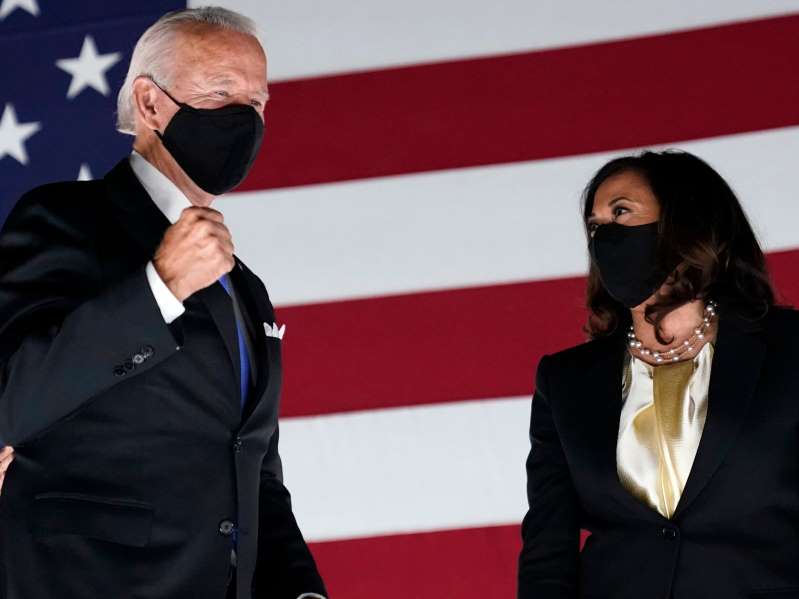
  • Kamala Harris makes history  as first female vice president-elect in US
  • Trump vows to contest results in court Monday

President Muhammadu Buhari, former presidents Olusegun Obasanjo and Goodluck Jonathan and many world leaders have rushed to congratulate Joe Biden on winning a nail-biting US presidential election, even as President Donald Trump who has refused to concede has vowed to challenge the results of the election in court from Monday November 09, 2020.

President Buhari in his message said Biden was elected as new President of the United States “at a time of uncertainty and challenges in world affairs.”

He, however, noted, “Your election is a significant reminder that democracy is the best form of government because it offers the people the opportunity to change their government by peaceful means.”

According to him, the most powerful people are not the politicians, but voters who can decide the fate of candidates for elective office at the polling booth, adding, “The main benefit of democracy is the freedom of choice and the supremacy of the will of the people.”

Obasanjo, in a congratulatory letter made available to The PUNCH by his Special Assistant on Media, Kehinde Akinyemi, hailed Biden and his running mate, Kamala Harris, over their ‘victory’ in the US election and described the ‘feat’ achieved by the two Democrats as “victory of good over evil”.

The former Nigerian leader wrote, “It is the victory of good over evil and it is not a victory for you and the people of America alone, but a victory for most people of the world, majority of whom watch helplessly as the world that had been steadily and painstakingly built since the end of the Second World War was being pulled down.

“Not that the world was perfect and equitable, but it was reasonably predictable with some measure of the rule of law and respect for international agreements and treaties.

“President-elect Joe Biden must restore confidence in the role of America as the largest economy in the world which has very significant responsibility for the peace, security, stability and progress of the world.

“I felicitate with Vice President-Elect Kamala Harris as the first female Vice-President of the U.S. We in Africa are proud of her success.”

Jonathan, in his message titled: ‘Goodwill message to United States President-elect Joe Biden and Vice President-elect Kamala Harris’, appealed to the incoming government to partner with African nations to help the continent overcome the vicissitudes of the pandemic, by building on existing trade and expanding on new frontiers for cooperation.

He said, “I congratulate President-elect, Joe Biden, and Vice President-elect, Kamala Harris, on their victory at the November 3, 2020 US Presidential election.

“Their election is not just historic, it is also futuristic in the sense that it gives us a glimpse of what the future will be-a world where race, gender and religion do not matter as much as competence and capacity.

“The best predictor of future behaviour is past behaviour, and based on his tenure as Vice President of the United States of America, between 2008 and 2016, I am fully persuaded that as President, Mr Biden will provide national and global leadership that will set the post COVID19 world on a path of peace and prosperity.”


What other world leaders say

Amid a flurry of congratulatory messages there were some noticeable silences from among both Mr Trump’s closest global allies and Washington’s staunchest enemies. After the news was called by the US’s biggest television networks on Saturday afternoon, there were no initial official statements issued by Russia, Turkey, Israel, Iran, Hungary Saudi Arabia and China.

The first world leader to break the silence, however, was Canadian prime minister Justin Trudeau, who made no mention of Mr Trump, with whom he had an often-troubled relationship.

Instead the Canadian leader said he would work with the United States to “advance peace and inclusion, economic prosperity, and climate action around the world” and congratulated both Mr Biden and  Kamala Harris, his running mate, who will become the first woman, the first Black American and the first American of Asian descent to serve as vice president, the country’s No. 2 office.

Several major television networks finally declared Mr Biden’s win on Saturday after a gruelling five-day ballot count saw him push ahead in key swing states.

“I am honoured and humbled by the trust the American people have placed in me and in Vice President-elect (Kamala) Harris,” Mr Biden said on Twitter.

Mr Trump, who has made repeated claims of electoral fraud and insists he has in fact won, accused Mr Biden of “rushing to falsely pose as the winner”.

“This election is far from over,” he said in a statement issued while he was playing golf in Virginia.

But this did not stop many leaders of western nations including those considered long-time allies of the U.S. celebrating Mr Biden’s win. Many had clashed with Mr Trump on security, trade, and numerous multilateral matters, including Washington’s withdrawal from the Paris climate accords. During Nato and G7 summits, Mr Trump has repeatedly insulted fellow leaders, hectored officials behind closed doors, and occasionally stormed out of meetings.

In quick succession, statements were released by France, Germany, Spain, Ireland and New Zealand.

“The Americans have chosen their President. Congratulations @JoeBiden and @KamalaHarris! We have a lot to do to overcome today’s challenges. Let’s work together!”  French President Emmanuel Macron wrote on Twitter. While Anne Hidalgo, the mayor of Paris, tweeted “Welcome back America!”

“Good that there’s finally a clear result,” wrote German foreign minister Heiko Maas, “We look forward to working with the next US administration.”

The Greek Prime Minister Kyriakos Mitsotakis also congratulated Mr Biden calling him a “true friend of Greece”.

Most of the world’s authoritarian or populist leaders who were considered Mr Trump’s ideological fellow travellers were, however, quiet about the impending fall of a man who had empowered and legitimised their brand of right-wing populism.

Turkey, which enjoyed exceptionally warm ties to the White House under Mr Trump, was among those who stayed mum.

Iranian officials — including the outspoken foreign minister Mohammed Javad Zarif – also issued no statement about Mr Biden’s victory which could mean a return to the nuclear deal negotiated by President Barack Obama while he served as vice president.

Instead Iran’s supreme leader Ali Khamenei called the vote “a spectacle” and “the definitive political, civil & moral decline of the US regime” on Twitter.

Abbas Mousavi, Iran’s ambassador to Azerbaijan and former spokesman of the Foreign Ministry, on Twitter said “Joe Biden would possibly be just the same as his predecessors.”

In Russia, the Kremlin was also quiet.  In a sign of what might be to come, however Konstantin Kosachyov, Chair of the Federation Council Committee on Foreign Affairs released a dismissive post on Facebook declaring Mr Biden’s victory premature as there was “clearly no official result yet”.

“There is no clear, unconditional and convincing winner. What has instead emerged victorious is schism, and mutually exclusive social views on the future of America,” he said.

Saudi Arabia which is close to the Trump administration have also yet to release a statement.

Ali Shihabi, a Saudi analyst who is on the advisory board of one of the mega-projects of the Saudi crown prince Mohammed bin Salman, said the Gulf generally favoured a Trump win but added “we can live with it”.

“He was unreliable and that scared thoughtful people in the Gulf,” Shihabi added.

In Israel, there was noticeable silence from one of Mr Trump’s closest allies Benjamin Netanyahu, who has been criticised back home for getting too close to Mr Trump and the Republican Party at the detriment of the bipartisan relationship between the two countries. The banner photo of Mr Netanyahu’s official Twitter account remained a picture of himself with Mr Trump.

However Israeli opposition figures and the Palestinian leadership were quick to chime in. Yair Lapid, who had run against Mr Netanyahu across three extraordinary elections in Israel, described Mr Biden as a “friend” in a statement where he made a point of referencing both the Democratic and Republican parties.

Harris makes history as first female, Black, South Asian American VP-elect

Sen. Kamala Harris has solidified her place in history Saturday by becoming the first woman, the first Black American and the first South Asian American elected vice president in U.S. history.

Harris’ political career has included many barrier-breaking moments, such as serving as California’s first Black female attorney general and being the second Black woman in history to be elected to the U.S. Senate.

Harris, 56, the only Black woman currently in the Senate, was elected in 2016 after serving as California’s attorney general and, before that, as the San Francisco district attorney.

Trump says election ‘far from over’ as he vows to fight results

President Donald Trump vowed Saturday to press forward with a legal fight, pushing unfounded claims of voter fraud in response to the news that President-elect Joe Biden had won the election.

Trump was at his Virginia golf club when NBC News and other networks projected Biden as the winner.

“Beginning Monday, our campaign will start prosecuting our case in court to ensure election laws are fully upheld and the rightful winner is seated,” Trump said. “The American People are entitled to an honest election: that means counting all legal ballots, and not counting any illegal ballots.”

Loading

Politics

Atiku denies Obasanjo’s N5m bribery claim, links accusation to 2027 presidential race

Published

on

Atiku denies Obasanjo’s N5m bribery claim, links accusation to 2027 presidential race
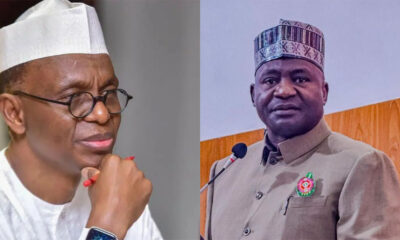
Atiku Abubakar and Olusegun Obasanjo

Atiku denies Obasanjo’s N5m bribery claim, links accusation to 2027 presidential race

Former Vice President and African Democratic Congress (ADC) presidential candidate, Atiku Abubakar, has rejected allegations by former President Olusegun Obasanjo that he bribed the late Speaker of the House of Representatives, Ghali Umar Na’Abba, with N5 million to initiate impeachment proceedings against him, describing the claims as politically motivated and aimed at rewriting history ahead of the 2027 general election.

Atiku made the remarks in a statement titled “The Grave Is Not A Witness Box,” issued on Friday by his Senior Special Assistant on Public Communication, Phrank Shaibu, in response to allegations made by Obasanjo during the public presentation of his newly released memoir.

The former Vice President expressed concern that Obasanjo chose to raise the allegation only after the death of Na’Abba, arguing that the late lawmaker was no longer alive to either confirm or deny the claims.

According to Atiku, invoking a deceased person as the principal witness in such a serious allegation denies Nigerians the opportunity to hear the full account of events.

“As Africans, we understand the solemn duty of speaking truthfully about the dead. It is therefore deeply troubling that former President Obasanjo has chosen this moment to allege that I gave the late Rt. Hon. Ghali Umar Na’Abba a bribe to impeach him,” Atiku said.

He questioned why the allegation was never made while Na’Abba was alive.

“If this allegation were true, why did he never make it while Rt. Hon. Na’Abba was alive? Why wait until the only man who could confirm or refute the claim has departed this world? By invoking a deceased man as the principal witness to such a grave allegation, former President Obasanjo has denied Nigerians the opportunity of hearing the other side of the story.”

The ADC presidential candidate maintained that if such a bribery incident had truly occurred during the Obasanjo administration, appropriate legal and institutional measures would have followed.

He argued that no criminal investigation, prosecution, judicial pronouncement or official report had ever established that he bribed Na’Abba or orchestrated an impeachment plot against the former President.

READ ALSO:

Atiku further alleged that the timing of the accusation, coming as political alignments ahead of the 2027 presidential election gather momentum, suggested an attempt to influence public opinion and weaken his political standing.

“Coming at a time when the political landscape ahead of the 2027 general election is taking shape, the obvious objective is to besmirch my person and reputation and confer an undeserved political advantage on the former President’s kinsman. Nigerians, however, know better. They are too discerning to be distracted by stale allegations resurrected for political convenience.”

The former Vice President also revisited the political disagreements that marked his relationship with Obasanjo while they served in office, insisting that their fallout stemmed largely from his opposition to the former President’s controversial third-term agenda.

According to Atiku, he chose to defend constitutional democracy and the rule of law instead of supporting any move to extend presidential tenure beyond constitutional limits.

“My offence was that I stood firmly against the unconstitutional third-term agenda. As a democrat, I chose the path of constitutionalism and the rule of law. Rather than surrender democratic principles on the altar of personal ambition, I defended the Constitution and successfully asserted my rights through the courts in a series of landmark legal victories against a sitting President.”

He added that those legal battles had become an important chapter in Nigeria’s democratic history and suggested that lingering political differences continued to shape Obasanjo’s perception of him.

Atiku said he would not allow disputes from more than two decades ago to distract attention from the pressing challenges facing Nigerians, including rising inflation, food insecurity, public debt, unemployment and insecurity.

“The task before leaders today is not to rewrite history but to rescue the future. Nigerians are more interested in knowing why food prices continue to soar, why public debt continues to rise despite increased revenues, and why scandal after scandal continues to trail the current administration than in revisiting political disagreements from over two decades ago.”

He also stated that Obasanjo was entitled to support any candidate in the 2027 presidential election, but urged the former President to openly declare his preferred aspirant rather than make allegations he described as unfounded.

“If former President Obasanjo has chosen to take a political position ahead of 2027, he should simply declare it and allow Nigerians to make their judgment based on the issues, records and vision presented by those seeking to lead the country.”

The response followed comments made by Obasanjo during the unveiling of his memoir, in which the former President alleged that Atiku secretly backed an impeachment plot against him during his first term in office.

Obasanjo claimed that Atiku invited the late Speaker, Ghali Umar Na’Abba, to his office while he was away from Abuja and allegedly handed him N5 million to commence impeachment proceedings. According to the former President, the alleged meeting was later reported to him by his then Chief of Staff, whom he described as a professional intelligence officer.

The renewed exchange has brought back one of the most enduring political rivalries in Nigeria, with both leaders once serving on the same presidential ticket before their relationship deteriorated during Obasanjo’s second term in office.

As political activities ahead of the 2027 general election continue to gather pace, the latest war of words between the two prominent politicians is expected to fuel fresh debate over Nigeria’s political history, accountability and leadership.

Atiku denies Obasanjo’s N5m bribery claim, links accusation to 2027 presidential race

Loading

Continue Reading

Politics

Court Stops EFCC’s “Fishing Expedition” as Makinde Links Probe to APC Warning Over 2027 Election

Published

on

Court Stops EFCC's "Fishing Expedition" as Makinde Links Probe to APC Warning Over 2027 Election
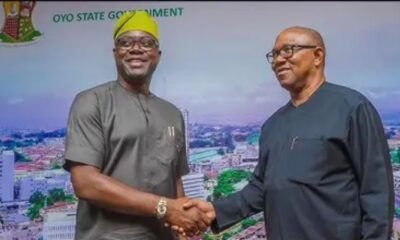
Governor of Oyo State, Engr. Seyi Makinde

Court Stops EFCC’s “Fishing Expedition” as Makinde Links Probe to APC Warning Over 2027 Election

Oyo State Governor, Seyi Makinde, has alleged that a chieftain of the All Progressives Congress (APC) warned him against contesting the 2027 presidential election against President Bola Tinubu, just one day before the Economic and Financial Crimes Commission (EFCC) requested extensive financial records from his administration.

Makinde disclosed this in his July 2026 monthly newsletter while reacting to Wednesday’s judgment of the Federal High Court sitting in Ibadan, which restrained the EFCC from proceeding with aspects of its planned investigation into the finances of the Oyo State Government. The governor said the warning came on June 1, 2025, shortly after President Tinubu had been endorsed by the APC as its sole presidential candidate for the 2027 election.

According to Makinde, the sequence of events began after he appeared on Channels Television on April 15, 2025, where he responded to a question on his presidential ambition, stating that he had the capacity to occupy the highest office in the country, although he had not formally declared his intention to run. The governor said political reactions followed the interview, and on June 1, 2025, an APC chieftain publicly warned him against contesting the presidency, describing such a candidacy as “an exercise in futility” and advising the opposition not to waste its time. The warning came shortly after the APC endorsed President Bola Tinubu as its sole presidential candidate for the 2027 election. “The following day, 2 June 2025, the EFCC wrote to the Accountant-General of Oyo State demanding copies of every contract involving the Oyo State Government and details of all transactions and payments made to contractors from 2021 to the date of its letter. No contractor was identified. No company was named. No questionable transaction or alleged offence was stated.” Makinde said his administration did not refuse to cooperate with the anti-graft agency but instead asked the EFCC to specify the contractors, companies, or transactions under investigation so that the relevant documents could be provided. “The EFCC did not respond, prompting the Oyo State Government to seek judicial interpretation of whether such a broad request was lawful,” he added.

READ ALSO:

The Federal High Court delivered judgment in suit number FHC/IB/CS/61/2025, filed by the Oyo State Government against the anti-graft agency. Justice Nkeonye Maha, who delivered the judgment on Wednesday, July 22, 2026, acknowledged the EFCC’s statutory powers to investigate financial crimes but held that such powers must be exercised in accordance with the Constitution and the rule of law. According to a statement by Makinde’s Special Adviser on Media, Sulaimon Olarenwaju, the court found that “The EFCC’s proposed investigation into Oyo State’s finances, particularly the demands contained in its letter of 2 June 2025, was speculative and amounted to a fishing expedition. His Lordship noted that the constitutional rights of the plaintiffs to fair hearing could not be trampled upon under the guise of investigation.” The court held that any request for information by the EFCC must be reasonable and linked to identifiable allegations or offences under the EFCC Act. Justice Maha ruled that Section 38 of the EFCC Act empowers the Commission to obtain information only for the purpose of investigating offences within its jurisdiction and does not authorise speculative or blanket investigations into the affairs of individuals or institutions. The judge set aside the EFCC’s letter dated June 2, 2025, and declared that any request by the Commission must be reasonable and tied to specific allegations.

Makinde stressed that his administration was not opposed to accountability or legitimate scrutiny and that no government should be shielded from investigation. However, he argued that such probes must be based on identifiable facts. “Accountability must be evidence-based,” he said, warning against broad investigations conducted merely in the hope of discovering wrongdoing. The governor described the court’s judgment as “a victory for the rule of law, not against the EFCC,” saying it reinforces the principle that government institutions, including law enforcement agencies, must operate within established constitutional and legal boundaries. “No government should be beyond legitimate investigation. Our administration is not beyond scrutiny, and we have never asked to be. But accountability must be based on evidence. An investigation should not begin with a blanket search through years of records in the hope that something incriminating might eventually be found.” Makinde said he would not speculate on the motive behind the EFCC’s letter but invited Nigerians to consider the sequence of events and draw their own conclusions. “Perhaps the timing of the EFCC’s letter was coincidental. I will not speculate about motives. Nigerians can consider the chronology and reach their own conclusions.”

Meanwhile, the Oyo State chapter of the APC has condemned the court ruling, describing it as a setback for accountability. The party’s Publicity Secretary, Wasiu Sadare, alleged that Governor Makinde was making desperate efforts to prevent the EFCC from examining the financial records of his administration. “The question on the lips of many patriots now is: Why would a governor be afraid to render an account of resources entrusted to him for the benefit of the citizenry? What size of skeleton does Governor Makinde have in the cupboard that he is keeping away from us?” the APC stated. The APC listed several projects it claimed would eventually come under investigation, including the exercise book printing contract, rehabilitation of the Lekan Salami Stadium, the Circular Road project, renovation of the Agodi Government House, construction of bus terminals, upgrade of Alakia Airport, and alleged unremitted deductions from workers’ salaries. “The truth is that he can only run but he cannot hide. EFCC and other anti-graft agencies will do their work at the appropriate time, and all the lid will be blown open,” the party added. In response, Makinde’s administration dismissed the allegations, insisting that its decision to approach the court was not an attempt to stop any investigation but to seek judicial clarification. The government stated that Governor Makinde has managed the state’s resources prudently and has nothing to hide. “Seeking judicial interpretation of the EFCC’s powers is neither cowardice nor an act of fear. Governor Makinde and the Oyo State Government are not afraid of the EFCC or any other federal agency. The state’s account books will be made available whenever a proper and lawful request is made.” The government added that the APC’s claim that Makinde’s decision to seek judicial intervention amounts to avoiding investigation is “both misleading and legally unfounded. Resorting to the courts is not an admission of guilt but a constitutional right guaranteed under Nigerian law.” The governor also addressed speculation about his presidential ambition, saying: “Let me be clear: I did not step forward in order to step down. I am going forward. I am going forward because Nigerians deserve better.” He added that Nigerians deserve institutions that serve the law rather than political interests and leaders who will defend the public interest even when doing so is inconvenient.

Court Stops EFCC’s “Fishing Expedition” as Makinde Links Probe to APC Warning Over 2027 Election

Loading

Continue Reading

Politics

Presidency, Obasanjo attack Atiku over US lobbying, reopen decades-old loyalty dispute

Published

on

Presidency, Obasanjo attack Atiku over US lobbying, reopen decades-old loyalty dispute
Former Vice President Atiku Abubakar

Presidency, Obasanjo attack Atiku over US lobbying, reopen decades-old loyalty dispute

The political battle ahead of Nigeria’s 2027 presidential election intensified on Thursday as the Presidency and former President Olusegun Obasanjo launched separate attacks on African Democratic Congress (ADC) presidential candidate Atiku Abubakar, accusing him of attempting to internationalise Nigeria’s domestic politics and reviving long-standing allegations of political disloyalty.

The Presidency faulted Atiku over reports that he engaged a United States lobbying firm to petition U.S. President Donald Trump, the U.S. State Department and members of the U.S. Congress over President Bola Tinubu’s 1993 civil forfeiture case in the United States.

According to the Presidency, the matter had been conclusively settled by both American authorities and Nigeria’s Supreme Court, making any fresh attempt to revive it unnecessary and politically motivated.

In a statement titled “When Will Atiku Abubakar Report Himself to President Trump?”, Special Adviser to the President on Information and Strategy, Bayo Onanuga, described Atiku’s reported move as an attempt to draw foreign governments into Nigeria’s internal political affairs.

Onanuga argued that Nigeria is a sovereign nation whose electoral and constitutional disputes should be resolved through its democratic institutions rather than by foreign governments.

He said the issue surrounding President Tinubu’s U.S. civil forfeiture had already undergone extensive judicial scrutiny during the 2023 presidential election litigation.

Following the 2023 election, Atiku Abubakar had challenged Tinubu’s eligibility before the Supreme Court, citing records relating to the 1993 civil forfeiture case in the United States.

However, the apex court ruled that the forfeiture was a civil settlement involving bank accounts and not a criminal conviction or indictment against Tinubu. The court held that there was no evidence that the President had been arraigned, tried or convicted of any criminal offence in the United States.

The Presidency also recalled that in December 2024, the Supreme Court dismissed a similar suit filed by Ambrose Owuru of the Hope Democratic Party seeking Tinubu’s removal over the same issue. The court described the case as frivolous and imposed a ₦5 million fine on the plaintiff.

Onanuga maintained that the legal questions surrounding the matter had been settled both judicially and politically through the electoral process.

READ ALSO:

He criticised Atiku for allegedly hiring foreign lobbyists to revisit issues already determined by Nigeria’s highest court, saying such actions amounted to externalising Nigeria’s domestic politics.

According to him, lobbying may be acceptable within the American political system, but using it to challenge decisions already settled by Nigerian institutions undermines the country’s sovereignty.

The presidential spokesman also questioned Atiku’s political approach, arguing that rather than presenting alternative solutions to Nigeria’s economic, security and governance challenges, the former vice president had chosen to focus on lobbying efforts abroad.

He further alleged that Atiku had spent about $1.2 million on lobbying activities in the United States aimed at reviving the decades-old forfeiture issue.

Beyond the lobbying controversy, Onanuga also revisited allegations linked to the administration in which Atiku served as vice president between 1999 and 2007, accusing him of supervising a privatisation programme that allegedly transferred strategic national assets to politically connected individuals at undervalued prices.

He claimed the programme resulted in job losses and pension challenges, allegations that have long remained part of Nigeria’s political debates.

The Presidency insisted that President Tinubu remains focused on implementing his Renewed Hope Agenda, stabilising the economy, attracting investment and improving national security rather than responding to political attacks.

Obasanjo revives loyalty allegations

Former President Olusegun Obasanjo separately reopened his long-running political disagreement with Atiku, accusing his former deputy of working against his administration during the build-up to the 2003 presidential election.

In a letter dated July 23, 2026, titled “Reply to Your Inaccurate Posture: How Obasanjo Deceived Us in 2003,” Obasanjo alleged that Atiku supported efforts by the House of Representatives under then Speaker Ghali Umar Na’Abba to impeach him while both men were serving in office.

According to the former president, the alleged impeachment plot originated from within the Presidency and formed part of a broader political strategy to prevent him from securing a second term.

Obasanjo also revisited the controversial “Mandela Option”, a political proposal advanced by Atiku and some governors before the 2003 election, which suggested that he should complete only one term before handing over power.

He claimed the proposal was designed to position Atiku as president and ultimately destroyed the trust that had existed between them.

The former president recalled that after eventually securing re-election in 2003, relations between him and Atiku deteriorated significantly.

Throughout his second term, Obasanjo gradually withdrew many of the official responsibilities previously assigned to Atiku, with both leaders operating in an atmosphere of growing political mistrust until they left office in 2007.

Obasanjo also defended his decision not to support Atiku’s presidential ambition after leaving office, maintaining that he believed the former vice president had not demonstrated the loyalty expected of a deputy.

Political tensions rise ahead of 2027

The latest exchange highlights the increasingly heated political atmosphere ahead of the 2027 general election, with the opposition ADC positioning itself as a major challenger to the ruling All Progressives Congress (APC).

Political analysts believe the renewed confrontation underscores how past political relationships and unresolved rivalries are resurfacing as parties intensify consultations, coalition talks and campaign preparations.

While the Presidency insists that the legal issues surrounding President Tinubu’s U.S. forfeiture case have been conclusively settled, Atiku’s allies have continued to argue that questions relating to transparency, accountability and public interest deserve continued scrutiny.

With political alignments gathering momentum, observers expect the exchanges between leading political figures to become even more pronounced as Nigeria moves closer to the next presidential election.

Presidency, Obasanjo attack Atiku over US lobbying, reopen decades-old loyalty dispute

Loading

Continue Reading

Trending