

International
Israel cracks down on Palestinian citizens criticising war in Gaza
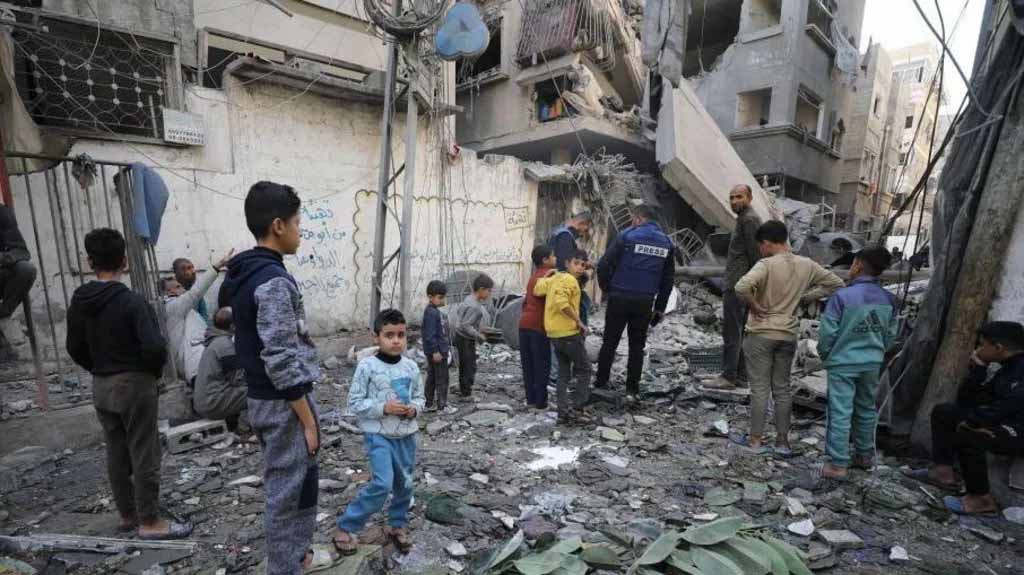
Israel cracks down on Palestinian citizens criticising war in Gaza
UMM AL-FAHM, Israel: Israel’s yearlong crackdown against Palestinian citizens who speak out against the war in Gaza is prompting many to self-censor out of fear of being jailed and further marginalized in society, while some still find ways to dissent — carefully.
Ahmed Khalefa’s life turned upside down after he was charged with inciting terrorism for chanting in solidarity with Gaza at an anti-war protest in October 2023.
The lawyer and city counselor from central Israel says he spent three difficult months in jail followed by six months detained in an apartment. It’s unclear when he’ll get a final verdict on his guilt or innocence. Until then, he’s forbidden from leaving his home from dusk to dawn.
Khalefa is one of more than 400 Palestinian citizens of Israel who, since the start of the war in Gaza, have been investigated by police for “incitement to terrorism” or “incitement to violence,” according to Adalah, a legal rights group for minorities. More than half of those investigated were also criminally charged or detained, Adalah said.
“Israel made it clear they see us more as enemies than as citizens,” Khalefa said in an interview at a cafe in his hometown of Umm Al-Fahm, Israel’s second-largest Palestinian city.
Israel has roughly 2 million Palestinian citizens, whose families remained within the borders of what became Israel in 1948. Among them are Muslims and Christians, and they maintain family and cultural ties to Gaza and the West Bank, which Israel captured in 1967.
Israel says its Palestinian citizens enjoy equal rights, including the right to vote, and they are well-represented in many professions. However, Palestinians are widely discriminated against in areas like housing and the job market.
Israeli authorities have opened more incitement cases against Palestinian citizens during the war in Gaza than in the previous five years combined, Adalah’s records show. Israeli authorities have not said how many cases ended in convictions and imprisonment. The Justice Ministry said it did not have statistics on those convictions.
READ ALSO:
- 48-year-old man remanded in Calabar for allegedly impregnating daughter
- Manchester City suffer fifth consecutive defeat, spanked 4-0
- Tension among Nigerians in Finland over Simon Ekpa’s arrest
Just being charged with incitement to terrorism or identifying with a terrorist group can land a suspect in detention until they’re sentenced, under the terms of a 2016 law.
In addition to being charged as criminals, Palestinians citizens of Israel — who make up around 20 percent of the country’s population — have lost jobs, been suspended from schools and faced police interrogations posting online or demonstrating, activists and rights watchdogs say.
It’s had a chilling effect.
“Anyone who tries to speak out about the war will be imprisoned and harassed in his work and education,” said Oumaya Jabareen, whose son was jailed for eight months after an anti-war protest. “People here are all afraid, afraid to say no to this war.”
Jabareen was among hundreds of Palestinians who filled the streets of Umm Al-Fahm earlier this month carrying signs and chanting political slogans. It appeared to be the largest anti-war demonstration in Israel since the Oct. 7 Hamas attack. But turnout was low, and Palestinian flags and other national symbols were conspicuously absent. In the years before the war, some protests could draw tens of thousands of Palestinians in Israel.
Authorities tolerated the recent protest march, keeping it under heavily armed supervision. Helicopters flew overhead as police with rifles and tear gas jogged alongside the crowd, which dispersed without incident after two hours. Khalefa said he chose not to attend.
Shortly after the Oct. 7 attack, Israel’s far-right government moved quickly to invigorate a task force that has charged Palestinian citizens of Israel with “supporting terrorism” for posts online or protesting against the war. At around the same time, lawmakers amended a security bill to increase surveillance of online activity by Palestinians in Israel, said Nadim Nashif, director of the digital rights group 7amleh. These moves gave authorities more power to restrict freedom of expression and intensify their arrest campaigns, Nashif said.
READ ALSO:
- Dangote jet fuel exported to London, Iceland, other airports
- Siblings Kunle, Aremu Afolayan reconcile, end age-long feud at mother’s wake-keep
- Reward your allies or face backlash – APC Chieftain tells Tinubu
The task force is led by Itamar Ben-Gvir, a hard-line national security minister who oversees the police. His office said the task force has monitored thousands of posts allegedly expressing support for terror organizations and that police arrested “hundreds of terror supporters,” including public opinion leaders, social media influencers, religious figures, teachers and others.
“Freedom of speech is not the freedom to incite … which harms public safety and our security,” his office said in a statement.
But activists and rights groups say the government has expanded its definition of incitement much too far, targeting legitimate opinions that are at the core of freedom of expression.
Myssana Morany, a human rights attorney at Adalah, said Palestinian citizens have been charged for seemingly innocuous things like sending a meme of a captured Israeli tank in Gaza in a private WhatsApp group chat. Another person was charged for posting a collage of children’s photos, captioned in Arabic and English: “Where were the people calling for humanity when we were killed?” The feminist activist group Kayan said over 600 women called its hotline because of blowback in the workplace for speaking out against the war or just mentioning it unfavorably.
Over the summer, around two dozen anti-war protesters in the port city of Haifa were only allowed to finish three chants before police forcefully scattered the gathering into the night. Yet Jewish Israelis demanding a hostage release deal protest regularly — and the largest drew hundreds of thousands to the streets of Tel Aviv.
Khalefa, the city counselor, is not convinced the crackdown on speech will end, even if the war eventually does. He said Israeli prosecutors took issue with slogans that broadly praised resistance and urged Gaza to be strong, but which didn’t mention violence or any militant groups. For that, he said, the government is trying to disbar him, and he faces up to eight years in prison.
“They wanted to show us the price of speaking out,” Khalefa said.
Israel cracks down on Palestinian citizens criticising war in Gaza
ARAB NEWS








International
UN Adopts New World Map Showing Africa Bigger, US Smaller in Landmark 2026 Vote
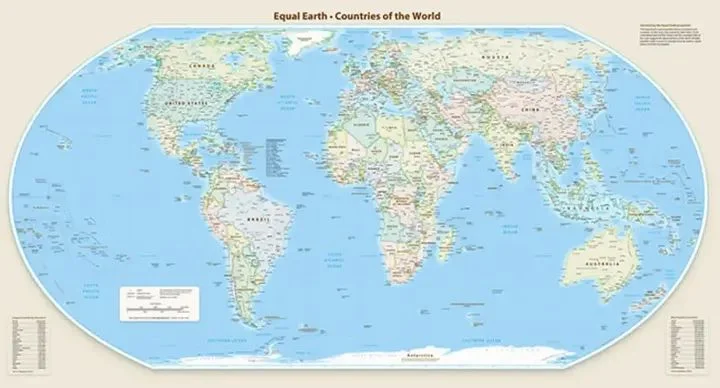
UN Adopts New World Map Showing Africa Bigger, US Smaller in Landmark 2026 Vote
The United Nations General Assembly has approved a historic resolution encouraging countries to adopt a new world map that more accurately reflects the true size of continents — a move that makes Africa appear significantly larger while shrinking North America and Europe. The United States was the only nation to vote against it.
On September 4, 2026, the UN General Assembly passed the resolution with 164 votes in favour, 6 abstentions, and just one opposed — the United States. The six countries that abstained were Ukraine, Moldova, Georgia, Serbia, Lithuania, and Estonia. The resolution, spearheaded by the West African nation of Togo and backed by the African Union, encourages governments, schools, and technology companies to phase out the centuries-old Mercator projection in favour of the Equal Earth projection developed in 2018. Togo’s Foreign Minister Robert Dussey, who presented the resolution, declared: “A fair world begins with a fair map.”
The resolution seeks to correct a distortion that has shaped global perceptions for over 450 years. The Mercator projection was created in 1569 by Flemish cartographer Gerardus Mercator specifically for maritime navigation. While it preserves accurate angles and directions, it severely distorts land area proportions: regions near the poles appear much larger than they actually are, while equatorial regions appear smaller. The most glaring example of this distortion is the comparison between Africa and Greenland. On a standard Mercator map, the two landmasses appear roughly the same size. In reality, Africa is 14 times larger than Greenland — Africa covers about 30.3 million square kilometres, while Greenland covers just 2.1 million. Advocacy groups point out that Africa could contain the United States, China, India, Japan, Mexico, and most of Europe within its area and still have space left.
READ ALSO:
- Kneeling to Propose Is Why Western Marriages Fail — Pete Edochie Sparks Fresh Debate
- US Strikes Three Iranian Oil Tankers in Retaliation for Missile Attack on Navy Ships
- Ondo Tragedy: 3 Siblings, Including Twins, Found Dead Near River on Family Farm
The Equal Earth projection, developed by cartographers Bojan Savric, Bernhard Jenny, and Tom Patterson in 2018, preserves the relative surface areas of continents while maintaining recognisable shapes. Under this new projection, Africa appears in its true massive scale — dramatically larger than in the familiar Mercator map. North America and Europe, by contrast, appear noticeably smaller. “Equal Earth preserves the relative surface areas of continents and, as much as possible, shows their shapes as they appear on a globe,” cartographer Bojan Savric told AFP in 2025. “Correcting the map means restoring to continents in the minds of people the reality of the true dimensions,” said Togo’s Foreign Minister Robert Dussey. He stressed that the campaign is “not directed against any nation, region, or civilization” but serves a “universal goal: to promote knowledge based on scientific rigour, respect for truth, and the equal dignity of peoples.”
American representatives dismissed the resolution as a distraction from pressing global issues. Speaking before the vote, US representative Yaryna Ferencevych argued that “such resolutions and the ideological agenda they promote hinder the work of this institution and lead to a decline in its credibility.” She urged member states to reject the text and focus instead on “genuine issues of international peace, prosperity, or good relations between nations.” Despite the US objection, the resolution passed overwhelmingly. It carries no legal force and does not mandate the replacement of existing maps — rather, it encourages institutions to educate the public on the limitations of flat maps and to adopt more accurate representations. The resolution “in no way challenges the use of the Mercator projection for maritime and aerial navigation, for which it remains fully suited,” the Togolese ministry said in a statement.
African leaders hailed the vote as a significant victory for continental representation. The African Union Mission to the UN welcomed the resolution as a “significant step towards ensuring that the map of the world reflects Africa’s true scale and place in the world.” Togo’s Dussey announced that Togo would become the first country to replace its geography textbooks with the new maps by the end of 2026, and the nation plans to engage with African Union members and other supporters to promote adoption globally. France, a co-sponsor of the resolution, expressed strong support. Foreign Minister Jean-Noël Barrot said in a speech at the Sorbonne: “Changing the map obviously won’t change the world… but correcting a distorted representation is itself an act of truth.” The advocacy group “Unfiltered Africa,” which promotes the Equal Earth map, welcomed the UN decision, stating: “We hope to see accurate maps in schools, textbooks, newsrooms, businesses, and the digital platforms used by billions of people every day.”
UN Adopts New World Map Showing Africa Bigger, US Smaller in Landmark 2026 Vote
International
US Strikes Three Iranian Oil Tankers in Retaliation for Missile Attack on Navy Ships
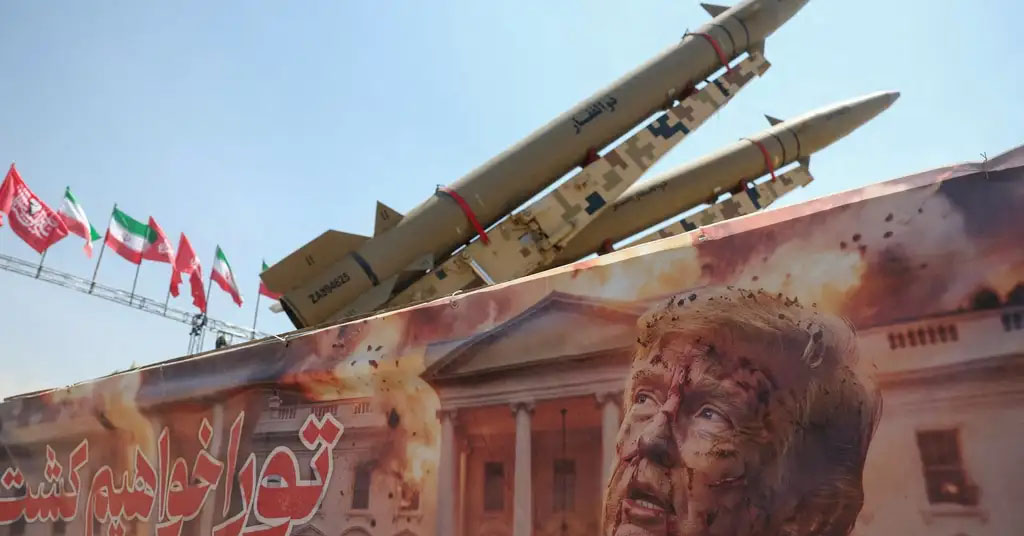
US Strikes Three Iranian Oil Tankers in Retaliation for Missile Attack on Navy Ships
Tensions in the Gulf of Oman escalated dramatically on September 5, 2026, as the United States military struck and disabled three Iranian crude oil carriers, following missile and drone attacks by Iran’s Islamic Revolutionary Guard Corps (IRGC) on U.S. Navy warships patrolling regional waters.
The confrontation began when the Islamic Revolutionary Guard Corps (IRGC) launched ballistic missiles toward two U.S. Navy warships operating in the region. According to U.S. Central Command (CENTCOM), an American aircraft carrier and a guided-missile destroyer successfully evaded multiple Iranian attacks, with no American personnel harmed. The IRGC claimed, however, that its missiles struck and damaged both vessels, forcing them to withdraw from the area.
In response to what it described as “unprovoked” Iranian attacks, CENTCOM forces permanently disabled two Iranian crude oil carriers—the M/T Downy off the coast of Kharg Island and the M/T Stark 1 near Jask. American forces also completely destroyed the unladen crude oil carrier M/T Kylo, also known as the “Noxen,” in the Gulf of Oman, striking it at multiple critical locations after the crew was directed to abandon ship. The U.S. military later released video footage showing the vessel sinking into the Gulf of Oman.
READ ALSO:
- Ondo Tragedy: 3 Siblings, Including Twins, Found Dead Near River on Family Farm
- Three killed, 20 injured in Ife-Ilesa Expressway crash
- Kano Political Earthquake: Kwankwaso Loyalists Dump NDC, Defect to APC in Major 2027 Blow
According to CENTCOM, the three tankers were part of a multibillion-dollar Iranian “shadow network” allegedly used to finance the IRGC and its regional proxy groups. The command noted that Iran has no means to defend these vessels. CENTCOM Commander Adm. Brad Cooper issued a stark warning to the IRGC, stating: “Let the message to the IRGC be clear: If you shoot at two of our ships, we will impose an even higher economic cost —taking out three of yours. We will not hesitate to defend American forces, and if necessary, destroy Iran’s limited and exposed oil fleet.”
U.S. Secretary of War Pete Hegseth also issued a direct warning to Tehran via social media: “It’s simple: if Iran shoots at US ships, we will destroy (and sink) their oil tankers. All they have to do is not shoot at @USNavy. Iran’s oil tanker fleet is defenceless — Iran has no navy or air force. Our planes, ships & subs can strike them all.” The strikes marked the first reported U.S. attacks on Iranian oil tankers in the Persian Gulf since the beginning of the conflict, adding a new dimension to the confrontation and raising concerns over the security of Iran’s maritime energy infrastructure.
Iran’s Foreign Ministry strongly condemned the U.S. attacks, describing them as “illegal and irresponsible” and a continuation of U.S. military aggression, naval blockade, and economic warfare against Iran. The ministry stated that the actions constituted a violation of Article 2(4) of the United Nations Charter, a war crime, and a threat to international peace and security, adding that the consequences would rest with the United States and its allies. A senior Iranian military official, Brigadier General Habibollah Sayyari, said Iran had withstood attacks despite facing an adversary with extensive technological and military capabilities, describing the conflict as a test of will and endurance. The IRGC warned that continued U.S. military action would draw “heavier” responses from Iran’s armed forces.
Following the attacks, the U.S. Embassy in Bahrain issued a security alert urging American citizens in Bahrain and across the region to exercise heightened vigilance and prepare for possible flight cancellations, airspace closures, and other travel disruptions amid heightened regional tensions.
The latest clashes have cast new doubt on the already fragile ceasefire between the U.S. and Iran, which had been announced on April 8, 2026, through Pakistani mediation. The U.S. has maintained its naval blockade of Iranian ports since April 13, with CENTCOM stating that more than 70 oil tankers are currently being prevented from entering or leaving Iranian ports, with the capacity to transport over 166 million barrels of Iranian oil worth an estimated $13 billion. As both sides accuse each other of violations and vow further retaliation, the risk of a wider military escalation remains high.
US Strikes Three Iranian Oil Tankers in Retaliation for Missile Attack on Navy Ships
International
Trump’s Peace Envoys Arrive in Moscow as Russia Bombs Ukraine Airports Overnight
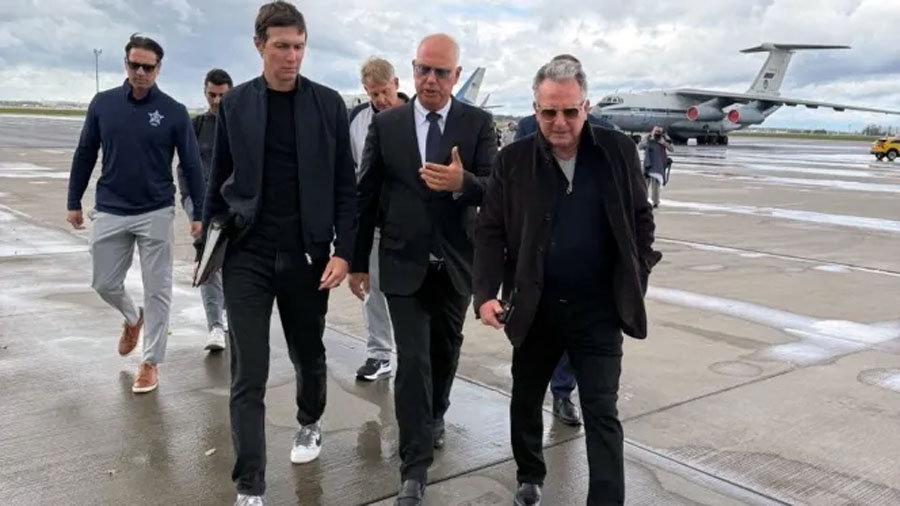
Trump’s Peace Envoys Arrive in Moscow as Russia Bombs Ukraine Airports Overnight
Trump’s special negotiators arrive with a peace proposal as Russian strikes target Kyiv’s airports overnight, prompting Ukraine’s leader to accuse Moscow of trying to derail the diplomatic mission.
US President Donald Trump‘s envoys Steve Witkoff and Jared Kushner landed in Moscow on Saturday for high-stakes talks aimed at ending more than four years of war in Ukraine. Their plane touched down at Vnukovo Airport at 12:52 pm local time, where they were met by Russian presidential envoy Kirill Dmitriev, who shared photos of the meeting on social media with the caption, “Welcome to Moscow Peacemakers.” The diplomatic push comes as Russian strikes hit Kyiv’s two airports overnight, with Ukrainian President Volodymyr Zelensky accusing Moscow of trying to disrupt the envoys’ visit. Zelensky stated on X that the attacks were “a reaction to the discussions and preparations for the possibility of the US side using an aircraft to travel to Ukraine.” He added there would be “no threats to diplomacy” from the Ukrainian side. The Russian strikes were “demonstrative,” Zelensky said, and targeted both Kyiv and Boryspil airports “for the first time in a while.”
Trump described Witkoff and Kushner as “two great negotiators” and confirmed they are bringing “a proposal to end the war.” However, he declined to say whether the plan involves Ukraine ceding territory, adding only: “We have an idea for peace.” The visit marks the first trip to Kyiv by Witkoff and Kushner since Trump returned to office last year and promised to bring the war to an end. Both envoys have made several trips to Moscow, with their last visit taking place on January 22, when they held four hours of late-night talks with Russian President Vladimir Putin at the Kremlin. After their talks in Moscow, the envoys are expected to travel to Kyiv on Sunday. This would be an unusual move, as Ukrainian airspace has been closed since Russia’s full-scale invasion in 2022, with foreign leaders typically traveling to Kyiv by train from Poland. However, plans for the delegation to arrive by plane have been thrown into doubt. A Ukrainian lawmaker, Aleksey Goncharenko, said two old Soviet Yak-40 passenger planes were struck at Zhulyany airport, suggesting the strike was intended as a “signal” to Washington ahead of the visit. A source told Reuters that discussions on the Ukraine portion of the trip were still ongoing, adding: “The Russians don’t want them to visit Kyiv and are trying to make them change the plan.”
READ ALSO:
- Kano Hisbah arrests 22 suspected crossdressers over alleged hook-up, drug abuse
- Two Weeks of Silence: Families of 600 Abducted Muslim Worshippers in Niger Demand Govt Action
- ‘It’s a lie’ – Wike’s aide challenges Peter Obi’s ‘I don’t give shishi’ claim
Zelensky reported that Russia struck both Kyiv and Boryspil airports overnight, describing the attacks as “deliberate” and “for the first time in a while.” Separately, a Russian strike on a civilian target in the Dnipro region killed four people and wounded five in the southeastern city of Kamianske. Russian forces also struck the headquarters of Ukraine’s SBU security service in central Kyiv on Friday, with Zelensky stating the attack was aimed at the office of the agency’s acting chief. Ukrainian Foreign Minister Andriy Sybiga described the incident as a “major escalation.” Despite the attacks, Zelensky proposed observing a ceasefire with Russia for the duration of the US envoys’ trip. “There will be no airstrikes on our part, and Russia must reciprocally ensure a ceasefire — without its own airstrikes — for the duration needed to conduct these talks,” he said in his evening address. In what may be a partial response to that proposal, Putin ordered a 72-hour pause in strikes on Kyiv starting at midnight Saturday, the Kremlin announced. “Putin has ordered that no strikes be carried out against Kyiv for three days,” presidential spokesperson Dmitry Peskov told Tass, tying the decision to preparations for the envoys’ planned visit to the Ukrainian capital.
The renewed push for diplomacy comes as Russia and Ukraine intensify long-range missile and drone attacks, driving up civilian casualties to levels not seen since the start of the conflict. Peace efforts have stalled in part because of Washington’s war with Iran. Moscow and Kyiv last held peace negotiations under US mediation earlier this year, when they held three rounds of peace talks in January and February. Negotiations have since been paused. Russian officials have signaled they are not in the mood for compromise. Deputy Foreign Minister Sergei Ryabkov told state media that “the US administration must take into account the realities on the ground,” where the situation is changing not in Kyiv’s favor. Kremlin spokesman Dmitry Peskov said the position that Putin set out two years ago – that Ukraine should cede the entire territory of four regions claimed by Russia and abandon its plan to join NATO – was “unshakeable.” Putin himself said on Thursday there was a chance of reaching an agreement to end the war, but he added that Kyiv’s warning to foreign airlines to avoid Russian airspace amounted to a threat that would make talks more difficult. This is not the first attempt at diplomacy. Witkoff and Kushner have traveled repeatedly to Moscow in previous efforts, including three rounds of US-mediated talks earlier this year in Abu Dhabi and Geneva. Their latest effort comes more than a week after a rare visit to Moscow by CIA director John Ratcliffe, who warned Russia against any attack on NATO member states, according to US media. Earlier this week, the United States welcomed the Russian finance minister at a G20 gathering in North Carolina.
Trump’s Peace Envoys Arrive in Moscow as Russia Bombs Ukraine Airports Overnight
-

 metro3 days ago
20-year-old arrested over alleged gang-rape of 19-year-old woman in Ogun
-

 metro3 days ago
Presidency breaks silence on Tinubu’s US FOIA case, denies criminal trial
-
 metro3 days ago
Oyo kidnap rescue: Five security personnel, four civilians killed — DSS DG
-

 News3 days ago
NAF recruitment 2026: Step-by-step guide to applying for BMTC 47/2026
-

 Business2 days ago
BREAKING: OPay Warns Customers Against Viral Shutdown Message, Threatens Legal Action
-

 metro3 days ago
NBA controversy: VDM apologises to security agencies over ‘unknown gunmen’ remarks
-

 Politics3 days ago
Amaechi: Atiku will restore electricity subsidy if elected in 2027
-

 Education3 days ago
LASU: Mother allegedly assaults daughter’s roommate, student rushed to LASUTH with eye injury