

metro
IPOB Says FG Cross-Appeal Undermines Kanu’s Conviction, Claims ‘Jurisdiction Is Not a Buffet’

IPOB Says FG Cross-Appeal Undermines Kanu’s Conviction, Claims ‘Jurisdiction Is Not a Buffet’
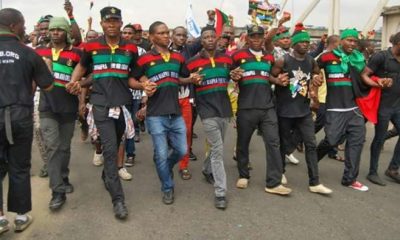
ABUJA, Nigeria – The Indigenous People of Biafra (IPOB) has declared that the Federal Government’s cross-appeal in the case of its leader, Mazi Nnamdi Kanu, has fundamentally weakened the legal foundation of his conviction and raised serious questions about the jurisdiction of the trial court. In a statement issued on Friday, June 5, 2026, by the group’s spokesperson, Emma Powerful, IPOB argued that the appeal process has moved beyond the fate of Kanu alone and now places the credibility of the Nigerian judiciary under intense scrutiny. The group claimed that the Federal Government, in its cross-appeal filed in response to Kanu’s appeal, allegedly admitted that Justice James Omotosho of the Federal High Court, Abuja, acted without jurisdiction when he convicted Kanu and sentenced him to life imprisonment instead of the death penalty.
“The global family of the Indigenous People of Biafra… wishes to draw the attention of all reasonable Nigerians, the international community, members of the diplomatic corps, legal practitioners, human-rights organizations, and all defenders of constitutional government to a reality that can no longer be hidden,” the statement said. IPOB said the recent cross-appeal filed by the Federal Government, in which it allegedly conceded that the trial court acted without jurisdiction in imposing a life sentence instead of a death penalty, had “changed everything” about the case. The group noted that the Federal Government’s brief of argument was filed on Friday, June 5, 2026, at the Court of Appeal, Abuja Division, in response to Kanu’s appeal challenging his conviction.
IPOB seized on the government’s cross-appeal argument that the trial judge erred by imposing a life sentence instead of the death penalty, interpreting this as a concession that the court acted without proper legal authority. “The Federal Government has effectively fired a cannon through the heart of the judgment it is simultaneously attempting to defend,” the statement read in part. “The implication is simple. Jurisdiction is not divisible. Jurisdiction is not a buffet… Jurisdiction is a continuum,” the group said. IPOB argued that if the trial court lacked jurisdiction at the sentencing stage, then the entire conviction should be considered invalid, maintaining that “the conviction and sentence are juridically inseparable. One cannot survive without the other.”
READ ALSO:
- Former UNILORIN VC Professor AbdulGaniyu Ambali Dies at 68
- Oyo Kidnappers Demand Release of Ansaru Terrorist Commanders in Exchange for Schoolchildren
- Kaduna Woman Sues Husband for Renting Out Her Bedroom Without Permission
IPOB further contended that the Court of Appeal would be forced to either reject or reconcile what it described as contradictions in the Federal Government’s position. “Any attempt by the Court of Appeal to affirm the conviction while simultaneously accepting the Federal Government’s admission regarding jurisdiction would require the creation of an entirely new species of criminal jurisprudence unknown to Nigeria, unknown to the Commonwealth, and unknown to the common-law world,” the statement added. “The court would effectively be saying that a trial court can lack jurisdiction and yet validly convict.” The group argued that the Federal Government has inadvertently converted itself into a witness against its own judgment. “If the trial court lacked jurisdiction to impose sentence, as the Federal Government now asserts, then the same trial court lacked jurisdiction to produce the conviction from which the sentence supposedly arose,” IPOB stated. “The question now becomes unavoidable: If the trial court lacked jurisdiction, what exactly is left to affirm?”
Justice James Omotosho of the Federal High Court, Abuja, convicted Kanu on November 20, 2025, on terrorism charges filed against him by the Federal Government, sentencing him to life imprisonment. Kanu is currently serving his life sentence at the Sokoto Correctional Facility. Kanu had previously filed his notice of appeal on February 4, 2026, challenging the conviction on 22 grounds. In that appeal, Kanu argued, among other things, that the trial court delivered its judgment while a preliminary objection challenging the competence of the charge and his bail application remained pending and undetermined, and that the court erred by convicting him under the Terrorism Prevention (Amendment) Act, 2013, which he asserted had been repealed by the Terrorism (Prevention and Prohibition) Act, 2022. Kanu also alleged that he was denied a fair hearing because he was not permitted to file and adopt a final written address before the verdict was delivered, and that the trial judge failed to grant him the right of allocutus—the opportunity to address the court before sentencing—and neglected to consider relevant mitigating factors. Following Kanu’s appeal, the Federal Government filed its cross-appeal, seeking an upward review of the sentence from life imprisonment to the death penalty. It is this cross-appeal that IPOB now claims contains the admission that Justice Omotosho acted without jurisdiction.
IPOB also outlined what it described as multiple procedural and legal defects in the trial proceedings. The group alleged that the proceedings were founded on repealed statutes, specifically noting that the Terrorism Prevention (Amendment) Act 2013 under which Kanu was charged had been repealed by the Terrorism Prevention and Prohibition Act 2022. The group further claimed that Kanu was denied a final address and allocutus, that the court failed to determine jurisdictional objections properly, and that the prosecution relied on provisions not pleaded in the charges. According to IPOB, the trial judge himself acknowledged that without a written law there can be no conviction, yet proceeded to convict Kanu under a repealed law. “The TPAA was not a written law in force in Nigeria as of 20 November 2025,” IPOB stated, referring to the Terrorism Prevention (Amendment) Act. The group further alleged that there was a failure to disclose applicable statutes and withholding of evidence, along with the denial of fair hearing. According to IPOB, these alleged irregularities have rendered Kanu’s conviction legally unsustainable.
READ ALSO:
- Nollywood Actress and Abia Gov Candidate Doris Ogala Collapses in Umuahia, Hospitalized at FMC
- US Intercepts Iranian Missiles, Drones Targeting Kuwait, Bahrain
- Nigerian Priest Sentenced to Life in Prison for Sexually Assaulting Women in Texas
IPOB declared that the Nigerian judiciary itself is now on trial, arguing that the issues before the Court of Appeal extend far beyond the fate of one man. “The issue before the Court of Appeal in the case of Onyendu Mazi Nnamdi Kanu is no longer merely about one man. It is now about whether the Nigerian judicial system is prepared to remain a legal institution or whether it is prepared to openly repudiate its own foundational principles,” the statement read. IPOB further argued that the appeal has assumed significance far beyond the immediate parties involved in the case. “The Court of Appeal is no longer deciding merely whether Onyendu Mazi Nnamdi Kanu should be convicted. It is deciding whether long-established principles of Nigerian criminal law still mean what they say,” IPOB said. “It would have to explain how a conviction can stand when the trial judge himself acknowledged that without a written law there can be no conviction,” the statement added.
The group warned that the implications of the appeal could extend beyond Kanu’s case and affect future criminal prosecutions in Nigeria. “Every future criminal defendant would be entitled to ask whether jurisdiction still matters… whether fair hearing still matters… whether constitutional supremacy still matters,” it said. “The Nigerian judiciary now stands at a crossroads. One path preserves the integrity of constitutional government. The other path requires the abandonment of principles repeatedly proclaimed by Nigerian courts over many decades,” the statement warned. The group called on the international community, members of the diplomatic corps, legal practitioners, human rights organizations, and all defenders of constitutional government to pay close attention to the proceedings. IPOB insisted that the outcome would have lasting consequences for Nigeria’s legal system and described the appeal as a test for the judiciary, urging observers within and outside Nigeria to monitor proceedings closely.
The legal saga surrounding Nnamdi Kanu has seen numerous twists since his initial arrest in 2015. He was granted bail in April 2017 but fled the country after an invasion of his home by the Nigerian military in September 2017 during Operation Python Dance. He was re-arrested in Kenya and controversially renditioned back to Nigeria in June 2021. The Court of Appeal had previously, on October 13, 2022, held that the manner of Kanu’s rendition violated the country’s extradition treaty and breached his fundamental human rights, striking out the terrorism charges and ordering his release. However, the Federal Government appealed that ruling to the Supreme Court, which set aside the Court of Appeal’s judgment and ruled that the trial could proceed despite the violation of Kanu’s rights. Following the Supreme Court’s decision, the trial resumed before Justice Omotosho, leading to the November 2025 conviction that is now the subject of the competing appeals. The Court of Appeal is yet to fix a hearing date for the appeals, while the Federal Government has not publicly responded to IPOB’s latest claims.
For readers seeking a quick summary of the key details, the following information has been confirmed. Nnamdi Kanu was convicted on November 20, 2025, by Justice James Omotosho of the Federal High Court, Abuja, and sentenced to life imprisonment. He is currently serving his sentence at the Sokoto Correctional Facility. Kanu filed his appeal on February 4, 2026, on 22 grounds. The Federal Government filed its cross-appeal on June 5, 2026, seeking the death penalty. IPOB claims that the cross-appeal contains an admission that the trial court lacked jurisdiction to impose the life sentence, arguing that jurisdiction is indivisible and that the conviction and sentence cannot be separated. The Court of Appeal has not yet fixed a hearing date for the appeals.
IPOB Says FG Cross-Appeal Undermines Kanu’s Conviction, Claims ‘Jurisdiction Is Not a Buffet’






metro
Nigerian Journalist Sentenced to 4 Years Over Facebook Post Criticising Police

Nigerian Journalist Farida Isiak Sentenced to 4 Years Over Facebook Post Criticising Police
Amnesty International has demanded the immediate release of a 23-year-old Nigerian journalist sentenced to four years in prison — or a fine of ₦1.75 million — over a Facebook post criticising police in Kaduna State, describing the case as a “travesty of justice” and a weaponisation of the courts to silence free speech.
The case of Farida Isiak, a reporter with Nagarta Radio in Kaduna, began not with journalism but with a minor neighbourhood quarrel. According to Amnesty International, a dispute broke out between Isiak’s mother and a neighbour over ₦100 in change from a charcoal sale. Police reportedly arrested Isiak’s mother — and then detained her father when he went to the station to secure her release. Amnesty says the couple’s detention was used as leverage to pressure Isiak to report to the police station. When she arrived, officers accused her of defaming the police in a Facebook post in which she had criticised their treatment of her parents. Isiak deleted the post and apologised, according to Amnesty. Despite that, she was taken before a Sharia Court in Kawo, where she was convicted of defamation and sentenced to four years’ imprisonment or a ₦1.75 million fine.
READ ALSO:
- NAFDAC Busts Illegal Herbal Factory in Lagos, Arrests Manager Over Fake Registration Number
- NELFUND Warns Schools: Student Loans Are Voluntary, Not Compulsory
- ‘I Never Asked Them to Abandon Loved Ones’ — Obi Clarifies Diaspora Remarks
The human rights organisation did not mince words. Amnesty International described the proceedings as a “sham” and a “travesty of justice,” arguing that the arrest, detention and hasty sentencing amounted to “a flagrant abuse of power by the police and weaponization of the judicial system to silence free speech and intimidate journalists.” The organisation has called on the Kaduna State Police Command and Nigerian judicial authorities to immediately release Isiak, on authorities to drop all charges and cancel the fine, and on the Nigeria Police Force to launch an independent investigation into the officers involved.
The case has reignited concerns about press freedom in Nigeria and the use of criminal defamation-type proceedings against journalists and citizens alike. Critics argue that using detention of family members as leverage — and fast-tracking a case through court within days — sets a chilling precedent for free speech online. It is important to note that the account above is drawn largely from Amnesty International’s statements and reporting. As of publication, the Kaduna State Police and the court had not offered substantive public responses to the specific allegations in the available reporting, and the case may yet be subject to appeal or review.
A young journalist’s Facebook post criticising police has cost her four years of liberty — or a fine she may struggle to pay. Whether Nigerian authorities respond to Amnesty’s demands will be a test of the country’s commitment to freedom of expression and the protection of journalists.
Nigerian Journalist Farida Isiak Sentenced to 4 Years Over Facebook Post Criticising Police
metro
Third Mainland Bridge Crash: 10 Injured as LASEMA Averts Train Collision in Lagos
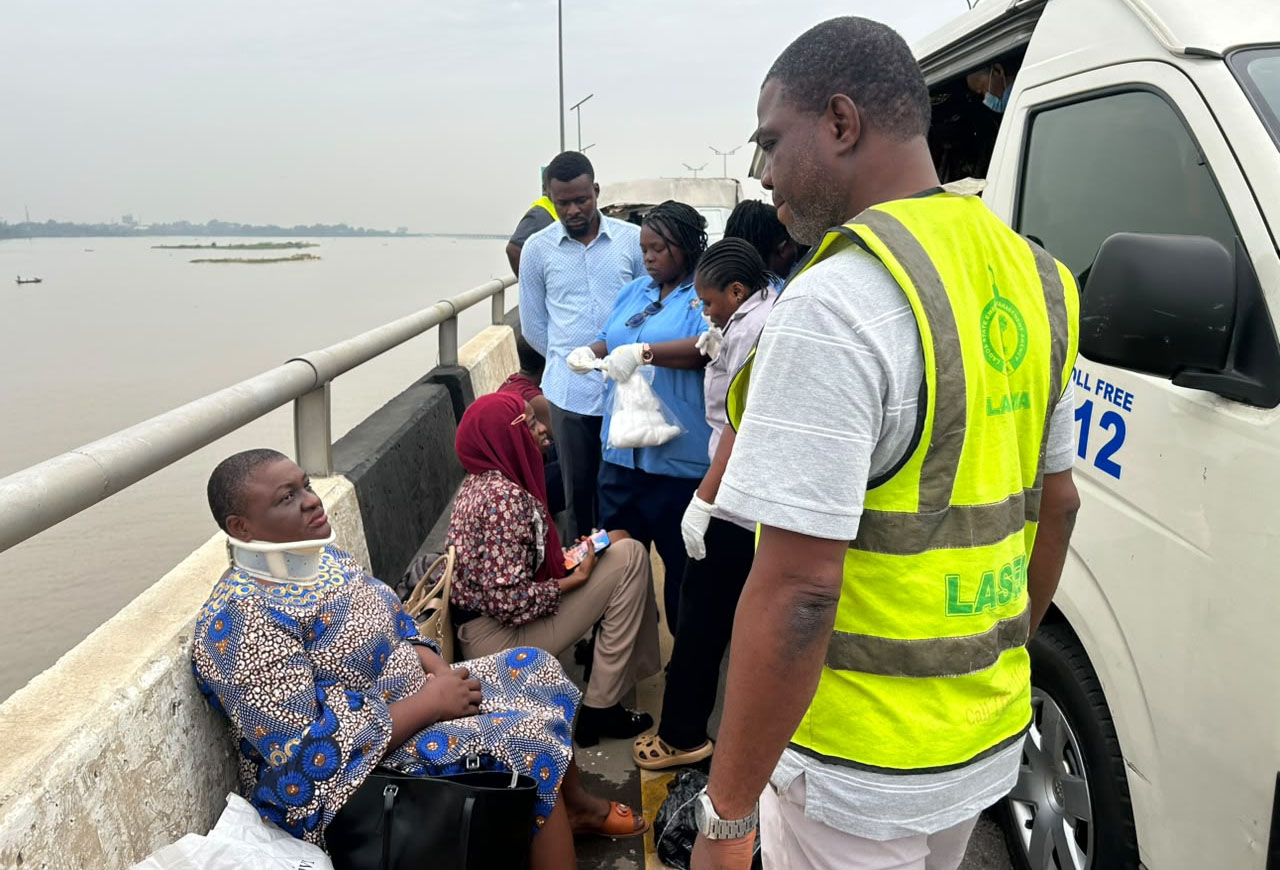
LAGOS — At least 10 passengers have been injured in a chain-reaction crash involving two commercial buses and a trailer on the Third Mainland Bridge in Lagos, while emergency responders separately averted a possible train collision at Ilupeju Bypass.
The two incidents occurred on Wednesday, October 21, 2026, according to the Lagos State Emergency Management Agency (LASEMA).
The bridge accident reportedly began when a commercial bus stopped to fix a faulty tyre. Another bus subsequently rammed into the stationary vehicle, triggering a chain reaction.
A trailer then crashed into the second bus before its driver reportedly fled the scene, leaving the injured passengers in need of emergency assistance.
LASEMA said its emergency response team arrived at the scene, administered first aid to the victims and evacuated them to a hospital for further treatment.
The damaged vehicles were subsequently cleared from the affected section of the bridge, allowing traffic to resume.
READ ALSO:
- ‘I Never Asked Them to Abandon Loved Ones’ — Obi Clarifies Diaspora Remarks
- FG Confirms Ebola Case in Abuja, Identifies 44 Contacts
- Breaking: Afenifere Leader Pa Fasoranti Dies at 100
The incident raised fresh concerns about road safety on the busy bridge, which connects Lagos Island with the mainland and carries heavy traffic daily.
In a separate incident at Ilupeju Bypass, emergency responders prevented a potential collision between a train and a commercial bus that had broken down on a railway track.
According to LASEMA, the bus became stranded on the track after developing a mechanical fault, creating a potentially dangerous situation for rail operations.
Emergency officials deployed a light tow truck to remove the vehicle from the railway line before a possible collision occurred.
The agency said its response team managed the situation and ensured that the stranded bus was removed from the track.
Following the incidents, LASEMA urged motorists to maintain their vehicles regularly and avoid stopping to carry out repairs on busy highways and bridges, warning that such actions could endanger passengers and other road users.
Motorists were also advised to exercise caution when their vehicles develop mechanical faults, particularly in locations where stopping could trigger secondary accidents.
The agency encouraged Lagos residents who require urgent assistance to contact its emergency hotlines on 767 or 112.
The incidents highlight the importance of vehicle maintenance, prompt emergency response and strict adherence to road and railway safety measures to prevent avoidable injuries and loss of life.
Third Mainland Bridge Crash: 10 Injured as LASEMA Averts Train Collision in Lagos
metro
Ebola Scare: NSCIA Directs Imams to Intensify Awareness in Friday Sermons

Ebola Scare: NSCIA Directs Imams to Intensify Awareness in Friday Sermons
The Nigerian Supreme Council for Islamic Affairs (NSCIA) has urged chief imams, Islamic scholars and Muslim organisations across Nigeria to intensify public awareness of Ebola virus disease (EVD) following the confirmation of a case in the Federal Capital Territory, Abuja.
The council called on religious leaders to use Friday sermons, mosque gatherings and community engagements to educate worshippers about the disease, its symptoms, preventive measures and the importance of seeking prompt medical attention.
The advisory, dated Wednesday, October 21, 2026, was signed by the NSCIA Secretary-General, Professor Is-haq Oloyede, on behalf of the council, which is led by its President-General and Sultan of Sokoto, Alhaji Muhammad Sa’ad Abubakar III.
The council said religious institutions had an important role to play in preventing the spread of the infection by providing accurate information, encouraging early reporting of suspected cases and discouraging practices that could expose people to the virus.
It also urged state councils for Islamic affairs and Muslim organisations to mobilise their networks to ensure that public health information reaches communities across the country.
READ ALSO:
- ‘I Never Asked Them to Abandon Loved Ones’ — Obi Clarifies Diaspora Remarks
- FG Confirms Ebola Case in Abuja, Identifies 44 Contacts
- Breaking: Afenifere Leader Pa Fasoranti Dies at 100
The NSCIA warned that the Bundibugyo strain of Ebola, responsible for the current outbreak, has no approved vaccine or specific curative treatment. However, it noted that early detection, prompt medical care and strict preventive measures could improve survival and help prevent further transmission.
The council advised Muslims who develop symptoms suggestive of Ebola to avoid congregational prayers and other public gatherings until they have received medical assessment.
It also cautioned against attempting to treat suspected cases at home or transporting potentially infected people without guidance from health authorities.
On burial practices, the NSCIA warned family members and ordinary burial attendants against washing or handling the bodies of suspected or confirmed Ebola victims. It said safe and dignified burials should be conducted by authorised health personnel in consultation with relevant Islamic authorities.
The council further encouraged regular handwashing, environmental cleanliness and avoidance of direct contact with the blood and other body fluids of people who may be infected.
It urged Nigerians to cooperate with contact-tracing teams and comply with official public health directives, while warning against rumours, unverified remedies and the stigmatisation of affected people and their families.
The NSCIA stressed that protecting human life and seeking medical care were consistent with Islamic teachings, urging religious leaders to communicate preventive advice responsibly without creating unnecessary panic.
The advisory followed the Federal Government’s confirmation on Tuesday, October 20, of an Ebola case in Abuja involving a woman who recently travelled to Nigeria after visiting Uganda and the Democratic Republic of the Congo.
The Federal Ministry of Health and Social Welfare said the patient was receiving medical care in isolation at a private hospital in the FCT.
Health authorities have identified 44 close contacts and commenced contact tracing to determine who may have been exposed to the infection. The contacts include healthcare workers, patients, caregivers and people linked to the patient’s travels.
The government, through the Nigeria Centre for Disease Control and Prevention (NCDC) and other relevant agencies, has intensified surveillance and infection-prevention measures to contain the disease.
The NSCIA urged Nigerians to remain calm, vigilant and guided by verified information as health authorities continue their response.
The council called on imams, Islamic scholars and Muslim organisations to circulate its advisory widely and work with public health officials to protect communities from further transmission.
Ebola Scare: NSCIA Directs Imams to Intensify Awareness in Friday Sermons
-

 metro1 day ago
Army Major, Soldiers Killed in ISWAP Ambush in Yobe State
-

 metro1 day ago
Breaking: Afenifere Leader Pa Fasoranti Dies at 100
-

 metro1 day ago
‘We Don’t Know What Else to Do’ — Mother Begs for Release of Abducted Children
-

 metro24 hours ago
Atiku: US Lobbying Firm Raises Alarm Over Alleged Assassination Plot
-

 metro1 day ago
‘I Never Asked Them to Abandon Loved Ones’ — Obi Clarifies Diaspora Remarks
-

 Auto1 day ago
Beyond the Showroom: Why After-Sales Service Will Define Auto Industry Winners
-

 metro21 hours ago
Five Arraigned Over Kidnapping of 20 Prospective NYSC Members in Imo
-

 Entertainment3 days ago
Jide Kosoko Reveals Drama Behind Controversial Yoruba Film Amina Eleha